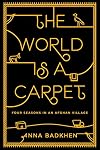
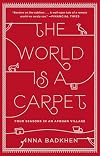
The World is a Carpet: Four Seasons in an Afghan Village
by Anna Badkhen
On This Page
Description
"An unforgettable portrait of a place and a people shaped by centuries of art, trade, and war. In the middle of the salt-frosted Afghan desert, in a village so remote that Google can't find it, a woman squats on top of a loom, making flowers bloom in the thousand threads she knots by hand. Here, where heroin is cheaper than rice, every day is a fast day. B-52s pass overhead--a sign of America's omnipotence or its vulnerability, the villagers are unsure. They know, though, that the earth is show more flat--like a carpet. Anna Badkhen first traveled to this country in 2001, as a war correspondent. She has returned many times since, drawn by a land that geography has made a perpetual battleground, and by a people who sustain an exquisite tradition there. Through the four seasons in which a new carpet is woven by the women and children of Oqa, she immortalizes their way of life much as the carpet does--from the petal half-finished where a hungry infant needs care to the interruptions when the women trade sex jokes or go fill in for wedding musicians scared away by the Taliban. As Badkhen follows the carpet out into the world beyond, she leaves the reader with an indelible portrait of fates woven by centuries of art, war, and an ancient trade that ultimately binds the invaded to the invader"-- show lessTags
Recommendations







Member Reviews
The back of Anna Badkhen's book, "The World Is A Carpet," led me to believe that the book would follow one particularly exquisite carpet from its creation in a remote Afghani village to its final sale somewhere on the other side of the world, describing along the way the various people involved in the process. What I found was something quite different: neither a description of one particular carpet's travels nor a description of the larger carpet-making and carpet-selling world, but a snapshot of what daily life is like in one very poor and very remote Afghani village where particularly beautiful carpets are made by some of the women while most of the men hunt for small game, search for kindling or trinkets among the dunes, or simply show more lounge about. The book, in fact, gives a much more detailed view of the lives of the men of the village than of the women. This probably stems from the fact that the author seems to spend more time with the local men than the local women, something that those same men would probably never allow a local women to do, but something they apparently do not object to a foreign female journalist doing, especially one who brings gifts when she visits the village.
While not what I expected, this was a fascinating book that presented a very interesting and eye-opening view of the region and its people. It also presents the author as very courageous, and perhaps even foolhardy, in her utter lack of concern about being kidnapped, raped, or murdered. Her courage is all the more astonishing when you realize she is a Russian-born American women in a region dominated by the Taliban and by other men who seem to harbor great animosity toward the idea of equality between the sexes and toward both Russians and Americans. The author seems like she would be a prime target, yet she seems to wander about the region without major problems. I still can't figure out how she managed to do that.
My only complaint about the book is Ms. Badkhen's adoption of a writing style that is the polar opposite of Hemingway's. Whereas Hemingway sought to get at the truth of a tale by banning adjectives from his writing, Ms. Badkhen seems to love unusual adjectives: sunsets are "tangerine"; the night sky is "spongy" or "cinnamon"; and sand dunes are "trout" colored. She also sprinkles her book with unusual words that are not used much these days, meaning that many readers will benefit from having a good dictionary at hand if they want to catch every nuance. While initially annoying, I came to conclude that Ms. Badkhen has the fine-tuned eye of an artist and wants her readers to see exactly what she saw when she was there. In that, I think she succeeds admirably, and I would recommend the book despite its flaws. show less
While not what I expected, this was a fascinating book that presented a very interesting and eye-opening view of the region and its people. It also presents the author as very courageous, and perhaps even foolhardy, in her utter lack of concern about being kidnapped, raped, or murdered. Her courage is all the more astonishing when you realize she is a Russian-born American women in a region dominated by the Taliban and by other men who seem to harbor great animosity toward the idea of equality between the sexes and toward both Russians and Americans. The author seems like she would be a prime target, yet she seems to wander about the region without major problems. I still can't figure out how she managed to do that.
My only complaint about the book is Ms. Badkhen's adoption of a writing style that is the polar opposite of Hemingway's. Whereas Hemingway sought to get at the truth of a tale by banning adjectives from his writing, Ms. Badkhen seems to love unusual adjectives: sunsets are "tangerine"; the night sky is "spongy" or "cinnamon"; and sand dunes are "trout" colored. She also sprinkles her book with unusual words that are not used much these days, meaning that many readers will benefit from having a good dictionary at hand if they want to catch every nuance. While initially annoying, I came to conclude that Ms. Badkhen has the fine-tuned eye of an artist and wants her readers to see exactly what she saw when she was there. In that, I think she succeeds admirably, and I would recommend the book despite its flaws. show less
 This review was written for LibraryThing Early Reviewers.
Oqa cannot easily be found or reached and, in the long colorful history of Afghanistan, its story can be overlooked and undervalued. And yet the beautiful tale, woven by Anna Badkhen, in The World is a Carpet: Four Season in an Afghan Village is as rich in passion, human misery and glory as any story coming out of that part of the world.
The tale is constructed around the annual weaving of a carpet by the young women of the village. Existence depends on the ability to create and sell this carpet at the end of the season. The women of the village, old and young, are shown to be resourceful and determined. The men for the most part seem to have given into their bleak fate and add little to the welfare of the village. Opium, much used, is show more the only relief many of them can find in their lives.
These people are cast off and cruelly used by war, nature and disease — remote yet not too remote to be threatened by the Taliban and the detritus of war (unexploded land mines and fouled wells).
Badkhen’s language is lyrical and intense; the story heartbreaking at times and often simply human and beautifully told. show less
The tale is constructed around the annual weaving of a carpet by the young women of the village. Existence depends on the ability to create and sell this carpet at the end of the season. The women of the village, old and young, are shown to be resourceful and determined. The men for the most part seem to have given into their bleak fate and add little to the welfare of the village. Opium, much used, is show more the only relief many of them can find in their lives.
These people are cast off and cruelly used by war, nature and disease — remote yet not too remote to be threatened by the Taliban and the detritus of war (unexploded land mines and fouled wells).
Badkhen’s language is lyrical and intense; the story heartbreaking at times and often simply human and beautifully told. show less
This review was written for LibraryThing Early Reviewers.Where to begin? Anna Badkhen writes as one possessed of a tortured, haunted soul, at once beautiful and disjointed; as rage describing and invoking peace. So much war. Soul deadening experience, earth, war, life; ravishing, blinding, joyous experience, earth, life.
Using the weaving of a carpet as the basic timeline, from the creation of the loom and purchase of yarn to the sale of the finished work, she covers the lives of a few handfuls of people for roughly a year. Glimpses of daily living in an impoverished village so small that it's unknown even to towns near it. Of immense heartbreak. Of incredible warmth and generosity. History lessons intertwined with current life, all flowing over a land unmoved by time.
The writing is lyrical, show more poetry disguised as prose. The story is a thousand juxtapositions--human nature. I cannot describe it; I can only urge you to read it. Read it at least once. And if you are at all interested in, intrigued by or an owner of those gorgeous rugs that cost so much, read it twice.
Are you near a rug? Run your hand over it; can you hear the laughter of a little girl or the squawk of chickens or the idle chatter of men? Can you smell the stomach-moving deliciousness of an old woman's marvelous cooking with nothing more than a few scraps to work with? Read this book; then perhaps you may. show less
Using the weaving of a carpet as the basic timeline, from the creation of the loom and purchase of yarn to the sale of the finished work, she covers the lives of a few handfuls of people for roughly a year. Glimpses of daily living in an impoverished village so small that it's unknown even to towns near it. Of immense heartbreak. Of incredible warmth and generosity. History lessons intertwined with current life, all flowing over a land unmoved by time.
The writing is lyrical, show more poetry disguised as prose. The story is a thousand juxtapositions--human nature. I cannot describe it; I can only urge you to read it. Read it at least once. And if you are at all interested in, intrigued by or an owner of those gorgeous rugs that cost so much, read it twice.
Are you near a rug? Run your hand over it; can you hear the laughter of a little girl or the squawk of chickens or the idle chatter of men? Can you smell the stomach-moving deliciousness of an old woman's marvelous cooking with nothing more than a few scraps to work with? Read this book; then perhaps you may. show less
This review was written for LibraryThing Early Reviewers.I really fought with a rating for this book. On the whole I loved it so much I wanted to give it a 5. The people and the village came alive for me (sometimes I wished for a list of the inhabitants, because I would become confused) and the way the author "wove" the concept of the carpet throughout the entire book was especially lovely. I should have guessed from the title, but I didn't and it was a pleasant surprise. We own carpets (a couple from Afghanistan) and these sentences particularly touched me.
"Do you own a carpet? Touch it. Feel for the sticky palm prints of a little girl on the warp."
I will never look at those carpets the same again.
The World is a Carpet is also very timely and informative. Sometimes you read a book, even if show more it's nonfiction, and you think "that really couldn't have happened," but when you read this book, you know it truly did.
And then, I wanted to give it a 3 rating. This is not a book for your average reader. The author loads the book with historical references that really add nothing to the story and uses words so big and cumbersome that you need a dictionary by your side to get through the book.
That's why I sadly settled on a rating of 4. show less
"Do you own a carpet? Touch it. Feel for the sticky palm prints of a little girl on the warp."
I will never look at those carpets the same again.
The World is a Carpet is also very timely and informative. Sometimes you read a book, even if show more it's nonfiction, and you think "that really couldn't have happened," but when you read this book, you know it truly did.
And then, I wanted to give it a 3 rating. This is not a book for your average reader. The author loads the book with historical references that really add nothing to the story and uses words so big and cumbersome that you need a dictionary by your side to get through the book.
That's why I sadly settled on a rating of 4. show less
This review was written for LibraryThing Early Reviewers.Yes, sometimes the world is a carpet, but mostly it’s not. This book is about a world that’s not.
You may think you have learned all about Afghanistan from the years our soldiers have spent time there, but this is not that Afghanistan. This is the Afghanistan experienced by the women who live there. The women who spend most of their days, most of their lives, making amazing carpets, beautiful carpets that will support their families, while their husbands escape this world with opium, while their children hunger.
Yes, the world is a carpet. But mostly it’s not.
You may think you have learned all about Afghanistan from the years our soldiers have spent time there, but this is not that Afghanistan. This is the Afghanistan experienced by the women who live there. The women who spend most of their days, most of their lives, making amazing carpets, beautiful carpets that will support their families, while their husbands escape this world with opium, while their children hunger.
Yes, the world is a carpet. But mostly it’s not.
This review was written for LibraryThing Early Reviewers.Ms. Badkhen writes that Oqa does not exist on any map. No signposts. Google can't find it. Yet she places the village not only in the context of its country - Afghanistan - but also in the context of the wider world her readers are living in. The world where we may be lucky enough one day see, touch or even purchase a carpet woven by one of their women. The world where there is war and terrorism. She gives a look not only inside this village, but also weaves the village into the life she leads as a journalist and the life the carpets lead as they travel to the world. From time to time she drops in a reference to events in the external world that helps you place her telling "in real time."
I enjoyed how she brought separate story lines show more together in a work of non-fiction that read at times like fiction. I was interested to attend a village wedding and learn how girls are considered of value among this group of villagers in the marriage market in a like status to boy children. In cultures such as this Western women are considered "honorary men" so Ms. Badkhen is able to move in the world of both the male and female villagers and the family she stays with in Mazar.
This is a tale you will want to sit an read in one sitting. show less
I enjoyed how she brought separate story lines show more together in a work of non-fiction that read at times like fiction. I was interested to attend a village wedding and learn how girls are considered of value among this group of villagers in the marriage market in a like status to boy children. In cultures such as this Western women are considered "honorary men" so Ms. Badkhen is able to move in the world of both the male and female villagers and the family she stays with in Mazar.
This is a tale you will want to sit an read in one sitting. show less
This review was written for LibraryThing Early Reviewers.A quick read, and a moving account. I found this a compelling, (if brief), look into Afghan culture. Well-crafted and simply written, it is a good book to try for those interested in the region.
This review was written for LibraryThing Early Reviewers.Members
- Recently Added By
Lists

Reading list
170 works; 1 member
Author Information

8 Works 329 Members
Anna Badkhen has been writing about conflicts since 2001 for The New York Times, The New Republic, Foreign Policy, The Boston Globe, and other publications. She lives in Philadelphia.
Common Knowledge
- Important places
- Afghanistan
Classifications
- Genres
- Nonfiction, Anthropology, General Nonfiction, Travel, Biography & Memoir
- DDC/MDS
- 305.409581 — Society, Government, and Culture Social sciences, sociology & anthropology Social group - Age, Gender, Ethnicity Women Standard subdivisions History, geographic treatment, biography Asia Central Asia
- LCC
- DS354 .B3225 — History of Europe, Asia, Africa and Oceania Asia History of Asia Afghanistan Ethnography
- BISAC
Statistics
- Members
- 92
- Popularity
- 347,567
- Reviews
- 18
- Rating
- (3.57)
- Languages
- English
- Media
- Paper, Ebook
- ISBNs
- 3
- ASINs
- 2