Observatory Mansions
by Edward Carey
On This Page
Description
The lives of thirty-seven-year-old Francis Orme and his parents and the other residents of the Observatory Mansions are changed when the vulnerable, sympathetic, and resourceful Anna Tap moves into an apartment there.Tags
Recommendations



Member Recommendations
Member Reviews
What a journey that was. I was enamored on page 1... I like solitude, quirky people, apparently shabby old buildings, and I wanted to be a statue when I was a small child. Then things got bleak and a little grotesque, and I loved the story in a different way. Compellingly honest investigation of memory and grief and engagement.
Wonderful and strange, slightly creepy, oddly touching. Francis Orme lives in flat six of Observatory Mansions, which was once the stately neoclassical manor home of the long line of Ormes but has now been broken up into flats. It would be hard to find an odder collection of eccentrics, from Twenty the Dog Woman to the Porter who hisses at all the residents. Francis thinks of them “as pure people, as concentrated people, or, to put it another way, as how everyday people would be if they were subtracted from work, friends, family and all the motions of life which we are told we should take part in.” The seven long-time residents, including Francis and his father and mother, are joined by a new resident whose arrival disrupts show more everything.
Francis tells the story in a matter-of-fact, deadpan tone, even when describing things so strange and sometimes disturbing that they provoke horrified fascination. It is tempting to describe this book as surreal, but the people and events are all quite real, only nudged past ordinary into hyperbole. Francis’s matter-of-fact tone increases rather than dispels the sense of the bizarre and the tragic.
I went into this novel knowing little about it, and I don’t want to ruin it for anyone else by describing too much of the plot or even the characters who constitute it. I’ll just say that it moves among absurdity, horror, tragedy, and romance in a most peculiar and fascinating way, and I loved it. show less
Francis tells the story in a matter-of-fact, deadpan tone, even when describing things so strange and sometimes disturbing that they provoke horrified fascination. It is tempting to describe this book as surreal, but the people and events are all quite real, only nudged past ordinary into hyperbole. Francis’s matter-of-fact tone increases rather than dispels the sense of the bizarre and the tragic.
I went into this novel knowing little about it, and I don’t want to ruin it for anyone else by describing too much of the plot or even the characters who constitute it. I’ll just say that it moves among absurdity, horror, tragedy, and romance in a most peculiar and fascinating way, and I loved it. show less
Observatory Mansions is an incredibly imaginative work of fiction with the most bizarre characters I've ever (and I'm in my mid sixties!) encountered in a novel. The story centers on the few remaining residents of Observatory Mansions, formerly called Tearsham Park and built on the site of a 16th century manor house of the same name which had been destroyed by fire. Set on an "island" surrounded by a heavily used traffic circle, Observatory Mansions was pretty much isolated from visits by casual passersby.
The story is narrated by Francis Orme, youngest descendent in a family in which each generation has at least one member of the same name. Our Francis Orme works as a statue by dressing in white (the white gloves are the most important show more part of his outfit) and maintaining inner stillness and outer stillness while standing on a plinth in nearby Tearsham Park.
Said Francis Orme, "I wore white gloves. I lived with my mother and father. I was not a child. I was thirty-seven years old..."
Reading those introductory sentences, I felt compelled to read more about this strange man. I learned about his social aversions. I discovered he liked to collect (steal?) and catalogue objects of former importance to others. Strangest of all, though, was he fact that he lived a contented life until a new resident moved into Tearsham Park. Francis Orme then became very unsettled.
I won't tell you more. Go read this enjoyable story for yourself! It's a strange and unforgettable trip. show less
The story is narrated by Francis Orme, youngest descendent in a family in which each generation has at least one member of the same name. Our Francis Orme works as a statue by dressing in white (the white gloves are the most important show more part of his outfit) and maintaining inner stillness and outer stillness while standing on a plinth in nearby Tearsham Park.
Said Francis Orme, "I wore white gloves. I lived with my mother and father. I was not a child. I was thirty-seven years old..."
Reading those introductory sentences, I felt compelled to read more about this strange man. I learned about his social aversions. I discovered he liked to collect (steal?) and catalogue objects of former importance to others. Strangest of all, though, was he fact that he lived a contented life until a new resident moved into Tearsham Park. Francis Orme then became very unsettled.
I won't tell you more. Go read this enjoyable story for yourself! It's a strange and unforgettable trip. show less
Wow, what a book. A pleasure to read, the delivery is very absorbing. The writer has created a strange but magnificent microcosm where objects are important and time suspended for protagonists, residents of an old mansion.
There's a house with many apartments, a house that has seen years of history, that was once a rich house but then transformed into a tenement. In it live several characters whose fates are interconnected in strange ways. Time is suspended for them, they lead a sort of enchanted life in denial from their past.
At the heart of it is Francis. Francis wears white gloves, steals various objects for a personal collection and is an ex-employee of a wax figure museum, priding himself on the art of inner and outer stillness. show more The writer has drawn on his experiences and the fascinating story of Madame Tussauds.
The residents lead this half-dead life until a new resident threatens their status quo. With Anna, time is once again set in motion and characters woken from their stagnation, a breath of humanity pushes them out of their doll-like existence. They are forced to face their past and time returns to its normal flow. Their pasts are intrinsically connected and conveyed by objects- objects that Francis collects.
At the heart of it is the mansion and Francis' parents, they are central to revealing the full picture. The characters, whose stories unfold little by little, are all very troubled with deep scars, pathological almost. They have built barriers around themselves. As their stories and stories of the objects unfold,we discover how everything is related and intertwined, and it leads us to the deepest, secret corner of the mansion and the saddest corner of Francis' own heart. Why does he wear gloves? Why is there a woman pretending to be a dog? What happened to Francis' dad? Who is the porter?
This is a wonderful, bizarre, grotesque tale of pain and loss, with a touch of mystery, a fascinating microcosm of stories. It's delightfully whimsical and surreal and mesmerises you into its world from the start. And it has a heart in the end..and hope, a ray of sunshine. I really love how it was written, the strangeness of it all but in the end warmth shines through barriers. But...Opening up requires courage, it means taking off gloves and getting dirty, leaving the heart fragile. I like it. Very unique. show less
There's a house with many apartments, a house that has seen years of history, that was once a rich house but then transformed into a tenement. In it live several characters whose fates are interconnected in strange ways. Time is suspended for them, they lead a sort of enchanted life in denial from their past.
At the heart of it is Francis. Francis wears white gloves, steals various objects for a personal collection and is an ex-employee of a wax figure museum, priding himself on the art of inner and outer stillness. show more The writer has drawn on his experiences and the fascinating story of Madame Tussauds.
The residents lead this half-dead life until a new resident threatens their status quo. With Anna, time is once again set in motion and characters woken from their stagnation, a breath of humanity pushes them out of their doll-like existence. They are forced to face their past and time returns to its normal flow. Their pasts are intrinsically connected and conveyed by objects- objects that Francis collects.
At the heart of it is the mansion and Francis' parents, they are central to revealing the full picture. The characters, whose stories unfold little by little, are all very troubled with deep scars, pathological almost. They have built barriers around themselves. As their stories and stories of the objects unfold,we discover how everything is related and intertwined, and it leads us to the deepest, secret corner of the mansion and the saddest corner of Francis' own heart. Why does he wear gloves? Why is there a woman pretending to be a dog? What happened to Francis' dad? Who is the porter?
This is a wonderful, bizarre, grotesque tale of pain and loss, with a touch of mystery, a fascinating microcosm of stories. It's delightfully whimsical and surreal and mesmerises you into its world from the start. And it has a heart in the end..and hope, a ray of sunshine. I really love how it was written, the strangeness of it all but in the end warmth shines through barriers. But...Opening up requires courage, it means taking off gloves and getting dirty, leaving the heart fragile. I like it. Very unique. show less
Intriguing setting and story concept: a building full of misanthropes and cranky lonely hearts gets their predictable, comfortable world turned upside down when a new tenant arrives. Observatory Mansions has a lot going for it: atmospheric, neoveau-gothic backdrop and a cast of quirky, twisted characters who live hiding behind the heavy drapes of regret and longing. Edward Carey tenderly reveals their stories to us in a meandering fashion, as if to ease us into this uncomfortable, mold-ridden world. So I had high expectations; I expected a kind of parallel, grotty magical universe akin to Alice in Wonderland or something written by Shirley Jackson.
Our reluctant hero and narrator is Francis Orme. Francis lives with and cares for his show more parents and is by profession a "stillness" artist, first working in a wax museum and then as one of those freelance human statues for tourists. When the interloper, Anna Tap, arrives, Francis rallies a few other OM residents, conniving through wonder, fear, and curiosity, to discover who this stranger is. As they investigate her, something happens. They remember things. A kind of fumbling in the dark happens to these sad misfits who have turned their backs to the world, a kind of breaking of the frozen sea inside.
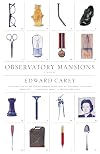
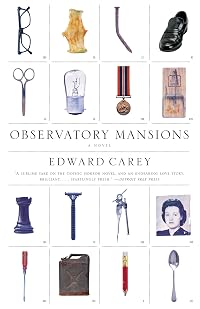
Could totally be profound and deep right? Against this setup, Carey weaves a strange world that is dominated by objects. Francis Orme et al. are the things they carry, the things they own. Francis himself collects objects he finds significant; the last few pages of the novel are devoted to an encyclopedic inventory, a cherished listing of everything in Francis's collection. In essence, his life. One of the more discomfiting things about the new arrival Anna is that she doesn't own very many things (they break into her apartment to snoop around), mostly items of clothing. It baffles Francis. One of the more disturbing characters is Twenty, named so because that's the apartment number she lives in. Twenty owns a dog collar, which in a twisted rendering, defines her identity and behavior. (Yes, a feral dog-woman character lives at Observatory Mansions.)
Where the book failed for me was in the writing style. I couldn't get into it, even though I thoroughly acknowledge the literary necessity of it. Francis Orme likes objects. People seem to be subsumed by the objects around them. So Carey writes in this repetitive, droning style, which reflects the mental state of the narrator and his sense of order and things-in-their-place-ness. You'll get lists and lists of things, which in their own way is the only way our emotionally stunted narrator can tell his story. In that way, the book almost feels like an inventory of human frailties. It's got a very visual and tactile feel to it, which makes me think this might have worked better as a graphic novel. (Do we need all the text and narration?)
Ironically the book's clipped, declarative style is what others found so captivating. Really?! I'm flummoxed. I'm a fan of the postmodern sleight of hand or two, but only when the trickery is filled with a little more intrigue than what we get in this book. You can't carry a story by just throwing a bunch of grotesque characters together, no matter how charming they are. Something needs to happen.
Sadly, I was largely immune to the charms of this oddball, but I admire its ambitions. show less
Our reluctant hero and narrator is Francis Orme. Francis lives with and cares for his show more parents and is by profession a "stillness" artist, first working in a wax museum and then as one of those freelance human statues for tourists. When the interloper, Anna Tap, arrives, Francis rallies a few other OM residents, conniving through wonder, fear, and curiosity, to discover who this stranger is. As they investigate her, something happens. They remember things. A kind of fumbling in the dark happens to these sad misfits who have turned their backs to the world, a kind of breaking of the frozen sea inside.
Could totally be profound and deep right? Against this setup, Carey weaves a strange world that is dominated by objects. Francis Orme et al. are the things they carry, the things they own. Francis himself collects objects he finds significant; the last few pages of the novel are devoted to an encyclopedic inventory, a cherished listing of everything in Francis's collection. In essence, his life. One of the more discomfiting things about the new arrival Anna is that she doesn't own very many things (they break into her apartment to snoop around), mostly items of clothing. It baffles Francis. One of the more disturbing characters is Twenty, named so because that's the apartment number she lives in. Twenty owns a dog collar, which in a twisted rendering, defines her identity and behavior. (Yes, a feral dog-woman character lives at Observatory Mansions.)
Where the book failed for me was in the writing style. I couldn't get into it, even though I thoroughly acknowledge the literary necessity of it. Francis Orme likes objects. People seem to be subsumed by the objects around them. So Carey writes in this repetitive, droning style, which reflects the mental state of the narrator and his sense of order and things-in-their-place-ness. You'll get lists and lists of things, which in their own way is the only way our emotionally stunted narrator can tell his story. In that way, the book almost feels like an inventory of human frailties. It's got a very visual and tactile feel to it, which makes me think this might have worked better as a graphic novel. (Do we need all the text and narration?)
Ironically the book's clipped, declarative style is what others found so captivating. Really?! I'm flummoxed. I'm a fan of the postmodern sleight of hand or two, but only when the trickery is filled with a little more intrigue than what we get in this book. You can't carry a story by just throwing a bunch of grotesque characters together, no matter how charming they are. Something needs to happen.
Sadly, I was largely immune to the charms of this oddball, but I admire its ambitions. show less
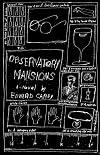
Edward Carey's modern gothic novel, Observatory Mansions, starts out with a illustration of the main character, Francis Orme, which looks strikingly like the picture of the author on the dust jacket of the novel. That's when it occurred to me that the author must have modeled Francis after extreme possibilities in himself. And, as a hint to this, he gives the character a last name that, when broken down, is "Or me" ("me" being the author). And, furthermore, there are no quotation marks in the book's dialogue which makes me think that the entire book is internal dialogue. Also, the author does not give the normal statement that none of the characters resemble the living or the dead.
The tendencies of Francis Orme, in fact, are very much show more like the tendencies of a very strange Scorpio-Saggitarius friend I spent a lot of time with last year. Francis displays many Scorpio-Saggitarius cusp tendencies in their extreme, but nowhere could I find anything about the author's birthday other than the year he was born. In Hermann Hesse's Steppenwolf, the main character is obviously a Cancer in the extreme. And upon a bit of research, one finds that Hesse is a Cancer; it seems that Hesse wrote Steppenwolf about his deepest fears of what he could become and how to deliver himself from himself. Consequentially, the characters I identified with the most while growing up were the first-person characters in the gothic novels of Victoria Holt, a Virgo (as I am).
Francis Orme is quite possibly the most colorful character I've ever met in a work of fiction. He once worked as a living display in a wax museum, but when he loses his job there, he begins making money by standing on a plinth in the park and pretending to be a statue all day. The only hint that he is real is the occasional blink of his eyes. He wears white gloves even when he is not working as a statue in the park. He works hard to keep his gloves clean and keeps a "glove diary" in which he keeps his retired white gloves along with an entry about how he soiled each of them. In addition to the glove diary, he keeps a private museum which contains only stolen objects which are the most loved or meaningful possessions of their original owner. In the exhibit he keeps everything from toy astronauts to a dried newt to a monk's habit to false teeth.
Francis lives in the dark and crumbling Observatory Mansions with a colorful cast of characters which includes an amnesiac who thinks she is a dog, a woman who doesn't know that her television friends are not real, a father who has been catatonic for years, and a porter who seems to try to destroy the loves of the women he cannot have. One can see how all of these characters are bound by worlds they've created for themselves. The dark edifice of Observatory Mansions is a metaphor for the dark confines of the characters' minds. Is it possible to escape? Can Francis allow himself to touch a real woman with his gloved hands instead of merely a wax bust of one? Furthermore, will he ever allow himself go out into the world without the false security of his gloves? Can he allow himself to love instead of collecting loved items that belong to everyone else? How does anyone escape the confines of their minds? How does anyone allow themselves to have the emotions they've so carefully sought to hide? show less
The tendencies of Francis Orme, in fact, are very much show more like the tendencies of a very strange Scorpio-Saggitarius friend I spent a lot of time with last year. Francis displays many Scorpio-Saggitarius cusp tendencies in their extreme, but nowhere could I find anything about the author's birthday other than the year he was born. In Hermann Hesse's Steppenwolf, the main character is obviously a Cancer in the extreme. And upon a bit of research, one finds that Hesse is a Cancer; it seems that Hesse wrote Steppenwolf about his deepest fears of what he could become and how to deliver himself from himself. Consequentially, the characters I identified with the most while growing up were the first-person characters in the gothic novels of Victoria Holt, a Virgo (as I am).
Francis Orme is quite possibly the most colorful character I've ever met in a work of fiction. He once worked as a living display in a wax museum, but when he loses his job there, he begins making money by standing on a plinth in the park and pretending to be a statue all day. The only hint that he is real is the occasional blink of his eyes. He wears white gloves even when he is not working as a statue in the park. He works hard to keep his gloves clean and keeps a "glove diary" in which he keeps his retired white gloves along with an entry about how he soiled each of them. In addition to the glove diary, he keeps a private museum which contains only stolen objects which are the most loved or meaningful possessions of their original owner. In the exhibit he keeps everything from toy astronauts to a dried newt to a monk's habit to false teeth.
Francis lives in the dark and crumbling Observatory Mansions with a colorful cast of characters which includes an amnesiac who thinks she is a dog, a woman who doesn't know that her television friends are not real, a father who has been catatonic for years, and a porter who seems to try to destroy the loves of the women he cannot have. One can see how all of these characters are bound by worlds they've created for themselves. The dark edifice of Observatory Mansions is a metaphor for the dark confines of the characters' minds. Is it possible to escape? Can Francis allow himself to touch a real woman with his gloved hands instead of merely a wax bust of one? Furthermore, will he ever allow himself go out into the world without the false security of his gloves? Can he allow himself to love instead of collecting loved items that belong to everyone else? How does anyone escape the confines of their minds? How does anyone allow themselves to have the emotions they've so carefully sought to hide? show less
Palaniuk che incontra Perec e vanno a pranzo con Thomas Bernhard: ne esce un testo precisamente allucinatorio, perfetto. Poi anche McGrath ci mette lo zampino e ci sono interi capitoli assolutamente deliranti (preoccupanti). C. ha scritto un libro che è un genere a sè, tradotto con maestria.
Su tutto, odore di stanze chiuse da anni, di tappeti consunti, di sotterraneo.
Su tutto, odore di stanze chiuse da anni, di tappeti consunti, di sotterraneo.
Members
- Recently Added By
Lists

2000s (the decade, not the century)
184 works; 11 members

Books Read in 2010
631 works; 11 members

I Could Live There
185 works; 12 members
Author Information

15+ Works 2,318 Members
Only thirty years old, Edward Carey has already achieved success as a playwright & as an illustrator. (Bowker Author Biography)
Common Knowledge
- Canonical title
- Observatory Mansions
- Original publication date
- 2000
- People/Characters
- Francis Orme; Mr Peter Bugg
Classifications
Statistics
- Members
- 581
- Popularity
- 50,583
- Reviews
- 14
- Rating
- (3.97)
- Languages
- 7 — Dutch, English, French, German, Italian, Polish, Turkish
- Media
- Paper, Audiobook, Ebook
- ISBNs
- 24
- ASINs
- 6