There is 1 current discussion about this work.
On This Page
Description
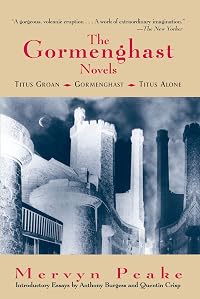
Titus is expected to rule this extraordinary kingdom and his eccentric and wayward subjects. But with the arrival of an ambitious kitchen boy, Steerpike, the established order is thrown into disarray. Over the course of these three novels-Titus Groan, Gormenghast, and Titus Alone- Titus must contend with a kingdom about to implode beneath the weight of centuries of intrigue, treachery, manipulation, and murder. Intoxicating, rich, and unique, The Gormenghast Trilogy is a tour de force that show more ranks as one of the twentieth century's most remarkable feats of imaginative writing. This special edition, published for the centenary of Mervyn Peake's birth, is accompanied by over one hundred of Peake's dazzling drawings. show lessTags
Recommendations






Member Recommendations
Member Reviews
And, so, finally, for me at least, the world of Gormenghast. The great gothic fantasy of Dickensian characters, vast engines of ritual and excitable melodrama and amazing names. The first thing is the writing. Words upon words upon words like brick upon brick. Sentences wringing imagery out of language, constructing the inconceivable, brooding edifice, the endless twisting warrens and halls and rooms, the towers and battlements and crenelations. Painting huges canvases of coloured landscapes and twisted psychology. Sketching visions of characters and poses and attitudes and physical features animate and inanimate. Digging deeper and deeper into the constructions of stone and mind and habit and tradition and loyalty and rebellion and show more madness. Because there is a story here, oh yes, scurrying between the piling thunderheads of paragraphs looming through the pages are the tiny figures, the little mechanisms that are part of the living machinery in the great dead thing that rules them. Steerpike, the upstart boy who flees the kitchen on the day of the birth of the next Earl of Gormenghast, who, through physical effort and starvation grasps at every slender advantage and uses it to haul himself up and up through the ossified social strata. He's no sympathetic lower-class rebel though, overthrowing tyranny, but a brutal, manipulative sociopath who wishes to rule. So he plots and plans and arranges his calamities and shakes the deeply insular world to its foundations, and so, climbs higher and higher.
What an incredible achievement. What a vision. Executed with a kind of sprawling, passionate precision. There is the enormity of the castle, and the tiny, banal, domestic lives, but each life is sculpted in features at least odd and often bizarre, from the depressed Earl and the somnolent Duchess and the emotionally incontinent daughter and the the tittering Doctor and the angular retainer. But the Earl's depression is kept at bay by ossified ritual, not caused by them. The distracted Duchess conceals one of the most powerful and formidable characters in the whole trilogy. The daughter's heart is true and good, if confused and starved of parental affection. the Doctor's mind is fine and decent. Melodrama rages through their lives. Comic and satirical; deadly and brutal; strange and heartbreaking, from our first visit to the Hall of bright Carvings in Titus Groan to the astonishing climactic flood of Gormenghast, their lives are small but enacted on a stage that dwarfs opera.
Then there is the third book, that orphan, that outcast, that shredded thing of intermittent brilliance. Half-formed, half-baked, a series of sketches and interludes and abrupt transitions in search of coherence, with a hero whose only heroic quality is his insistence of his lineage and the existence of his home, utterly unknown in the city, where he drifts into haphazard adventure, where he is saved and rescued over and over again by others, never himself, where he is haunted and tormented by Gormenghast at first psychologically and at the end literally in a cruel theatre of revenge for motives that are underdeveloped like so much else in the book. It would have been a difficult book to write at the height of the author's powers - to either find a unity or make proper thematic use of the disunity. Sadly, Peake was not at that height. One senses that it conveys a particularly callow and chaotic stage of Titus' development, and wonders what he would have grown into given the chance.
The first two books are works of genius. The third is that of a genius in decline, but still capable of moments of brilliance. Perhaps we should express dissatisfaction at this, or perhaps we should forgive. I do not think people who read the first two should neglect the third. What it lacks as a novel, it makes up for in the poignancy of its failure. show less
What an incredible achievement. What a vision. Executed with a kind of sprawling, passionate precision. There is the enormity of the castle, and the tiny, banal, domestic lives, but each life is sculpted in features at least odd and often bizarre, from the depressed Earl and the somnolent Duchess and the emotionally incontinent daughter and the the tittering Doctor and the angular retainer. But the Earl's depression is kept at bay by ossified ritual, not caused by them. The distracted Duchess conceals one of the most powerful and formidable characters in the whole trilogy. The daughter's heart is true and good, if confused and starved of parental affection. the Doctor's mind is fine and decent. Melodrama rages through their lives. Comic and satirical; deadly and brutal; strange and heartbreaking, from our first visit to the Hall of bright Carvings in Titus Groan to the astonishing climactic flood of Gormenghast, their lives are small but enacted on a stage that dwarfs opera.
Then there is the third book, that orphan, that outcast, that shredded thing of intermittent brilliance. Half-formed, half-baked, a series of sketches and interludes and abrupt transitions in search of coherence, with a hero whose only heroic quality is his insistence of his lineage and the existence of his home, utterly unknown in the city, where he drifts into haphazard adventure, where he is saved and rescued over and over again by others, never himself, where he is haunted and tormented by Gormenghast at first psychologically and at the end literally in a cruel theatre of revenge for motives that are underdeveloped like so much else in the book. It would have been a difficult book to write at the height of the author's powers - to either find a unity or make proper thematic use of the disunity. Sadly, Peake was not at that height. One senses that it conveys a particularly callow and chaotic stage of Titus' development, and wonders what he would have grown into given the chance.
The first two books are works of genius. The third is that of a genius in decline, but still capable of moments of brilliance. Perhaps we should express dissatisfaction at this, or perhaps we should forgive. I do not think people who read the first two should neglect the third. What it lacks as a novel, it makes up for in the poignancy of its failure. show less
A novel of atmosphere and character rather than plot, Mervyn Peake's 'Titus Groan' (1946) is rightly seen as an important Gothic fantasy. It subverts the deadly seriousness and unintended comedy of classical Gothic writing into something that is art for art's sake. It is not easily categorisable.
It is not an unflawed masterpiece. The flaws stop it from becoming truly great but it meets one of the most difficult requirements of intelligent fantasy - that the world it creates should be regarded as a reality in its own right. We recognise the author more than the book as representative of genius.
Peake refuses to cross the line into allegorical interpretation. The book resists reading the decaying castle of Gormenghast as a superficially show more hidebound Britain under austerity and the dwellers of the outlying mud houses as some sort of proletariat.
You can read this interpretation of the novel into it if you insist on being prosaic but the point of the novel is entirely a poetic one - to construct an alternative reality which we read as theoretically possible albeit somewhere in a multiverse beyond our ken.
There are scarcely any indications of the alien. The Groans appear to have red or purple pupils reminiscent of our vampire lore (yet are clearly not vampires) and the mud house dwellers seem to be marginally different biologically, suddenly aging from beauty to ordinariness in their early twenties.
The total environment remains obscure. Some 76 earls have been in place before Titus is born. If we average a generation at a quarter of a century then the Groans may have held their fiefdom for nearly 2,000 years. The technology of Gormenghast is pre-industrial (say around 1750 in our world).
We see no allegiance (an Earldom implies a Kingship somewhere) yet Countess Gertrude must have come from another bloodline. The territory is drear and relatively underdeveloped dominated by a grim mountain but it is clear that there is world beyond into which people travel.
Oddly disease seeems not to concern these people. They are hardy but not very fertile or perhaps sexual - one male child seems sufficient to carry on the blood line although this is a world of aunts and a daughter of limited intelligence or experience. Desire is present but romantic.
Each of the characters is a rounded caricature, eccentric but not impossible to envisage in our world physically if scarcely mentally. Peake performs a clever trick by giving them names that should imply the allegorical but never do - Lord Sepulchrave is the nearest in his depressive gloom.
The anti-hero of the story is certainly literary - a Machiavellian Iago-type, Steerpike. His machinations are a central thread to the tale. Indeed, throughout it is as if tropes of English literature had twisted themselves into entirely new shapes.
There is something of the Dickensian here but also of Tristram Shandy alongside the obvious Gothick motifs. Titus Groan himself is not yet two years old when the novel closes just as Tristram is not yet born until Volume III.
The stand-alone literariness of the novel is matched by something that is over-egged on a few too many occasions but which reflects the other side of Mervyn Peake, his artist's eye. Part of the faux-realism lies in extremely specific descriptions of location and passing weather.
Peake is a master of language. He treats it as a master of the painterly might treat colours. He can describe the most eccentric of weathers as if we were there. We feel wet. We wonder at the discomfort from the elements accepted as normal yet essential to Gormenghast's obscure rituals.
Peake loves words. How many of these does the average reader know? rabous, daedal, lapsury, abactinal, querait, perches, laze, comber-hindered, chloral hours, fugness, thorn prick windows. These and more are used.
He is also brilliant at describing the movement of persons through places - over roofs, through corridors and halls, across country. The reader sees the movement of the mover through the mover's eyes. Gormenghast (to the determined reader) can be reconstructed in the mind.
Which leads us to the flaws in the book. Peake clearly lost himself in his project and his fruity descriptions sometimes take over. They can bring us to the very edge of tedium. Yet, at its greatest, the prose style is staggering in its ability to evoke an event. Such moments are cinematic.
There is also a depressingly dull pseudo-romantic sub-plot involving Keda from the village that largely overstays its welcome after she ceases to be wet nurse to the tiny Titus although this perhaps has to be accepted for a 'big reveal' near the very end of the book.
Keda herself is an attractive cypher. This is another aspect of the characterisation. The characters are caricatures and roles, behavioural rituals in their own right, yet Peake somehow gets away with making them seem like very real people despite this and the fantasy environment.
It is a remarkable achievement - to create personages that are both extremely limited in their nature and without any true awareness of their own condition but which come to elicit our sympathy and with whom in some cases we become empathetic.
Fuchsia Groan starts as a spoilt brat in our estimation and, without actually changing her basic nature, shifts into someone yearning for some kind of love. Lord Sepulchrave's ritualistic distance transforms into a perception of the Earl's loneliness and depression.
Dr. Prunesquallor appears a vain butterfly yet steadily becomes the only person to have around in a crisis and the only one with an inkling of the source of unfolding darkness. Steerpike may be a caricature of evil (in literary mode) but somehow we understand the roots of his sociopathy.
Countess Gertrude appears mad and yet knows her duty when necessary and copes with a ritualistic world centred on a loveless marriage which contains no malice. Little Nannie Slagg is a silly stupid woman filled with terrible anxiety but her heart is a good one. She is kind in a way that matters.
The sub-plot of the violent feud between Flay, Sepulchrave's servant, and the blubbery cook Swelter holds the attention and Steerpike's psychopathic control over the 'aunts' (Cora and Clarice Groan) is tragi-comical but depends on our full understanding of their exceptional stupidity.
Flay often carries the story where Steerpike does not - another intellectually limited character with limited self awareness, nevertheless he 'feels' within his instinct for service and his downfall appears more an awakening than a tragedy.
What we have (many fascinating minor characters can be added to these) is an atmosphere less of caricatured Gothick gloom and more of characters trapped in an improvisatory drama with the curtain going up on the 77th performance - that of Titus Groan himself.
The implication is that this new performance will be different from all previous ones despite the continuity of ritual and stage directions because of the irruption of the devious working class radical Steerpike into the play. We see enough of his darkness but the book ends before he really gets going.
Nor is Steerpike pure malice. Rather he is simply single-minded ambition where this seventeen year old has one major advantage. He is more intelligent than anyone else except Prunesquallor and perhaps Flay or Sepulchrave at a pinch. Above all, he is curious which the last two are not.
The material Steerpike is working on is actually most of us, dear reader, creatures stuck in our roles, consigned to ritual and habit and taking our patterns from texts and interpreters of texts. Like the Groans, we are ripe for plunder by those who know what plunder is.
If there is a political sub-test it is well-hidden but it may be there in the short exchanges between Fuchsia and Steerpike where he lays out his analysis of the unfairness in Gormenghast's hierarchy which she simply cannot comprehend. He fascinates her as much as she rightly distrusts him.
It is difficult to know where the author stands on all this. I suspect his instinct is towards wallowing in his dying world but the fact that he puts (albeit briefly) the standard line of socialists in the 1940s into the mouth of his villain suggests conservative instincts.
And yet his portrayal of the villagers outside the castle (which some say was drawn from his experience of inequity and social stultification as a child in late imperial China) also shows a kindly sympathy for these abandoned people largely disregarded by the castle's aristocrats and servants.
There is ambiguity here from a peculiar and fascinating man simultaneously a cultural insider (as a well educated creative genius) and an outsider. It is why political interpretations should be avoided. Gormenghast just 'is'. show less
It is not an unflawed masterpiece. The flaws stop it from becoming truly great but it meets one of the most difficult requirements of intelligent fantasy - that the world it creates should be regarded as a reality in its own right. We recognise the author more than the book as representative of genius.
Peake refuses to cross the line into allegorical interpretation. The book resists reading the decaying castle of Gormenghast as a superficially show more hidebound Britain under austerity and the dwellers of the outlying mud houses as some sort of proletariat.
You can read this interpretation of the novel into it if you insist on being prosaic but the point of the novel is entirely a poetic one - to construct an alternative reality which we read as theoretically possible albeit somewhere in a multiverse beyond our ken.
There are scarcely any indications of the alien. The Groans appear to have red or purple pupils reminiscent of our vampire lore (yet are clearly not vampires) and the mud house dwellers seem to be marginally different biologically, suddenly aging from beauty to ordinariness in their early twenties.
The total environment remains obscure. Some 76 earls have been in place before Titus is born. If we average a generation at a quarter of a century then the Groans may have held their fiefdom for nearly 2,000 years. The technology of Gormenghast is pre-industrial (say around 1750 in our world).
We see no allegiance (an Earldom implies a Kingship somewhere) yet Countess Gertrude must have come from another bloodline. The territory is drear and relatively underdeveloped dominated by a grim mountain but it is clear that there is world beyond into which people travel.
Oddly disease seeems not to concern these people. They are hardy but not very fertile or perhaps sexual - one male child seems sufficient to carry on the blood line although this is a world of aunts and a daughter of limited intelligence or experience. Desire is present but romantic.
Each of the characters is a rounded caricature, eccentric but not impossible to envisage in our world physically if scarcely mentally. Peake performs a clever trick by giving them names that should imply the allegorical but never do - Lord Sepulchrave is the nearest in his depressive gloom.
The anti-hero of the story is certainly literary - a Machiavellian Iago-type, Steerpike. His machinations are a central thread to the tale. Indeed, throughout it is as if tropes of English literature had twisted themselves into entirely new shapes.
There is something of the Dickensian here but also of Tristram Shandy alongside the obvious Gothick motifs. Titus Groan himself is not yet two years old when the novel closes just as Tristram is not yet born until Volume III.
The stand-alone literariness of the novel is matched by something that is over-egged on a few too many occasions but which reflects the other side of Mervyn Peake, his artist's eye. Part of the faux-realism lies in extremely specific descriptions of location and passing weather.
Peake is a master of language. He treats it as a master of the painterly might treat colours. He can describe the most eccentric of weathers as if we were there. We feel wet. We wonder at the discomfort from the elements accepted as normal yet essential to Gormenghast's obscure rituals.
Peake loves words. How many of these does the average reader know? rabous, daedal, lapsury, abactinal, querait, perches, laze, comber-hindered, chloral hours, fugness, thorn prick windows. These and more are used.
He is also brilliant at describing the movement of persons through places - over roofs, through corridors and halls, across country. The reader sees the movement of the mover through the mover's eyes. Gormenghast (to the determined reader) can be reconstructed in the mind.
Which leads us to the flaws in the book. Peake clearly lost himself in his project and his fruity descriptions sometimes take over. They can bring us to the very edge of tedium. Yet, at its greatest, the prose style is staggering in its ability to evoke an event. Such moments are cinematic.
There is also a depressingly dull pseudo-romantic sub-plot involving Keda from the village that largely overstays its welcome after she ceases to be wet nurse to the tiny Titus although this perhaps has to be accepted for a 'big reveal' near the very end of the book.
Keda herself is an attractive cypher. This is another aspect of the characterisation. The characters are caricatures and roles, behavioural rituals in their own right, yet Peake somehow gets away with making them seem like very real people despite this and the fantasy environment.
It is a remarkable achievement - to create personages that are both extremely limited in their nature and without any true awareness of their own condition but which come to elicit our sympathy and with whom in some cases we become empathetic.
Fuchsia Groan starts as a spoilt brat in our estimation and, without actually changing her basic nature, shifts into someone yearning for some kind of love. Lord Sepulchrave's ritualistic distance transforms into a perception of the Earl's loneliness and depression.
Dr. Prunesquallor appears a vain butterfly yet steadily becomes the only person to have around in a crisis and the only one with an inkling of the source of unfolding darkness. Steerpike may be a caricature of evil (in literary mode) but somehow we understand the roots of his sociopathy.
Countess Gertrude appears mad and yet knows her duty when necessary and copes with a ritualistic world centred on a loveless marriage which contains no malice. Little Nannie Slagg is a silly stupid woman filled with terrible anxiety but her heart is a good one. She is kind in a way that matters.
The sub-plot of the violent feud between Flay, Sepulchrave's servant, and the blubbery cook Swelter holds the attention and Steerpike's psychopathic control over the 'aunts' (Cora and Clarice Groan) is tragi-comical but depends on our full understanding of their exceptional stupidity.
Flay often carries the story where Steerpike does not - another intellectually limited character with limited self awareness, nevertheless he 'feels' within his instinct for service and his downfall appears more an awakening than a tragedy.
What we have (many fascinating minor characters can be added to these) is an atmosphere less of caricatured Gothick gloom and more of characters trapped in an improvisatory drama with the curtain going up on the 77th performance - that of Titus Groan himself.
The implication is that this new performance will be different from all previous ones despite the continuity of ritual and stage directions because of the irruption of the devious working class radical Steerpike into the play. We see enough of his darkness but the book ends before he really gets going.
Nor is Steerpike pure malice. Rather he is simply single-minded ambition where this seventeen year old has one major advantage. He is more intelligent than anyone else except Prunesquallor and perhaps Flay or Sepulchrave at a pinch. Above all, he is curious which the last two are not.
The material Steerpike is working on is actually most of us, dear reader, creatures stuck in our roles, consigned to ritual and habit and taking our patterns from texts and interpreters of texts. Like the Groans, we are ripe for plunder by those who know what plunder is.
If there is a political sub-test it is well-hidden but it may be there in the short exchanges between Fuchsia and Steerpike where he lays out his analysis of the unfairness in Gormenghast's hierarchy which she simply cannot comprehend. He fascinates her as much as she rightly distrusts him.
It is difficult to know where the author stands on all this. I suspect his instinct is towards wallowing in his dying world but the fact that he puts (albeit briefly) the standard line of socialists in the 1940s into the mouth of his villain suggests conservative instincts.
And yet his portrayal of the villagers outside the castle (which some say was drawn from his experience of inequity and social stultification as a child in late imperial China) also shows a kindly sympathy for these abandoned people largely disregarded by the castle's aristocrats and servants.
There is ambiguity here from a peculiar and fascinating man simultaneously a cultural insider (as a well educated creative genius) and an outsider. It is why political interpretations should be avoided. Gormenghast just 'is'. show less
I first read Titus Groan because some literary critic listed The Gornemghast Novels as one of the great fantasy series of all time, along with The Lord of Rings, The Chronicles of Narnia, and The Return to Neveryon series. My reactions to Titus Groan (the first book in the series) went like this:
"I honestly can't tell if this is any good... but I can't stop reading it!"
"I think this might be a work of utter genius and I can't stop reading it!"
"I don't even know if I like this book... but I can't stop reading it!"
This is, quite simply, one of the strangest and most original set of novels ever written. And it is a masterpiece! In light of the monumental achievement of this work, whether or not I like it is completely irrelevant.
"I honestly can't tell if this is any good... but I can't stop reading it!"
"I think this might be a work of utter genius and I can't stop reading it!"
"I don't even know if I like this book... but I can't stop reading it!"
This is, quite simply, one of the strangest and most original set of novels ever written. And it is a masterpiece! In light of the monumental achievement of this work, whether or not I like it is completely irrelevant.
I like to read reviews of a book before I read it myself. I focus on the one and five star reviews, and check out the reviews that fall somewhere in between the two extremes. This method has helped me find good books, but more often it prevents me from wasting time on bad books.
Of all the reviews, those for [b:The Gormenghast Trilogy: Titus Groan/Gormenghast/Titus Alone|457382|The Gormenghast Trilogy Titus Groan/Gormenghast/Titus Alone|Mervyn Peake|https://i.gr-assets.com/images/S/compressed.photo.goodreads.com/books/1174932286l/457382._SX50_.jpg|38776] were the most accurate. I just knew that I had to get my hands on this book because it completely filled the bill for all my literary tastes.
Basically, this is the story of an isolated show more society in decline; full of gloomy atmosphere. Gormenghast itself is a massive city/castle, full of forgotten rooms in abandoned wings, mysterious and often bizarre characters filling arcane positions in the noble household while the ancient stones slowly crumble to dust. Gloom, rot and decay are evident everywhere in the castle. Before our eyes the head of the family slowly sinks into madness and a chaotic interloper schemes to bring about the downfall of the Groan legacy.
I won't go into details about the plot or characters, other reviews have already done this masterfully and I don't want to be redundant. I'll be honest, this book isn't for everyone; especially those who want a lot of action or romance. Readers who enjoy heavy atmosphere and a slowly building plot with lots of Gothic gloom and doom will be happy to read this literary gem. The character names are a constant delight, as are the sly jokes at the narcissistic and foolish notions of human society.
There are newer, more popular fantasy novels I could be reading. I'm familiar with what they have to offer, the literary equivalent of a "dinner party" hosted by broke-ass twenty-somethings in which there is no actual dinner, just a lot of gluten-free, non-lactose, sugar-free snacks and endless shots of various candy-flavored vodkas. Your fellow guests will be prone to high-drama drunken behavior and repetitive, predictable stories. Gormenghast will host an eight course meal with a wide variety of flavors and subtle textures and a wine thoughtfully paired with each course. The other guests might be a bit odd, but the conversation will be lively and fascinating and none of them will invite you back to their mom's basement for some anonymous sex, and are unlikely to puke a rainbow-hued puddle into your lap. Everyone gets to choose which party they attend; it's a clear choice to me. show less
Of all the reviews, those for [b:The Gormenghast Trilogy: Titus Groan/Gormenghast/Titus Alone|457382|The Gormenghast Trilogy Titus Groan/Gormenghast/Titus Alone|Mervyn Peake|https://i.gr-assets.com/images/S/compressed.photo.goodreads.com/books/1174932286l/457382._SX50_.jpg|38776] were the most accurate. I just knew that I had to get my hands on this book because it completely filled the bill for all my literary tastes.
Basically, this is the story of an isolated show more society in decline; full of gloomy atmosphere. Gormenghast itself is a massive city/castle, full of forgotten rooms in abandoned wings, mysterious and often bizarre characters filling arcane positions in the noble household while the ancient stones slowly crumble to dust. Gloom, rot and decay are evident everywhere in the castle. Before our eyes the head of the family slowly sinks into madness and a chaotic interloper schemes to bring about the downfall of the Groan legacy.
I won't go into details about the plot or characters, other reviews have already done this masterfully and I don't want to be redundant. I'll be honest, this book isn't for everyone; especially those who want a lot of action or romance. Readers who enjoy heavy atmosphere and a slowly building plot with lots of Gothic gloom and doom will be happy to read this literary gem. The character names are a constant delight, as are the sly jokes at the narcissistic and foolish notions of human society.
There are newer, more popular fantasy novels I could be reading. I'm familiar with what they have to offer, the literary equivalent of a "dinner party" hosted by broke-ass twenty-somethings in which there is no actual dinner, just a lot of gluten-free, non-lactose, sugar-free snacks and endless shots of various candy-flavored vodkas. Your fellow guests will be prone to high-drama drunken behavior and repetitive, predictable stories. Gormenghast will host an eight course meal with a wide variety of flavors and subtle textures and a wine thoughtfully paired with each course. The other guests might be a bit odd, but the conversation will be lively and fascinating and none of them will invite you back to their mom's basement for some anonymous sex, and are unlikely to puke a rainbow-hued puddle into your lap. Everyone gets to choose which party they attend; it's a clear choice to me. show less
The Gormenghast trilogy is the brilliant invention of Mervyn Peake, who created a unique, imaginative, bizarre and compelling world in the form of an enormous decaying castle called Gormenghast. It's titular head is the Earl of Gormenghast, but the place is really ruled by the arcane and stringent rituals that define and dictate daily life for everyone from the Earl to the lowliest kitchen boy.
The story begins with the birth of Titus Groan, heir to the seventy-sixth Earl of Gormenghast, Lord Sepulchrave. The Earl hides in his massive library, but can't help being drawn to his only son. His wife retreated years ago into her own mind, and into her love of animals, specifically the birds that visit her room through an ivy-covered window show more and her hoard of white cats. And Fuchsia, the odd and temperamental daughter of the house who finds that she loves Titus, in spite of herself.
As Lord Sepulchrave descends into madness, a lowly kitchen boy seizes his chance to better himself. Steerpike may have come from nothing, but he's more than a match for the moribund members of the royal family.
Peake named two of the books, Titus Groan and Titus Alone, after the seventy-seventh Earl of Gormenghast, but the real linchpin of the story is the castle itself, even as it moulders, decays, burns and floods. It's a strange, almost indescribable place, which Peake somehow manages to make real, writing in an over-blown style that suits the place, characters and events beautifully.
I'm surprised these books aren't better known than they are. Peake's Gormenghast is an imaginative tour de force that puts places like Narnia to shame. And his characters veer wildly toward caricature, but he never loses control of them. The best of the lot are the sullen and impulsive Fuchsia, the affected and silly Doctor Prunesquallor, who is nonetheless the glue holding a fraying family together, Steerpike, the kitchen boy who will do what he has to do to get what he wants and the imposing Muzzlehatch, with his nose like a rudder and his amazing menangerie. show less
The story begins with the birth of Titus Groan, heir to the seventy-sixth Earl of Gormenghast, Lord Sepulchrave. The Earl hides in his massive library, but can't help being drawn to his only son. His wife retreated years ago into her own mind, and into her love of animals, specifically the birds that visit her room through an ivy-covered window show more and her hoard of white cats. And Fuchsia, the odd and temperamental daughter of the house who finds that she loves Titus, in spite of herself.
As Lord Sepulchrave descends into madness, a lowly kitchen boy seizes his chance to better himself. Steerpike may have come from nothing, but he's more than a match for the moribund members of the royal family.
Peake named two of the books, Titus Groan and Titus Alone, after the seventy-seventh Earl of Gormenghast, but the real linchpin of the story is the castle itself, even as it moulders, decays, burns and floods. It's a strange, almost indescribable place, which Peake somehow manages to make real, writing in an over-blown style that suits the place, characters and events beautifully.
I'm surprised these books aren't better known than they are. Peake's Gormenghast is an imaginative tour de force that puts places like Narnia to shame. And his characters veer wildly toward caricature, but he never loses control of them. The best of the lot are the sullen and impulsive Fuchsia, the affected and silly Doctor Prunesquallor, who is nonetheless the glue holding a fraying family together, Steerpike, the kitchen boy who will do what he has to do to get what he wants and the imposing Muzzlehatch, with his nose like a rudder and his amazing menangerie. show less
I consider it pointless to compare Tolkien and Peake; you might as well argue whether Raymond Chandler is better than Ivy Compton-Burnett. I would only point out, since I believe no one has so far, that in Gormenghast, unlike Middle Earth, Sex exists. I also think Peake fits into the Gothic tradition in literature – it is surprising that a book containing no magic or mythological creatures or supernatural events is so reflexively categorized as “fantasy”, but perhaps, without that classification, one would have to consider it “sui generis”. I agree too with the comment about Peake’s writing being pictorial; at times when reading Titus Groan or Gormenghast, it is like allowing ones eye to wander into a large detailed canvas show more by Bosch or Breughel, filled with grotesque and amusing details scattered throughout a fantastic landscape.
I discovered Gormenghast at age 14, picking up the books after reading a brief but tantalizing description in Lin Carter’s “Tolkien: A Look Behind the Lord of the Rings.” I was living in a big city built on and surrounded by 7 hills, with its share of eccentric characters, large public buildings and a street of decaying mansions signifying a departed importance and opulence, and many narrow lanes, supplemented by iron staircases, climbing up and down its slopes. For me Gormenghast was at first a strange and exotic place in which I gradually recognized so many parallels with my home city that, by the time I was into the second volume, I almost felt I was living simultaneously in both my familiar town and the increasingly familiar environs of Gormenghast. Sitting in a late spring study hall with warm mote filled sunlight streaming through the dusty windows, reading about Titus daydreaming adventures in a similar situation, I experienced almost an identity of reader and subject.
There's one obvious difference between the Lord of the Rings and Gormenghast, and that is that Tolkien's book contains fantasy in the sense of magic and the supernatural, and Peake's doesn't. So if people like "fantasy" as a genre, they're going to be disappointed in Gormenghast. The other difference is that Tolkien gives his readers a hard-earned victory, whereas the first volume of Peake's trilogy ends with evil triumphant, and the second includes the murder and defeat of good characters, and the suicide of another. Gormenghast as a world and characters is really quite unpleasant, so it's not surprising that it hasn't caught on to the same extent. A more pronounced difference is that Tolkien gives us hobbits as a device to enter the world of Middle Earth, figures who are just smaller versions of ourselves; Peake makes no concessions to his readers, and the figure you start out identifying with, Steerpike, the kitchen boy who escapes his caste to realise his potential, turns out to be an amoral murderer who is willing to use rape as a means to an end. Who is the hero in Titus Groan?
But the main difference has got largely to do with language - Tolkien went to great length to construct 'ancient' languages to give an extra level of authenticity to his vision of Middle Earth, but his actual language, the language his novels are written in, is distinctly workaday, filled with olde-english tweeness. When Moorcock wrote about "Epic Pooh" he was criticizing Tolkein's cozy world-view, but he could also have been describing Tolkien's language. Peake didn't try and create a language, but his actual language is so dense, pungent,and bizarre, so unexpected and "outré", that reading it feels like walking through a strange, alien swamp. That language, and the equally unsettling names he gives his characters, is what gives his vision its power.
The thing that makes it seductive and special is what works against it for many readers: it's a painting in text rather than a story. Sequential logical connections between one event in one place and another on a different place are secondary (at best) to a dream-like elision between set-pieces. It's not a trilogy because the third book, like the fourth, is what's left of Peake's notes for a set of images-in-words that accreted organically rather than having novelistic plotting. Nothing of any more consequence than anything else happens but it's all happening all the time. Anyone who enters this with expectations of an ordinary mundane 'resolution' is barking up the wrong tree. It's about the journey, not some destination that didn't interest Peake. It's not that kind of work.
Peake's books are perhaps the last glorious outburst of Gothic romance in English fiction. Freud and surrealism provide considerable impetus as well. In that respect Titus Groan is so different from Gormenghast as to make it a very difficult opening volume: it meanders, it glories in static tableaux, it immerses itself in ritual and gloom. By contrast, the second book is full of action and drama. The rivalry of Flay and Swelter in the first book is a slow dance of death, whereas that between the adolescent Titus and the upstart Steerpike is energised by their youthful vigour and imagination.
Worth mentioning (as my edition of Titus Alone points out) that Peake was a war artist who entered Belsen and was profoundly affected by what he saw. Titus Alone appears to reference some of this in the horrors of the factory. But it has to be read for what it is - a fragmentary work which the author was unable to bring to completion. Each made an honourable attempt to work through some of those experiences in their fiction, in their different ways.
NB: Just look at the illustrations - Tolkien and Peake were both accomplished artists, but Tolkien tends towards the whimsical, while Peake tends towards the grotesque. show less
I discovered Gormenghast at age 14, picking up the books after reading a brief but tantalizing description in Lin Carter’s “Tolkien: A Look Behind the Lord of the Rings.” I was living in a big city built on and surrounded by 7 hills, with its share of eccentric characters, large public buildings and a street of decaying mansions signifying a departed importance and opulence, and many narrow lanes, supplemented by iron staircases, climbing up and down its slopes. For me Gormenghast was at first a strange and exotic place in which I gradually recognized so many parallels with my home city that, by the time I was into the second volume, I almost felt I was living simultaneously in both my familiar town and the increasingly familiar environs of Gormenghast. Sitting in a late spring study hall with warm mote filled sunlight streaming through the dusty windows, reading about Titus daydreaming adventures in a similar situation, I experienced almost an identity of reader and subject.
There's one obvious difference between the Lord of the Rings and Gormenghast, and that is that Tolkien's book contains fantasy in the sense of magic and the supernatural, and Peake's doesn't. So if people like "fantasy" as a genre, they're going to be disappointed in Gormenghast. The other difference is that Tolkien gives his readers a hard-earned victory, whereas the first volume of Peake's trilogy ends with evil triumphant, and the second includes the murder and defeat of good characters, and the suicide of another. Gormenghast as a world and characters is really quite unpleasant, so it's not surprising that it hasn't caught on to the same extent. A more pronounced difference is that Tolkien gives us hobbits as a device to enter the world of Middle Earth, figures who are just smaller versions of ourselves; Peake makes no concessions to his readers, and the figure you start out identifying with, Steerpike, the kitchen boy who escapes his caste to realise his potential, turns out to be an amoral murderer who is willing to use rape as a means to an end. Who is the hero in Titus Groan?
But the main difference has got largely to do with language - Tolkien went to great length to construct 'ancient' languages to give an extra level of authenticity to his vision of Middle Earth, but his actual language, the language his novels are written in, is distinctly workaday, filled with olde-english tweeness. When Moorcock wrote about "Epic Pooh" he was criticizing Tolkein's cozy world-view, but he could also have been describing Tolkien's language. Peake didn't try and create a language, but his actual language is so dense, pungent,and bizarre, so unexpected and "outré", that reading it feels like walking through a strange, alien swamp. That language, and the equally unsettling names he gives his characters, is what gives his vision its power.
The thing that makes it seductive and special is what works against it for many readers: it's a painting in text rather than a story. Sequential logical connections between one event in one place and another on a different place are secondary (at best) to a dream-like elision between set-pieces. It's not a trilogy because the third book, like the fourth, is what's left of Peake's notes for a set of images-in-words that accreted organically rather than having novelistic plotting. Nothing of any more consequence than anything else happens but it's all happening all the time. Anyone who enters this with expectations of an ordinary mundane 'resolution' is barking up the wrong tree. It's about the journey, not some destination that didn't interest Peake. It's not that kind of work.
Peake's books are perhaps the last glorious outburst of Gothic romance in English fiction. Freud and surrealism provide considerable impetus as well. In that respect Titus Groan is so different from Gormenghast as to make it a very difficult opening volume: it meanders, it glories in static tableaux, it immerses itself in ritual and gloom. By contrast, the second book is full of action and drama. The rivalry of Flay and Swelter in the first book is a slow dance of death, whereas that between the adolescent Titus and the upstart Steerpike is energised by their youthful vigour and imagination.
Worth mentioning (as my edition of Titus Alone points out) that Peake was a war artist who entered Belsen and was profoundly affected by what he saw. Titus Alone appears to reference some of this in the horrors of the factory. But it has to be read for what it is - a fragmentary work which the author was unable to bring to completion. Each made an honourable attempt to work through some of those experiences in their fiction, in their different ways.
NB: Just look at the illustrations - Tolkien and Peake were both accomplished artists, but Tolkien tends towards the whimsical, while Peake tends towards the grotesque. show less
Good
Over their irregular roofs would fall throughout the seasons, the shadows of time-eaten buttresses, of broken and lofty turrets, and, most enormous of all, the shadow of the Tower of Flints. This tower, patched unevenly with black ivy, arose like a mutilated finger from among the fists of knuckled masonry and pointed blasphemously at heaven. At night the owls made of it an echoing throat; by day it stood voiceless and cast its long shadow.
A dusty tome languished on the shelves for many years, once dipped into but abandoned like an unwanted child, guiltily, stealthily. Then a chorus of voices called for it to return to the light, called for it to be given voice once more, demanded it be read. So read it he most assuredly did, show more studiously, laboriously, willingly, eventually. Such words, descriptions built upon description like a house made from massive blocks of granite like the abandoned building blocks of long dead gods. But wait, this tome is in three parts, three months assigned to its investigation. Three months were needed, as like a barium meal it is difficult to ingest but illuminating in effect. Part the first sees Titus Groan born into a family of such old and bizarre ritual that the very walls of his home and the life of the castle itself in its daily minutiae is the main character. Doctor and twins, sister and parents, servants of all stripes, and all physical types, thin and fat, old and young, and carvers of bright carvings are lesser characters, small actors upon a grand stage. All lovingly, minutely, richly, sometimes tediously detailed. A plot you ask, why yes there is the barest one but it is subsumed, servant to the description, kept in dark places and fed on worms and scraps. Part the second sees the child grown and the birds come home to roost, such birds, all manner of feathered kind, like unto the birds the countess Groan can call to her despite her carpet of cats. There is a flood, a biblical, catastrophic, all-encompassing flood which moves the second part to its denouement. This second part was the one most avidly consumed. Part the third sees Titus leave the castle and become lost in the larger world and is the weakest of the three, a product of sick bed and inadvisably abandoning the looming, brooding, ubiquitous castle. Young Groan comes close to losing his mind, is Gormenghast real? Taken together the three are less than excellent yet more than merely good but require a concerted effort to consume. The third is terribly flawed and the runt of the litter, one perhaps best left in the dark. Now that it sleeps once more upon the shelf would he recommend it, or leave it to slumber? Could he envisage another adventure within the dusty parchment in the future. All is unsure.
Withdrawn and ruinous it broods in umbra: the immemorial masonry: the towers, the tracks. Is all corroding? No. Through an avenue of spires a zephyr floats; a bird whistles; a freshet bears away from a choked river. Deep in a fist of stone a doll's hand wriggles, warm rebellious on the frozen palm. A shadow shifts its length. A spider stirs...
And darkness winds between the characters.
Overall – Like a whisper in a dream, disturbing, portentous, absorbing, infuriating, incomparable… show less
Over their irregular roofs would fall throughout the seasons, the shadows of time-eaten buttresses, of broken and lofty turrets, and, most enormous of all, the shadow of the Tower of Flints. This tower, patched unevenly with black ivy, arose like a mutilated finger from among the fists of knuckled masonry and pointed blasphemously at heaven. At night the owls made of it an echoing throat; by day it stood voiceless and cast its long shadow.
A dusty tome languished on the shelves for many years, once dipped into but abandoned like an unwanted child, guiltily, stealthily. Then a chorus of voices called for it to return to the light, called for it to be given voice once more, demanded it be read. So read it he most assuredly did, show more studiously, laboriously, willingly, eventually. Such words, descriptions built upon description like a house made from massive blocks of granite like the abandoned building blocks of long dead gods. But wait, this tome is in three parts, three months assigned to its investigation. Three months were needed, as like a barium meal it is difficult to ingest but illuminating in effect. Part the first sees Titus Groan born into a family of such old and bizarre ritual that the very walls of his home and the life of the castle itself in its daily minutiae is the main character. Doctor and twins, sister and parents, servants of all stripes, and all physical types, thin and fat, old and young, and carvers of bright carvings are lesser characters, small actors upon a grand stage. All lovingly, minutely, richly, sometimes tediously detailed. A plot you ask, why yes there is the barest one but it is subsumed, servant to the description, kept in dark places and fed on worms and scraps. Part the second sees the child grown and the birds come home to roost, such birds, all manner of feathered kind, like unto the birds the countess Groan can call to her despite her carpet of cats. There is a flood, a biblical, catastrophic, all-encompassing flood which moves the second part to its denouement. This second part was the one most avidly consumed. Part the third sees Titus leave the castle and become lost in the larger world and is the weakest of the three, a product of sick bed and inadvisably abandoning the looming, brooding, ubiquitous castle. Young Groan comes close to losing his mind, is Gormenghast real? Taken together the three are less than excellent yet more than merely good but require a concerted effort to consume. The third is terribly flawed and the runt of the litter, one perhaps best left in the dark. Now that it sleeps once more upon the shelf would he recommend it, or leave it to slumber? Could he envisage another adventure within the dusty parchment in the future. All is unsure.
Withdrawn and ruinous it broods in umbra: the immemorial masonry: the towers, the tracks. Is all corroding? No. Through an avenue of spires a zephyr floats; a bird whistles; a freshet bears away from a choked river. Deep in a fist of stone a doll's hand wriggles, warm rebellious on the frozen palm. A shadow shifts its length. A spider stirs...
And darkness winds between the characters.
Overall – Like a whisper in a dream, disturbing, portentous, absorbing, infuriating, incomparable… show less
Members
- Recently Added By
Lists

Best Fantasy Novels
821 works; 357 members

Best of British Literature
226 works; 41 members

Weird and Weirder Fiction
270 works; 35 members

Folio Society
831 works; 53 members
Favorite Long Books
330 works; 42 members

Stories About Other Worlds
145 works; 13 members

50 Tough Books for Extreme Readers
71 works; 38 members

Sense of place
156 works; 13 members

Houses and Buildings as Characters in Fiction
182 works; 28 members

Harold Bloom - The Western Canon: D. The Chaotic Age
833 works; 24 members

Survey of Fantasy Classics
111 works; 23 members

Stephen King's 'Danse Macabre' reading list
111 works; 25 members

Catalog
41 works; 2 members

Troublesome bodies
110 works; 7 members

S.F. Masterworks (Complete)
229 works; 15 members

Books worth rereading
21 works; 1 member

Mustich's 1000 Books to Read Before You Die: A Life Changing List
1,001 works; 20 members
Books We'd Want on a Desert Island
204 works; 133 members

Autumn books
31 works; 8 members
Books We Love to Reread
695 works; 298 members
Book Worlds We'd Like To Visit
322 works; 158 members

Stephen King's Danse Macabre Full Appendix List
110 works; 2 members

I Can't Finish This Book
189 works; 22 members
Talk Discussions
Current Discussions
Gormenghast SE photos in Folio Society Devotees (May 8)
Past Discussions
Gormenghast LE 2022 in Folio Society Devotees (April 2023)
Gormenghast LE! in Folio Society Devotees (May 2022)
Group Read: Gormenghast Trilogy - Titus Groan, Gormenghast, Titus Alone in 2013 Category Challenge (October 2013)
Author Information

47+ Works 17,162 Members
Some Editions
Awards and Honors
Distinctions
Series

Belongs to Publisher Series
Work Relationships
Is contained in
Contains
Has the (non-series) prequel
Has the adaptation
Common Knowledge
- Canonical title
- The Gormenghast Trilogy
- Alternate titles
- The Gormenghast Novels; The Gormenghast Trilogy; The Titus Books
- Original publication date
- 1967
- People/Characters
- Steerpike; Titus Groan; Mr. Flay; Nannie Slagg; Fuchsia Groan; Alfred Prunesquallor (show all 15); Irma Prunesquallor; Gertrude Groan; Sepulchrave Groan; Cora Groan; Clarice Groan; Abiatha Swelter; Barquentine; Sourdust; Rottcodd
- Important places
- Gormenghast
- Related movies
- Gormenghast (2000 | IMDb)
- Epigraph
- Dost thou love picking meat? Or would'st thou see/A man in the clouds, and have him speak to thee?
-- Bunyan - Dedication
- For Maeve
- First words
- Gormenghast, that is, the main massing of the original stone, taken by itself would have displayed a certain ponderous architectural quality were it possible to have ignored the circumfusion of those mean dwellings that swarm... (show all)ed like an epidemic around its outer walls.
Introduction by Quentin Crisp: Style is a terrible thing to happen to anybody. - Last words
- (Click to show. Warning: May contain spoilers.)With every pace he drew away from Gormenghast Mountain, and from everything that belonged to his home.
- Blurbers
- Davies, Robertson; Lewis, C.S.
- Original language
- English
Classifications
Statistics
- Members
- 4,928
- Popularity
- 2,862
- Reviews
- 71
- Rating
- (4.12)
- Languages
- 5 — English, French, German, Hungarian, Italian
- Media
- Paper, Ebook
- ISBNs
- 20
- ASINs
- 36