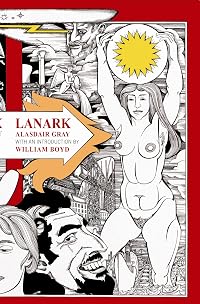
Lanark
by Alasdair Gray
On This Page
Description
A modern vision of hell, is set in the disintegrating cities of Unthank and Glasgow, and tells the interwoven stories of Lanark and Duncan Thaw. A work of extraordinary imagination and wide range, its playful narrative techniques convey a profound message, both personal and political, about humankind's inability to love, and yet our compulsion to go on trying. First published in 1981, Lanark immediately established Gray as one of Britain's leading writers.Tags
Recommendations








Member Recommendations

fugitive Surreal, bizarre, pretentious, weighty, confusing. Those are good things. I think.


SnootyBaronet Afterlife
Member Reviews
Most of the commentary on this book concentrates on its famous division between the Bildungsroman/roman à clef sections of Books 1 and 2, and the adult/fantastical sections of Books 3 and 4. That's true, and there's a lot to say about the way that Gray structured the book to enhance the parallelisms between Thaw and Lanark's lives (and he even says as much in the Epilogue), but I think the main division in the book is between the quotidian stuff - meaning the lives and loves of the dual protagonists - and the broader thematic stuff about society and its evolution.
The Introduction, which like all introductions should really be read last, claims that this is the Glaswegian equivalent of Ulysses. This is neither a true compliment, as show more Glasgow does not come off like a very nice place in the book, nor really all that meaningful, since Lanark and Ulysses are fairly different works. Lanark has some metafictional elements in it that I didn't enjoy much, but at heart it's divided between a sort of young adult novel about the adolescence of the artistic, asthmatic, alienated youth Duncan Thaw, who's openly based on the author; and a dystopian political novel about Lanark, who is Thaw's spiritual doppelgänger. Both halves of the book, somewhat reordered for artistic effect, have a lot of obvious parallels with each other, and while different readers will have their own favorite parts, I thought the "lovable loser" sections of Thaw's story were the strongest, both since they seemed to be written with real feelings, and because few people who grow through adolescence won't sympathize with his growing pains. By contrast, a lot of the Lanark sections consist of him essentially blundering around in a bizarre future landscape that's clearly based on Glasgow, yet alien enough to be offputting without truly being something new.
The real interest for me was in seeing how Thaw/Lanark's emotional turmoil got reflected in the world around them. One of the more interesting "soft" sci-fi novels I've read in the past few years is Olaf Stapledon's Star Maker, wherein the main character sees the similarity of life at many different scales - conflict between individuals is like conflict between tribes, is like conflict between races, is like conflict between species, and so on. In Lanark, the author, in a cringingly awkward ex cathedra cameo that's reminiscent of nothing so much as the Architect scene in the second Matrix movie, says as much to Lanark: "The Thaw narrative shows a man dying because he is bad at loving. It is enclosed by your narrative which shows civilization collapsing for the same reason." That's the kind of stuff I like reading about, what the relationship is between the omnipresence of human frailty and the corresponding flaws in our societies, what our growth and change says about us, and whether our actions are really leading us anywhere or merely sublimating our failures into ever less satisfying receptacles. The novel doesn't talk about that stuff as much as I'd have liked, but it's good to know Gray was thinking about it when he wrote it.
The emotional turmoil stuff is good too, although better in the Thaw parts, where he's just a kid and can be excused for his weirdness and clumsiness, than in Lanark's, who spends a lot of time in baffling non-conversations with the people around him. Gray is very good at making emotional pain present, be it towards parents, friends, or lovers. Some parts of Thaw's story are actually hard to read, so vividly do Thaw's struggles with girls, his art, his parents, and his maturity come across. However, Lanark strikes me as a book that would have been improved without the metafictional Epilogue where Gray explains exactly that. I'm just not sure it's possible to be truly artistically successful when being so self-referential, even if the little list of plagiarisms is actually really helpful for thinking about what the novel means. I prefer works to stand on their own; it's the job of critics - who are actually encouraged to talk about books and their reactions to them, and reactions to other reactions, etc. - who should be trusted with that stuff, because otherwise the author's breaking of the fourth wall just emphasizes how artificial their work is, and all suspension of disbelief is lost.
Other than that, it's an immense, fascinating novel about a man's journey through the world and his relationship to it that will please both lovers of sci-fi and young adult literature, who are seldom in agreement. show less
The Introduction, which like all introductions should really be read last, claims that this is the Glaswegian equivalent of Ulysses. This is neither a true compliment, as show more Glasgow does not come off like a very nice place in the book, nor really all that meaningful, since Lanark and Ulysses are fairly different works. Lanark has some metafictional elements in it that I didn't enjoy much, but at heart it's divided between a sort of young adult novel about the adolescence of the artistic, asthmatic, alienated youth Duncan Thaw, who's openly based on the author; and a dystopian political novel about Lanark, who is Thaw's spiritual doppelgänger. Both halves of the book, somewhat reordered for artistic effect, have a lot of obvious parallels with each other, and while different readers will have their own favorite parts, I thought the "lovable loser" sections of Thaw's story were the strongest, both since they seemed to be written with real feelings, and because few people who grow through adolescence won't sympathize with his growing pains. By contrast, a lot of the Lanark sections consist of him essentially blundering around in a bizarre future landscape that's clearly based on Glasgow, yet alien enough to be offputting without truly being something new.
The real interest for me was in seeing how Thaw/Lanark's emotional turmoil got reflected in the world around them. One of the more interesting "soft" sci-fi novels I've read in the past few years is Olaf Stapledon's Star Maker, wherein the main character sees the similarity of life at many different scales - conflict between individuals is like conflict between tribes, is like conflict between races, is like conflict between species, and so on. In Lanark, the author, in a cringingly awkward ex cathedra cameo that's reminiscent of nothing so much as the Architect scene in the second Matrix movie, says as much to Lanark: "The Thaw narrative shows a man dying because he is bad at loving. It is enclosed by your narrative which shows civilization collapsing for the same reason." That's the kind of stuff I like reading about, what the relationship is between the omnipresence of human frailty and the corresponding flaws in our societies, what our growth and change says about us, and whether our actions are really leading us anywhere or merely sublimating our failures into ever less satisfying receptacles. The novel doesn't talk about that stuff as much as I'd have liked, but it's good to know Gray was thinking about it when he wrote it.
The emotional turmoil stuff is good too, although better in the Thaw parts, where he's just a kid and can be excused for his weirdness and clumsiness, than in Lanark's, who spends a lot of time in baffling non-conversations with the people around him. Gray is very good at making emotional pain present, be it towards parents, friends, or lovers. Some parts of Thaw's story are actually hard to read, so vividly do Thaw's struggles with girls, his art, his parents, and his maturity come across. However, Lanark strikes me as a book that would have been improved without the metafictional Epilogue where Gray explains exactly that. I'm just not sure it's possible to be truly artistically successful when being so self-referential, even if the little list of plagiarisms is actually really helpful for thinking about what the novel means. I prefer works to stand on their own; it's the job of critics - who are actually encouraged to talk about books and their reactions to them, and reactions to other reactions, etc. - who should be trusted with that stuff, because otherwise the author's breaking of the fourth wall just emphasizes how artificial their work is, and all suspension of disbelief is lost.
Other than that, it's an immense, fascinating novel about a man's journey through the world and his relationship to it that will please both lovers of sci-fi and young adult literature, who are seldom in agreement. show less
I'd had this book on my to-read list for ages. Jessa put it on the 100 Best Books of the 20th century list for Bookslut, and had raved to me about Gray enough that I'd read and loved Poor Things and 1982, Janine (the latter is perpetually on my list of 10 favorite books). I'd had an eye out for Lanark for at least a decade, but not stumbled upon it anywhere. Finally, it occurred to me that I could make an interlibrary loan request. (Seriously a dangerous thing.)
I really do not want to give this book back. It's clear from the condition of the book that it had never been read. And now it's got some foxing and bumping to corners and actually looks loved and they can't have it back. I am tempted to ask them about the replacement price, but show more I also do want to send it back in the hopes that someone else will eventually pick it up and read it.
You may be able to tell, but I'm having a hard time approaching discussing the actual contents of this book. Lanark is the story of Lanark and of Thaw, who may or may not be the same person. Lanark's story is dystopian science fiction in parts, wildly speculative fantasy in others, sometimes reminding me of Brazil, or LOST, with occasional bouts of biting political satire. Thaw's story is more grinding realism, the story of a young artist with mysterious health problems, limited income, and trouble with authority. It sometimes reminded me of 1982, Janine. The stories are linked twice, once, by an oracle, who tells Lanark (who does not remember his life before waking on a train to Unthank), that before Unthank he was Thaw. The second time, Lanark meets The Author a few chapters before the end, who intimates that he started writing a story about Thaw, but found him too unlikeable, and so started over with Lanark.
This section on the conversation between Lanark and The Author was my favorite of the book -- I was grinning madly in the airport as I read it. It is, of course, a meta meditation on the roles of characters, authors, and readers, and what is the point of it all? And why are so few characters in literary novels ever happy? Amongst other things.
I can imagine this would be a love it or hate it kind of book. Despite Thaw's Serious Women Problems (and, to a lesser extent, Lanark's), something that often turns me off of a book, I loved it. Adored it. Will have to reread it again, sometime in the future.
Fabulous. show less
I really do not want to give this book back. It's clear from the condition of the book that it had never been read. And now it's got some foxing and bumping to corners and actually looks loved and they can't have it back. I am tempted to ask them about the replacement price, but show more I also do want to send it back in the hopes that someone else will eventually pick it up and read it.
You may be able to tell, but I'm having a hard time approaching discussing the actual contents of this book. Lanark is the story of Lanark and of Thaw, who may or may not be the same person. Lanark's story is dystopian science fiction in parts, wildly speculative fantasy in others, sometimes reminding me of Brazil, or LOST, with occasional bouts of biting political satire. Thaw's story is more grinding realism, the story of a young artist with mysterious health problems, limited income, and trouble with authority. It sometimes reminded me of 1982, Janine. The stories are linked twice, once, by an oracle, who tells Lanark (who does not remember his life before waking on a train to Unthank), that before Unthank he was Thaw. The second time, Lanark meets The Author a few chapters before the end, who intimates that he started writing a story about Thaw, but found him too unlikeable, and so started over with Lanark.
This section on the conversation between Lanark and The Author was my favorite of the book -- I was grinning madly in the airport as I read it. It is, of course, a meta meditation on the roles of characters, authors, and readers, and what is the point of it all? And why are so few characters in literary novels ever happy? Amongst other things.
I can imagine this would be a love it or hate it kind of book. Despite Thaw's Serious Women Problems (and, to a lesser extent, Lanark's), something that often turns me off of a book, I loved it. Adored it. Will have to reread it again, sometime in the future.
Fabulous. show less
Because it's a weird mashup of an autobiographical bildungsroman and a dystopian fantasy, with drawings by the author--who, on top of everything, is Scottish-- none of the critics knew what to do with this book, apparently, but I think it's one of the great novels of the 20th century, and I definitely think the dystopia is one of the most compelling ever created by somebody who can actually write prose that people who love prose as much as they love fantastical stories would actually want to read. That's a pretty short list: Kafka, Orwell, maybe Anna Kavan or Ursula LeGuin at her best, and Alasdair Gray.
Big and baffling. Feels like it needs a re-read to comprehend, but it is big. There are Big Themes of socialism and capitalism and Freud and subconscious, but it's hard to know how seriously any of it is being taken. The parts (Books) that are fantastical are sort of compelling and sort of tiresome—lots of visual imagery and description that I find hard to keep in mind. The time-mangling stuff is well done, though. Plot is picaresque in these parts. The parts (Books) that are realist-ish are kind of straightforward and very much a reminder that the 1950s are now an awful long time ago. The protagonist is both fully realised and a cypher. The sexual politics and general attitude to women are both pretty dated. The whole is somehow less show more playful than I expected from Gray, though there is the odd good joke. It's certainly an achievement but I don't know what it achieves. show less
Lanark is an autobiographical novel composed of four books: books 1 and 2 are in the middle supported on either side by book 3 at the beginning and then book 4 at the end. Books 3 and 4 are dystopian, the story of the man named Lanark who lives in the city of Unthank. They depict his struggle to understand class and politics against a weird backdrop where people are swallowed by gullets and suffer from diseases that turn them into dragons. The middle sections, books 1 and 2, are Lanark's alter-ego named Duncan Thaw, a boy growing up in Glasgow in a working class family who is devoted to his art.
I'm a quick reader, but it's taken me a long time to read this book, mostly because I wanted to ponder what was written. It's a hard book to show more explain; it's mystical with a touch of the ordinary, often cruel with just a few moments of tenderness, and always thought-provoking in what is said about working men and women. The drudgery of Duncan Thaw's everyday life is offset by the weirdness that Lanark lives through.
Other reviewers have noted what an excellent portrait of the city of Glasgow this book reflects. It's is Gray's city in real life and in the guise of Duncan Thaw, but Unthank is also Glasgow as Grays sees it. In many ways, this is his tribute as much as Ulysses was Joyce's tribute to Dublin, the high points and the flaws.
This is a book I'll go back to again and again, I suspect. It's probably not for everyone, but there is much here to digest. show less
I'm a quick reader, but it's taken me a long time to read this book, mostly because I wanted to ponder what was written. It's a hard book to show more explain; it's mystical with a touch of the ordinary, often cruel with just a few moments of tenderness, and always thought-provoking in what is said about working men and women. The drudgery of Duncan Thaw's everyday life is offset by the weirdness that Lanark lives through.
Other reviewers have noted what an excellent portrait of the city of Glasgow this book reflects. It's is Gray's city in real life and in the guise of Duncan Thaw, but Unthank is also Glasgow as Grays sees it. In many ways, this is his tribute as much as Ulysses was Joyce's tribute to Dublin, the high points and the flaws.
This is a book I'll go back to again and again, I suspect. It's probably not for everyone, but there is much here to digest. show less
This novel is a mix of dystopia with fantasy elements and bildungsroman. We start in the future where we come across a dysfunctional group of pseudo-cognoscenti hanging out in a cinema-cum-coffee shop called The Elite. In this section of the book, Lanark, our hero, lives a rather purposeless life in Unthank (parallel universe Glasgow), cavorts with these layabouts there before being sucked underground by a big pair of lips. He enters a vast Orwellian compound known as the Institute where everyone's a doctor, or becomes one. He saves a woman, Rima, one of the layabouts, from turning salamander. He discovers that Soylent Green is people, and for that reason decides to leave the subterreanean Institute. But before doing so, he is told the show more story by a portable oracle of his former life as one Duncan Thaw. Thaw lived in the real Glasgow, which I was pleased to see meticulously described for the first time in any fiction that I have ever read. Over 300+ pages Thaw grows from child to neurotic art student. He has terrible asthma. He masturbates avidly. He can't get a girl. His mother dies horribly. His relationship with his father is deeply moving. The relationships throughout these two central books are so genuine, so vivid. This human warmth is an element lacking from the framing dystopia, because that setting, and all its whacky goings on, distract from the humanity, as it's meant to do. But the dystopic sections are valuable for other reasons: for their depiction of vast, illogical space, of an incomprehensible and deeply criminal military-industrial complex that will stop at nothing to realize a profit. Future rereadings are merited. That's high praise. show less
(Original Review, 1981-03-10)
I don't have problem with intertextual interpretation as such. It's only that I've always seen reading as a collaborative process between an author and a reader. If you look at it that way, it makes you wonder which parts of deep reading “Lanark” come from the mind of Alasdair Gray and which come from the attic of your own subconscious. I also wonder if it matters which mind it comes from, at least when reading fiction.
I've, finally, got around to finishing the last few chapters of “Lanark”, and found the wonderful bit at the end where the “Alasdair Gray” appears in his own work having a conversation with his hero. He explains the sources of his writing and ends up apologising to his character show more for having to end the book the way he feels he must. He includes the line 'a parade of irrelevant erudition through grotesquely inflated footnotes' to describe the list of intertextual references he used in his novel. There is something characteristically Glaswegian about the humour in that whole chapter.
I think that's what made me start considering the value of hunting out references against letting a work stand by itself as separate entity. It reminds me of Hammett who does seem to avoid places where he could insert deeper meaning in the text. His performance of Shylock might be related to the character of Cairo, but it is a fleeting touch, not the heavy reference of Lowry's “Hands of Orlac.”
Over the last years or so I've been gradually reading “Ulysses”. Sometimes I can skip over the surface enjoying the beauty of the language. At other times I can sink without a trace, following references into the depths until I am studying and not reading. At present rate of progress, it will probably take me another twenty years to finish it, but I'm never going to have fully 'deep read' it. Perhaps just like “Lanark”. show less
I don't have problem with intertextual interpretation as such. It's only that I've always seen reading as a collaborative process between an author and a reader. If you look at it that way, it makes you wonder which parts of deep reading “Lanark” come from the mind of Alasdair Gray and which come from the attic of your own subconscious. I also wonder if it matters which mind it comes from, at least when reading fiction.
I've, finally, got around to finishing the last few chapters of “Lanark”, and found the wonderful bit at the end where the “Alasdair Gray” appears in his own work having a conversation with his hero. He explains the sources of his writing and ends up apologising to his character show more for having to end the book the way he feels he must. He includes the line 'a parade of irrelevant erudition through grotesquely inflated footnotes' to describe the list of intertextual references he used in his novel. There is something characteristically Glaswegian about the humour in that whole chapter.
I think that's what made me start considering the value of hunting out references against letting a work stand by itself as separate entity. It reminds me of Hammett who does seem to avoid places where he could insert deeper meaning in the text. His performance of Shylock might be related to the character of Cairo, but it is a fleeting touch, not the heavy reference of Lowry's “Hands of Orlac.”
Over the last years or so I've been gradually reading “Ulysses”. Sometimes I can skip over the surface enjoying the beauty of the language. At other times I can sink without a trace, following references into the depths until I am studying and not reading. At present rate of progress, it will probably take me another twenty years to finish it, but I'm never going to have fully 'deep read' it. Perhaps just like “Lanark”. show less
Members
- Recently Added By
Published Reviews
ThingScore 100
Bulk alone--560 or so pages--signals Scottish first-novelist Gray's determination: he means to make a detailed, leisurely analogue to today, to set it in a future-world city much like Glasgow. The main of Gray's big metaphorical structure is built on fantasy. And though this construct has its moments, it never even comes close to cohering. The eye, instead of being scathing, is more simply show more chafed; there's a sharp edge here, but it glints only once in a long while. Some appeal for fanciers of grand-scale sociological futurescapes, then, with more ambition than real imagination or power. show less
added by poppycocteau
What's worth saying, these decades on, is that Lanark , in common with all great books, is still, and always will be, an act of resistance. It is part of the system of whispers and sedition and direct communion, one voice to another, we call literature. Its bravery in finding voice, in encouraging the enormous power of public, national, artistic, sexual and political imagination, is not show more something to take for granted.
Alasdair Gray's big book about Glasgow is also a big book about everywhere. Its insistence on the literal if mistrusted truth - that Glasgow and Scotland and every small nation and individual within it are part of the whole wide world - is something worth saying indeed. Dear reader, delay no longer. Engage with the text. Imagine. Admire the view. show less
Alasdair Gray's big book about Glasgow is also a big book about everywhere. Its insistence on the literal if mistrusted truth - that Glasgow and Scotland and every small nation and individual within it are part of the whole wide world - is something worth saying indeed. Dear reader, delay no longer. Engage with the text. Imagine. Admire the view. show less
added by SnootyBaronet
Lists

The Guardian's 1000 Novels Everyone Must Read
1,005 works; 547 members

The Guardian's 100 greatest novels of all time
100 works; 16 members

Anthony Burgess 99 Post War Novels
99 works; 7 members

1,001 BYMRBYD Concensus
723 works; 27 members

A Novel Cure
742 works; 23 members

TML 200 Best Books 1950-1999
202 works; 10 members

BBC Radio 4 Bookclub
340 works; 13 members

The Guardian's best novels in English: Readers' alternative list
15 works; 2 members

Schwob Nederland
207 works; 2 members

David Pringle's Modern Fantasy: The 100 Best Novels
100 works; 5 members

My TBR
371 works; 3 members

Recommended Literary Books
111 works; 1 member

living room bookshelf
150 works; 1 member

The Modern Library (The Two Hundred Best Novels....
202 works; 1 member
Author Information

42+ Works 7,436 Members
Alasdair James Gray was born on Dec. 28, 1934, in Glasgow to Amy (Fleming) and Alexander Gray. His mother worked in a clothing warehouse, his father in construction. Mr. Gray studied design and mural painting at the Glasgow College of Art. When he graduated in 1957, he was commissioned to paint murals around Glasgow, which he continued to create show more until 2014. He worked on freelance projects and also wrote plays before publishing his first novel. Whether he was creating etchings for his books or a mural to adorn the ceiling of the Glasgow arts and entertainment venue Oran Mor, Mr. Gray created an unusual niche for himself encompassing Scotland's literary and artistic spheres. While his murals can be found at subway stops and restaurants in Glasgow, some of his works are in the collection of the National Galleries of Scotland. In addition to writing fiction, poems and plays for the stage, television and radio Mr. Gray published an autobiography, A Life in Pictures, in 2010. It combined photos, written descriptions and lavish illustrations to reveal that much of Mr. Gray's personal life was embedded in his work. Alasdair James Gray passed away on December 29, 2019 at the age of 85. (Bowker Author Biography) show less
Awards and Honors
Awards
Notable Lists
Series
Belongs to Publisher Series
Work Relationships
Common Knowledge
- Canonical title
- Lanark
- Original title
- Lanark: A Life in Four Books
- Original publication date
- 1981
- People/Characters
- Duncan Thaw; Rima; Lanark; Sludden; Marjory Laidlaw; Professor Ozenfant
- Important places
- Glasgow, Scotland, UK; Unthank
- First words
- The Elite Cafe was entered by a staircase from the foyer of a cinema.
- Quotations
- "Who did the council fight?"
"It split in two and fought itself."
"That's suicide!"
"No, ordinary behaviour. The efficient half eats the less efficient half and grows stronger. War is just a violent way of doing what... (show all) half the people do calmly in peacetime: using the other half for food, heat, machinery and sexual pleasure. Man is the pie that bakes and eats himself, and the recipe is separation."
"It is plain that the vaster the social unit, the less possible is true democracy."
He wallows under, gasping and tumbling over and over in salt sting, knowing nothing but the need not to breathe. A humming drumming fills his brain, in panic he opens eyes and glimpses green glimmers through salt sting. And w... (show all)hen at last, like fingernails losing clutch on too narrow a ledge, he, tumbling, yells out last dregs of breath and has to breathe, there flows in upon him, not pain, but annihilating sweetness.
You suffer from the oldest delusion in politics. You think you can change the world by talking to a leader. Leaders are the effects, not the causes of changes.
The world is only improved by people who do ordinary jobs and refuse to be bullied. - Last words
- (Click to show. Warning: May contain spoilers.)I HAVE GROWN UP. MY MAPS ARE OUT OF DATE. THE LAND LIES OVER ME. I CANNOT MOVE. IT IS TIME TO GO.
- Blurbers
- Aldiss, Brian; Burgess, Anthony
- Original language
- English
Classifications
Statistics
- Members
- 2,399
- Popularity
- 8,151
- Reviews
- 41
- Rating
- (4.01)
- Languages
- 13 — Catalan, Czech, Dutch, English, French, German, Italian, Korean, Norwegian (Bokmål), Portuguese, Spanish, Swedish, Turkish
- Media
- Paper, Audiobook, Ebook
- ISBNs
- 43
- ASINs
- 7