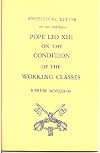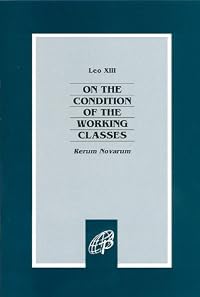
Rerum Novarum: On the Condition of the Working Classes
by Pope Leo XIII
Papal Magisterial Documents (Encicliche — 1891)
On This Page
Description
Excerpt: Rights and Duties of Capital and LaborThat the spirit of revolutionary change, which has long been disturbing the nations of the world, should have passed beyond the sphere of politics and made its influence felt in the cognate sphere of practical economics is not surprising. The elements of the conflict now raging are unmistakable, in the vast expansion of industrial pursuits and the marvelous discoveries of science; in the changed relations between masters and workmen; in the show more enormous fortunes of some few individuals, and the utter poverty of the masses; the increased self-reliance and closer mutual combination of the working classes; as also, finally, in the prevailing moral degeneracy. The momentous gravity of the state of things now obtaining fills every mind with painful apprehension; wise men are discussing it; practical men are proposing schemes; popular meetings, legislatures, and rulers of nations are all busied with it - actually there is no question which has taken deeper hold on the public mind.2. Therefore, venerable brethren, as on former occasions when it seemed opportune to refute false teaching, We have addressed you in the interests of the Church and of the common weal, and have issued letters bearing on political power, human liberty, the Christian constitution of the State, and like matters, so have We thought it expedient now to speak on the condition of the working classes. It is a subject on which We have already touched more than once, incidentally. But in the present letter, the responsibility of the apostolic office urges Us to treat the question of set purpose and in detail, in order that no misapprehension may exist as to the principles which truth and justice dictate for its settlement. The discussion is not easy, nor is it void of danger. It is no easy matter to define the relative rights and mutual duties of the rich and of the poor, of capital and of labor. And the danger lies in this, that crafty agitators are intent on making use of these differences of opinion to pervert men's judgments and to stir up the people to revolt. show lessTags
Recommendations








































Member Reviews
Pope Leo XIII was pope from 1878 to his death in 1903. He experienced the dramatic changes that occurred worldwide during the Industrial Revolution and saw the increasingly desperate plights of the working class as well as the growing economic inequality of the Gilded Age. He also saw the rise of Socialism and Socialist parties which he considered a threat to the church.
This encyclical was published in 1891 and was subtitled On the Condition of the Working Classes. He provides his thinking on the social aspects of Capital and Labor. This Kindle edition of the encyclical has recently been rereleased as a result of the ascension of Pope Leo XIV increasing curiosity about the previous Leo. The Kindle edition has added footnotes that show more provide additional historical context, a short biography of Pope Leo XIII, and one-line summaries of each of the paragraphs of the encyclical.
The encyclical begins with a declaration that it has become necessary for the church to address the issues of capital and labor noting that it is urgently necessary to find remedies to the current miseries of members of the working class. He then proceeds to explain the evils of Socialism saying that it is a bad solution for society and for the working class as well. He is primarily upset with Socialism wanting to eliminate private property so several sections are spent defending the importance of private property.
The encyclical then continues with a condemnation of strikes and with a list of the duties of workers and the duties of employers. The duties he prescribes for workers are numerous and very specific in contrast to the duties of employers which can generously be described as appealing to the better natures of employers so they will treat their employees well. He wants everyone in society to follow Christian principles in order to bring the relationship between workers and employers into balance. He does, however, discuss the role of the State for regulating work but generally wants the State to remain neutral.
Pope Leo regretted the elimination of the trade guilds because of the ways that they looked out for worker welfare. As a substitute he favors workers forming mutual aid societies that can help members who become injured or sick.
The work is interesting to read as first efforts to address social welfare issues during the Industrial Revolution and Gilded Age. His analysis and recommendations appear almost timid to modern ears although the encyclical was considered very progressive when it was first released. show less
This encyclical was published in 1891 and was subtitled On the Condition of the Working Classes. He provides his thinking on the social aspects of Capital and Labor. This Kindle edition of the encyclical has recently been rereleased as a result of the ascension of Pope Leo XIV increasing curiosity about the previous Leo. The Kindle edition has added footnotes that show more provide additional historical context, a short biography of Pope Leo XIII, and one-line summaries of each of the paragraphs of the encyclical.
The encyclical begins with a declaration that it has become necessary for the church to address the issues of capital and labor noting that it is urgently necessary to find remedies to the current miseries of members of the working class. He then proceeds to explain the evils of Socialism saying that it is a bad solution for society and for the working class as well. He is primarily upset with Socialism wanting to eliminate private property so several sections are spent defending the importance of private property.
The encyclical then continues with a condemnation of strikes and with a list of the duties of workers and the duties of employers. The duties he prescribes for workers are numerous and very specific in contrast to the duties of employers which can generously be described as appealing to the better natures of employers so they will treat their employees well. He wants everyone in society to follow Christian principles in order to bring the relationship between workers and employers into balance. He does, however, discuss the role of the State for regulating work but generally wants the State to remain neutral.
Pope Leo regretted the elimination of the trade guilds because of the ways that they looked out for worker welfare. As a substitute he favors workers forming mutual aid societies that can help members who become injured or sick.
The work is interesting to read as first efforts to address social welfare issues during the Industrial Revolution and Gilded Age. His analysis and recommendations appear almost timid to modern ears although the encyclical was considered very progressive when it was first released. show less
Leo XIII's Rundskrivelse om Arbejderspørgsmaalet
kun i kopi
kun i kopi
iN BOX B
UG-2
Sep 22, 2023Catalan
Ratings
Members
- Recently Added By
Author Information

Some Editions
Series

Work Relationships
Is contained in
Catholicism and Socialism: Encyclicals of Pope Leo XIII: Rerum Novarum - Quod Apostolici Muneris - Gravis de Communi Re by Ralph Plunkett
A doutrina Social da Igreja: As Encíclicas Papais de Leão XIII (Rerum Novarum), Pio XI (Quadragesimo Anno) e João XXIII (Master et Magistra) seguidas de minucioso índice remissivo e da Declaração do Episcopado Brasileiro by Pimentel Júnior
L'Encyclique 'Rerum Novarum...' Sur la condition des ouvriers. Nouvelle édition avec divisions, notes marginales et commentaires, précédée d'une allocution de S. S. Benoît XV sur l'opportunité de l'Encyclique à l'usage des cercles d'études, par l'abbé P. Tiberghien, aumônier de jeunesse catholique à Lille by P. Tiberghien
Is abridged in
Inspired
Rerum Novarum Laborem Exercens 2000 - symposium / from Rerum Novarum to Laborem Exercens : towards the year 2000 - symposium by Pontificia commissio iustitia et pax
La doctrina social de la Iglesia: Según las Encíclicas "Rerum Novarum" y "Quadragesimo Anno" by Georges-Ceslas Rutten
Ob jubileju papeških socialnih okrožnic 'Rerum novarum' in 'Quadragesimo anno' : 1891-1931, 1951 by Ivan Ahčin
La doctrina social de la Iglesia: Según las Encíclicas "Rerum Novarum" y "Quadragesimo Anno" by Georges-Ceslas Rutten
1991 - Turning point : celebrating the centenary of "Rerum novarum" and the future of Catholic social teaching : presentations to the 1991 - Turning Point National Forum, Adelaide, October 1991 by David Shinnick
Bring Down the Walls (VHS) Commemorating the 100th Anniversary of Rerum Novarum by Dept. of Social Development and World Peace
Doctrina social de la Iglesia y realidad socio-económica: En el Centenario de la Rerum Novarum. XII Simposio Internacional de Teolo gia (Colección teológica) (Spanish Edition) by Javier Sesé
Henry George, Rerum Novarum and The Controversy Concerning Private Property in Land by Jack Schwartzman
La carta magna de la justicia social : XL Aniversario de la "Rerum Novarum" by Maximiliano Arboleya Martínez
La destinazione universale dei beni: atti del colloquio internazionale nel centenario della Rerum novarum, Citta del Vaticano, 14-15 maggio 1991 by Enrico Bellavite
On the condition of labor and the social question one hundred years later : commemorating the 100th anniversary of Rerum Novarum, and the fiftieth anniversary of the Association for Social Economics by Thomas O. Nitsch
Has as a study
Common Knowledge
- Canonical title
- Rerum Novarum: On the Condition of the Working Classes
- Original title
- Rerum Novarum: Über die Lage der arbeitenden Klasse; Rerum novarum
- Alternate titles
- The Workers' Charter; On the Rights and Duties of Capital and Labour
- Original publication date
- 1891-05-15
- Dedication*
- An die Ehrwürdigen Brüder,
die Patriarchen, Primaten,
Erzbischöfe, Bischöfe
und die sonstigen Ortsordinarien,
die in Frieden und Gemeinschaft mit dem Apostolischen Stuhle stehen - First words*
- Der Geist der Neuerung, welcher seit langem durch die Völker geht, mußte,
nachdem er auf dem politischen Gebiete seine verderblichen Wirkungen entfaltet
hatte, folgerichtig auch das volkswirtschaftliche Gebiet ergreif... (show all)en. - Last words*
- (Click to show. Warning: May contain spoilers.)Das Heil ist ja insbesondere von der vollen
Betätigung der Liebe zu erwarten, jener christlichen Liebe, die der kurzgefaßte
Inbegriff der evangelischen Gebote ist, die, immer bereit, sich selbst für des
Nächsten Heil zu opfern, das heilkräftigste Gegengift gegen den Hochmut und
Egoismus der Welt darstellt, und deren göttliches Bild und Walten der Apostel Paulus
mit den Worten gezeichnet hat: „Die Liebe ist geduldig, sie ist gütig; sie sucht nicht
das Ihrige, sie duldet alles, sie trägt alles“.
Als Unterpfand des göttlichen Segens und Erweis Unseres Wohlwollens spenden Wir
Euch, Ehrwürdige Brüder, Eurem Klerus und Volke in Liebe den Apostolischen
Segen im Herrn.
Gegeben zu Rom bei St. Peter am 15. Mai 1891, im vierzehnten Jahre Unseres
Pontifikates.
Leo XIII., Papst - Original language*
- Latein
*Some information comes from Common Knowledge in other languages. Click "Edit" for more information.
Classifications
Statistics
- Members
- 312
- Popularity
- 102,035
- Reviews
- 4
- Rating
- (4.05)
- Languages
- 5 — Dutch, English, Italian, Portuguese (Portugal), Spanish
- Media
- Paper, Ebook
- ISBNs
- 13
- ASINs
- 16