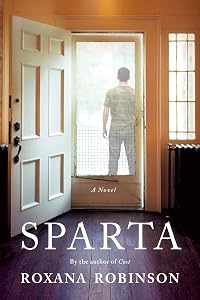
Sparta
by Roxana Robinson
On This Page
Description
"[After four years in Iraq, Conrad Farrell returns to Katonah, New York], and he's beginning to learn that something has changed in his landscape. Something has gone wrong, though things should be fine: he hasn't been shot or wounded; he's never had psychological troubles. But as he attempts to reconnect with his family and his girlfriend and to find his footing in the civilian world, he learns how hard it is to return to the people and places he used to love"--Dust jacket flap.Tags
Recommendations














Member Reviews
Roxana Robinson's SPARTA is gut-wrenching, heartbreaking literary fiction that kept me reading late into the night, And as I got closer and closer to the book's end, I began to dread what would come, was actually afraid for this young man, protagonist Conrad Farrell, and what he might do. Because he had become that real to me. Not a fictional character, but a real-life, flesh and blood human being, and one who was in deep trouble, tortured by unbearable "storms of anguish and grief and despair ... of guilt and shame."
With Marine Corps LT Conrad Farrell, a returning Iraq War veteran, Roxana Robinson has created a character who, while real enough as an individual - and vividly so - could also be construed as a composite of thousands of show more veterans irreparably damaged by the war. And so many of them, like Farrell, fail to seek help because they are still governed by the "suck it up" and "be a man" mindset drilled into them by their training.
Farrell comes from a comfortably upper-class background in Westchester County, and is a graduate of Williams College, where he studied the classics. His father is a professor, his mother a licensed social worker and therapist. It seems an unlikely background for a Marine officer, in this era of no draft and a professional military which comprises barely one percent of the population. But Conrad was drawn by that age old pull of wanting to test himself, and there was also some idealism, wanting to do something for his country. The Iraq War was not yet a reality when he signed up, but came soon after, and his long nightmare of combat, casualties, and his subsequent return to an uncaring general populace is documented here in a narrative so compelling and real that it will not just draw you in; it will break your heart.
It doesn't take Conrad long, upon his return home, to realize that he doesn't fit in, not with his loving family, not with his girl friend. Not anywhere. A veteran of numerous firefights and victim of IEDs, he is plagued by crippling headaches, bloody memories and horrifying flashbacks, and forced to admit, "The stuff in my head is permanent. It can't be erased." And only when thoughts of suicide become more frequent does he seek help, through an overburdened and indifferent VA Hospital system.
Robinson compares the rigid warrior codes and training of Sparta, the ancient Greek city-state, to those of the Marine Corps, and tells us -
"Sparta failed, in the end, because the energies of the state were directed only toward war ... The costs of war were great, both to the nation and to the soldiers. Sparta made young boys into warriors; it was left to the warriors to restore themselves to men."
Conrad Farrell's story is grim proof of the difficulty of effecting such a restoration.
Roxana Robinson's previous novel, which I have not read, is called COST. She could have easily used the same title for this book, with its heart wrenching descriptions of the human cost of our current wars. Robinson is a marvelous writer, and SPARTA is a book which cries out to be read. My highest recommendation.
- Tim Bazzett, author of the memoir, SOLDIER BOY: AT PLAY IN THE ASA show less
With Marine Corps LT Conrad Farrell, a returning Iraq War veteran, Roxana Robinson has created a character who, while real enough as an individual - and vividly so - could also be construed as a composite of thousands of show more veterans irreparably damaged by the war. And so many of them, like Farrell, fail to seek help because they are still governed by the "suck it up" and "be a man" mindset drilled into them by their training.
Farrell comes from a comfortably upper-class background in Westchester County, and is a graduate of Williams College, where he studied the classics. His father is a professor, his mother a licensed social worker and therapist. It seems an unlikely background for a Marine officer, in this era of no draft and a professional military which comprises barely one percent of the population. But Conrad was drawn by that age old pull of wanting to test himself, and there was also some idealism, wanting to do something for his country. The Iraq War was not yet a reality when he signed up, but came soon after, and his long nightmare of combat, casualties, and his subsequent return to an uncaring general populace is documented here in a narrative so compelling and real that it will not just draw you in; it will break your heart.
It doesn't take Conrad long, upon his return home, to realize that he doesn't fit in, not with his loving family, not with his girl friend. Not anywhere. A veteran of numerous firefights and victim of IEDs, he is plagued by crippling headaches, bloody memories and horrifying flashbacks, and forced to admit, "The stuff in my head is permanent. It can't be erased." And only when thoughts of suicide become more frequent does he seek help, through an overburdened and indifferent VA Hospital system.
Robinson compares the rigid warrior codes and training of Sparta, the ancient Greek city-state, to those of the Marine Corps, and tells us -
"Sparta failed, in the end, because the energies of the state were directed only toward war ... The costs of war were great, both to the nation and to the soldiers. Sparta made young boys into warriors; it was left to the warriors to restore themselves to men."
Conrad Farrell's story is grim proof of the difficulty of effecting such a restoration.
Roxana Robinson's previous novel, which I have not read, is called COST. She could have easily used the same title for this book, with its heart wrenching descriptions of the human cost of our current wars. Robinson is a marvelous writer, and SPARTA is a book which cries out to be read. My highest recommendation.
- Tim Bazzett, author of the memoir, SOLDIER BOY: AT PLAY IN THE ASA show less
This one BLEW. ME. AWAY. I did not want to read another book about the Iraq war. I did not want to read anything else grim, dark, or depressing but I couldn't put it down.
I can't begin to get my thoughts ordered enough to write this one the review it deserves, but I can sing its praises to the heavens. Have no doubt-- this is a meaty book, with a subject matter that many of us find distasteful, but it is an exquisite piece of writing...no extra words, no fluff, but bold, brazen, heart-wrenching; it's a panic attack-producing introspective look at what is happening to an entire generation of this country's (and maybe the world's?) young military aged people who have gone off to serve their country with high hopes of changing the world, show more only to return to a world they don't know, don't understand, and a world that doesn't seem able to understand them or help them cope with the traumas they've endured. They may come home in pieces physically, or they may return looking intact, but they are all fractured indelibly from what they've done, what they've endured, what they've seen and heard and smelt and experienced.
The story is about Conrad Farrell - New England upper middle class classics major in college, enamored of the ancient Spartans and the purity of their thoughts, who decides after graduation to do "something real.. something that will make a difference" by accepting a commission in the US Marines. As a Marine leader, he is responsible for his men, and goes off to Iraq to watch and engage in the carnage that was Fallujah and surrounding area battles. When he returns after four years, he is irrevocably changed and unable to settle back into a world he no longer recognizes.
"You don't get it. I'd love to do this....Change. I can't. Something's not working. All you do is tear me apart. I'd like to be back here with you all, but I'm not. You don't get it. I'm not here. I'm not home. I'm still there." p. 348
His family (parents, brother, sister and girl-friend) are devastated when their efforts to understand are scorned, all offers of help are ignored or rejected, when they see him sinking further and deeper into non-functioning desperation and are forced to stand by helplessly. His inability to articulate his problems compounds the tragedy. The VA is not much help. (The book is set in 2006). His mother, a professional therapist, is particularly upset:
"I know what I'm supposed to do....I do it all the time as a therapist...but I can't do it with Con. I can't do it.....I'm not supposed to reach out to him. He doesn't like it. I can see that. If he were a client, I'd tell myself to stop....I'm too afraid. I can't leave him alone....What kind of a therapist! What kind of a mother! I can't stop." p. 340
It should be required reading in high school, in college, at our military's officer training academies and War Colleges, and by all who are in the unenviable position of treating these returning veterans both physically and mentally. Ultimately, it's not only an indictment of our mental health care system, but of our national caring system, our national conscience, and the conflicted values of leadership theory.
Ultimately it's also a book about hope, and love and caring, and never giving up.
Definitely going to be on my top 5 of the year list. GO GET IT. GO READ IT. show less
I can't begin to get my thoughts ordered enough to write this one the review it deserves, but I can sing its praises to the heavens. Have no doubt-- this is a meaty book, with a subject matter that many of us find distasteful, but it is an exquisite piece of writing...no extra words, no fluff, but bold, brazen, heart-wrenching; it's a panic attack-producing introspective look at what is happening to an entire generation of this country's (and maybe the world's?) young military aged people who have gone off to serve their country with high hopes of changing the world, show more only to return to a world they don't know, don't understand, and a world that doesn't seem able to understand them or help them cope with the traumas they've endured. They may come home in pieces physically, or they may return looking intact, but they are all fractured indelibly from what they've done, what they've endured, what they've seen and heard and smelt and experienced.
The story is about Conrad Farrell - New England upper middle class classics major in college, enamored of the ancient Spartans and the purity of their thoughts, who decides after graduation to do "something real.. something that will make a difference" by accepting a commission in the US Marines. As a Marine leader, he is responsible for his men, and goes off to Iraq to watch and engage in the carnage that was Fallujah and surrounding area battles. When he returns after four years, he is irrevocably changed and unable to settle back into a world he no longer recognizes.
"You don't get it. I'd love to do this....Change. I can't. Something's not working. All you do is tear me apart. I'd like to be back here with you all, but I'm not. You don't get it. I'm not here. I'm not home. I'm still there." p. 348
His family (parents, brother, sister and girl-friend) are devastated when their efforts to understand are scorned, all offers of help are ignored or rejected, when they see him sinking further and deeper into non-functioning desperation and are forced to stand by helplessly. His inability to articulate his problems compounds the tragedy. The VA is not much help. (The book is set in 2006). His mother, a professional therapist, is particularly upset:
"I know what I'm supposed to do....I do it all the time as a therapist...but I can't do it with Con. I can't do it.....I'm not supposed to reach out to him. He doesn't like it. I can see that. If he were a client, I'd tell myself to stop....I'm too afraid. I can't leave him alone....What kind of a therapist! What kind of a mother! I can't stop." p. 340
It should be required reading in high school, in college, at our military's officer training academies and War Colleges, and by all who are in the unenviable position of treating these returning veterans both physically and mentally. Ultimately, it's not only an indictment of our mental health care system, but of our national caring system, our national conscience, and the conflicted values of leadership theory.
Ultimately it's also a book about hope, and love and caring, and never giving up.
Definitely going to be on my top 5 of the year list. GO GET IT. GO READ IT. show less
Inspired by the romanticized accounts of war in the ancient world, classics major Conrad Farrell joins the Marines in an attempt to enter into the venerable brotherhood of honor, sacrifice, and courage forged in the heat of combat. Explaining his decision to enlist, Conrad naively tells his parents, "The classical writers love war, that's their main subject. Being a soldier was the whole deal, the central experience . . . It seems like it's the great thing. The great challenge" (22). And so Conrad goes to Sparta--the nickname for the Marine military base in Haditha, Iraq. However, he also goes to Sparta in the figurative sense, learning that what gave greatness to the ancient Greek city-state famous for its military might was also the show more chink in its armor: when you surrender everything to war, you lose something intrinsic and necessary for the survival of the human spirit.
Sparta is not about Conrad's time in Iraq, although there are several well-written flashback sequences that give us insight into what Conrad endured as a soldier. Instead, it is a powerful novel focusing on what happens when a warrior returns home. What is his place when his service is done, when the mission is complete, and when what he found in war was not glory or purpose or righteousness, but waste and hypocrisy? Roxana Robinson does a superb job of delineating Conrad's slow descent into existential darkness, finding it increasingly impossible to reconnect to an America and a family so materially comfortable and willfully insular that it knows nothing of what his time in Iraq was like. As he tells his father, "It's hard to describe. It's like I can't get in here. It's as though I'm standing outside. I can see everyone in here, rushing around and doing things, and I can't get in" (240).
Conrad's training as a Marine defines him, leading to a single-minded determination to fight against the anxiety, the fear, and the rage on his own; to seek outside help would be a sign of weakness and failure. He begins to see himself as a man divided: there is the Conrad who existed before the war, the one everyone expects him to be, and the soldier who is so defined by combat that he cannot exist in a world without it. As it becomes more evident that he is losing the battle within himself, Conrad's plight is made all the more distressing when he begins to seek help from a disinterested and unforgivably slow VA. While I know that many VA clinics are run by compassionate, engaged medical professionals, it is just as true that many are indifferent or ill-equipped to handle the task of treating our veterans. That any man or woman who has been willing to sacrifice for our nation should have to wait months for needed medical treatment or tolerate a slow-moving bureaucracy is a shameful condemnation of our society's refusal to respect and honor the human cost of war.
Robinson's creation of a soldier's struggle is certainly admirable and, for the most part, surprisingly convincing given that it's written by a female author outside of the military. Her real strength lies in depicting the complexity of the relationships: the silent agony of his family, the confusion of his girlfriend, the awkward interactions with former friends, and the painful communications with his fellow Marines (many of whom are also struggling, but valiantly trying to hide it from their former lieutenant). In particular, the sibling bond between Conrad and his younger brother and sister (a bond forged of shared experience and damaged by Conrad's isolated time outside of that bond) struck me as genuine and authentic. Robinson is certainly to be commended for the beauty of the writing, as well as the light she sheds on the emotional toll of war. Despite this, it does sometimes feel a bit too studied, too researched; it doesn't (brace yourselves for what you should have known would be the inevitable Tim O'Brien comparison) make me feel the effects in the way that The Things They Carried does. And while Robinson is an impressive chronicler of the minutiae of daily life--the ever changing earrings worn by Conrad's sister, the flotsam and jetsam that inevitably end up on the kitchen refrigerator, the festive decor of a Christmas table--such details strike me as decidedly feminine; granted, Conrad's training has taught him to home in on details, but these still seem like the things that make up the lives of women and might be briefly noted and then discarded as irrelevant by a masculine mind.
A brief history lesson on the Iraq War and on military life in Sparta are awkwardly shoe-horned into the narrative in the beginning, but once Sparta finds its focus in the mind of Conrad, it is a powerful and necessary reminder that not every soldier who comes home without injury is, in fact, whole.
Cross posted at This Insignificant Cinder and at Shelf Inflicted show less
Sparta is not about Conrad's time in Iraq, although there are several well-written flashback sequences that give us insight into what Conrad endured as a soldier. Instead, it is a powerful novel focusing on what happens when a warrior returns home. What is his place when his service is done, when the mission is complete, and when what he found in war was not glory or purpose or righteousness, but waste and hypocrisy? Roxana Robinson does a superb job of delineating Conrad's slow descent into existential darkness, finding it increasingly impossible to reconnect to an America and a family so materially comfortable and willfully insular that it knows nothing of what his time in Iraq was like. As he tells his father, "It's hard to describe. It's like I can't get in here. It's as though I'm standing outside. I can see everyone in here, rushing around and doing things, and I can't get in" (240).
Conrad's training as a Marine defines him, leading to a single-minded determination to fight against the anxiety, the fear, and the rage on his own; to seek outside help would be a sign of weakness and failure. He begins to see himself as a man divided: there is the Conrad who existed before the war, the one everyone expects him to be, and the soldier who is so defined by combat that he cannot exist in a world without it. As it becomes more evident that he is losing the battle within himself, Conrad's plight is made all the more distressing when he begins to seek help from a disinterested and unforgivably slow VA. While I know that many VA clinics are run by compassionate, engaged medical professionals, it is just as true that many are indifferent or ill-equipped to handle the task of treating our veterans. That any man or woman who has been willing to sacrifice for our nation should have to wait months for needed medical treatment or tolerate a slow-moving bureaucracy is a shameful condemnation of our society's refusal to respect and honor the human cost of war.
Robinson's creation of a soldier's struggle is certainly admirable and, for the most part, surprisingly convincing given that it's written by a female author outside of the military. Her real strength lies in depicting the complexity of the relationships: the silent agony of his family, the confusion of his girlfriend, the awkward interactions with former friends, and the painful communications with his fellow Marines (many of whom are also struggling, but valiantly trying to hide it from their former lieutenant). In particular, the sibling bond between Conrad and his younger brother and sister (a bond forged of shared experience and damaged by Conrad's isolated time outside of that bond) struck me as genuine and authentic. Robinson is certainly to be commended for the beauty of the writing, as well as the light she sheds on the emotional toll of war. Despite this, it does sometimes feel a bit too studied, too researched; it doesn't (brace yourselves for what you should have known would be the inevitable Tim O'Brien comparison) make me feel the effects in the way that The Things They Carried does. And while Robinson is an impressive chronicler of the minutiae of daily life--the ever changing earrings worn by Conrad's sister, the flotsam and jetsam that inevitably end up on the kitchen refrigerator, the festive decor of a Christmas table--such details strike me as decidedly feminine; granted, Conrad's training has taught him to home in on details, but these still seem like the things that make up the lives of women and might be briefly noted and then discarded as irrelevant by a masculine mind.
A brief history lesson on the Iraq War and on military life in Sparta are awkwardly shoe-horned into the narrative in the beginning, but once Sparta finds its focus in the mind of Conrad, it is a powerful and necessary reminder that not every soldier who comes home without injury is, in fact, whole.
Cross posted at This Insignificant Cinder and at Shelf Inflicted show less
Brilliantly told, heartbreaking without being hopeless...enlightening if you know someone fighting this same PTSD fight.
Well written book about a returning Iraq veteran. Author gets inside his head and makes it believable. I really cared about what would happen to this guy.
Conrad Farrell returns from a tour of duty in Afghanistan and is no longer a Marine but finds life as a civilian difficult to live. The Conrad who joined the Marines is not the same person who returned. 375 pages of his angst, not being able to concentrate on tests, unable to behave "normally", unable to have personal relationships with family members/girlfriend. Finally decides to commit suicide - but younger brother talks him out of it. He gets better in the final TWO PAGES. Aargh!
This book was wonderful. This subject needs to be discussed more openly and the author provided a story that was extremely realistic. I recommend that everyone read this book. I especially think it would be important to high school students to read this book as they may have friends or older relatives going through this same issue.
Members
- Recently Added By
Lists

Top Five Books of 2013
1,562 works; 721 members

International IMPAC Dublin Literary Award
179 works; 6 members
Author Information

13+ Works 1,934 Members
Roxana Robinson is an art historian and novelist and the author of ten books. Four of these were chosen as New York Times Notable Books, two as New York Times Editors' Choices. Her fiction has appeared in the New Yorker, the Atlantic, Harper's Best American Short Stories, Tin House, and has been anthologized and broadcast on National Public Radio, show more and she is a recipient of both NEA and Guggenheim Fellowships. show less
Awards and Honors
Awards
Distinctions
Common Knowledge
- Canonical title
- Sparta
- Important events
- Iraq War
Classifications
Statistics
- Members
- 121
- Popularity
- 270,132
- Reviews
- 8
- Rating
- (4.12)
- Languages
- English
- Media
- Paper, Audiobook, Ebook
- ISBNs
- 9
- ASINs
- 1