If You Meet the Buddha on the Road, Kill Him! The Pilgrimage of Psychotherapy Patients
by Sheldon B. Kopp
On This Page
Description
A fresh, realistic approach to altering one's destiny and accepting the responsibility that grows with freedom. No meaning that comes from outside of ourselves is real. The Buddahood of each of us has already been obtained. We only need to recognize it. "The most important things that each man must learn no one can teach him. Once he accepts this disappointment, he will be able to stop depending on the therapist, the guru who turns out to be just another struggling human being." Using the show more myth of Gilgamesh, Siddhartha, The Wife of Bath, Don Quizote . . . the works of Buber, Ginsberg, Shakespeare, Karka, Nin, Dante and Jung . . . a brilliant psychotherapist, guru and pilgrim shares the epic tales and intimate revelations that help to shape Everyman's journey through life. show lessTags
Recommendations






































Member Reviews
Self-help books are generally terrible. This is not, therefore, a true self-help book, because it isn't terrible. It does, though, help - if you get the idea. Kopp is a psychoanalyst (and a lot else besides) and his book is a combination memoir and guide to troubled souls. It was well-written and accessible, and not at all airy or empty like so many others in the genre.
This book is a mix of Sheldon Kopp's personal life and professional story, his views on the nature of therapy and its possibilities, and his recounting of religious or legendary tales of gurus and pilgrimages as a metaphor for therapy. One of his central themes - that the client must eventually realise their therapist is as much of a journeying pilgrim as they are in order to benefit from the therapy - is helpful, even if the pilgrims' tales occupy rather more space in the book than they probably deserve in order to make the point. It is his honesty in writing about his personal suffering and journey, including his own loneliness, illness, and suicidal despair that bring the book to life for me. In keeping with his central theme, it show more helps to remind me that therapists too are allowed to feel helpless, lost, evil, lonely and weak simply by virtue of being human. Kopp is a very quotable writer, and throughout his perspective is very existential in orientation, even if he never uses that term. One small quibble are a couple of references to homosexuality as deviant or misguided - perhaps this was a more common attitude in the early 1970s, even among therapists. show less
If I Meet [a:Sheldon B. Kopp|1326397|Sheldon B. Kopp|http://www.goodreads.com/images/nophoto/nophoto-U-50x66.jpg] on the Road, I will Kill Him! That's what I thought when I was halfway through the [b:If You Meet the Buddha on the Road Kill Him|119390|If You Meet the Buddha on the Road, Kill Him! The Pilgrimage of Psychotherapy Patients|Sheldon B. Kopp|http://photo.goodreads.com/books/1316542361s/119390.jpg|1660264]. Towards the end though it completely changed my perspective. Don't be biased like I was after seeing the "The Pilgrimage of Psychotherapy Patients" in the title and the continuous mention of "in therapy" throughout the book.
"The most important things that each man must learn no one can teach him. Once he accepts this show more disappointment, he will be able to stop depending on the therapist, the guru who turns out to be just another struggling human being." This is what is written at the back of the book and is emphasized throughout as well. But the message doesn't ends here and you end up knowing or rather remembering, like a forgotten dream, much more than you thought.
The book is divided into four parts which I will not mention. The journey was rewarding and I just loved Part III and Part IV. Writings and tales have been included to give a fresh perspective to the book but there lies its folly as it has become rather a confused mixture and that's why Part II tends to be the weakest. But the author draws from his personal experiences as well and this is what makes this book so realistically honest.
In all a must read, for towards the end you will find though you have learnt nothing new you were not aware of already. The only point being here "you were not aware of it". show less
"The most important things that each man must learn no one can teach him. Once he accepts this show more disappointment, he will be able to stop depending on the therapist, the guru who turns out to be just another struggling human being." This is what is written at the back of the book and is emphasized throughout as well. But the message doesn't ends here and you end up knowing or rather remembering, like a forgotten dream, much more than you thought.
The book is divided into four parts which I will not mention. The journey was rewarding and I just loved Part III and Part IV. Writings and tales have been included to give a fresh perspective to the book but there lies its folly as it has become rather a confused mixture and that's why Part II tends to be the weakest. But the author draws from his personal experiences as well and this is what makes this book so realistically honest.
In all a must read, for towards the end you will find though you have learnt nothing new you were not aware of already. The only point being here "you were not aware of it". show less
Dr. Kopp relates a number of “tales” in an effort to describe the “pilgrimage” aspect of psychotherapy. The experience of Zen is a prominent thread, and Kopp does a nice job of describing the many ways in which our lives are simply a journey, and his belief that it is the journey that matters, not the destination.
From the standpoint of a psychotherapeutic view of reality Koop interacts with a lot of varying thought streams - Jewish, Christian, New Age, Eastern - though always from the position of a collage of thought rather than defending the thesis which is the title of his book. I like the fact that he interacted with "Carlos Castaneda" and found some value there. And I read wise thoughts in this book that well up from his variety of sources.
parts of this book were good and parts were tough to push through. i like much of his message but not all, and the delivery of parts of it were lacking. definitely just ok for me.
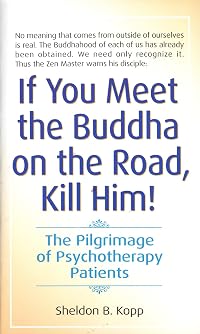
No meaning that comes from outside of ourselves is real. The Buddhahood of each of us has already been obtained. We need only recognize it. Thus the Zen Master warns his disciple: If you meet the Buddha on the road, Kill him!
"The most important things that each man must learn no one else can teach him. Once he accepts this disappointment, he will be able to stop depending on the therapist, the guru who turns out to be just another struggling human being".
Using the myths of Gilgamesh, Siddhartha, The Wife of Bath, Don Quixote... the works of Buber, Ginsberg, Shakespeare, Kafka, Nin, Dante and Jung ... a brilliant psychotherapist, guru and pilgrim shares the epic tales and intimate revelations that help to shape Everyman's journey through show more life. show less
"The most important things that each man must learn no one else can teach him. Once he accepts this disappointment, he will be able to stop depending on the therapist, the guru who turns out to be just another struggling human being".
Using the myths of Gilgamesh, Siddhartha, The Wife of Bath, Don Quixote... the works of Buber, Ginsberg, Shakespeare, Kafka, Nin, Dante and Jung ... a brilliant psychotherapist, guru and pilgrim shares the epic tales and intimate revelations that help to shape Everyman's journey through show more life. show less
Members
- Recently Added By
Author Information

20 Works 1,439 Members
Series
Belongs to Publisher Series
Common Knowledge
- Canonical title
- If You Meet the Buddha on the Road, Kill Him! The Pilgrimage of Psychotherapy Patients
- Original title
- If You Meet the Buddha on the Road, Kill Him! The Pilgrimage of Psychotherapy Patients
- Original publication date
- 1972
- Dedication
- For me dead parents,whom I often miss:
My Mother whose strength and ferocity nurtured me, almost did me in, and taught me how to survive.
And my Father whose gentleness and passivity showed me ho... (show all)w to love, let me down often, and freed me to find my own way.
Classifications
- Genres
- Nonfiction, General Nonfiction, Religion & Spirituality, Philosophy
- DDC/MDS
- 181 — Philosophy & psychology Ancient, medieval & eastern philosophy Eastern philosophy
- LCC
- RC480 .K66 — Medicine Internal medicine Internal medicine Neurosciences. Biological psychiatry. Neuropsychiatry Psychiatry Therapeutics. Psychotherapy
- BISAC
Statistics
- Members
- 926
- Popularity
- 28,999
- Reviews
- 7
- Rating
- (3.86)
- Languages
- English, Finnish, German, Italian
- Media
- Paper, Audiobook, Ebook
- ISBNs
- 19
- ASINs
- 12