
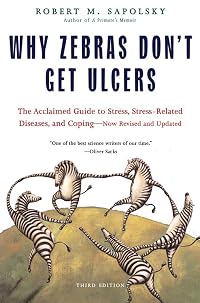
Why Zebras Dont Get Ulcers: A Guide to Stress, Stress-Related Diseases, and Coping
by Robert M. Sapolsky
On This Page
Description
Now in a third edition, Robert M. Sapolsky's acclaimed and successful Why Zebras Don't Get Ulcers features new chapters on how stress affects sleep and addiction, as well as new insights into anxiety and personality disorder and the impact of spirituality on managing stress. As Sapolsky explains, most of us do not lie awake at night worrying about whether we have leprosy or malaria. Instead, the diseases we fear-and the ones that plague us now-are illnesses brought on by the slow show more accumulation of damage, such as heart disease and cancer. When we worry or experience stress, our body turns on the same physiological responses that an animal's does, but we do not resolve conflict in the same way-through fighting or fleeing. Over time, this activation of a stress response makes us literally sick. Combining cutting-edge research with a healthy dose of good humor and practical advice, Why Zebras Don't Get Ulcers explains how prolonged stress causes or intensifies a range of physical and mental afflictions, including depression, ulcers, colitis, heart disease, and more. It also provides essential guidance to controlling our stress responses. This new edition promises to be the most comprehensive and engaging one yet. show lessTags
Recommendations












































Member Recommendations

Member Reviews
When people burdened with stress start to feel bad physically, it is not just in their minds. Emotional crises bring on specific physical changes in the body. If those stress responses are prolonged or set in motion too often, the resulting wear and tear can lead to digestive and sleeping problems, heart disease, cerebrovascular diseases, reproductive disorders and other illnesses. "Why Zebras Don't Get Ulcers" is Robert Sapolsky's look at the interconnections between emotion and physical well-being. Drawing on the latest research, Sapolsky describes the physical toll associated with emotional turmoil. He also discusses some proven effective ways of learning to moderate the body's responses to stress. This book's balance of biology and show more psychology, and research-supported suggestions for coping, should make it a helpful guidebook for people worried about worrying themselves sick. show less
Glucocorticoids, produced by different stresses, do bad things to you over time. And it's a positive feedback: glucocorticoids makes you produce more when you're stressed. And, sadly, being stressed as child permanently increases your glucocorticorticoids.
l’ho trovato troppo prolisso e ripetitivo. la parte più interessante è dove descrive come lo stress produce degli ormoni, cortisolidi, che generano diversi problemi a sistema circolatorio, digestivo, neurologico. le modalità suggerite per gestire lo stress non vanno oltre il normale buonsenso.
Dec 8, 2025Italian
Ratings
Members
- Recently Added By
Author Information

Robert M. Sapolsky is a Professor of Biology & Neurology at Stanford & a Research Associate with the Institute of Primate Research, National Museums of Kenya. He is the author of "The Trouble with Testosterone" & "Why Zebras Don't Get Ulcers", both Los Angeles Times Book Award finalists. A regular contributor to Discover & The Sciences & a show more recipient of a MacArthur Foundation genius grant, Sapolsky lives in San Francisco, California. (Bowker Author Biography) show less
Awards and Honors
Awards
Notable Lists
Work Relationships
Common Knowledge
- Canonical title
- Why Zebras Dont Get Ulcers: A Guide to Stress, Stress-Related Diseases, and Coping
- Original publication date
- 1994
- Dedication
- For Lisa, my best friend, who has made my life complete
- First words
- It's two o'clock in the morning and you're lying in bed.
Classifications
Statistics
- Members
- 134
- Popularity
- 243,206
- Reviews
- 3
- Rating
- (3.80)
- Languages
- 7 — Dutch, English, Italian, Polish, Russian, Swedish, Turkish
- Media
- Paper, Audiobook, Ebook
- ISBNs
- 14
- UPCs
- 1
- ASINs
- 4