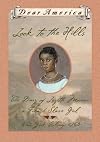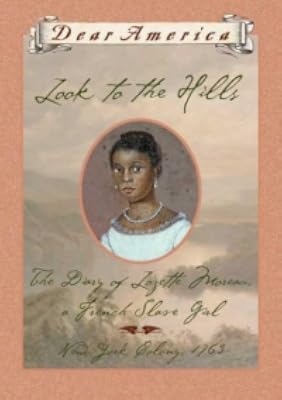
Look to the Hills: The Diary of Lozette Moreau, a French Slave Girl, New York Colony, 1763
by Patricia C. Mckissack
Dear America Collections (Dear America: Colonial Times, 1763), Dear America (1763. Colonial Times: New York Colony), Dear America - Publication Order (34), My Story
On This Page
Description
Brought up in France as the African slave companion of a nobleman's daughter, thirteen-year-old Zettie records the events of 1763, when she and her mistress escape to the New World where they are inadvertently drawn into the hostilities of the ongoing French and Indian War and, eventually, find a new direction to their lives.Tags
Recommendations

Member Reviews
Part of the Dear America series, Look to the Hills: The Diary of Lozette Moreau, a French Slave Girl (New York Colony, 1763) is written at a child's level, but full of the scholarship that author Patricia C. McKissack brings to her work. This story follows Lozette (Zettie), born on a slave ship as her mother dies, to a brief stay at a convent, then being sold as a companion to a young girl in France, where she lives on friendly terms with her mistress, Marie-Louise Boyer (Ree). Ree's oldest brother joins the military and is presumed dead in America, which news precipitates her father's death. Her next brother then squanders the family fortunes and sells everything to stay out of debtor's prison. Ree escapes with Zettie to America.
There show more is a good history and geography lesson here about Cape Breton Island, the great lakes, the New York wilderness, and Indian relations with the different Europeans. A “Historical Notes” section at the end, shows pictures of maps, slave ships, and the real persons depicted in this story.
A sample: That need to be free is a force that draws people to this land. It goes beyond being French, English, Dutch, Spanish, man, woman, rich, poor, slave, or free. I can feel the energy of that yearning all around me in the colonists, the trappers, the soldiers.
Very nicely done. 3.6 stars show less
There show more is a good history and geography lesson here about Cape Breton Island, the great lakes, the New York wilderness, and Indian relations with the different Europeans. A “Historical Notes” section at the end, shows pictures of maps, slave ships, and the real persons depicted in this story.
A sample: That need to be free is a force that draws people to this land. It goes beyond being French, English, Dutch, Spanish, man, woman, rich, poor, slave, or free. I can feel the energy of that yearning all around me in the colonists, the trappers, the soldiers.
Very nicely done. 3.6 stars show less
Children's fiction; historical. This diary follows the travels and thoughts of a French girl's companion slave; Lozette and her "owner" Marie-Louise escape the clutches of M.'s would-be husband and embark on an adventure (or at least a very long journey) that will end with them finding M's brother (a captive of the English during the French and Indian war), M. getting married to someone she actually likes, and L. being granted her freedom. I read the first 50 pages or so then started skimming, then gave up. The writing is somewhat decent but the characters/plot need more development.
Twelve-year-old Lozette Moreau, called Zettie, has lived all her life since she was a baby in the French countryside as the companion to Marie-Louise Boyer, called Ree, daughter of a wealthy nobleman. Although she is still considered a slave, as Ree's companion she is treated well, able to read and write, and to speak French, Spanish, and English. But when Ree's father dies and her brother Pierre inherits everything, he loses the family fortune with his bad decisions. Now he is going to sell Zettie, and force Ree into marriage to a man she despises. Then Ree learns that her other brother Jacques, presumed dead in the war with the English, may be alive, and living with Indians in the Colonies. Ree and Zettie escape to Spain and then show more travel across the ocean to the New World, where they end up living at Fort Niagara. In her diary, Lozette describes their journey, their experiences at Fort Niagara at the end of the French and Indian War, and her own longing to be considered free.
I highly recommend this new book to all readers who love the Dear America series. I especially love Colonial American settings and I liked reading a different type of slavery story. Zettie was well treated but still longed to be a free person. It's a very unique book sure to be enjoyed by historical fiction fans. show less
I highly recommend this new book to all readers who love the Dear America series. I especially love Colonial American settings and I liked reading a different type of slavery story. Zettie was well treated but still longed to be a free person. It's a very unique book sure to be enjoyed by historical fiction fans. show less
"Freedom is the source of our happiness."
"Look to the Hills. The Diary of Lozette Moreau, a French Slave Girl," tells of the year in the life of French Slave (Companion) who transported from the one home she has ever known to a new world toward the end of the French and Indian War. There Zettie (nicname everyone called her) is faced with new landscapes, new people, and new laws especially those governing slavery. Being a companion (a fancy word for slave) had it's advantages such as being taught how to read and write. (Companions were often hired to look after the daughters of Aristocrats until marriage of said daughter.) Zettie tells of being sold & transported from person to person like property. At one point she brought like show more property by British soliders and from there need to consider if her loyalty lie with the British who fought along side the Indians or the French, where she was a citizen of. show less
"Look to the Hills. The Diary of Lozette Moreau, a French Slave Girl," tells of the year in the life of French Slave (Companion) who transported from the one home she has ever known to a new world toward the end of the French and Indian War. There Zettie (nicname everyone called her) is faced with new landscapes, new people, and new laws especially those governing slavery. Being a companion (a fancy word for slave) had it's advantages such as being taught how to read and write. (Companions were often hired to look after the daughters of Aristocrats until marriage of said daughter.) Zettie tells of being sold & transported from person to person like property. At one point she brought like show more property by British soliders and from there need to consider if her loyalty lie with the British who fought along side the Indians or the French, where she was a citizen of. show less
"Freedom is the source of our happiness."
"Look to the Hills. The Diary of Lozette Moreau, a French Slave Girl," tells of the year in the life of French Slave (Companion) who transported from the one home she has ever known to a new world toward the end of the French and Indian War. There Zettie (nicname everyone called her) is faced with new landscapes, new people, and new laws especially those governing slavery. Being a companion (a fancy word for slave) had it's advantages such as being taught how to read and write. (Companions were often hired to look after the daughters of Aristocrats until marriage of said daughter.) Zettie tells of being sold & transported from person to person like property. At one point she brought like show more property by British soliders and from there need to consider if her loyalty lie with the British who fought along side the Indians or the French, where she was a citizen of. show less
"Look to the Hills. The Diary of Lozette Moreau, a French Slave Girl," tells of the year in the life of French Slave (Companion) who transported from the one home she has ever known to a new world toward the end of the French and Indian War. There Zettie (nicname everyone called her) is faced with new landscapes, new people, and new laws especially those governing slavery. Being a companion (a fancy word for slave) had it's advantages such as being taught how to read and write. (Companions were often hired to look after the daughters of Aristocrats until marriage of said daughter.) Zettie tells of being sold & transported from person to person like property. At one point she brought like show more property by British soliders and from there need to consider if her loyalty lie with the British who fought along side the Indians or the French, where she was a citizen of. show less
This entire series is a wonderful way to learn history or teach it to adolescents. I find today's generations seem to recall more when they learn through other people (pop songs, celebrity gossip, etc.), so what better way to teach history than through someone else's perspective? Yes, "authentic" diaries would be "better", but would the language really hold the modern student's attention? Did the diary writer know what WOULD be important in the context of history? Probably not.
This book offers a different perspective on slavery- it compares slavery in America to that in France. Though slavery in France is less cruel, the main character, Lozette, makes it clear that being free is important, regardless of the conditions. I found the story interesting and the character relateable.
Members
- Recently Added By
Lists

Learning history through first-person, young adult, historical fiction one
188 works; 4 members
Author Information

150+ Works 26,810 Members
Patricia C. McKissack was born in Smyrna, Tennessee on August 9, 1944. She received a bachelor's degree in English from Tennessee State University in 1964 and a master's degree in early childhood literature and media programming from Webster University in 1975. After college, she worked as a junior high school English teacher and a children's book show more editor at Concordia Publishing. Since the 1980's, she and her husband Frederick L. McKissack have written over 100 books together. Most of their titles are biographies with a strong focus on African-American themes for young readers. Their early 1990s biography series, Great African Americans included volumes on Frederick Douglass, Marian Anderson, and Paul Robeson. Their other works included Black Hands, White Sails: The Story of African-American Whalers and Days of Jubilee: The End of Slavery in the United States. Over their 30 years of writing together, the couple won many awards including the C.S. Lewis Silver Medal, a Newbery Honor, nine Coretta Scott King Author and Honor awards, the Jane Addams Peace Award, and the NAACP Image Award for Sojourner Truth: Ain't I a Woman?. In 1998, they received the Coretta Scott King-Virginia Hamilton Award for Lifetime Achievement. She also writes fiction on her own. Her book included Flossie and the Fox, Stitchin' and Pullin': A Gee's Bend Quilt, A Friendship for Today, and Let's Clap, Jump, Sing and Shout; Dance, Spin and Turn It Out! She won the Newberry Honor Book Award and the King Author Award for The Dark Thirty: Southern Tales of the Supernatural in 1993 and the Caldecott Medal for Mirandy and Brother Wind. She dead of cardio-respiratory arrest on April 7, 2017 at the age of 72. (Bowker Author Biography) show less
Series


Common Knowledge
- Canonical title
- Look to the Hills: The Diary of Lozette Moreau, a French Slave Girl, New York Colony, 1763
- Original title
- Look to the Hills: The Diary of Lozette Moreau, a French Slave Girl, New York Colony, 1763
- Original publication date
- 2004-04
- People/Characters
- Lozette Moreau
- Important places
- New York, New York, USA; New York, USA
- Important events
- French and Indian War; Seven Years' War
Classifications
Statistics
- Members
- 388
- Popularity
- 80,861
- Reviews
- 9
- Rating
- (3.66)
- Languages
- English
- Media
- Paper
- ISBNs
- 3