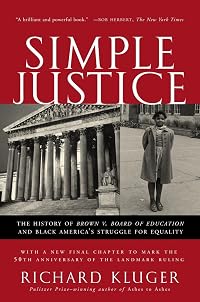
Simple Justice
by Richard Kluger
On This Page
Description
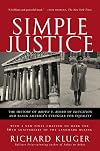
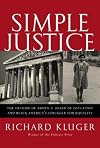
Simple Justice is the definitive history of the landmark case Brown v. Board of Education and the epic struggle for racial equality in this country. Combining intensive research with original interviews with surviving participants, Richard Kluger provides the fullest possible view of the human and legal drama in the years before 1954, the cumulative assaults on the white power structure that defended segregation, and the step-by-step establishment of a team of inspired black lawyers that show more could successfully challenge the law. Now, on the fiftieth anniversary of the unanimous Supreme Court decision that ended legal segregation, Kluger has updated his work with a new final chapter covering events and issues that have arisen since the book was first published, including developments in civil rights and recent cases involving affirmative action, which rose directly out of Brown v. Board of Education. show lessTags
Recommendations




Member Reviews
Quite possibly the single best history book I've yet read. Incredible in its scope, impossibly detailed - never a light read but I always wanted to read it. I found Kluger's style refreshing - not that it was biased, it seemed merely to address the absurdity of Jim Crow and the systematic, ongoing denial of rights. The final decision, unfolding in gripping, almost novelistic fashion in seeming real time, was one of the most fascinating parts.
Eminently readable account of the history of Brown v. Board of Education, the Supreme Court decision that held that "separate but equal" facilities are inherently unequal, and banned segregation.
"Here is the human drama . . . of the many plaintiffs. . . who made the hard decision to proceed. . . Here, too, is the extraordinary tale . . . of the black legal establishment, forced literally to invent itself before it could join the fight. . ."
It was clear from the start that this decision could not be a close vote, if it was to be supportable. Kluger's analysis of how Chief Justice Warren achieved what many thought impossible - a unanimous decision - is absolutely fascinating.
"Here is the human drama . . . of the many plaintiffs. . . who made the hard decision to proceed. . . Here, too, is the extraordinary tale . . . of the black legal establishment, forced literally to invent itself before it could join the fight. . ."
It was clear from the start that this decision could not be a close vote, if it was to be supportable. Kluger's analysis of how Chief Justice Warren achieved what many thought impossible - a unanimous decision - is absolutely fascinating.
3636. Simple Justice: The History of Brown v. Board of Education and Black America's Struggle for Equality, by Richard Kluger (read 12 Oct 2002) This is a 1976 book which tells the story of all five school desegregation cases from their beginning to the eventual triumph in the Supreme Court. It is a fascinating story, extremely well-told and holding one's interest thru every one of its 822 pages. The case has always been a great interest of mine, I remembering well how and where I first heard of the Supreme Court decision on May 17, 1954, and the enthusiasm I felt on the momentous victory for justice which it was. This book is easily the best I read this month.
Simple Justice is the story of the battle to desegregate U.S. schools culminating in the epoch ruling by the Supreme Court in Brown v. Board of Education in 1954. The author traces the entire background of this ruling from its remote legal and cultural roots to the complex of personalities of those involved in making it. The result is a landmark work of popular history, graceful and fascinatingly detailed, the panoramic account of a struggle for human dignity in process since the birth of the nation. - from book jacket
Separate but equal was never equal.
Supreme Court decision upheld Jim Crow laws and the Federal govt. abided by Jim Crow laws in their own employment, cafeteria, offices, etc.
The Garland Fund (Charles Garland's inheritance that he set up as a trust, living as a farmer himself) provided money to attack segregation. The Margold Plan proposed not to dispute the legality of segregation, but to sue institutions and/or states for not providing equal education as per segregation laws. Attack graduate schools first, as states can't afford to provide dual grad programs.
Brown vs. Bd. of Ed. attacked segregation per se. 1954, the Supreme Court, headed by Chief Justice Earl Warren, decided unanimously that segregation per se is unequal. But they show more decided to move slowly to do away with it -- a mistake. Quick action would have resulted in less friction. show less
Supreme Court decision upheld Jim Crow laws and the Federal govt. abided by Jim Crow laws in their own employment, cafeteria, offices, etc.
The Garland Fund (Charles Garland's inheritance that he set up as a trust, living as a farmer himself) provided money to attack segregation. The Margold Plan proposed not to dispute the legality of segregation, but to sue institutions and/or states for not providing equal education as per segregation laws. Attack graduate schools first, as states can't afford to provide dual grad programs.
Brown vs. Bd. of Ed. attacked segregation per se. 1954, the Supreme Court, headed by Chief Justice Earl Warren, decided unanimously that segregation per se is unequal. But they show more decided to move slowly to do away with it -- a mistake. Quick action would have resulted in less friction. show less
Ratings
Members
- Recently Added By
Lists

LT picks: Blue Books
197 works; 44 members

r/AskHistorians' Recommended Books
1,068 works; 18 members
Author Information

14+ Works 1,449 Members
Awards and Honors
Awards
Notable Lists
Series
Belongs to Publisher Series
Common Knowledge
- Canonical title
- Simple Justice
- Original publication date
- 1976
- Important events
- Brown v. Board of Education (1954)
- Epigraph
- ... we are of the humble opinion that we have the right to enjoy the privileges of free men. But that we do not will appear in many instances, and we beg leave to mention one out of many, and that is the education of out chil... (show all)dren which now receive no benefit from the free schools in the town of Boston, which we think is a great grievance, as by woeful experience we now feel the of a common education. We, therefore, must fear for our rising offspring to see them in ignorance in a land of gospel light when there is provision made for them as well as others and yet can't enjoy them, and for not other reason can be given this they are black...
We therfore pray your Honors that you would in your wisdom some provision be made for the free education of our dear children. And in duty bound shall ever pray. --FROM A PETITION TO THE STATE LEGISLATURE OF THE COMMONWEALTH OF MASSACHUSETTS BAY, 1787 - Dedication
- FOR MATTHEW AND TEDDY AND MINA'S GIRLS
- Canonical DDC/MDS
- 344.730798
- Canonical LCC
- KF4155
Classifications
- Genres
- Politics and Government, Nonfiction, History, General Nonfiction
- DDC/MDS
- 344.730798 — Society, government, & culture Law Labor, social service, education, cultural law North America [Option B: Law > Eastern Europe Russia]
- LCC
- KF4155 — Law Law of the United States Law of the United States (Federal) Education
- BISAC
Statistics
- Members
- 469
- Popularity
- 64,768
- Reviews
- 5
- Rating
- (4.57)
- Languages
- English
- Media
- Paper, Ebook
- ISBNs
- 8
- ASINs
- 12