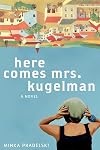
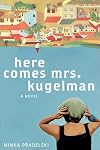
Here Comes Mrs. Kugelman: A Novel
by Minka Pradelski
On This Page
Description
When feisty young Tsippy Silberberg of the curious eating habits receives word from Tel Aviv that a distant aunt has left her a mysterious inheritance-an incomplete fish service in a battered brown suitcase-she decides to break her rigid routine and go collect it in person. But before she is even able to settle into her hotel room, an odd old woman bangs on her door and invites herself in. Her name is Bella Kugelman, and she is determined to talk. And talk she does.Tags
Recommendations







Member Reviews
Young Tsippy Silberberg is more than a little surprised when her aunt in Tel Aviv passes away and leaves her an inheritance. When she arrives to claim it, she's even more puzzled that it consists of an incomplete fish service in a suitcase. As she sits in her beach-side hotel room trying to puzzle out the meaning of having silverware to serve something she refuses to even eat, her journey gets even stranger with a knock on the door. Behind that knock is Mrs. Bella Kugelman, a Holocaust survivor like Tsippy's parents, who is determined to keep her hometown in Poland alive through stories that she insists on telling to Tsippy and anyone else who will listen. Much to her surprise, it's this odd and persistent woman and her stories that show more will help Tsippy unearth the meaning behind her aunt's bizarre bequest.
To get to the heart of things, Here Comes Mrs. Kugelman is kind of a weird book. Tsippy is a bizarre narrator prone to flights of fancy and impulsiveness that hardly make sense. Her bizarre diet centers on frozen vegetables for reasons that aren't entirely clear. The whole premise of an aged survivor materializing in her hotel room every day to tell stories of the old country regardless of whether Tsippy wants to hear them or not requires a healthy dose of suspension of disbelief. It's easy to see why Mrs. Kugelman is probably not a book that everyone is going to like. That said, I liked it quite a lot indeed.
Despite her oddities, Tsippy is an interesting character who has grown up in the shadow of her parents' silence over the terrible events of the Holocaust they survived. Her bizarre eating habits seemed to be grounded in a desperate need to get her emotionally repressed parents to say anything even if it was just to scold her for her increasingly bizarre behavior. I came to terms with odd Tsippy Silberberg as the story's primary narrator, but what I really loved were the stories Mrs. Kugelman came to tell Tsippy. Determined to keep her Polish town of Bedzin and its denizens alive long after the Holocaust destroyed it, Mrs. Kugelman is happy to tell anyone who will listen the stories of her childhood and the many characters that populated it. Her stories both satisfy Tsippy's hunger for some sense of her past and draw readers into the lives of mischievous kids, extremely religious adults, lovers, scam artists, businessmen, bakers and grocers and porters who populate an above-average small town that stood on the precipice of its own destruction and never knew.
Mrs. Kugelman's stories call to mind the sort of small-time legends that populate any town or even any one family, and Pradelski's choice to focus on the life of the town in its glory days before the horrors of the Holocaust came calling is a refreshing departure. Minka Pradelski is a sociologist who has spent considerable time exploring the psychological effects of the Holocaust on survivors, and her depiction of the very willful disconnect Tsippy's guilt-ridden father has made between the painful past and the promising future he hopes for his daughter definitely seems to spring from that knowledge. However, as Tsippy and Mrs. Kugelman's tale shows us, it might just be that the very stories survivors avoid are the ones that stand to heal a new generation. Here Comes Mrs. Kugelman is unexpectedly touching novel that shows the value of knowing our past even as we plunge into the uncertain future, and one that I would highly recommend if you don't mind reading a book that's just a bit outside the box. show less
To get to the heart of things, Here Comes Mrs. Kugelman is kind of a weird book. Tsippy is a bizarre narrator prone to flights of fancy and impulsiveness that hardly make sense. Her bizarre diet centers on frozen vegetables for reasons that aren't entirely clear. The whole premise of an aged survivor materializing in her hotel room every day to tell stories of the old country regardless of whether Tsippy wants to hear them or not requires a healthy dose of suspension of disbelief. It's easy to see why Mrs. Kugelman is probably not a book that everyone is going to like. That said, I liked it quite a lot indeed.
Despite her oddities, Tsippy is an interesting character who has grown up in the shadow of her parents' silence over the terrible events of the Holocaust they survived. Her bizarre eating habits seemed to be grounded in a desperate need to get her emotionally repressed parents to say anything even if it was just to scold her for her increasingly bizarre behavior. I came to terms with odd Tsippy Silberberg as the story's primary narrator, but what I really loved were the stories Mrs. Kugelman came to tell Tsippy. Determined to keep her Polish town of Bedzin and its denizens alive long after the Holocaust destroyed it, Mrs. Kugelman is happy to tell anyone who will listen the stories of her childhood and the many characters that populated it. Her stories both satisfy Tsippy's hunger for some sense of her past and draw readers into the lives of mischievous kids, extremely religious adults, lovers, scam artists, businessmen, bakers and grocers and porters who populate an above-average small town that stood on the precipice of its own destruction and never knew.
Mrs. Kugelman's stories call to mind the sort of small-time legends that populate any town or even any one family, and Pradelski's choice to focus on the life of the town in its glory days before the horrors of the Holocaust came calling is a refreshing departure. Minka Pradelski is a sociologist who has spent considerable time exploring the psychological effects of the Holocaust on survivors, and her depiction of the very willful disconnect Tsippy's guilt-ridden father has made between the painful past and the promising future he hopes for his daughter definitely seems to spring from that knowledge. However, as Tsippy and Mrs. Kugelman's tale shows us, it might just be that the very stories survivors avoid are the ones that stand to heal a new generation. Here Comes Mrs. Kugelman is unexpectedly touching novel that shows the value of knowing our past even as we plunge into the uncertain future, and one that I would highly recommend if you don't mind reading a book that's just a bit outside the box. show less
Here Comes Mrs. Kugelman turns out to be a very touching, emotional story, so my advice to potential readers is: don’t give up. This novel is very slow to start and introduces the main characters with all their quirks, holding nothing back. Tsippy Silberberg, the unrealistic drama queen - she enjoys late night freezer raids in which she gorges herself on ice and frozen vegetables - is the protagonist and narrator. She is prone to dramatic episodes and seems to live in her own imaginary world, but she doesn’t let it stop her from flying to Tel Aviv to accept an inheritance from her recently deceased aunt. Little does she know, events will lead her to discover her past, her history, and more about who she is as a person once she meets show more Mrs. Kugelman. Mrs. Kugelman is, to say the least, annoying. She barges into hotel rooms to tell her story and dislikes being interrupted. But in the end, it is impossible not to be drawn to these quirky characters; they become so enamored with each other that they seem like family.
Here Comes Mrs. Kugelman is, above all, about the power of story-telling. Bella Kugelman, who survived World War II in Poland as a Jew, spends her days telling stories to anyone who will listen (and more often than not, even people who don’t want to listen). She recalls with vivid memories her life growing up in the small town of Bedzin. She tells stories of her own experiences as well as those of her friends and classmates, and soon the town really does come alive, both for Tsippy and for the reader. As the story progresses it becomes apparent that Mrs. Kugelman’s life goal is to make sure her town, her friends, and everyone else who perished during the War are remembered, through her stories.
This novel is a story within a story and everything connects in the end through these two outrageous, spirited women. An enjoyable read, it will leave you thinking long after you’ve turned the last page about how your own life will be remembered and what the future holds when every day seems unbearably normal. show less
Here Comes Mrs. Kugelman is, above all, about the power of story-telling. Bella Kugelman, who survived World War II in Poland as a Jew, spends her days telling stories to anyone who will listen (and more often than not, even people who don’t want to listen). She recalls with vivid memories her life growing up in the small town of Bedzin. She tells stories of her own experiences as well as those of her friends and classmates, and soon the town really does come alive, both for Tsippy and for the reader. As the story progresses it becomes apparent that Mrs. Kugelman’s life goal is to make sure her town, her friends, and everyone else who perished during the War are remembered, through her stories.
This novel is a story within a story and everything connects in the end through these two outrageous, spirited women. An enjoyable read, it will leave you thinking long after you’ve turned the last page about how your own life will be remembered and what the future holds when every day seems unbearably normal. show less
 This review was written for LibraryThing Early Reviewers.
Something must have been lost in translation in this book. The protagonist, usually supposed to ground us to the story--and certainly to the present in a book that's half set in the past--fell short. Her odd eating habits were frequently mentioned by insufficiently explained. I find it difficult to believe that a psychologist wrote the book, as I felt only the remotest connection to the characters, despite the requisite Holocaust horrors thrown in at the end, almost like an afterthought. In short, it's a tale that's been told before and evokes more sympathy than empathy.
This review was written for LibraryThing Early Reviewers.Mrs. Kugelman delivers a quirky, endearing journey from Israel to pre-wartime Poland. Tsippy Silberberg travels from Germany to Israel to pick up a seemingly inconsequential inheritance from a distant Aunt. But the incomplete silver fish service she collects is only the first thing she gains in Israel. An odd old woman, Mrs. Kugelman, forces herself into Tsippy's hotel room and returns day after day to recount tales of her childhood town, Bedzen, Poland, upon an initially reluctant and annoyed Tsippy. But Mrs. Kugelman's stories prove to be so compelling that Tsippy becomes wrapped up in the experience of the small town's Jewish residents as World War II approaches. Author Pradelski focuses on the town and the townspeople of Bedzen and show more their day to day lives with gentle humor. The humanity of the town is the focus rather than the inhumanity of Hitler's approaching forces.
After getting used to its quirkiness- Tsippy's strange habits and Mrs. Kugelman's prickly demeanor- I loved this book. show less
After getting used to its quirkiness- Tsippy's strange habits and Mrs. Kugelman's prickly demeanor- I loved this book. show less
This review was written for LibraryThing Early Reviewers.I'm a big believer in the the value of stories. I treasure the ones I learned from elders in my family, true or not. For the thing about stories is that the truth can slip as time and memory blur the edges of a tale. But a gifted storyteller is a treasure for the ability to craft images, characters, and situations for their audience.
In this novel, the storyteller is Mrs. Kugelman. She enters the world of the narrator, a young woman named Tsippy Silberberg, in a rather haphazard way. Tsippy, who has some rather peculiar quirks of her own with her eating habits, is in Tel Aviv to pick up an inheritance left to her by her father's sister. Bella Kugelman enters Tsippy's life with a knock on the door, and a story to tell. Through her words, show more the inhabitants of Bedzin, a small, predominantly Jewish, Polish village on the border with Germany, come to life again. She tells of day to day life, before the war, before the invasion, before the Holocaust. It's a time when children played pranks in school (or were even still in school, since those were closed almost immediately when things got bad), when people went to the rebbe for blessings before new ventures, when families sent their cholent to the baker on Friday, so it could cook in the oven all day on the Sabbath, and they would not be working to do so. Mrs K's tales take the reader right up through the start of the end of a way of life, painting a vivid picture of what was lost, both in lives and lifestyle.
The stories charmed me, especially since some of my own family probably lived a similar life. The bits in between didn't carry the same type of interest for me, and oddly enough, either did the two main characters. The subplot of the relationship of Mrs Kugelman's stories to Tsippy's own life was a nice touch, but lacked the clarity of the mini-plots about the villagers of Bedzin. Indeed, just as kugel is often a side dish to a holiday table, Mrs Kugelman was more of a side character to the people she talked about.
I'm told the author is both a sociologist and documentary filmmaker and that her own parents were Holocaust survivors. Her interest in these survivors, their families, and the impact of horrors that occurred in that awful time, helped round this book out in a realistic way. This is her first novel. I look forward to reading more of her works in the future.
Thank you to LibraryThing Early Reviewers and to the publisher for sending me this copy of the book. show less
In this novel, the storyteller is Mrs. Kugelman. She enters the world of the narrator, a young woman named Tsippy Silberberg, in a rather haphazard way. Tsippy, who has some rather peculiar quirks of her own with her eating habits, is in Tel Aviv to pick up an inheritance left to her by her father's sister. Bella Kugelman enters Tsippy's life with a knock on the door, and a story to tell. Through her words, show more the inhabitants of Bedzin, a small, predominantly Jewish, Polish village on the border with Germany, come to life again. She tells of day to day life, before the war, before the invasion, before the Holocaust. It's a time when children played pranks in school (or were even still in school, since those were closed almost immediately when things got bad), when people went to the rebbe for blessings before new ventures, when families sent their cholent to the baker on Friday, so it could cook in the oven all day on the Sabbath, and they would not be working to do so. Mrs K's tales take the reader right up through the start of the end of a way of life, painting a vivid picture of what was lost, both in lives and lifestyle.
The stories charmed me, especially since some of my own family probably lived a similar life. The bits in between didn't carry the same type of interest for me, and oddly enough, either did the two main characters. The subplot of the relationship of Mrs Kugelman's stories to Tsippy's own life was a nice touch, but lacked the clarity of the mini-plots about the villagers of Bedzin. Indeed, just as kugel is often a side dish to a holiday table, Mrs Kugelman was more of a side character to the people she talked about.
I'm told the author is both a sociologist and documentary filmmaker and that her own parents were Holocaust survivors. Her interest in these survivors, their families, and the impact of horrors that occurred in that awful time, helped round this book out in a realistic way. This is her first novel. I look forward to reading more of her works in the future.
Thank you to LibraryThing Early Reviewers and to the publisher for sending me this copy of the book. show less
This review was written for LibraryThing Early Reviewers.I never thought I would call a book about the Holocaust delightful, but this book really is delightful. It is as much about psychology and what we do to protect ourselves and our children as it is about how memory works and the importance of storytelling (particularly family stories). A magical story.
This review was written for LibraryThing Early Reviewers.As other reviewers have noted, I found the two main characters of this book, Mrs. Kugelman and Tsippy, much less compelling than Mrs. Kugelman's story of life in her Polish village in the years leading up to World War II. Tsippy and Mrs. Kugelman were obviously vehicles for the story of the villagers but they didn't interest me, despite the author's attempt to invest them with personality and quirks. Fortunately, they were a minor part of the novel as a whole,which was both an evocation of a bygone era and an exploration of the roots of the Holocaust.
This review was written for LibraryThing Early Reviewers.Members
- Recently Added By
Lists

Top Five Books of 2014
1,064 works; 398 members
Author Information

3 Works 93 Members
Some Editions
Series
Belongs to Publisher Series
btb (73619)
Work Relationships
Common Knowledge
- Canonical title*
- Und da kam Frau Kugelmann
- Original title
- Und da kam Frau Kugelmann
- Original publication date
- 2005
- People/Characters*
- Zippy Silberberg; Bella Kugelmann
- Important places
- Tel Aviv, Israel
- First words*
- Einen Monat nach dem Tod meiner Tante, genauer gesagt, drei Stunden nach der Testamentseröffnung, informierten mich meine Verwandten über Halinas Ableben.
*Some information comes from Common Knowledge in other languages. Click "Edit" for more information.
Classifications
- Genres
- Fiction and Literature, General Fiction, Historical Fiction
- DDC/MDS
- 833.92 — Literature & rhetoric German & related literatures German fiction 1900- 1990-
- LCC
- PT2676 .R265 .U5313 — Language and Literature German, Dutch and Scandinavian literatures German literature Individual authors or works 1961-2000
- BISAC
Statistics
- Members
- 84
- Popularity
- 380,966
- Reviews
- 16
- Rating
- (3.52)
- Languages
- Dutch, English, German, Italian
- Media
- Paper, Ebook
- ISBNs
- 9
- ASINs
- 2