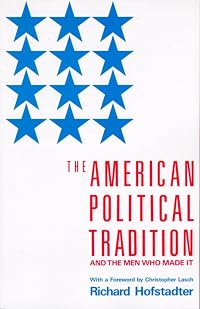
The American Political Tradition and the Men Who Made it
by Richard Hofstadter
On This Page
Description
The classic study of American politics from the Founding Fathers to FDR.Tags
Recommendations










Member Reviews
Rereading this book after 30 years, I was amazed how well it holds up after 60 years (it was first published in 1948 and it's still in print). It's a work of interpretation, rather than narrative history, and assumes a knowledge of the broad sweep of American history. Hofstadter tells his story through the lives, thought and activities of key political leaders of the past 200 years. He's not afraid to take (still) controversial stands, many of which have been challenged by other scholars. But it's a measure of the book's staying power that, even today, if you're going to write about Jefferson, Jackson, Roosevelt (both), Wilson, you're still obliged to address Hofstadter's analysis of these men and their policies.
Many of his insights show more into the character, ideas, and significance of American political icons still impress (me, at least):
On Jefferson's differences with the drafters of the Constitution: "While his friends at home were watching the failure of the Articles of Confederation, looking anxiously upon the political advances of the dirt farmers, and turning rightward in their politics, he was touring Europe, taking the measure of feudal and monarchical institutions, observing the bitter exploitation of the workers of England and the peasantry of France, and confirming his republicanism.”
On the significance of Jackson's election: “The election of 1828 was not an uprising of the West against the East nor a triumph of the frontier: outside of New England and its colonized areas in the West, Federalist Delaware, New Jersey, and Maryland, Jackson swept the country. Nor was his election a mandate for economic reform; no financial changes, no crusades against the national bank, were promised. The main themes of Jacksonian democracy thus far were militant nationalism and equal access to office. Jackson's election was more a result than a cause of the rise of democracy, and the 'revolution of 1828' more an overturn of personnel than of ideas or programs.”
On TR as a Progressive reformer: “In retrospect...it is hard to understand how Roosevelt managed to keep his reputation as a strenuous reformer. Unlike Bryan, he had no passionate interest in the humane goals of reform; unlike LaFollette, no mastery of its practical details.... Reform in his mind did not mean a thoroughgoing purgation; it was meant to heal only the most conspicuous sores on the body politic. And yet many people were willing and eager to accept his reform role at its face value.”
And his take on FDR, and comparision with Hoover, strikes some chords today (2009):
“At the heart of the New Deal there was not a philosophy but a temperament. The essence of this temperament was Roosevelt's confidence that even when he was operating in unfamiliar territory he could do no wrong, commit no serious mistakes. From the standpoint of an economic technician this assurance seemed almost mad at times.... And yet there was a kind of intuitive wisdom under the harum-scarum surface of his methods.When he came to power, the people had seen stagnation go dangerously far. They wanted experiment, activity, trial and error, anything that would convey a sense of movement and novelty...."
"Although...Roosevelt had been reared on a social and economic philosophy rather similar to Hoover's, he succeeded at once in communicating the fact that his temperament was antithetical. When Hoover bumbled that it was necessary only to restore confidence, the nation laughed bitterly. When Roosevelt said: 'The only thing we have to fear is fear itself,' essentially the same thread-bare half-true idea, the nation was thrilled. Hoover had lacked motion; Roosevelt lacked direction. But his capacity for growth, or at least for change, was enormous."
Hofstadter was among the first of the postwar historians to cross the line into "popular history," in the sense that his books made the best seller lists, but he never pandered to the popular desire for simple narratives and patriotic celebration. His analyses were always trenchant, often controversial, and invariably well-written; he could be challenged, but it took serious effort to best him. I recommend all of his works (most or perhaps all remain in print), as well as the excellent biography by David S. Brown, "Richard Hofstadter : An Intellectual Biography". show less
Many of his insights show more into the character, ideas, and significance of American political icons still impress (me, at least):
On Jefferson's differences with the drafters of the Constitution: "While his friends at home were watching the failure of the Articles of Confederation, looking anxiously upon the political advances of the dirt farmers, and turning rightward in their politics, he was touring Europe, taking the measure of feudal and monarchical institutions, observing the bitter exploitation of the workers of England and the peasantry of France, and confirming his republicanism.”
On the significance of Jackson's election: “The election of 1828 was not an uprising of the West against the East nor a triumph of the frontier: outside of New England and its colonized areas in the West, Federalist Delaware, New Jersey, and Maryland, Jackson swept the country. Nor was his election a mandate for economic reform; no financial changes, no crusades against the national bank, were promised. The main themes of Jacksonian democracy thus far were militant nationalism and equal access to office. Jackson's election was more a result than a cause of the rise of democracy, and the 'revolution of 1828' more an overturn of personnel than of ideas or programs.”
On TR as a Progressive reformer: “In retrospect...it is hard to understand how Roosevelt managed to keep his reputation as a strenuous reformer. Unlike Bryan, he had no passionate interest in the humane goals of reform; unlike LaFollette, no mastery of its practical details.... Reform in his mind did not mean a thoroughgoing purgation; it was meant to heal only the most conspicuous sores on the body politic. And yet many people were willing and eager to accept his reform role at its face value.”
And his take on FDR, and comparision with Hoover, strikes some chords today (2009):
“At the heart of the New Deal there was not a philosophy but a temperament. The essence of this temperament was Roosevelt's confidence that even when he was operating in unfamiliar territory he could do no wrong, commit no serious mistakes. From the standpoint of an economic technician this assurance seemed almost mad at times.... And yet there was a kind of intuitive wisdom under the harum-scarum surface of his methods.When he came to power, the people had seen stagnation go dangerously far. They wanted experiment, activity, trial and error, anything that would convey a sense of movement and novelty...."
"Although...Roosevelt had been reared on a social and economic philosophy rather similar to Hoover's, he succeeded at once in communicating the fact that his temperament was antithetical. When Hoover bumbled that it was necessary only to restore confidence, the nation laughed bitterly. When Roosevelt said: 'The only thing we have to fear is fear itself,' essentially the same thread-bare half-true idea, the nation was thrilled. Hoover had lacked motion; Roosevelt lacked direction. But his capacity for growth, or at least for change, was enormous."
Hofstadter was among the first of the postwar historians to cross the line into "popular history," in the sense that his books made the best seller lists, but he never pandered to the popular desire for simple narratives and patriotic celebration. His analyses were always trenchant, often controversial, and invariably well-written; he could be challenged, but it took serious effort to best him. I recommend all of his works (most or perhaps all remain in print), as well as the excellent biography by David S. Brown, "Richard Hofstadter : An Intellectual Biography". show less
Hofstadter writes very well and makes big claims, which is a pleasant change from a lot of contemporary history. The book's general thesis - that the American Political Tradition is by and large an ongoing defense of the property rights of the well-off - seems correct. The book itself lags a bit. It's odd but understandable that the worst chapters are about people who are just transparently evil and or idiots; he's at his best as a debunker (i.e., Andrew Jackson was no champion of the oppressed) and obviously doesn't much care to take yet another swipe at the Grant presidency.
The most entertaining part of this book, though, is hearing from my historian friend that Hofstadter is regarded as an arch-conservative. I know he changed some show more later on in his career, but this book would be considered an unpublishable incitement to class war these days. Meanwhile the self-professed radical professors and graduate students are writing about the Disabled Phillipino-American Bisexual Communities of Northern Montana from 1863-1864. Sometimes you just have to throw yourselves on the gears of power, right? show less
The most entertaining part of this book, though, is hearing from my historian friend that Hofstadter is regarded as an arch-conservative. I know he changed some show more later on in his career, but this book would be considered an unpublishable incitement to class war these days. Meanwhile the self-professed radical professors and graduate students are writing about the Disabled Phillipino-American Bisexual Communities of Northern Montana from 1863-1864. Sometimes you just have to throw yourselves on the gears of power, right? show less
Though it is a mid-Twentieth Century text, Hofstadter shows right off in the introduction that he has an intuitive grasp of the American mind: "Since Americans have recently found it more comfortable to see where they have been than to think of where they are going, their state of mind has become increasingly passive and spectatorial. Historical novels, fictionalized biographies, collections of pictures and cartoons, books on American regions and rivers, have poured forth to satisfy a ravenous appetite for Americana. This quest for the American past is carried on in a spirit of sentimental appreciation rather than of critical analysis. An awareness of history is always a part of any culturally alert national life; but I believe that show more what underlies this overpowering nostalgia of the past fifteen years is a keen feeling of insecurity. . . . American history, presenting itself as a rich and rewarding spectacle, a succession of well–fulfilled promises, induces a desire to observe and enjoy, not to analyze and act. The most common vision of national life, in its fondness for the panoramic backward gaze, has been that of the observation–car platform."
Long ago, Horace White observed that the Constitution of the United States "is based upon the philosophy of Hobbes and the religion of Calvin. It assumes that the natural state of mankind is a state of war, and that the carnal mind is at enmity with God." This is from one of the may epigraphs that liven up this text.
Another of is its intrinsic joys is the implicit commentary on was as the failure of, if not only the absence of, politics. (Take that Clausewitz.) The book goes from the inception of the nation to FDR, chronologically. When The American Civil War rears its head, one chapter ends with the first secession, and the next begins "After Appomattox...". Similarly with WWI & WWII.
This is an eminently readable and educational political history of this U.S. mostly told through the political biographies of Presidents like Hoover and demagogues and politicians like John C. Calhoun and William James Bryant. show less
Long ago, Horace White observed that the Constitution of the United States "is based upon the philosophy of Hobbes and the religion of Calvin. It assumes that the natural state of mankind is a state of war, and that the carnal mind is at enmity with God." This is from one of the may epigraphs that liven up this text.
Another of is its intrinsic joys is the implicit commentary on was as the failure of, if not only the absence of, politics. (Take that Clausewitz.) The book goes from the inception of the nation to FDR, chronologically. When The American Civil War rears its head, one chapter ends with the first secession, and the next begins "After Appomattox...". Similarly with WWI & WWII.
This is an eminently readable and educational political history of this U.S. mostly told through the political biographies of Presidents like Hoover and demagogues and politicians like John C. Calhoun and William James Bryant. show less
Hofstadter's tone is at times a bit - I would go so far to say - obnoxious in the way that he presents himself and his arguments in an overly self-important light. Perhaps when the book was first published, it brought forth a different response from its audience; however, at this point in time any person remotely interested in history should be familiar with what Hofstadter seems to consider his avant garde arguments.
I read sections of this book over and over, trying to get a grasp on politics, and finding this revisionist history much more interesting than what I learned in high school.
This is a book I've picked up many times, and put down an equal number of times. I recently purchased a new copy, read it through and enjoyed it thoroughly. Hofstadter's view is that there is nothing truly radical in America's political history. Each of the country's leading political figures from the founding through FDR's administration are rooted in common values, such as republican democracy and protection of private property rights.
This is a history of American politics told through the biographies of some of the most influential participants. The author always brings a new point of view to each person. For example the biography of FDR portrays him as a savior of free market capitalism who was seen as a traitor to his class. The author skillfully weaves through the biographies his understanding of fundamental American political ideals. This book is viewed as a classic and used as a college textbook for many years. I found the short biographies to be very informative and this is a book that I have read at least three times and plan to read again.
Members
- Recently Added By
Lists

Modern Library 100 Best Nonfiction Books
100 works; 8 members
Author Information

53+ Works 6,925 Members
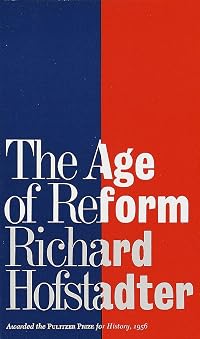
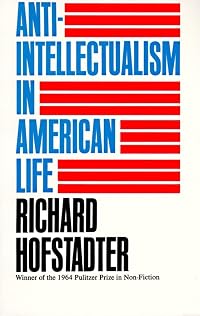
DeWitt Clinton Professor of History at Columbia University from 1959 until the time of his death, Richard Hofstadter was one of the most influential historians in post--World War II America. His political, social, and intellectual histories raised serious questions about assumptions that had long been taken for granted and cast the American show more experience in an interesting new light. His 1948 work, The American Political Tradition, is an enduring classic study in political history. His 1955 work, The Age of Reform, which still commands respect among both historians and general readers, won him that year's Pulitzer Prize. A measure of Hofstadter's standing in literary and scholarly circles is the honors he received in 1964 for Anti-Intellectualism in American Life (1963)---Pulitzer Prize for general nonfiction, the Ralph Waldo Emerson Prize of Phi Beta Kappa, and the Sidney Hillman Prize Award. Hofstadter's greatest talent, however, may have been his ability to order complex events and issues and to synthesize from them a rational, constructively critical perspective on American history. (Bowker Author Biography) show less
Some Editions
Awards and Honors
Notable Lists
Series
Belongs to Publisher Series
Vintage Books (V-9)
Work Relationships
Has as a student's study guide
Common Knowledge
- Canonical title
- The American Political Tradition and the Men Who Made it
- Original publication date
- 1948
- People/Characters
- John Adams; William Jennings Bryan; John C. Calhoun; Grover Cleveland; William Lloyd Garrison; Alexander Hamilton (show all 17); Herbert Hoover; Edward M. House; Andrew Jackson; Thomas Jefferson; Robert M. La Follette, Sr.; Abraham Lincoln; Wendell Phillips; Franklin Delano Roosevelt; Theodore Roosevelt; William Howard Taft; Woodrow Wilson
- First words
- Introduction -- Since Americans have recently found it more comfortable to see where they have been than to think of where they are going, their state of mind has become increasingly passive and spectatorial.
Classifications
- Genres
- History, Nonfiction, Politics and Government, General Nonfiction, Biography & Memoir, Philosophy
- DDC/MDS
- 320.973 — Society, government, & culture Political science Types of Government Political situation and conditions North America United States
- LCC
- E178 .H727 — History of the United States United States History General
- BISAC
Statistics
- Members
- 1,383
- Popularity
- 17,254
- Reviews
- 15
- Rating
- (3.86)
- Languages
- English, French, Spanish
- Media
- Paper, Audiobook, Ebook
- ISBNs
- 9
- ASINs
- 28