On This Page
Description
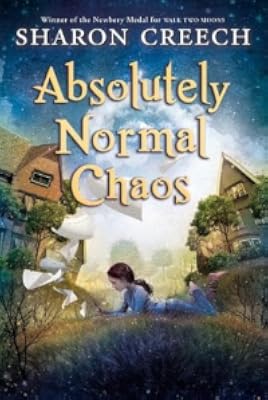
Thirteen-year-old Mary Lou grows up considerably during the summer while learning about romance, homesickness, death, and her cousin's search for his biological father.Tags
Recommendations




Member Reviews
An easy, and mostly enjoyable read. As someone who did a good amount of journaling around the same age the protagonist does I thought the author did a good job capturing the way a young teenager would write. I went with two stars because while I didnt have any big issues with the book, its also not one of my favorites. Its ok, and if you are doing a read thru of Sharon Creech's books (like I am at the moment) its worth including, but on its own it doesnt stand up as well.
Sharon Creech introduced us to Mary Lou Finney as a classmate of Sal Hiddle in her Newbury-award-winning novel, Walk Two Moons. In this follow-up, Absolutely Normal Chaos, we get to see more into the life of Miss Mary Lou, and what a life it is! Mary Lou’s thirteenth summer turns out to be one of the most exciting, confusing, and crazy times of her entire life, and teenagers will definitely be able to relate. There’s Alex Cheevey, “whose skin is always a little pink”; her boy-crazy best friend, Beth Ann; and then there’s her taciturn, “cabbage-headed” cousin, Carl Ray, who turns out to have the most exciting, confusing, and crazy story of all. The novel is told from Mary Lou’s journal, where she documents the constant show more turbulence of adolescence. Creech’s teenage voice is spot on, even with the dated slang.
What I liked best about this book was how normal everything was. There are no vampires, werewolves, or angelic halfmen cluttering up the story, just the absolute gushing of a teenage girl experiencing her first romance. Mary Lou’s relationship with Alex Cheevey is described as a series of confusing moments of soaring delight and soul-crushing lows, but you can always sense Creech’s empathy for her characters; she isn’t laughing at teens, she’s identifying with them. For example, the first time Alex holds Mary Lou’s hand, she is silently dying inside, not sure if she is behaving how she should with a boy. Mary Lou also has to put up with large family, who are rumply and lovable, but also exasperating for a teenage girl. But it is Carl Ray, who shows up one day and forgets to make the bed, who lends this story its heart. Mary Lou’s slowly burgeoning relationship with her gawky cousin gently teaches her that there is more to life than cliques and boyfriends. Carl Ray’s character is slowly, beautifully revealed throughout the book, and is the perfect complement to Mary Lou’s warmth and outgoing nature.
This book is at times laugh-out-loud funny, and at times heartbreaking, but it is always full of good, old-fashioned human goodness. No vampires required. For grades 6 and up. show less
What I liked best about this book was how normal everything was. There are no vampires, werewolves, or angelic halfmen cluttering up the story, just the absolute gushing of a teenage girl experiencing her first romance. Mary Lou’s relationship with Alex Cheevey is described as a series of confusing moments of soaring delight and soul-crushing lows, but you can always sense Creech’s empathy for her characters; she isn’t laughing at teens, she’s identifying with them. For example, the first time Alex holds Mary Lou’s hand, she is silently dying inside, not sure if she is behaving how she should with a boy. Mary Lou also has to put up with large family, who are rumply and lovable, but also exasperating for a teenage girl. But it is Carl Ray, who shows up one day and forgets to make the bed, who lends this story its heart. Mary Lou’s slowly burgeoning relationship with her gawky cousin gently teaches her that there is more to life than cliques and boyfriends. Carl Ray’s character is slowly, beautifully revealed throughout the book, and is the perfect complement to Mary Lou’s warmth and outgoing nature.
This book is at times laugh-out-loud funny, and at times heartbreaking, but it is always full of good, old-fashioned human goodness. No vampires required. For grades 6 and up. show less
This was one of my favorite novels as a young teen. Creech is a very truthful writer, never talking down to her audience or making unfair presumptions - she seems to be one of the few writers who really remembers what it feels like to be young. The family drama is hilariously, tragically, relatable. The main character (a strong young girl) writes about her growing sexuality achingly honestly - unsure of herself, but unwilling to make judgment or censure. I'd recommend this to any young teen, especially a young woman. It's an older book, but in no way outdated. The relationship discussed is heterosexual, so a good pairing would be "Annie On My Mind" or "Boy Meets Boy".
I wanted to really like this book; I loved the other book I read by Sharon Creech. However, though I did like the conclusions that Mary Lou came to at the end of the book, about herself and people around her, I won’t be keeping this one. There are two reasons: Throughout the entire book, Mary Lou’s and her best friend’s focus is on having a boyfriend and kissing… at age 13. Also, God’s name is used in vain on nearly every page. I don’t mind so much if that happens a handful of times in a book, but when I run out of the book darts I use to mark things to remember for reviewing, it’s too many.
Not my favorite SC book, but not bad. Writer's voice (13 year old girl keeping a journal) was believable. Quite slow to start, but revved up considerably at the end (parallel to her summer reading of the Odyssey--a bit heavy handed, but age approp).
Mary Lou Finney is assigned to keep a journal during the summer vacation, and boy does she. We follow multiple story lines in her life. Her best friend Beth Ann, who is boy-crazy and a bit immature, goes back and forth between two boys, and longs to be a part of the in-clique. Mary Lou herself experiences her own first love, with non-talkative Alex Cheevey. She toils through reading The Odyssey, and provides her often amusing commentary on that epic. The main line is the story of her cousin, Carl Ray, who comes to live with the Finney's for the summer, "so he can find a job." At first Carl Ray is an appalling guest in the home. Unhelpful, unresponsive, and while not necessarily rude or mean - certainly not friendly. But as Mary Lou's show more journal moves along, we (and she) learn more and more about Carl Ray, and there is more to him than initially meets the eye. show less
The title pretty much says it all.
Mary Lou Finney, a character seen in "Walk Two Moons," narrates this book completely through her summer journal, and ends up having more fun with the project than she ever expected. And a crazier summer than she ever expected.
Between a bunch of rambunctious siblings, having to read "The Odyssey" (which Mary Lou questions throughout in hilarious fashion) over summer, a blossoming crush on her neighbor Alex, and her very odd cousin Carl Ray staying with them, Mary Lou can't see how she's ever going to enjoy her vacation.
But chaos has a way of bringing unexpected results.
In Sharon Creech's typical quirky style, Mary Lou's narration is humorous and realistic, sometimes jumping wildly around as journals show more often do. And by the end of it, the story brings you right about to the time when Creech's other incredible novel, "Walk Two Moons," begins. show less
Mary Lou Finney, a character seen in "Walk Two Moons," narrates this book completely through her summer journal, and ends up having more fun with the project than she ever expected. And a crazier summer than she ever expected.
Between a bunch of rambunctious siblings, having to read "The Odyssey" (which Mary Lou questions throughout in hilarious fashion) over summer, a blossoming crush on her neighbor Alex, and her very odd cousin Carl Ray staying with them, Mary Lou can't see how she's ever going to enjoy her vacation.
But chaos has a way of bringing unexpected results.
In Sharon Creech's typical quirky style, Mary Lou's narration is humorous and realistic, sometimes jumping wildly around as journals show more often do. And by the end of it, the story brings you right about to the time when Creech's other incredible novel, "Walk Two Moons," begins. show less
Members
- Recently Added By
Lists

6th Grade
68 works; 4 members
Author Information

51+ Works 46,354 Members
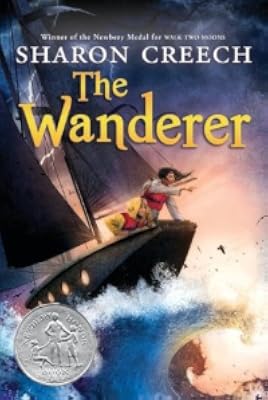
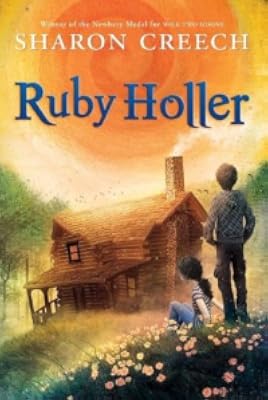
Sharon Creech was on born July 29, 1945 in South Euclid, Ohio, a suburb of Cleveland. She was in college when she took literature and writing courses and became intrigued by story-telling. Later, she was a teacher (high school English and writing) in England and in Switzerland. Her novel Walk Two Moons received in 1995 Newbery Medal; The Wanderer show more was a 2001 Newbery Honor book and Ruby Holler received the 2002 Carnegie Medal. In 2007, Heartbeat was a finalist in the Junior Division (4th to 6th grades) of the Young Reader's Choice Awards, sponsored by the Pacific Northwest Library Association. She has written over 15 fiction novels for young readers. She is married to Lyle Rigg, who is the headmaster of The Pennington School in Pennington, New Jersey, and have two grown children, Rob and Karin. (Bowker Author Biography) show less
Awards and Honors
Series

Work Relationships
Common Knowledge
- Original title
- Absolutely Normal Chaos
- Original publication date
- 1990
- People/Characters
- Mary Lou Finney; Carl Ray Finney; Alex Cheevers; Beth Ann Bartels
- Important places
- Easton
- Dedication
- For Karin and Rob Leuthy and all our Creeches
- First words
- Dear Mr. Birkway, Here it is: my summer journal.
- Last words
- (Click to show. Warning: May contain spoilers.)Alpha and Omega!!
Classifications
- Genres
- Fiction and Literature, Kids, Children's Books
- DDC/MDS
- 813.54 — Literature & rhetoric American literature in English American fiction in English 1900-1999 1945-1999
- LCC
- PZ7 .C8615 .A — Language and Literature Fiction and juvenile belles lettres Fiction and juvenile belles lettres Juvenile belles lettres
- BISAC
Statistics
- Members
- 2,112
- Popularity
- 9,793
- Reviews
- 27
- Rating
- (3.88)
- Languages
- English, German, Italian, Spanish
- Media
- Paper, Audiobook, Ebook
- ISBNs
- 30
- ASINs
- 12