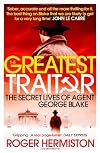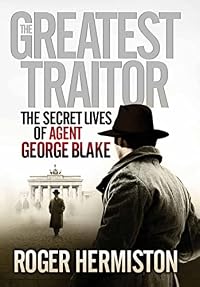
The Greatest Traitor: The Secret Lives of Agent George Blake
by Roger Hermiston
On This Page
Description
On 3 May 1961, after a trial conducted largely in secret, a man named George Blake was sentenced to an unprecedented forty-two years in jail. At the time few details of his crimes were made known. By his own confession he was a Soviet spy and rumours later circulated that his actions had endangered British agents, but the reasons for such a severe punishment were never revealed. To the public, Blake was simply the greatest traitor of the Cold War. Yet, as Roger Hermiston reveals in this show more thrilling new biography, his story touches not only the depths of treachery, but also the heights of h show lessTags
Recommendations










Member Reviews
This well-written biography tells the fascinating and exciting story of George Blake, who worked as an officer in Britain’s Secret Intelligence Service (SIS or MI6), but who was actually for many years a double agent who passed on SIS’s secrets to the Russian KGB, after being converted to “communism”.
I say “exciting” because the book often reads like an adventure story or thriller. An idea of this is conveyed by some of the chapter headings: Resistance; Flight to England; Secret Intelligence Service; Captive in Korea; Death March; Secrets of the Tunnel; Berlin; The Unmasking; Prison; Breakout.
What makes Blake interesting is that, like Kim Philby, he was motivated by political principles. He never took a penny from the KGB. show more He genuinely believed that by spying for the USSR he was advancing the cause of a fairer and more peaceful world. He could see that capitalism was a system based on exploitation, a system which kept dragging the world into economic crisis and war, and a system which had given birth to the monstrosity of fascism. (We see similar developments today.)
But what Hermiston does not discuss is the unfortunate fact that the Russian state that Blake and Philby decided to serve had moved a long way from genuine Marxism. The 1917 Russian Revolution, led by Lenin, Trotsky and the Bolsheviks, had been a genuine workers’ revolution, with working people exercising power through the “soviets” (elected workers’ councils). But by the late 1920s the gains and democracy of the revolution had been destroyed by Stalin and the bureaucratic ruling class that had usurped power and turned Russia into a state capitalist tyranny.
Blake’s tragedy is that he dedicated his life to a totalitarian state which called itself socialist, but which was just as exploitative a system as the one in the West. (Whereas genuine Marxists were advocating the slogan of “Neither Washington Nor Moscow But International Socialism”.)
Many of us enjoy the escapism of a good spy story, whether fictional or “true”, and there is something strangely fascinating about the world of the secret services. But we also need to remember that the real world of secret services is a nasty one. They do not just spy on each other. They spy on (and often persecute) dissenting voices within their own countries, and they conduct dirty tricks such as the toppling of elected governments (as the CIA did in Chile).
The secret services on both sides of Blake’s secret war were (and are) are villains. But these spooks are not all-powerful: the Tsar’s secret police could not stop the 1917 Revolution; the KGB could not stop the fall of the state capitalist regimes of Russia and Eastern Europe; and MI6 did not even see the collapse of these so-called “communist” regimes coming. show less
I say “exciting” because the book often reads like an adventure story or thriller. An idea of this is conveyed by some of the chapter headings: Resistance; Flight to England; Secret Intelligence Service; Captive in Korea; Death March; Secrets of the Tunnel; Berlin; The Unmasking; Prison; Breakout.
What makes Blake interesting is that, like Kim Philby, he was motivated by political principles. He never took a penny from the KGB. show more He genuinely believed that by spying for the USSR he was advancing the cause of a fairer and more peaceful world. He could see that capitalism was a system based on exploitation, a system which kept dragging the world into economic crisis and war, and a system which had given birth to the monstrosity of fascism. (We see similar developments today.)
But what Hermiston does not discuss is the unfortunate fact that the Russian state that Blake and Philby decided to serve had moved a long way from genuine Marxism. The 1917 Russian Revolution, led by Lenin, Trotsky and the Bolsheviks, had been a genuine workers’ revolution, with working people exercising power through the “soviets” (elected workers’ councils). But by the late 1920s the gains and democracy of the revolution had been destroyed by Stalin and the bureaucratic ruling class that had usurped power and turned Russia into a state capitalist tyranny.
Blake’s tragedy is that he dedicated his life to a totalitarian state which called itself socialist, but which was just as exploitative a system as the one in the West. (Whereas genuine Marxists were advocating the slogan of “Neither Washington Nor Moscow But International Socialism”.)
Many of us enjoy the escapism of a good spy story, whether fictional or “true”, and there is something strangely fascinating about the world of the secret services. But we also need to remember that the real world of secret services is a nasty one. They do not just spy on each other. They spy on (and often persecute) dissenting voices within their own countries, and they conduct dirty tricks such as the toppling of elected governments (as the CIA did in Chile).
The secret services on both sides of Blake’s secret war were (and are) are villains. But these spooks are not all-powerful: the Tsar’s secret police could not stop the 1917 Revolution; the KGB could not stop the fall of the state capitalist regimes of Russia and Eastern Europe; and MI6 did not even see the collapse of these so-called “communist” regimes coming. show less
This is a riveting biography of George Blake, the Secret Intelligence Service (MI6) officer who spied for the Soviet Union for several years in the 1950s, was discovered, tried and sentenced to the unprecedentedly long prison term of 42 years, sprung from Wormwood Scrubs five years later, and assisted to flee via East Germany to the Soviet Union, where he still lives today at the age of 92. His has been a fascinating life from its earliest days: the son of a British Jewish father and a Dutch mother, he was born and brought up in the Netherlands and never saw himself as British anyway. He helped the Dutch resistance under the Nazis, displaying a necessary predilection for subterfuge. He joined MI6 in the late 1940s and while working in show more South Korea was taken prisoner by the North Koreans during the war on the peninsula, when Kim Il Sung's forces at the height of their success swept south and captured the South Korean capital. During that time he offered his services to the Soviets, having become genuinely convinced that communism, for all its faults in practice, offered in principle a better and more just future for humankind. He was always clear that he spied on this basis and never for personal gain, so can be said to be, at one level, a man of principle, despite the damage that his actions caused for Western security and the probable (though not entirely proven) deaths of British agents. It was this feature, plus the length of his sentence, compared to the comparatively more lenient treatment of the Cambridge Five and the atomic spy Klaus Fuchs, that prompted sympathy from him on the inside and efforts by the peace campaigners Michael Randle and Pat Pottle, and petty criminal Sean Bourke, to spring him from prison and assist in his fleeing to the Soviet Union. Randle and Pottle were eventually tried for the springing much later in 1991, but acquitted by the jury. Blake settled into Soviet life better than Philby or Burgess (Maclean also settled in well) and married a Russian lady and had a son. As recently as 2007 he was awarded an Order of Friendship medal by Putin (an award that has also been bestowed on Prince Michael of Kent and Rowan Williams, among others). A fascinating story of the long, colourful and controversial life. show less
One of the blurbs when you open the book says that Hermiston "... writes in a way so objective and unslanted that the reader is challenged to decide what to make of his subject." I didn't find it so. I found Hermiston to be subjective (and thereby slanted). I don't use Kindle, but I challenge anyone who does to put in the words treacherous and treachery and see how many times they appear in the text. In the parts where he talks about Blake's work with SIS, the British Secret Service, they appear at least once per page, and there are a couple hundred pages of that.
But he does lay out all the facts (I hope) and those facts, in spite of Hermiston's favored treachery, leave a reader with that challenge to decide what to make of Blake. I'm show more all for those who helped him escape. His trial was a sham and he was given an unjustly heavy sentence because he was "Not one of us." show less
But he does lay out all the facts (I hope) and those facts, in spite of Hermiston's favored treachery, leave a reader with that challenge to decide what to make of Blake. I'm show more all for those who helped him escape. His trial was a sham and he was given an unjustly heavy sentence because he was "Not one of us." show less
A good solid account of George Blake the MI6 agents who, in the course of nine years betrayed details of some 40 MI6 agents to the Soviets, destroying most of MI6's operations in Eastern Europe.
I'd read Sean Bourke's book [b:The Springing of George Blake|3478179|The Springing of George Blake|Sean Bourke|https://s.gr-assets.com/assets/nophoto/book/50x75-6121bf4c1f669098041843ec9650ca19.png|4443339] quite a few years back and have been fascinated by this case. Particularly how the small group of non-soviet sympathisers helped to organise his escape from Wormwood Scrubs prison and subsequent journey to East Germany.
The book covers in detail his early life, capture in the Korean war and particularly the solidifying of his political views as show more a result his experiences.
Worthy of anyone who has an interest in the Cold War.
Anyone know of anything similar on the Portland Spy Ring? That story is definitely worth a book. show less
I'd read Sean Bourke's book [b:The Springing of George Blake|3478179|The Springing of George Blake|Sean Bourke|https://s.gr-assets.com/assets/nophoto/book/50x75-6121bf4c1f669098041843ec9650ca19.png|4443339] quite a few years back and have been fascinated by this case. Particularly how the small group of non-soviet sympathisers helped to organise his escape from Wormwood Scrubs prison and subsequent journey to East Germany.
The book covers in detail his early life, capture in the Korean war and particularly the solidifying of his political views as show more a result his experiences.
Worthy of anyone who has an interest in the Cold War.
Anyone know of anything similar on the Portland Spy Ring? That story is definitely worth a book. show less
Pretty good book. Unlike most American spies who were bought, Blake fit the pattern of his fellow British spies in being a Soviet supporter. It's hard to say if he really loved communism or if he just enjoyed stabbing his country in the back. I got the impression he really only cared about himself.
Ratings
Members
- Recently Added By
Author Information
5 Works 107 Members
Classifications
- Genres
- Nonfiction, History, General Nonfiction, Biography & Memoir, Politics and Government
- DDC/MDS
- 327.12092 — Society, Government, and Culture Political science International Relations: Spies Foreign policy and specific topics in international relations Espionage and subversion Intelligence Gathering - subdivisions Biography And History Biography
- LCC
- UB271 .R92 .H47 — Military Science Military administration Military administration Intelligence
- BISAC
Statistics
- Members
- 55
- Popularity
- 553,951
- Reviews
- 5
- Rating
- (3.77)
- Languages
- English
- Media
- Paper, Audiobook, Ebook
- ISBNs
- 7
- ASINs
- 2