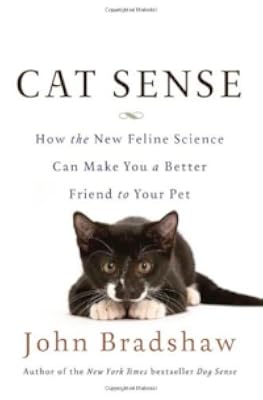
Cat Sense: How the New Feline Science Can Make You a Better Friend to Your Pet
by John Bradshaw
On This Page
Description
Based on cutting edge science, the New York Times bestselling book on the inner lives of cats In Cat Sense, renowned anthrozoologist John Bradshaw takes us further into the mind of the domestic cat than ever before, using cutting-edge scientific research to dispel lingering myths and explain the true nature of our feline friends. Tracing the cat's evolution from lone predator to domesticated companion, Bradshaw shows that although cats and humans have lived together for eight thousand years, show more cats remain independent, predatory, and wary of contact with their own kind, qualities that often clash with our modern lifestyles. To live in harmony with our cats, Bradshaw explains, we first need to understand their inherited quirks including understanding their body language, and managing both their natural hunting instincts and their relationships with other cats. A must-read for any cat lover, Cat Sense offers humane, penetrating insights about the domestic cat that challenge our most basic assumptions and promise to dramatically improve our pets' lives--and ours. show lessTags
Recommendations
















Member Reviews
This fascinating book explores the domain of the world's most popular pet, the domestic cat. Surprisingly, very little scientific research has been done on the cat, but Bradshaw compiles the outcomes of recent research in this book. The book begins with a natural history of cats and how they developed a relationship with humans.
The famous independence of cats comes from how they first were first domesticated. Cats were "hired" to be mousers, a job that they did on their own as opposed to the more social aspects of the dog's work of herding, hunting, and guarding. Despite their independence, the affection of cats is real. In addition to touch and grooming, a raised tail is a signal of friendliness. While cats meow often with humans, it's show more rarely used among wild and feral cats. While cats can bond with humans (especially if they're socialized before they reach 8 weeks) they are less likely to want to spend time with other cats due to their territorial nature. Getting a second cat to keep your original cat company rarely works. In fact, a cat coming to a new home may find that they yard of their humans' property is already marked by a neighboring cat, leading to stress and standoffs.
The issue of allowing pet cats outdoors on their own is a contentious one. Bradshaw argues that the evidence that cats decimate local wildlife are built on faulty data (although cats can be bad for certain environments, such as islands, and feral cat communities anywhere). In some cases, cats may be beneficial to bird populations since they hunt other predators such as rats. Nevertheless, Bradshaw offers a lot of tips on how best to allow cats outdoors should you choose to do so as well as enrichment to help keep indoor cats happy. Bradshaw believes that when cats leave a dead animal as a "treat" for their humans that they simply remembered once they got home that there was much tastier store-bought food and lost interest in the animal they caught.
The last chapter is a little strange in how Bradshaw considers how to select traits in domestic cats in order to breed them to be better companions to humans and to living indoors. He does make a good point that the growing practice of neutering pet cats means that future kittens are more likely to come from feral cats who have traits opposite of what we desire in cats. Overall it's an interesting book that's taught me some new things about my favorite pet.
Favorite Passages:
The famous independence of cats comes from how they first were first domesticated. Cats were "hired" to be mousers, a job that they did on their own as opposed to the more social aspects of the dog's work of herding, hunting, and guarding. Despite their independence, the affection of cats is real. In addition to touch and grooming, a raised tail is a signal of friendliness. While cats meow often with humans, it's show more rarely used among wild and feral cats. While cats can bond with humans (especially if they're socialized before they reach 8 weeks) they are less likely to want to spend time with other cats due to their territorial nature. Getting a second cat to keep your original cat company rarely works. In fact, a cat coming to a new home may find that they yard of their humans' property is already marked by a neighboring cat, leading to stress and standoffs.
The issue of allowing pet cats outdoors on their own is a contentious one. Bradshaw argues that the evidence that cats decimate local wildlife are built on faulty data (although cats can be bad for certain environments, such as islands, and feral cat communities anywhere). In some cases, cats may be beneficial to bird populations since they hunt other predators such as rats. Nevertheless, Bradshaw offers a lot of tips on how best to allow cats outdoors should you choose to do so as well as enrichment to help keep indoor cats happy. Bradshaw believes that when cats leave a dead animal as a "treat" for their humans that they simply remembered once they got home that there was much tastier store-bought food and lost interest in the animal they caught.
The last chapter is a little strange in how Bradshaw considers how to select traits in domestic cats in order to breed them to be better companions to humans and to living indoors. He does make a good point that the growing practice of neutering pet cats means that future kittens are more likely to come from feral cats who have traits opposite of what we desire in cats. Overall it's an interesting book that's taught me some new things about my favorite pet.
Favorite Passages:
"Unlike the dog, which was domesticated much earlier, there would have been no niche for the cat in a hunter-gatherer society. It was not until the first grain stores appeared, resulting in localized concentrations of wild rodents, that it would have been worth any cat’s while to visit human habitations—and even then, those that did must have run the risk of being killed for their pelts. It was probably not until after the house mouse had evolved to exploit the new resource provided by human food stores that cats began to appear regularly in settlements, tolerated because they were obviously killing rodents and thereby protecting granaries."show less
"Cats’ hearing is therefore superior to ours in many ways, but inferior in one respect: the ability to distinguish minor differences between sounds, both in pitch and intensity. If it was possible to train a cat to sing, it couldn’t sing in tune (bad news for Andrew Lloyd Webber)."
"We could consider some of this behavior manipulative, but only to the extent that two friends negotiate the details of their relationship. The underlying emotion on both sides is undoubtedly affection: cats show this in the way they communicate with their owners, using the same patterns of behavior that they employ to form and maintain close relationships with members of their own feline family."
"pet cats rarely hunt “seriously,” often watching potential prey without bothering to stalk it. A hungry cat will pounce several times until the prey either escapes or is caught; a well-fed pet will pounce halfheartedly and then give up, probably explaining why pet cats, when they do kill birds, usually succeed only when they target individuals already weakened by hunger or disease. Furthermore, pet cats rarely consume their prey, often bringing it home as if to consume it there, but then abandoning it."
Good book about what's known about the psychology, genetics, and socialization of the domestic cat.
What's most remarkable to me is just how little basic science has been done -- many basic things like knowing the optimal age to home kittens with their new families, the extent of genetic influence over personality traits, etc. have never been studied.
A particularly scary thing is that widespread neutering of pet cats has led to the least sociable and human adapted cats being responsible for most new kittens (unaltered female cats kept in homes, but feral tomcats rather than outdoor pet tomcats); this has apparently led to observable behavioral differences in kittens in areas where the majority of pet cats are neutered.
Pedigree cats don't show more seem to have been bred with personality taken into account, and the market for random-bred or non-pedigreed cats based on personality may not exist, but it seems like there should be a market for a super-premium known-parentage cat, raised in a home environment until age 8 weeks or so, combined with feline enrichment and other pet ecosystem products -- basically the "Apple" of cats. show less
What's most remarkable to me is just how little basic science has been done -- many basic things like knowing the optimal age to home kittens with their new families, the extent of genetic influence over personality traits, etc. have never been studied.
A particularly scary thing is that widespread neutering of pet cats has led to the least sociable and human adapted cats being responsible for most new kittens (unaltered female cats kept in homes, but feral tomcats rather than outdoor pet tomcats); this has apparently led to observable behavioral differences in kittens in areas where the majority of pet cats are neutered.
Pedigree cats don't show more seem to have been bred with personality taken into account, and the market for random-bred or non-pedigreed cats based on personality may not exist, but it seems like there should be a market for a super-premium known-parentage cat, raised in a home environment until age 8 weeks or so, combined with feline enrichment and other pet ecosystem products -- basically the "Apple" of cats. show less
Great book. I am an unashamed cat lover, but after reading this it was clear I didn't actually know much about cats, their biology, ancestry or the reasons for their behaviour. Probably the most startling revelation for me is that cats are not yet fully domesticated. Although they have been hanging around with humans for millenia, until very recently they were simply tolerated because they kept pests down. The idea of cats as cute pets kept solely for company is not more than a couple of centuries old. Hence cats are struggling to reconcile their wild instincts with our demands on them as companions. I liked how the author worked in the science with his own experiences with cats, particularly Splodge, a large bad-tempered neutered tom, show more who appears a number of times in the book demonstrating some point or other. For myself I remembered back to cats in my family up to 30 years ago and suddenly mysterious behaviours made sense. I think the most diparaging thing I read was the advice that Bengal cats,a cross between domestic and wild leopard cats that I absolutely adore, just do not make good pets. Disappointing but good to know. I loved this book, I learned so much and it was entertaining too. Recommended for all cat-lovers and even cat-haters as well. show less
Cat Sense is a thoroughly enjoyable read for both cat lovers and those interested in feline behavior. What immediately strikes the reader is how little scientific study of cats there is when compared to that of dogs.
Bradshaw seeks to pull together the disparate studies and incorporate them with his own to further reveal the universally enigmatic creature which is the domestic (and feral) cat.
Most poignantly, his remarks on the potential for breeding for temperament in cats as is done with dogs, highlights the changing relationship between cats and their human owners and also makes one think on what exactly cats mean to us and whether respecting their wild nature may be as important as any attempts to change them to meet human show more needs.
Not since Desmond Morris's "Catwatching" has their been such a well researched, thoroughly scientific study of cats. It's a must read for feline enthusiasts everywhere.
Disclaimer: I received a free copy of this book as part of the Goodreads First Reads Program. show less
Bradshaw seeks to pull together the disparate studies and incorporate them with his own to further reveal the universally enigmatic creature which is the domestic (and feral) cat.
Most poignantly, his remarks on the potential for breeding for temperament in cats as is done with dogs, highlights the changing relationship between cats and their human owners and also makes one think on what exactly cats mean to us and whether respecting their wild nature may be as important as any attempts to change them to meet human show more needs.
Not since Desmond Morris's "Catwatching" has their been such a well researched, thoroughly scientific study of cats. It's a must read for feline enthusiasts everywhere.
Disclaimer: I received a free copy of this book as part of the Goodreads First Reads Program. show less
A really interesting read, especially if you own a Cat. There is a lot in here that will make you think, especially about the Cat's role as a predator. There is also a chilling vision for the future of the Domestic Cat.
Cats are the single most popular pet today outstripping dogs 3-1. The internet is jampacked with popular cat memes and You Tube stars like Grumpy Cat and Li'l Bub. Yet, as much as we love them, most of us really don't understand them. In Cat Sense, John Bradshaw looks at the history and the science of cats to help us understand better this mysterious creature who shares our homes and our hearts.
It should be noted that this is not a How-to manual for cat owners. Rather it concerns the history, the science, and the future of Felis Silvestris catus (best Latin name ever). For me, the section on their history was the most interesting. From the ritual sacrifices of cats in ancient Egypt to the burning of cats as witches' familiars in the show more Middle Ages which, ironically, helped the spread of the Black Plague, the history of the cat is not a happy one.
Bradshaw also talks about the psychology of the cat - turns out that much that we cat fanciers thought we knew is wrong and may be hurting our pets. He discusses the problems of multi-cat households, the difference between domestic and feral cats, the different personality traits, their genetic heritage, and the effect on breeding for specific traits. He also discusses the vocal and growing group of detractors, including conservationists and gardeners, who feel that cats are a threat to the delicate balance of many ecosystems and demand more controls. He discusses many of the studies both pro and con of these accusations and makes some suggestions to ensure the future of cats including some controversial but compelling arguments against neutering every pet cat.
Cat Sense is neither an owner's manual or a biology text. It is simply an attempt to help cat lovers understand their pets better, to create a healthier and happier environment, not only for the cat but for its owner and, most importantly, to ensure the future of the cat so that it may live long and prosper. show less
It should be noted that this is not a How-to manual for cat owners. Rather it concerns the history, the science, and the future of Felis Silvestris catus (best Latin name ever). For me, the section on their history was the most interesting. From the ritual sacrifices of cats in ancient Egypt to the burning of cats as witches' familiars in the show more Middle Ages which, ironically, helped the spread of the Black Plague, the history of the cat is not a happy one.
Bradshaw also talks about the psychology of the cat - turns out that much that we cat fanciers thought we knew is wrong and may be hurting our pets. He discusses the problems of multi-cat households, the difference between domestic and feral cats, the different personality traits, their genetic heritage, and the effect on breeding for specific traits. He also discusses the vocal and growing group of detractors, including conservationists and gardeners, who feel that cats are a threat to the delicate balance of many ecosystems and demand more controls. He discusses many of the studies both pro and con of these accusations and makes some suggestions to ensure the future of cats including some controversial but compelling arguments against neutering every pet cat.
Cat Sense is neither an owner's manual or a biology text. It is simply an attempt to help cat lovers understand their pets better, to create a healthier and happier environment, not only for the cat but for its owner and, most importantly, to ensure the future of the cat so that it may live long and prosper. show less
I love cats and have lived with them as far back as I can remember with only a few breaks. My very first cat friend was named Tigger, a huge feral tomcat who decided to take up residence with us and who put up with my pokes and prods with equanimity and kindness. He was a great cat. I've had the pleasure of living with many other cat friends since that time and never grow tired of their company. I like their independence, their different natures, the sense that these are relationships built and worked on over time. Cats, barely domesticated as they are, don't have to like you for their survival, they're not particularly inclined to like you, when they do like you it feels worthwhile.
Cat Sense is full of interesting research about our show more feline friends. I particularly enjoyed the early histories of the cat as it came into contact with human society. It was also fun to read about all the ways that humans create pressure on cat evolution and cat evolution influences humans. I wish Mr. Bradshaw had included even more information about social predators, particularly lions, since many of their behaviors provide insights into our own behaviors. A warm and interesting book on cat behavior - a reminder that they are little deities for whom we are fortunate to be allowed to provide thumbs. show less
Cat Sense is full of interesting research about our show more feline friends. I particularly enjoyed the early histories of the cat as it came into contact with human society. It was also fun to read about all the ways that humans create pressure on cat evolution and cat evolution influences humans. I wish Mr. Bradshaw had included even more information about social predators, particularly lions, since many of their behaviors provide insights into our own behaviors. A warm and interesting book on cat behavior - a reminder that they are little deities for whom we are fortunate to be allowed to provide thumbs. show less
Members
- Recently Added By
Lists

Books for Cat Lovers
16 works; 4 members

Books Read in 2018
4,360 works; 110 members

Favorite Animal Non-Fiction
293 works; 144 members
Author Information

4 Works 1,452 Members
Awards and Honors
Distinctions
Common Knowledge
- Alternate titles
- Cat Sense; Cat Sense: How the New Feline Science Can Make You a Better Friend to Your Pet
- Original publication date
- 2013
- Important events
- Domestication of the cat
- Epigraph
- Dogs look up to us: cats look down on us.
- Winston Churchill
When a man loves cats, I am his friend and comrade, without further introduction.
- Mark Twain - Dedication
- To Splodge (1988-2004) - A Real Cat
- First words
- What is a cat?
- Last words
- (Click to show. Warning: May contain spoilers.)If we can agree to support them in both these ways, cats will be assured a future in which they rare not only popular and populous, but are also more relaxed, and affectionate, than they are today.
- Original language
- English
Classifications
Statistics
- Members
- 689
- Popularity
- 41,624
- Reviews
- 30
- Rating
- (3.52)
- Languages
- 8 — Dutch, English, Finnish, French, German, Polish, Portuguese, Spanish
- Media
- Paper, Audiobook, Ebook
- ISBNs
- 22
- ASINs
- 13