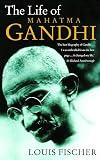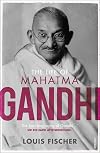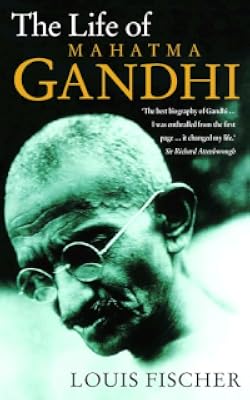
The Life of Mahatma Gandhi
by Louis Fischer
On This Page
Description
Mahatma Gandhi became a legend in his own time. A tireless fighter for human rights and for Indian independence, his strategy of satyagraha, or passive resistance, earned him the admiration of millions. Louis Fischer's biography is the definitive account of Gandhi's life; it tells the astonishing story of one man who changed the world forever.Tags
Recommendations






















Member Reviews
https://nwhyte.livejournal.com/3527867.html
The Oscar for Best Original Screenplay was not completely fairly awarded in the case of Gandhi, as the screenplay was not particularly original. The film is pretty strongly based on Louis Fischer's 1950 biography.
Written soon after Gandhi's death, it is largely positive but does not gloss over some of the negative aspects of Gandhi's beliefs and behaviour. He was a terrible parent to his sons, emotionally distant and borderline abusive. He was also an anti-vaxxer who believed that all illness could be healed by meditation and diet. He lost touch with his own political movement towards the end. One also has to wonder what Kasturba really thought; we don't hear much from her between their show more marriage as horny young teenagers to her death sixty years later.
However, Fischer as a journalist does very well at explaining the situation of both South Africa and colonial India to the general reader, and making it clear just how important Gandhi was to the political developments of both. In particular, he stresses Gandhi's commitment to non-violence even more than the film does. And I think it's fair to say that without a Gandhi-like figure, India would certainly have become independent, probably somewhat sooner, but at a much greater cost of lives lost in conflict.
I was also interested to learn that Gandhi's family were always political - his grandfather served as prime minister of Porbandar, the small state where he was born, and his father was successively prime minister there and in three other states, Rajkot, Wandaner and Bikaner. The book does get a little unmoored at the end when Fischer appears in his own narrative and gives us verbatim notes of his (many, long) conversations with Gandhi, but in general I found it readable enough. show less
The Oscar for Best Original Screenplay was not completely fairly awarded in the case of Gandhi, as the screenplay was not particularly original. The film is pretty strongly based on Louis Fischer's 1950 biography.
Written soon after Gandhi's death, it is largely positive but does not gloss over some of the negative aspects of Gandhi's beliefs and behaviour. He was a terrible parent to his sons, emotionally distant and borderline abusive. He was also an anti-vaxxer who believed that all illness could be healed by meditation and diet. He lost touch with his own political movement towards the end. One also has to wonder what Kasturba really thought; we don't hear much from her between their show more marriage as horny young teenagers to her death sixty years later.
However, Fischer as a journalist does very well at explaining the situation of both South Africa and colonial India to the general reader, and making it clear just how important Gandhi was to the political developments of both. In particular, he stresses Gandhi's commitment to non-violence even more than the film does. And I think it's fair to say that without a Gandhi-like figure, India would certainly have become independent, probably somewhat sooner, but at a much greater cost of lives lost in conflict.
I was also interested to learn that Gandhi's family were always political - his grandfather served as prime minister of Porbandar, the small state where he was born, and his father was successively prime minister there and in three other states, Rajkot, Wandaner and Bikaner. The book does get a little unmoored at the end when Fischer appears in his own narrative and gives us verbatim notes of his (many, long) conversations with Gandhi, but in general I found it readable enough. show less
I was surprised at some details from the life of Gandhi. For example, he was not a very good father to his children, and not always a good husband to his devoted wife, Kasturbai. He had flaws, which are usually omitted or glossed over when the subject of Gandhi comes up. All I ever knew was that he was the embodiment of non-violence, that he helped the Indians in South Africa, and that he returned to India to help achieve independence from Britain. His was a much more complex life. This biography is not entirely chronological, and deviates occasionally into the author's own experiences in India, but it relies on many good sources and seems to be an honest telling.
Fisher weaves truths, writings, stories, and a deep message that subtly challenges the reader to analyse their own lives from within into this beautiful biography of a man of beautiful character.
This is a biography of Mahatma Gandhi (1869-1948). He led the fight for Indian independence from British rule, who tirelessly pursued a strategy of passive resistance, and who was assassinated by a Hindu fanatic only a few months after independence was achieved.
Ratings
Members
- Recently Added By
Author Information

22+ Works 1,658 Members
Awards and Honors
Awards
Distinctions
Notable Lists
Work Relationships
Inspired
Common Knowledge
- Original publication date
- 1950
- People/Characters
- Mohandas Gandhi; Jawaharlal Nehru; Rajendra Prasad; Muhammad Ali Jinnah; Winston Churchill; Frederick Pethick-Lawrence, 1st Baron Pethick-Lawrence (show all 9); Stafford Cripps; Nirmal Kumar Bose; Rabindranath Tagore
- Important places
- India; British Empire; South Africa
- Important events
- Salt March (1930)
- Dedication
- To Markoosha
- First words
- At 4.30 p.m., Abha brought in the last meal he was ever to eat; it consisted of goat's milk, cooked and raw vegetables, oranges and a concoction of ginger, sour lemons and strained butter with juice of aloe.
- Last words
- (Click to show. Warning: May contain spoilers.)Gandhi fell, and died murmuring, 'Oh, God.'
Classifications
Statistics
- Members
- 600
- Popularity
- 49,010
- Reviews
- 5
- Rating
- (4.05)
- Languages
- Dutch, English, French, German
- Media
- Paper
- ISBNs
- 11
- ASINs
- 18