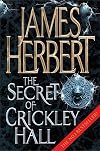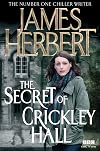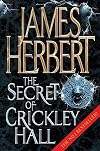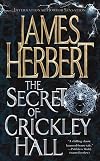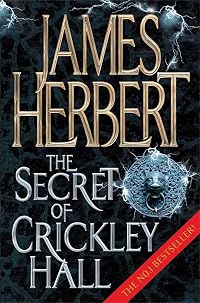
The Secret of Crickley Hall
by James Herbert
On This Page
Description
The Caleighs have had a terrible year... They need time and space, while they await the news they dread. Gabe has brought his wife, Eve, and daughters, Loren and Cally, down to Devon, to the peaceful seaside village of Hollow Bay. He can work and Eve and the kids can have some peace and quiet and perhaps they can try, as a family, to come to terms with what's happened to them... Crickley Hall is an unusually large house on the outskirts of the village at the bottom of Devil's Cleave, a show more massive tree-lined gorge - the stuff of local legend. A river flows past the front garden. It's perfect for them... if a bit gloomy. And Chester, their dog, seems really spooked at being away from home. And old houses do make sounds. And it's constantly cold. And even though they shut the cellar door every night, it's always open again in morning... The Secret of Crickley Hall is James Herbert's finest novel to date. It explores the darker, more obtuse territories of evil and the supernatural. With brooding menace and rising tension, he masterfully and relentlessly draws the reader through to the ultimate revelation - one that will stay to chill the mind long after the book has been laid aside. show lessTags
Recommendations















Member Reviews
I have been meaning to read a James Herbert novel for years, but unfortunately for me, I picked a duff 'un. Not bad enough to abandon, even clocking in at over 600 pages, but still more of an endurance test than a ghost story. The plot was intriguing enough, if decidedly lacking in originality and belaboured with every device known to horror writers, but the writing was atrocious! Not only is James Herbert of the 'Tell Don't Show' school of fiction, he's the patron saint. There was so much unnecessary detail in this book - even minor characters sound like police e-fits, all medium builds with low foreheads and clothing itemised by brand - that a decent editor would have been able to chop this book in half with ease. (And don't forget show more the humble bracket for wedging in additional pointless facts!)
I vaguely remember this being made into a BBC miniseries with the ubiquitous Suranne Jones a few years ago, which would probably have been a quicker introduction to Herbert than reading this brick of a book. The story is the same - after the loss of their young son, the Caleigh family move from London to the Devon coast while husband Gabe (he's American! and an engineer!) is working on a sea turbine project (which you'll learn all about, even though his work isn't relevant!) Unfortunately, they make the mistake of renting Crickley Hall, which is haunted to the hilt, all creaking doors and banging in the night, not to mention mysterious wet patches drifting up from the cellar. The dog runs away after a couple of days, but nope, Gabe doesn't believe in ghosts, so they'll just have to hack it. Through lonnnnnnnnnnnnnnng scenes of exposition ('Are you growing tired of my reminiscences, Eve?'), naturally, we learn that a group of orphaned children were evacuated to the house in the 40s, to be cared for by a religious crackpot called Augustus Theophilus Cribben (yep, he was always going to turn out well) and his equally unstable sister Magda. Bad things happened, in graphic detail, and now the house is filled with the tormented spirits of the children and bonkers Augie himself. A medium (female, sympathetic) and a paranormal investigator (male, dodgy) also join in the exposition, so that the final two hundred pages drag on for HOURS. Not even a fight in the cellar, with the villain turning into Rasputin and refusing to die, until the decomposing corpse of his first victim pushes him down a well, and then old Augustus returning for an encore, could save the story for me by that point.
I have read that James Herbert's other books are better, and hopefully shorter, so I won't give up on him just yet, but that was not a promising start! (Helpful hint: watch the TV series instead. Or the Poltergeist trilogy, which is the same sort of thing.) show less
I vaguely remember this being made into a BBC miniseries with the ubiquitous Suranne Jones a few years ago, which would probably have been a quicker introduction to Herbert than reading this brick of a book. The story is the same - after the loss of their young son, the Caleigh family move from London to the Devon coast while husband Gabe (he's American! and an engineer!) is working on a sea turbine project (which you'll learn all about, even though his work isn't relevant!) Unfortunately, they make the mistake of renting Crickley Hall, which is haunted to the hilt, all creaking doors and banging in the night, not to mention mysterious wet patches drifting up from the cellar. The dog runs away after a couple of days, but nope, Gabe doesn't believe in ghosts, so they'll just have to hack it. Through lonnnnnnnnnnnnnnng scenes of exposition ('Are you growing tired of my reminiscences, Eve?'), naturally, we learn that a group of orphaned children were evacuated to the house in the 40s, to be cared for by a religious crackpot called Augustus Theophilus Cribben (yep, he was always going to turn out well) and his equally unstable sister Magda. Bad things happened, in graphic detail, and now the house is filled with the tormented spirits of the children and bonkers Augie himself. A medium (female, sympathetic) and a paranormal investigator (male, dodgy) also join in the exposition, so that the final two hundred pages drag on for HOURS. Not even a fight in the cellar, with the villain turning into Rasputin and refusing to die, until the decomposing corpse of his first victim pushes him down a well, and then old Augustus returning for an encore, could save the story for me by that point.
I have read that James Herbert's other books are better, and hopefully shorter, so I won't give up on him just yet, but that was not a promising start! (Helpful hint: watch the TV series instead. Or the Poltergeist trilogy, which is the same sort of thing.) show less
Well.
Consider me—for the first time in reading all of Herbert's novels—actually blown away by one of his books.
What's even wilder? I read the three David Ash books back to back, so I end my years-long reading of everything Herbert with this, his second-last book. And I have to say, had he written any other books this well-written, this well-plotted, and without his usual man-meets-woman-eventually-have-explicit-sex feature?
Yeah, that twenty-three book read would have been far more enjoyable.
I enjoyed this novel possibly because it was lacking the standard Herbert elements, but also because, quite frankly, it was just so well written and so well plotted.
I actually started this final novel with a lot of trepidation, having just show more DNF'd the novel right before it, Nobody True. Herbert had seemed to completely forget about carrying any plot forward in that one because he was more concerned with giving far too much detail about the inner workings of an ad agency.
And I got a little worried when he launched into the engineering project that Gabe was taking on, but it was just lightly sketched in, and then we got on with the story. And it's an incredible story. So many elements that, before this novel, I would have sworn the author could never have juggled.
And yet, juggle them he did. And very well. This novel has it all. Grief. Sorrow. Anger. Hate. And a slow burn of terror running underneath all of it, like the river under Crickley Hall.
This was just brilliant. I'm so glad I didn't give up on Herbert, and finally got to read the best book he ever wrote. show less
Consider me—for the first time in reading all of Herbert's novels—actually blown away by one of his books.
What's even wilder? I read the three David Ash books back to back, so I end my years-long reading of everything Herbert with this, his second-last book. And I have to say, had he written any other books this well-written, this well-plotted, and without his usual man-meets-woman-eventually-have-explicit-sex feature?
Yeah, that twenty-three book read would have been far more enjoyable.
I enjoyed this novel possibly because it was lacking the standard Herbert elements, but also because, quite frankly, it was just so well written and so well plotted.
I actually started this final novel with a lot of trepidation, having just show more DNF'd the novel right before it, Nobody True. Herbert had seemed to completely forget about carrying any plot forward in that one because he was more concerned with giving far too much detail about the inner workings of an ad agency.
And I got a little worried when he launched into the engineering project that Gabe was taking on, but it was just lightly sketched in, and then we got on with the story. And it's an incredible story. So many elements that, before this novel, I would have sworn the author could never have juggled.
And yet, juggle them he did. And very well. This novel has it all. Grief. Sorrow. Anger. Hate. And a slow burn of terror running underneath all of it, like the river under Crickley Hall.
This was just brilliant. I'm so glad I didn't give up on Herbert, and finally got to read the best book he ever wrote. show less
I have the softest spot for haunted house novels and I've often found this book at the top of most lists. Of course, I had to read it.
The author is apparently well known and referred to as the British Steven King. Huh. I've always disliked Steven King so I have to say that, after reading this, the description feels kinda accurate.
Started off nice and kept getting worse the closer it got to the end.
Written in 2005 but the casual sexism reads like it's much older. The women are called by their names and the husband gets called by his profession, the Engineer, more than he does by his name. His profession is irrelevant to the plot other than being the plot device for the family deciding to move into the titular haunted house.
We are show more surprised by unnecessary descriptions of women's beasts like, she walked clutching the papers on her small breasts. However, we never encounter a description of what the husband's firm buttocks or flaccid penis are doing while he does menial tasks.
The husband is smart and good and kind and does everything right and is the skeptic and the logical one. The wife is on the verge of a breakdown, believes in ghosts and is unbelievably naive.
Towards the end of the book we get so much exposition that it feels like a parody and the bad writing really starts to show. The husband is so smart, he is an Engineer after all, that he understands everything about the spirit world, even if he thought it didn't exist 5 minutes before. For instance. A hideous ghost appears in front of him and another man. Later the other man mentions the same ghost as a beautiful one. The husband immediately and with the utmost certainty concludes that this was a conscious choice the ghost made, due to the emotional bond the ghost had with the other man, and thus chose to alter her appearance to each man watching her.
Oh so I guess ghosts can do that? And you can reason this in a split second while having barely escaped a mad man trying to kill your kids? Of course the Engineer would deduce so.
And by the end there is not even a tiny thing left to the imagination. Even things that don't need to be described are explained to us in detail. Someone gives us the exposition. Always.
And there's much more uncomfortableness still. Rape of a minor passed of as consensual because the child was born evil. The sexual deviancy of the bad guys.
Uuugh.
This reads so much like a 70s book. show less
The author is apparently well known and referred to as the British Steven King. Huh. I've always disliked Steven King so I have to say that, after reading this, the description feels kinda accurate.
Started off nice and kept getting worse the closer it got to the end.
Written in 2005 but the casual sexism reads like it's much older. The women are called by their names and the husband gets called by his profession, the Engineer, more than he does by his name. His profession is irrelevant to the plot other than being the plot device for the family deciding to move into the titular haunted house.
We are show more surprised by unnecessary descriptions of women's beasts like, she walked clutching the papers on her small breasts. However, we never encounter a description of what the husband's firm buttocks or flaccid penis are doing while he does menial tasks.
The husband is smart and good and kind and does everything right and is the skeptic and the logical one. The wife is on the verge of a breakdown, believes in ghosts and is unbelievably naive.
Towards the end of the book we get so much exposition that it feels like a parody and the bad writing really starts to show. The husband is so smart, he is an Engineer after all, that he understands everything about the spirit world, even if he thought it didn't exist 5 minutes before. For instance. A hideous ghost appears in front of him and another man. Later the other man mentions the same ghost as a beautiful one. The husband immediately and with the utmost certainty concludes that this was a conscious choice the ghost made, due to the emotional bond the ghost had with the other man, and thus chose to alter her appearance to each man watching her.
Oh so I guess ghosts can do that? And you can reason this in a split second while having barely escaped a mad man trying to kill your kids? Of course the Engineer would deduce so.
And by the end there is not even a tiny thing left to the imagination. Even things that don't need to be described are explained to us in detail. Someone gives us the exposition. Always.
And there's much more uncomfortableness still. Rape of a minor passed of as consensual because the child was born evil. The sexual deviancy of the bad guys.
Uuugh.
This reads so much like a 70s book. show less
Swish-Thwack and Puddles from Hell
Out in Hollow Bay, a gloomy house (in fact, the entire neighborhood is pretty grim) is rented by a family who have recently suffered the tragedy of a missing son. But there's something wrong with this rental property. The dog hates the place. A cellar door won't stay shut. The tree swing has ideas of its own. Closets make an unearthly racket. Teeny disembodied footsteps are heard. And a naked man walks down the stairs with a wooden switch. Switch-thwack.
I'm a big fan of James Herbert and this is a departure from his usual fare. Its an old-fashioned (in a good way) ghost story. Complete with a 70-year-old caretaker who supplies the back story of this former "orphanage," the psychic who's afraid of show more readings, a spook hunter, and spectacularly stormy weather (Herbert's setup of atmos can't be beat).
There's some surprising twists and tragic turns (especially where the orphans and the lost son is concerned.) And unusual too, is the treatment of hauntings which are not grounded. (Ghosts following people . . . away from the place of the original haunting). I won't reveal anymore other than I gave it a 4 because the father, Gabe, took more than half the book to believe his house was haunted!! Engineers, what to do???
This is the perfect book to curl up in an armchair with your sharp-eyed dog in your lap. And better yet, if the branch of that birch or oak is banging on the glass panes of your window and and the rain and wind is beginning to sound like soft whispers . . . eek show less
Out in Hollow Bay, a gloomy house (in fact, the entire neighborhood is pretty grim) is rented by a family who have recently suffered the tragedy of a missing son. But there's something wrong with this rental property. The dog hates the place. A cellar door won't stay shut. The tree swing has ideas of its own. Closets make an unearthly racket. Teeny disembodied footsteps are heard. And a naked man walks down the stairs with a wooden switch. Switch-thwack.
I'm a big fan of James Herbert and this is a departure from his usual fare. Its an old-fashioned (in a good way) ghost story. Complete with a 70-year-old caretaker who supplies the back story of this former "orphanage," the psychic who's afraid of show more readings, a spook hunter, and spectacularly stormy weather (Herbert's setup of atmos can't be beat).
There's some surprising twists and tragic turns (especially where the orphans and the lost son is concerned.) And unusual too, is the treatment of hauntings which are not grounded. (Ghosts following people . . . away from the place of the original haunting). I won't reveal anymore other than I gave it a 4 because the father, Gabe, took more than half the book to believe his house was haunted!! Engineers, what to do???
This is the perfect book to curl up in an armchair with your sharp-eyed dog in your lap. And better yet, if the branch of that birch or oak is banging on the glass panes of your window and and the rain and wind is beginning to sound like soft whispers . . . eek show less
I read this novel by the British master horror writer after recently watching the 2012 TV adaptation. I thought that was a very good piece of drama, and the book is also very good, but it is rather too long and drawn out at some 630 pages - I think it could easily have been a couple of hundred pages shorter. The author is as effective as ever at building up a thick atmosphere of impending evil and fear, though the cruel mistreatment and killing of the children, much more vivid and horrific than in the TV adaptation, makes this a rather depressing and disturbing read, especially in the later chapters. The scenes set in 1943, achieved through parallel story lines on TV, are here handled somewhat less effectively through modern characters' show more own thoughts and lengthy recollections, which can sometimes come across as slightly artificial. So a good and gripping read, but perhaps not quite as effective as it might have been. show less
Book 237 - James Herbert - The Secret of Crickley Hall
Prolific English writer James Herbert, an author famous for his horror writings and often described as the British Stephen King, is another author I have never tackled before. I have mentioned that I grew up watching the old 1930s black & white Universal horror movies and 50s and 60s Hammer horror movies and this would fit perfectly into either of these.
Perhaps a bit too explicit and brutal in places but stunning…creepy…terrifying…
When Eve is out at a play park with her youngest son Cam…she dozes over and on awakening she discovers her son is missing. Fast forward a year and Eve and husband Gabe along with their two daughters are looking to escape to the country to try and show more begin to move on from their missing and never found son… and so they rent out Crinkley Hall…an old country house that is just what they are looking for…in the middle of nowhere…to relax and recharge…as Gabe does some work nearby.
However the hall has a horrific history…one that we visit through flashbacks to a flood strewn 1943 with echoes of the rains of 2006. Links abound…links between then and now…between children missing then and missing now…
As for the ghosts…the horrors of what everyone went through back then are reflected in the here and now…strange noises…a gloomy cellar that keeps unlocking and a shadowy figure with a cane…
When things go bump in the night the whole family are in danger.
A brilliantly scary novel with incredibly crafted characters and a climax that had me breathless with twist after twist.
Magnificent and an author I will return to. show less
Prolific English writer James Herbert, an author famous for his horror writings and often described as the British Stephen King, is another author I have never tackled before. I have mentioned that I grew up watching the old 1930s black & white Universal horror movies and 50s and 60s Hammer horror movies and this would fit perfectly into either of these.
Perhaps a bit too explicit and brutal in places but stunning…creepy…terrifying…
When Eve is out at a play park with her youngest son Cam…she dozes over and on awakening she discovers her son is missing. Fast forward a year and Eve and husband Gabe along with their two daughters are looking to escape to the country to try and show more begin to move on from their missing and never found son… and so they rent out Crinkley Hall…an old country house that is just what they are looking for…in the middle of nowhere…to relax and recharge…as Gabe does some work nearby.
However the hall has a horrific history…one that we visit through flashbacks to a flood strewn 1943 with echoes of the rains of 2006. Links abound…links between then and now…between children missing then and missing now…
As for the ghosts…the horrors of what everyone went through back then are reflected in the here and now…strange noises…a gloomy cellar that keeps unlocking and a shadowy figure with a cane…
When things go bump in the night the whole family are in danger.
A brilliantly scary novel with incredibly crafted characters and a climax that had me breathless with twist after twist.
Magnificent and an author I will return to. show less
It’s almost Halloween as I write so I’m in the mood for some creepy read. If you are ever in the mood for horror fiction and you have never read anything by James Herbert you have been outrageously remiss. In the 70s and 80s James Herbert was King, practically [a:Stephen King|3389|Stephen King|https://d.gr-assets.com/authors/1362814142p2/3389.jpg] as teens and horror fans were reading his books all over the place (in the UK where I was residing any way I have no idea about Herbertism in other countries). His most widely known book [b:The Rats|397867|The Rats (Rats, #1)|James Herbert|https://d.gr-assets.com/books/1356454885s/397867.jpg|2452726] was published in 1974 it was a barnstorming debut, an ultra-violent, graphic and horrific show more little novel about mutant rats. His second novel [b:The Fog|397860|The Fog|James Herbert|https://d.gr-assets.com/books/1348466044s/397860.jpg|1260691] was even worse (or better, depends on how you look at it). He was 31 at the time.
The Secret Of Crickley Hall was published in 2006 when Herbert was 63, I would say age has mellowed him over the years. That said, “Crickley” still pretty damn gruesome in places and not for the faint of heart. However, in addition to the Herbertian patented ew! factor this book is also quite compassionate, poignant and even sentimental. A lot of care and attention has been put into developing the characters.
This is basically a haunted house story, not a first from Mr. Herbert (see [b:Haunted|397868|Haunted (David Ash, #1)|James Herbert|https://d.gr-assets.com/books/1347578899s/397868.jpg|2239286]. All the haunted house tropes are in place; a nice family (with cute kids and a dog) move into a spooky old house with a dark history, things soon start to go bump in the night. The wife is open to the idea of supernatural phenomena, but the husband is extremely skeptical, soon a psychic and even a paranormal investigator show up.
The book is saved from becoming pointlessly predictable by the characterization, the gradually unfolding backstory of the eponymous house and Herbert’s sheer story telling skills. I haven't read anything by him for years; I have forgotten how good he was at grabbing your attention and never letting go. However, the backstory of the house does involve some scenes of extreme cruelty to children so if you are easily offended by such scenes this book is seriously not for you. Even so, the theme of children’s basic right to love, comfort and protection is evident and even highlighted by the harrowing details of their ordeal. I don’t think the author’s intention is to titillate, not something that can be said about the violent scenes in [b:The Rats|397867|The Rats (Rats, #1)|James Herbert|https://d.gr-assets.com/books/1356454885s/397867.jpg|2452726]. If I have a complaint it would be the characterization of Gabe the skeptical husband whose extreme skepticism in the face of extremely weird occurrences make him seem like an imbecile of first water. The way he relentlessly rationalizes the unrationalizable makes me want to improve his outlook with a frying pan.
The supernatural events in the story are vividly depicted and very creepy, as you would expect from an author who has been writing such material for decades. [a:Neil Gaiman|1221698|Neil Gaiman|https://d.gr-assets.com/authors/1234150163p2/1221698.jpg] said this of James Herbert: “His first book was a bestseller, which is something that happens to very few writers. He had to do all his growing up in public. He had to learn to write in public.”. His growth as a writer over the decades of his career has been tremendous. His prose is highly readable, often witty without ever becoming clumsy; it makes for a very smooth reading experience.
Sadly James Herbert passed away a few months ago (March 2013), so this review is intended to be something of a tribute. Thanks to his prolificacy while I have read many books by him there are still many that I have yet to read.
R.I.P. Mr. Herbert, you were the best.
Note: The Secret Of Crickley Hall was adapted by the BBC and broadcasted last year (2012). show less
The Secret Of Crickley Hall was published in 2006 when Herbert was 63, I would say age has mellowed him over the years. That said, “Crickley” still pretty damn gruesome in places and not for the faint of heart. However, in addition to the Herbertian patented ew! factor this book is also quite compassionate, poignant and even sentimental. A lot of care and attention has been put into developing the characters.
This is basically a haunted house story, not a first from Mr. Herbert (see [b:Haunted|397868|Haunted (David Ash, #1)|James Herbert|https://d.gr-assets.com/books/1347578899s/397868.jpg|2239286]. All the haunted house tropes are in place; a nice family (with cute kids and a dog) move into a spooky old house with a dark history, things soon start to go bump in the night. The wife is open to the idea of supernatural phenomena, but the husband is extremely skeptical, soon a psychic and even a paranormal investigator show up.
The book is saved from becoming pointlessly predictable by the characterization, the gradually unfolding backstory of the eponymous house and Herbert’s sheer story telling skills. I haven't read anything by him for years; I have forgotten how good he was at grabbing your attention and never letting go. However, the backstory of the house does involve some scenes of extreme cruelty to children so if you are easily offended by such scenes this book is seriously not for you. Even so, the theme of children’s basic right to love, comfort and protection is evident and even highlighted by the harrowing details of their ordeal. I don’t think the author’s intention is to titillate, not something that can be said about the violent scenes in [b:The Rats|397867|The Rats (Rats, #1)|James Herbert|https://d.gr-assets.com/books/1356454885s/397867.jpg|2452726]. If I have a complaint it would be the characterization of Gabe the skeptical husband whose extreme skepticism in the face of extremely weird occurrences make him seem like an imbecile of first water. The way he relentlessly rationalizes the unrationalizable makes me want to improve his outlook with a frying pan.
The supernatural events in the story are vividly depicted and very creepy, as you would expect from an author who has been writing such material for decades. [a:Neil Gaiman|1221698|Neil Gaiman|https://d.gr-assets.com/authors/1234150163p2/1221698.jpg] said this of James Herbert: “His first book was a bestseller, which is something that happens to very few writers. He had to do all his growing up in public. He had to learn to write in public.”. His growth as a writer over the decades of his career has been tremendous. His prose is highly readable, often witty without ever becoming clumsy; it makes for a very smooth reading experience.
Sadly James Herbert passed away a few months ago (March 2013), so this review is intended to be something of a tribute. Thanks to his prolificacy while I have read many books by him there are still many that I have yet to read.
R.I.P. Mr. Herbert, you were the best.
Note: The Secret Of Crickley Hall was adapted by the BBC and broadcasted last year (2012). show less
Members
- Recently Added By
Lists

Ghosts
278 works; 18 members

READ IN 2022
206 works; 2 members
Author Information

41+ Works 15,093 Members
Horror writer James Herbert was born in London, England on April 8, 1943. Before becoming a full-time writer, he worked as a singer and an art director for an advertising agency. His novels have sold more than forty-two million copies worldwide and have been translated into thirty-three languages, including Russian and Chinese. His stories are show more simple, yet compelling and usually have a young, jaded man as the hero. Besides writing his novels, he also designs the book covers and handles the publicity. He currently lives in London, England with his wife and children. (Bowker Author Biography) show less
Awards and Honors
Notable Lists
Work Relationships
Has the adaptation
Common Knowledge
- Canonical title
- The Secret of Crickley Hall
- Original publication date
- 2006; 2011-06-07 (Tor books) (Tor books)
- Important places
- Devils Cleave; Crickley Hall; North Devon, England, UK
- Related movies
- The Secret of Crickley Hall (2012 | IMDb)
- Epigraph
- 'From the darkness let the innocent speak so that the guilty may know their shame'
ANON
'The evil that men do lives after them...'
SHAKESPEARE
'Train up a child in the way he should go: and when he is old, he will not depart from it.'
PROVERBS ch 22, v 6 - First words
- They scattered into a darkness scarcely tempered by oil lamps, the soft glow easily repressed by the deep shadows of the house.
- Last words
- (Click to show. Warning: May contain spoilers.)Swish-thwack!
Classifications
Statistics
- Members
- 720
- Popularity
- 39,321
- Reviews
- 32
- Rating
- (3.54)
- Languages
- English, French, Spanish
- Media
- Paper, Audiobook, Ebook
- ISBNs
- 29
- ASINs
- 15