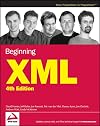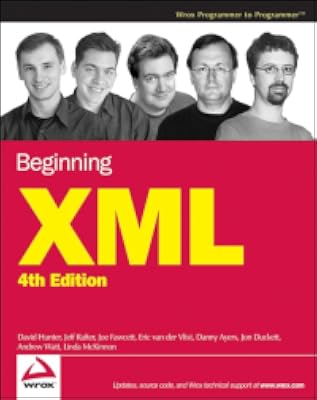
Beginning XML
by David Hunter
On This Page
Description
When the first edition of this book was written, XML was a relatively new language but already gaining ground fast and becoming more and more widely used in a vast range of applications. By the time of the second edition, XML had already proven itself to be more than a passing fad, and was in fact being used throughout the industry for an incredibly wide range of uses. With the third edition, it was clear that XML was a mature technology, but more important, it became evident that the XML show more landscape was dividing into several areas of expertise. Now in this edition, we needed to categorize the i show lessTags
Recommendations






Member Reviews
"Beginning XML" is a misleading title for this 1080-page tome. Only the first 250 pages fall into that category; the following 16 chapters are small tastes of various tools and uses for xml.
It's hard to think of an audience optimally suited for this book. It's not for a complete beginner. While it does try to explain what the various xml applications and tools are, it would be easy to get lot in the sea of acronyms without previous exposure to them. Yet, if you recognize the acronyms, chances are you already know the basics of well-formed xml. Frustrating, many of these topics are necessarily linked; the chapter on XPath makes reference to XSLT, covered in the subsequent chapter.
One of the book's strong points is the practical examples show more that make up a majority of each chapter; these are followed up with exercises whose answers are in the back. Unfortunately, some of these examples rely heavily on other languages, such as JavaScript, that aren't explained. As a book for beginners, it's unrealistic to expect the reader to be able to follow it closely.
"Beginning XML" is a decent introduction to the basics of xml, and tour of related tools and applications. The examples sometimes sacrifice clarity for the sake of impressing the reader, but with only 30-50 pages devoted to each topic, the authors only have room to inspire people to seek out other resources, rather than teach them much-- for better or worse.
(Q) show less
It's hard to think of an audience optimally suited for this book. It's not for a complete beginner. While it does try to explain what the various xml applications and tools are, it would be easy to get lot in the sea of acronyms without previous exposure to them. Yet, if you recognize the acronyms, chances are you already know the basics of well-formed xml. Frustrating, many of these topics are necessarily linked; the chapter on XPath makes reference to XSLT, covered in the subsequent chapter.
One of the book's strong points is the practical examples show more that make up a majority of each chapter; these are followed up with exercises whose answers are in the back. Unfortunately, some of these examples rely heavily on other languages, such as JavaScript, that aren't explained. As a book for beginners, it's unrealistic to expect the reader to be able to follow it closely.
"Beginning XML" is a decent introduction to the basics of xml, and tour of related tools and applications. The examples sometimes sacrifice clarity for the sake of impressing the reader, but with only 30-50 pages devoted to each topic, the authors only have room to inspire people to seek out other resources, rather than teach them much-- for better or worse.
(Q) show less
Ratings
Members
- Recently Added By
Author Information
3 Works 227 Members
David Hunter is a Senior Technical Consultant for CGI, the largest Canadian independent information technology (IT) services firm and the fifth largest in North America.
Series
Belongs to Publisher Series
Common Knowledge
- Canonical title
- Beginning XML
Classifications
- Genres
- Technology, Nonfiction, General Nonfiction
- DDC/MDS
- 006.74 — Computer science, information & general works Computer science, knowledge & systems Special computer methods (AI, barcoding, VR, web design, social media) Multimedia systems Markup Language
- LCC
- QA76.76 .H94 .B439 — Science Mathematics Mathematics Instruments and machines Calculating machines Electronic computers. Computer science Computer software
- BISAC
Statistics
- Members
- 205
- Popularity
- 160,142
- Reviews
- 1
- Rating
- (3.69)
- Languages
- English, Korean, Spanish
- Media
- Paper, Ebook
- ISBNs
- 13
- ASINs
- 1