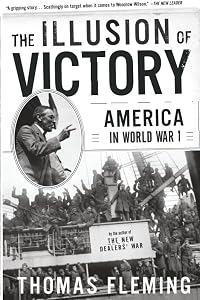
The Illusion Of Victory: America In World War I
by Thomas Fleming
On This Page
Description
"In this book, acclaimed historian Thomas Fleming undertakes nothing less than a drastic revision of America's experience in World War I. He reveals how the British and French duped Wilson and the American people into thinking the war was as good as won, and there would be no need to send an army overseas. He describes a harried president making speech after speech proclaiming America's ideals while supporting the Espionage and Sedition Acts that sent critics to federal prisons. Meanwhile, a show more government propaganda machine created a hate-driven "war will" that soon spilled over into attacks on ethnic Americans. On the Western Front, the Allies did their utmost to turn the American Expeditionary Force into cannon fodder. At the Paris Peace Conference, the cynical Europeans mocked Wilson and his ideals, and browbeat him into accepting the vengeful Treaty of Versailles, sowing the seeds of World War II."--BOOK JACKET. show lessTags
Recommendations










Member Reviews
A certain prominent American has recently proposed that November 11th be celebrated as “Victory Day for World War I” in America. That day had the more somber and appropriate designation of Armistice Day until 1968 when it became Veterans Day.
But what did America actually win in World War One?
Fleming offers a witty and devastating riposte that it was little. It’s not a revisionist book. There are no claims of new documents discovered. Just an unpleasant reminder of everything most Americans forgot (if they ever knew) about the war.
It’s primarily a book concerned with domestic and foreign politics under the Woodrow Wilson administration. In fact, much of it concerns America’s role in settling the peace (which didn’t actually show more happen in parts of Europe until 1924) after the armistice was declared.
In a narrow sense, America’s did contribute significantly to the victory on the Western Front.
But Wilson declared war on Germany in April 1917 (and, months later, on the Austro-Hungarian Empire) because he wanted a place at the treaty table in order to remake the world, provide a just settlement and not one for just the victors. He thought the war was almost won. America would just provide some naval and material support.
He was unpleasantly surprised to learn that, contrary to the massive British propaganda machine operating in America, the Germans were far from beaten and that American troops were needed.
And the troops were called out. And, after all was said and done, it is estimated 460,000 American troops died from their service. 50,300 died on the battlefield. 62,668 died of disease with more than 38,000 of those in training camps in America. And they weren’t all from the Spanish Flu. Despite the “preparedness movement”, those camps were poorly provided with shelter and clothing. 1,000 committed suicide during the war. More died from gas injuries after the war. And that was just from American troops spending slightly more than six months at the front.
Belleau Wood is a justly celebrated example of the tenacity of the United States Marine Corps. They suffered 42% casualties. But the battle was initiated without reconnaissance, a political exercise to show American troops were tougher than British and French, to show that Pershing’s idea of “open warfare” with just rifle and bayonet could win the day. The Wood, a square-mile of forest, was finally taken when the Marines were withdrawn and the Germans shelled for 14 hours and the Marines sent back in.
The Meusse-Argonne Offensive, still the largest offensive involving the U.S. Army as well as its deadliest, was another exercise in open warfare. Poorly fed troops advanced on a large front. Many got lost. An estimated 100,000 ran away, so many an order was issued to shoot them. (This is well-covered in John Dos Passos Three Soldiers.)
Eventually, Pershing turned command of two armies over to Hunter Liggett and Robert Lee Bullard. Those, along with Herbert Hoover, George Marshall, and Charles Dawes, are some of the few military and political leaders Fleming has no criticism of.
All the while the Allies pleaded for incorporation of American troops into their forces, Britain had 1.5 million troops in the United Kingdom because Lloyd George wanted them for internal security and to keep them out of the hands of Douglas Haig after Passchendaele.
And what was all this carnage for? A place at the victor’s table, to insure the peoples of the world right of self-determination, to have a world of no secret treaties, to ensure free movement of goods and people. War was declared by Wilson not against the German people but its Prussian government.
Except Senator “Fighting” Bob La Follette of Wisconsin answered every one of Wilson’s justifications for war at the time. Free navigation. What about the British blockade? Right of Americans to travel on the ships of countries at war and expect no harm. Should Americans expect no harm if they camped near a munitions dump at the front?
Wilson was particularly hypocritical on the issue of submarine warfare. Submarines were an uncivilized weapon of war claimed the British. So why did it commission, in violation of American law, Bethlehem Steel to build them for it? (Bethlehem Steel’s excuse was they were only building the parts. The submarines would be assembled in Canada.) The British put false flags on their Q-ships. Their official policy, if a German submarine did comply with “civilized” rules and surface and give a ship the chance to evacuate its crew, is that no surrender should occur in order to give any nearby British warships the chance to attack the submarine. The crews of German submarines were not to be afforded the protections of prisoners of war.
At Versailles, Wilson consented to the enforcement of those “secret treaties” he railed against. He allowed a blockade to starve hundreds of thousands of Germans to death though the German government he had once declared war against was gone. He allowed unreasonable repatriations to be enacted – reparations whose damage was foreseen even by some at Versailles. Herbert Hoover would end German payments in 1931. Germany became America’s leading trading partner in the 1920s, and the American troops occupying Germany found they liked the hated Hun better than the French or British they dealt with.
The cliché is that American isolationism killed America joining the League of Nations. There was probably a majority of support for the idea among the American people and in both parties for the idea. But they wanted some changes to Wilson’s proposal. But it was Wilson’s way or the highway. He made the 1920 election a referendum on his idea, and it was rejected.
It didn’t help that the Irish Americans turned against him for his failure to support Irish Independence. Italian Americans were angry he spoke against Italy claiming the city of Fiume.
President Warren G. Harding, after that election, announced a “return to normalcy”. Things had gotten very abnormal during the war years of Wilson. There was a massive suppression of civil rights. The sinister George Creel and his Committee on Public Information initiated the age of US government propaganda. In the war years, it also initiated private vigilantes who struck out against any citizen not deemed loyal enough. Political candidates were jailed. There were race riots during and after the war (including one in Washington DC) and labor unrest. The producer of the film Spirit of ’76 was jailed. His patriotic film of the American Revolution was deemed too critical of America’s ally Britain. Farmers (unless they were cotton growers) faced price controls.
The world this book covers is depressingly familiar to an American of the last ten years. Lying reporters collude with politicians. Government officials collude with foreign governments and seek to sabotage their superiors. Private organizations join in spreading the partisan lies they favor. A president’s disqualifying disability is kept hidden. Immigrants show unseemly concern with countries they supposedly abjured loyalty to. President use blustering rhetoric to sell their vacillating principles to their followers.
I did have a few quibbles. Fleming somewhat undersells the idea of German subversion in America. The Red Scare of 1919 and possibility of communist subversion and anarchic terrorism was there. The book could have used a better index.
But it’s not all about the great and good. Fleming gives us haunting accounts of what war, metal and blast wave meeting flesh, means in some sections on the experience of American women serving as nurses in France.
One recounts how she, with no medical training, was thrown into assisting with surgery. She learned her vocation. But, then, another casualty came in. A man she knew and a friend of the surgeon.
And, as they returned home to America, two women, both Red Cross volunteers in hospitals, kept to themselves, depressed. One night, both women threw themselves overboard. The woman relating the story, the writer Eunice Tietjens, said “I believe every one of us on that boat might have done the same.”
Fleming provides a brief alternate history of how America, and, specifically, Woodrow Wilson, could have had another sort of victory. If America had remained truly neutral, it’s likely a settlement would have been reached on the Western Front in 1916. The poor and broken combatants would have had to turn to America for economic support. Wilson could have leveraged that need to come closer to realizing his vision of a new world.
What did the victorious America win? Entanglement in European affairs. A Europe eventually broken by fascism and communism. Some Americans made a lot of money though.
Victory indeed. show less
But what did America actually win in World War One?
Fleming offers a witty and devastating riposte that it was little. It’s not a revisionist book. There are no claims of new documents discovered. Just an unpleasant reminder of everything most Americans forgot (if they ever knew) about the war.
It’s primarily a book concerned with domestic and foreign politics under the Woodrow Wilson administration. In fact, much of it concerns America’s role in settling the peace (which didn’t actually show more happen in parts of Europe until 1924) after the armistice was declared.
In a narrow sense, America’s did contribute significantly to the victory on the Western Front.
But Wilson declared war on Germany in April 1917 (and, months later, on the Austro-Hungarian Empire) because he wanted a place at the treaty table in order to remake the world, provide a just settlement and not one for just the victors. He thought the war was almost won. America would just provide some naval and material support.
He was unpleasantly surprised to learn that, contrary to the massive British propaganda machine operating in America, the Germans were far from beaten and that American troops were needed.
And the troops were called out. And, after all was said and done, it is estimated 460,000 American troops died from their service. 50,300 died on the battlefield. 62,668 died of disease with more than 38,000 of those in training camps in America. And they weren’t all from the Spanish Flu. Despite the “preparedness movement”, those camps were poorly provided with shelter and clothing. 1,000 committed suicide during the war. More died from gas injuries after the war. And that was just from American troops spending slightly more than six months at the front.
Belleau Wood is a justly celebrated example of the tenacity of the United States Marine Corps. They suffered 42% casualties. But the battle was initiated without reconnaissance, a political exercise to show American troops were tougher than British and French, to show that Pershing’s idea of “open warfare” with just rifle and bayonet could win the day. The Wood, a square-mile of forest, was finally taken when the Marines were withdrawn and the Germans shelled for 14 hours and the Marines sent back in.
The Meusse-Argonne Offensive, still the largest offensive involving the U.S. Army as well as its deadliest, was another exercise in open warfare. Poorly fed troops advanced on a large front. Many got lost. An estimated 100,000 ran away, so many an order was issued to shoot them. (This is well-covered in John Dos Passos Three Soldiers.)
Eventually, Pershing turned command of two armies over to Hunter Liggett and Robert Lee Bullard. Those, along with Herbert Hoover, George Marshall, and Charles Dawes, are some of the few military and political leaders Fleming has no criticism of.
All the while the Allies pleaded for incorporation of American troops into their forces, Britain had 1.5 million troops in the United Kingdom because Lloyd George wanted them for internal security and to keep them out of the hands of Douglas Haig after Passchendaele.
And what was all this carnage for? A place at the victor’s table, to insure the peoples of the world right of self-determination, to have a world of no secret treaties, to ensure free movement of goods and people. War was declared by Wilson not against the German people but its Prussian government.
Except Senator “Fighting” Bob La Follette of Wisconsin answered every one of Wilson’s justifications for war at the time. Free navigation. What about the British blockade? Right of Americans to travel on the ships of countries at war and expect no harm. Should Americans expect no harm if they camped near a munitions dump at the front?
Wilson was particularly hypocritical on the issue of submarine warfare. Submarines were an uncivilized weapon of war claimed the British. So why did it commission, in violation of American law, Bethlehem Steel to build them for it? (Bethlehem Steel’s excuse was they were only building the parts. The submarines would be assembled in Canada.) The British put false flags on their Q-ships. Their official policy, if a German submarine did comply with “civilized” rules and surface and give a ship the chance to evacuate its crew, is that no surrender should occur in order to give any nearby British warships the chance to attack the submarine. The crews of German submarines were not to be afforded the protections of prisoners of war.
At Versailles, Wilson consented to the enforcement of those “secret treaties” he railed against. He allowed a blockade to starve hundreds of thousands of Germans to death though the German government he had once declared war against was gone. He allowed unreasonable repatriations to be enacted – reparations whose damage was foreseen even by some at Versailles. Herbert Hoover would end German payments in 1931. Germany became America’s leading trading partner in the 1920s, and the American troops occupying Germany found they liked the hated Hun better than the French or British they dealt with.
The cliché is that American isolationism killed America joining the League of Nations. There was probably a majority of support for the idea among the American people and in both parties for the idea. But they wanted some changes to Wilson’s proposal. But it was Wilson’s way or the highway. He made the 1920 election a referendum on his idea, and it was rejected.
It didn’t help that the Irish Americans turned against him for his failure to support Irish Independence. Italian Americans were angry he spoke against Italy claiming the city of Fiume.
President Warren G. Harding, after that election, announced a “return to normalcy”. Things had gotten very abnormal during the war years of Wilson. There was a massive suppression of civil rights. The sinister George Creel and his Committee on Public Information initiated the age of US government propaganda. In the war years, it also initiated private vigilantes who struck out against any citizen not deemed loyal enough. Political candidates were jailed. There were race riots during and after the war (including one in Washington DC) and labor unrest. The producer of the film Spirit of ’76 was jailed. His patriotic film of the American Revolution was deemed too critical of America’s ally Britain. Farmers (unless they were cotton growers) faced price controls.
The world this book covers is depressingly familiar to an American of the last ten years. Lying reporters collude with politicians. Government officials collude with foreign governments and seek to sabotage their superiors. Private organizations join in spreading the partisan lies they favor. A president’s disqualifying disability is kept hidden. Immigrants show unseemly concern with countries they supposedly abjured loyalty to. President use blustering rhetoric to sell their vacillating principles to their followers.
I did have a few quibbles. Fleming somewhat undersells the idea of German subversion in America. The Red Scare of 1919 and possibility of communist subversion and anarchic terrorism was there. The book could have used a better index.
But it’s not all about the great and good. Fleming gives us haunting accounts of what war, metal and blast wave meeting flesh, means in some sections on the experience of American women serving as nurses in France.
One recounts how she, with no medical training, was thrown into assisting with surgery. She learned her vocation. But, then, another casualty came in. A man she knew and a friend of the surgeon.
And, as they returned home to America, two women, both Red Cross volunteers in hospitals, kept to themselves, depressed. One night, both women threw themselves overboard. The woman relating the story, the writer Eunice Tietjens, said “I believe every one of us on that boat might have done the same.”
Fleming provides a brief alternate history of how America, and, specifically, Woodrow Wilson, could have had another sort of victory. If America had remained truly neutral, it’s likely a settlement would have been reached on the Western Front in 1916. The poor and broken combatants would have had to turn to America for economic support. Wilson could have leveraged that need to come closer to realizing his vision of a new world.
What did the victorious America win? Entanglement in European affairs. A Europe eventually broken by fascism and communism. Some Americans made a lot of money though.
Victory indeed. show less
Ratings
Members
- Recently Added By
Author Information

68+ Works 3,768 Members
Common Knowledge
- Original publication date
- 2003
- People/Characters
- Woodrow Wilson
- Important events
- World War I (1914 | 1918)
Classifications
Statistics
- Members
- 188
- Popularity
- 174,585
- Reviews
- 1
- Rating
- (3.71)
- Languages
- English
- Media
- Paper, Ebook
- ISBNs
- 3
- ASINs
- 1