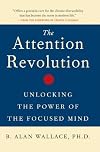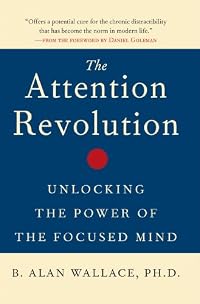
The Attention Revolution: Unlocking the Power of the Focused Mind
by B. Alan Wallace
On This Page
Description
Meditation offers, in addition to its many other benefits, a method for achieving previously inconceivable levels of concentration. Author B. Alan Wallace has nearly thirty years' practice in attention-enhancing meditation, including a retreat he performed under the guidance of the Dalai Lama. An active participant in the much-publicized dialogues between Buddhists and scientists, Alan is uniquely qualified to speak intelligently to both camps, and The Attention Revolution is the definitive show more presentation of his knowledge. Beginning by pointing out the ill effects that follow from our inability to focus, Wallace moves on to explore a systematic path of meditation to deepen our capacity for deep concentration. The result is an exciting, rewarding "expedition of the mind," tracing everything from the confusion at the bottom of the trail to the extraordinary clarity and power that come with making it to the top. Along the way, the author also provides interludes and complementary practices for cultivating love, compassion, and clarity in our waking and dreaming lives. Attention is the key that makes personal change possible, and the good news is that it can be trained. This book shows how. show lessTags
Recommendations












Member Reviews
This book grew on me as I read it. At first, I felt quite discouraged by Wallace's frequent references about the true amount of time that one would likely need to spend to even begin to possibly achieve shamatha, particularly during modern times for those of us that have "worldly duties" [my words, not his].
Furthermore, he indicates that Buddhist experts believe that it is rare, at least during our modern times, to achieve shamatha.
Wallace has over 30 years practice, and it is not clear from this book whether he reached shamatha.
Nevertheless, as I finished the book, I was encouraged to recall that Wallace asserts early on in the book (and other references confirm) that even earlier stages and practices of attention are definitely show more beneficial.
It was also fascinating to read small snippets of Wallace's interweaving the concepts of physics and Buddhist philosophy. Though this book only touches on these interrelationships, it was enough to entice me to read more of Wallace's books.
Finally, the techniques and practices of meditation and attention and frequent exhortations of Wallace regarding letting go of one's preexisting conceptualizations, helped to open my mind regarding the nature of consciousness and even reality. show less
Furthermore, he indicates that Buddhist experts believe that it is rare, at least during our modern times, to achieve shamatha.
Wallace has over 30 years practice, and it is not clear from this book whether he reached shamatha.
Nevertheless, as I finished the book, I was encouraged to recall that Wallace asserts early on in the book (and other references confirm) that even earlier stages and practices of attention are definitely show more beneficial.
It was also fascinating to read small snippets of Wallace's interweaving the concepts of physics and Buddhist philosophy. Though this book only touches on these interrelationships, it was enough to entice me to read more of Wallace's books.
Finally, the techniques and practices of meditation and attention and frequent exhortations of Wallace regarding letting go of one's preexisting conceptualizations, helped to open my mind regarding the nature of consciousness and even reality. show less
A really good book, which clearly and closely describes the differing stages and advancement if Shamatha meditation. The author quite carefully distinguishes some subtle differences to Vipanassa (mindfulness) meditation referencing the methods of Henepola Gurantana. Some of these I have read and much appreciated. Def a book to come back to, especially the first few chapters. A lay practitioner will almost certainly not progress beyond the first few stages. (Much as an amateur sports person is unlikely to progress to levels of elite sport.) However, there is a lot of clarity and detail to help withose first stages.
The is an excellent, practical introduction to meditation from a secular point of view - great for both beginner and advanced practitioner.
philosophy of mind and meditation theory from Tibetan perspective
not bad note book #823
La tesi di questo libro è che si può non solo accrescere la durata e la concentrazione dell'attenzione, ma addirittura aumentare radicalmente tali qualità. Mentre è notevole l'assenza di cognizioni scientifiche sulla cura dei disturbi di attenzione, nelle tradizioni contemplative lo sviluppo dell'attenzione stabile, nota nel buddhismo col termine "samatha", rappresenta da millenni un elemento chiave, originando un vasto insieme di pratiche e tecniche dovute essenzialmente al fatto che la mente non addestrata, oscillando fra agitazione e torpore, e fra irrequietezza e noia, è del tutto inadatta a qualsiasi genere di meditazione. Quadro di riferimento del presente volume, una vera e propria guida sul sentiero dello "samatha", è la show more celebre opera di Kamalasila, maestro buddhista dell'VII secolo, che individua dieci stadi nello sviluppo graduale dell'attenzione. Se solo raggiungesse il secondo dei dieci stadi, la maggior parte degli individui noterebbe un grande miglioramento nella propria vita, e nonostante tale livello di sviluppo richieda un certo sforzo, può essere ottenuto da persone che svolgono una vita piena d'impegni professionali e familiari, purché siano disposte a riservare un po' di tempo alla meditazione. show less
Sep 10, 2015Italian
Ratings
Members
- Recently Added By
Author Information

53+ Works 2,205 Members
B. Alan Wallace teaches at the University of California, Santa Barbara. (Bowker Author Biography)
All Editions
Some Editions
Common Knowledge
- Canonical title
- The Attention Revolution: Unlocking the Power of the Focused Mind
- Original publication date
- 2006
- First words
- Few things affect our lives more than our facility of attention.
Classifications
- Genres
- Nonfiction, Religion & Spirituality, General Nonfiction
- DDC/MDS
- 294.34435 — Religion Other religions Buddhism/Hinduism Buddhism Buddhism - practice Religious experience, life, practice Worship, meditation, yoga Meditation
- LCC
- BQ7805 .W33 — Philosophy, Psychology and Religion Buddhism Buddhism Modifications, schools, etc. Tibetan Buddhism (Lamaism)
- BISAC
Statistics
- Members
- 289
- Popularity
- 110,942
- Reviews
- 6
- Rating
- (3.76)
- Languages
- 5 — Catalan, English, German, Italian, Portuguese
- Media
- Paper, Audiobook, Ebook
- ISBNs
- 10
- ASINs
- 5