
Matthieu Ricard
Author of Happiness: A Guide to Developing Life's Most Important Skill
About the Author
Matthieu Ricard, a Buddhist monk residing in Katmandu, is a coauthor of "The Monk & the Philosopher" & is the official French translator of His Holiness the Dalai Lama. (Bowker Author Biography)
Works by Matthieu Ricard
The Monk and the Philosopher: A Father and Son Discuss the Meaning of Life (1998) — Author — 734 copies, 7 reviews
The Quantum and the Lotus: A Journey to the Frontiers Where Science and Buddhism Meet (2000) 555 copies, 10 reviews
On the Path to Enlightenment: Heart Advice from the Great Tibetan Masters (2001) — Author — 148 copies, 3 reviews
A Plea for the Animals: The Moral, Philosophical, and Evolutionary Imperative to Treat All Beings with Compassion (2014) 105 copies, 4 reviews
In Search of Wisdom: A Monk, a Philosopher, and a Psychiatrist on What Matters Most (2014) — Author — 98 copies, 2 reviews
Journey to Enlightenment: The Life and World of Khyentse Rinpoche, Spiritual Teacher From Tibet (1996) 49 copies
The Spirit of Tibet: The Life and World of Khyentse Rinpoche, Spiritual Teacher (1998) 48 copies, 1 review
Our Animal Neighbors: Compassion for Every Furry, Slimy, Prickly Creature on Earth (2020) 13 copies, 2 reviews
Freedom for All of Us: A Monk, a Philosopher, and a Psychiatrist on Finding Inner Peace (2020) 5 copies
Allumfassende Nächstenliebe: ALTRUISMUS - die Antwort auf die Herausforderungen unserer Zeit (2017) 3 copies
felicidade 1 copy
Journey to Enlightenment–The Life and World of Khyentse Rinpoche, Spiritual Teacher from Tibet 1 copy
The Life of Shabkar 1 copy
Associated Works
Emotional Awareness: Overcoming the Obstacles to Psychological Balance and Compassion (2008) — Foreword, some editions — 235 copies, 5 reviews
The Great Medicine That Conquers Clinging to the Notion of Reality: Steps in Meditation on the Enlightened Mind (2007) — Foreword, some editions — 40 copies
Buddha, the Brain and the Science of Happiness (2007) — Preface, some editions — 24 copies, 2 reviews
Tagged
Common Knowledge
- Birthdate
- 1946-02-15
- Gender
- male
- Education
- Pasteur Institute
- Relationships
- Revel, Jean-François (father)
- Nationality
- France
- Associated Place (for map)
- France
Members
Reviews
Our Animal Neighbors: Compassion for Every Furry, Slimy, Prickly Creature on Earth by Matthieu Ricard

Consider that this big, round earth is in fact one single neighborhood, and every living being is our neighbor. How might this affect the way we treat animals? Our Animal Neighbors celebrates the rich diversity of skills, habits, needs, and homes that creatures on this earth have, and yet reminds us that we all, from ant to octopus to human being, live as part of one global community.
The book was co-written by Matthieu Ricard, Buddhist monk, teacher, and author of A Plea for the Animals, and show more Jason Gruhl, a psychotherapist and founder of The Joshua School who recently wrote the lovely children’s book Everything Is Connected. Our Animal Neighbors brings together Ricard’s dedication to animal welfare and Gruhl’s talent for making interconnection and interdependence fun, personal and accessible for children. The result is an informative exploration of the world’s species and ecosystems, and the ways we humans affect other beings around us. It’s a warm and friendly book that invites us to think outside of the anthropocentric box and access our compassion for all living things.
Note: this book advocates for the reduction of meat consumption, and offers others resources for supporting animal welfare. show less
The book was co-written by Matthieu Ricard, Buddhist monk, teacher, and author of A Plea for the Animals, and show more Jason Gruhl, a psychotherapist and founder of The Joshua School who recently wrote the lovely children’s book Everything Is Connected. Our Animal Neighbors brings together Ricard’s dedication to animal welfare and Gruhl’s talent for making interconnection and interdependence fun, personal and accessible for children. The result is an informative exploration of the world’s species and ecosystems, and the ways we humans affect other beings around us. It’s a warm and friendly book that invites us to think outside of the anthropocentric box and access our compassion for all living things.
Note: this book advocates for the reduction of meat consumption, and offers others resources for supporting animal welfare. show less
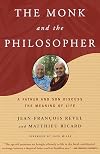
The Monk and the Philosopher
~ The Provident Son
The relationship between father and son is always complex. Fathers want the best for their sons, and sons balance a natural tension of wanting to learn from father, and live up to his father’s expectations, while exploring all that is new and exciting in the world. It is a respectful yet powerful tension between old and new, experience and novelty, obedience and autonomy, belief and curiosity, advice and adventure. This tension is richly show more realized throughout the remarkable dialogue created by these two brilliant men. The monk shares and explains what he learns from his years of conscientious practice of the Buddhist traditions. The philosopher critically analyzes what the monk presents and compares it to the philosophical traditions of the West while struggling to learn from his son.
The philosopher-father begins by asking the monk-son why he decided to leave a promising career as a molecular biologist to commit himself completely to the Buddhist practice. “In short”, he answers, “science however interesting wasn’t enough to give meaning to my life.” Based on the limited exposure he had to the contemplative lifestyle through extraordinary documentary films by Arnaud Desjardins, he saw that the monks were the most sincerely happy people he knew of, and he wanted to explore and experience their authentic lifestyle for himself. “I had the impression of seeing the living beings who were the very image of what they taught.” He goes on to say, “here were beings who seemed to be the living examples of wisdom.” He met the Tibetan Buddhist lama, Kangyur Rinpoche and eventually studied with him for years until the teacher’s death in 1975. He went on to study with Khysntse Rinpoche for 12 more years and was ordained as a monk in 1979. The younger monk seems wholly content with his decision.
“Suffering is the result of ignorance,” he learned, and “ignorance, in essence is belief in a truly existing self and in the solidly of phenomena”. However skeptical at first, observing the perfect being of his teacher convinced him of this truth and inspired him to absorb himself in the practice. He went on to learn that negative emotions arise from the notion of a self, the “me” that we all cherish, however, “attachment to the self is a fact, but the self that is the object of that attachment has no true existence; it exists nowhere and in no way as an autonomous and permanent entity.” Destructive thoughts, such as hatred, are “liberated by looking at their nature”, recognizing that thoughts have no substance, and releasing yourself from the illusion of their grip.
To dissolve a thought, begin by breaking the flow of thoughts for a few minutes. Just remain in awareness of the present moment, free of any conscious thoughts. As thoughts reappear, begin to examine the nature of discursive thoughts, looking for their source and substance, until you reach a state of ‘not found’ where thoughts vanish without leaving a trace. With the thought dissolved you can enter a state of inner simplicity, clear mindfulness, and awareness absent of any concepts. The monk attests that “working on oneself inwardly in this way gets rid of hatred, desire, jealousy, pride, and everything else that disturbs the mind.”
The extraordinary introspective skills and beliefs of Buddhist monks are the results of years of conscientious practice guided by “contemplative science.” The philosopher is skeptical, and refuses to accept evidence that is not materially observable by anyone wishing to see for himself. The monk compares the feats of Buddhist contemplatives to the skills of an Olympic athlete, who after many years of training, can jump 8 feet high. Certainly the ability to jump that high is extraordinary, and greatly exceeds the ability of any untrained athlete. We would not believe this was possible if we could not go to a track meet or watch coverage on TV and see extraordinary athletes repeating this amazing skill. The skills of highly trained monks are equally extraordinary, but not observable by others. However we can consider reliable testimony by many credible practitioners who have no reason to mislead or deceive. “A statement can be accepted as valid”, the monk argues, “when there are substantial reasons for believing the person making it”. In addition, we can directly observe the serenity of these expert practitioners.
“Action on the world is desirable”, the monk tells his father, “while inner transformation is indispensable.”, “This opening of the eyes of wisdom” he says referring to dismissing the illusions, “Increases your strength of mind, your diligence, and your capacity to take appropriate and altruistic action.” This requires a strong mind, an unshakable certainty, and a radiant personality, without the slightest trace of ego, selfishness, or self-centeredness. “If a prisoner wants to free his companions in misfortune, he must first break out of his own chains”, the monk assures us, “It’s the only way to do it”. The philosopher asks, “Do you mean that the only way to attain lasting peace in the world is the reform of the individuals?” The monk replies, “To think otherwise is surely utopian.” “In any case,” the monk elaborates, “the first thing is to make peace within oneself — inner disarmament; then peace in the family; then in the village; and finally in the nation and beyond.”
“Western efficiency is a major contribution to minor needs” the son proposes to his skeptical father, “What Buddhism could help to change is the overall attitude that consists of giving priority to ‘having’ over ‘being’. It’s a matter of establishing a new order of values, giving priority to the quest for inner well-being.” Buddhism provides a vision of tolerance, open-mindedness, altruism, quiet confidence, a science of the mind through which all people, including westerners, can find their own inner peace. Buddhism simply offers to share an experience with anyone who wishes. The point isn’t to convert people but to contribute to their well-being.
A disturbing chapter describes the Chinese invasion, occupation, and on-going destruction of Tibet, its people, and its culture since 1950. Millions of Tibetans were slaughtered, and 6,150 monasteries were destroyed nearly annihilating this unique and most peaceful culture. Despite this genocide the strong will of the Tibetan people still survives. The Dalai Lama lives in exile with about 100,000 Tibetans who still seek a peaceful return to their homeland. He often says, “Tibet has no petrol for engines, like Kuwait, but it does have petrol for the mind which should justify other countries coming to its rescue.” He points out the advantages to be gained in making Tibet a buffer state, a haven of peace in the middle of major Asian powers. He passionately advocates for support from the most powerful nations and patiently awaits their action.
The monk offers us many more pearls; each explored in much more depth in the book:
+ Truth is strong enough by itself to convince, and should never be imposed by force.
+ The goal of nonviolence is specifically to diminish violence. It’s not a passive approach.
+ Evil has no more existence than a mistake; it is only an incorrect perception of reality.
+ The great virtue of sin is precisely that it doesn’t have any true existence. There’s therefore no negative action or thought that can’t be dissolved, purified, or repaired.
+ The idea of man’s true nature can be understood as a state of balance, while violence is a state of imbalance.
+ It’s obvious that unless a sense of responsibility develops in all the individuals sharing this planet, it’ll be very difficult to apply any democratic ideals.
+ Enlightenment is the discovery of the ultimate nature of both oneself and phenomena.
+ Mastery of oneself, like so many other qualities, is only something of true value when it’s based on the right motivation and metaphysical principles.
+ What Buddhism calls meditation is a gradual discovery, over years of practice, of the nature of the mind and how mental events appear in it.
+ It doesn’t make much sense to think that because a truth is an ancient truth it’s no longer worth bothering about.
+ In spiritual practices the difficulties come at the beginning, and in worldly practice the difficulties come at the end.
+ Without wisdom, reason will just argue about human happiness without ever actually bringing it about. Education needs to be more than just the accumulation of knowledge; it should really be education on how to be.
In the end each man gains a deeper understanding and appreciation for the other’s beliefs, but neither abandons his chosen path. show less
~ The Provident Son
The relationship between father and son is always complex. Fathers want the best for their sons, and sons balance a natural tension of wanting to learn from father, and live up to his father’s expectations, while exploring all that is new and exciting in the world. It is a respectful yet powerful tension between old and new, experience and novelty, obedience and autonomy, belief and curiosity, advice and adventure. This tension is richly show more realized throughout the remarkable dialogue created by these two brilliant men. The monk shares and explains what he learns from his years of conscientious practice of the Buddhist traditions. The philosopher critically analyzes what the monk presents and compares it to the philosophical traditions of the West while struggling to learn from his son.
The philosopher-father begins by asking the monk-son why he decided to leave a promising career as a molecular biologist to commit himself completely to the Buddhist practice. “In short”, he answers, “science however interesting wasn’t enough to give meaning to my life.” Based on the limited exposure he had to the contemplative lifestyle through extraordinary documentary films by Arnaud Desjardins, he saw that the monks were the most sincerely happy people he knew of, and he wanted to explore and experience their authentic lifestyle for himself. “I had the impression of seeing the living beings who were the very image of what they taught.” He goes on to say, “here were beings who seemed to be the living examples of wisdom.” He met the Tibetan Buddhist lama, Kangyur Rinpoche and eventually studied with him for years until the teacher’s death in 1975. He went on to study with Khysntse Rinpoche for 12 more years and was ordained as a monk in 1979. The younger monk seems wholly content with his decision.
“Suffering is the result of ignorance,” he learned, and “ignorance, in essence is belief in a truly existing self and in the solidly of phenomena”. However skeptical at first, observing the perfect being of his teacher convinced him of this truth and inspired him to absorb himself in the practice. He went on to learn that negative emotions arise from the notion of a self, the “me” that we all cherish, however, “attachment to the self is a fact, but the self that is the object of that attachment has no true existence; it exists nowhere and in no way as an autonomous and permanent entity.” Destructive thoughts, such as hatred, are “liberated by looking at their nature”, recognizing that thoughts have no substance, and releasing yourself from the illusion of their grip.
To dissolve a thought, begin by breaking the flow of thoughts for a few minutes. Just remain in awareness of the present moment, free of any conscious thoughts. As thoughts reappear, begin to examine the nature of discursive thoughts, looking for their source and substance, until you reach a state of ‘not found’ where thoughts vanish without leaving a trace. With the thought dissolved you can enter a state of inner simplicity, clear mindfulness, and awareness absent of any concepts. The monk attests that “working on oneself inwardly in this way gets rid of hatred, desire, jealousy, pride, and everything else that disturbs the mind.”
The extraordinary introspective skills and beliefs of Buddhist monks are the results of years of conscientious practice guided by “contemplative science.” The philosopher is skeptical, and refuses to accept evidence that is not materially observable by anyone wishing to see for himself. The monk compares the feats of Buddhist contemplatives to the skills of an Olympic athlete, who after many years of training, can jump 8 feet high. Certainly the ability to jump that high is extraordinary, and greatly exceeds the ability of any untrained athlete. We would not believe this was possible if we could not go to a track meet or watch coverage on TV and see extraordinary athletes repeating this amazing skill. The skills of highly trained monks are equally extraordinary, but not observable by others. However we can consider reliable testimony by many credible practitioners who have no reason to mislead or deceive. “A statement can be accepted as valid”, the monk argues, “when there are substantial reasons for believing the person making it”. In addition, we can directly observe the serenity of these expert practitioners.
“Action on the world is desirable”, the monk tells his father, “while inner transformation is indispensable.”, “This opening of the eyes of wisdom” he says referring to dismissing the illusions, “Increases your strength of mind, your diligence, and your capacity to take appropriate and altruistic action.” This requires a strong mind, an unshakable certainty, and a radiant personality, without the slightest trace of ego, selfishness, or self-centeredness. “If a prisoner wants to free his companions in misfortune, he must first break out of his own chains”, the monk assures us, “It’s the only way to do it”. The philosopher asks, “Do you mean that the only way to attain lasting peace in the world is the reform of the individuals?” The monk replies, “To think otherwise is surely utopian.” “In any case,” the monk elaborates, “the first thing is to make peace within oneself — inner disarmament; then peace in the family; then in the village; and finally in the nation and beyond.”
“Western efficiency is a major contribution to minor needs” the son proposes to his skeptical father, “What Buddhism could help to change is the overall attitude that consists of giving priority to ‘having’ over ‘being’. It’s a matter of establishing a new order of values, giving priority to the quest for inner well-being.” Buddhism provides a vision of tolerance, open-mindedness, altruism, quiet confidence, a science of the mind through which all people, including westerners, can find their own inner peace. Buddhism simply offers to share an experience with anyone who wishes. The point isn’t to convert people but to contribute to their well-being.
A disturbing chapter describes the Chinese invasion, occupation, and on-going destruction of Tibet, its people, and its culture since 1950. Millions of Tibetans were slaughtered, and 6,150 monasteries were destroyed nearly annihilating this unique and most peaceful culture. Despite this genocide the strong will of the Tibetan people still survives. The Dalai Lama lives in exile with about 100,000 Tibetans who still seek a peaceful return to their homeland. He often says, “Tibet has no petrol for engines, like Kuwait, but it does have petrol for the mind which should justify other countries coming to its rescue.” He points out the advantages to be gained in making Tibet a buffer state, a haven of peace in the middle of major Asian powers. He passionately advocates for support from the most powerful nations and patiently awaits their action.
The monk offers us many more pearls; each explored in much more depth in the book:
+ Truth is strong enough by itself to convince, and should never be imposed by force.
+ The goal of nonviolence is specifically to diminish violence. It’s not a passive approach.
+ Evil has no more existence than a mistake; it is only an incorrect perception of reality.
+ The great virtue of sin is precisely that it doesn’t have any true existence. There’s therefore no negative action or thought that can’t be dissolved, purified, or repaired.
+ The idea of man’s true nature can be understood as a state of balance, while violence is a state of imbalance.
+ It’s obvious that unless a sense of responsibility develops in all the individuals sharing this planet, it’ll be very difficult to apply any democratic ideals.
+ Enlightenment is the discovery of the ultimate nature of both oneself and phenomena.
+ Mastery of oneself, like so many other qualities, is only something of true value when it’s based on the right motivation and metaphysical principles.
+ What Buddhism calls meditation is a gradual discovery, over years of practice, of the nature of the mind and how mental events appear in it.
+ It doesn’t make much sense to think that because a truth is an ancient truth it’s no longer worth bothering about.
+ In spiritual practices the difficulties come at the beginning, and in worldly practice the difficulties come at the end.
+ Without wisdom, reason will just argue about human happiness without ever actually bringing it about. Education needs to be more than just the accumulation of knowledge; it should really be education on how to be.
In the end each man gains a deeper understanding and appreciation for the other’s beliefs, but neither abandons his chosen path. show less
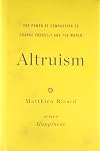
Excellently heartfelt and well-researched tome that arrives at a definition and tackles various subjects such as: Can animals act altruistically; the selfishness of corporations (Monsanto the perfect example), and many others, all with footnotes and a rather extensive bibliography. I particularly enjoyed the section on animals, which waded into the murky waters of stubborn scientists who refuse against all evidence to use language that admits that animals do indeed feel fear and loyalty and show more love; he asks "Can we call a spade a spade?" Ricard furnishes many examples of animals that rather do prove that animals can and do act altruistically (the chimp who dashes across electrical wires to rescue a drowning friend; such spontaneity precluded calculation, but had the other chimp drowned, there would be no point of expecting return kindness in future; and the elephant that lost part of its trunk to a snare, who was assisted and waited on by others until he'd regained some strength). Also really heartening was the Monsanto section in which "Vandana Shiva, recipient of the Right Livelihood Award (the 'alternative Nobel Prize') in 2003 and named by The Guardian one of the 100 most remarkable women in the world, fights against the practices that are at the root of so many acts of despair in India." It gives one hope to read about people fighting against such corporate greed in a country where 270,940 Indian farmer suicides have occurred since 1995. You give capitalism a bad name, Monsanto, procurer of DDT, Agent Orange, GMOs, Roundup, and Aroclor! All in all, a huge, easy-to-read effort from a onetime geneticist who turned his back on his trade. show less
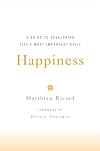
After receiving his doctorate in molecular biology, Frenchman Matthieu Ricard chose to leave his privileged life for the ascetic life of a Buddhist monk. Since then he has been called the happiest person in the world. In this book he describes paths toward happiness drawn from ancient traditions and modern science.
Happiness is a general term encompassing many different experiences. It is important to distinguish pleasure—a fleeting emotion often based on outer circumstances—from show more contentment—an optimal and long-lasting state of being with an enlightened state of mind—the enduring form of happiness discussed in this book.
Ignorance in the form of ego involvement—described here as attachment to the illusion of the self—is the primary obstacle to happiness. A calm mind, attained through mediation, is essential to lifting the veil, seeing past the illusion, and allowing compassion to flourish. Exercises throughout the book help the conscientious reader practice these mental disciplines and move toward optimal states of being.
I imagine detaching the self by visualizing it as a spoiled three year old child. Think of taking a bratty toddler shopping. He might nag you to buy every toy in sight, make cruel and nasty comments about the appearance or behavior of other shoppers, impatiently ask to go home right now, annoy you with constant whining and misbehavior, and start crying at the least inconvenience. But you are not that child; you can use good judgment, act responsibly, calm the child, and move away from those behaviors. Similarly, the self—that bratty ego—can also be displaced, ignored, and silenced, because it has no substance.
Rigorous scientific examination, using EEG, fMRI, and other techniques confirm that monks who have extensively practiced various meditation techniques have achieved remarkably high levels of positive emotional experiences, mental coherence, and peace of mind. Ricard integrates ancient traditions with modern scientific thought to provide a coherent and reliable message.
A variety of mental disciplines are described, including a general technique for dispelling destructive emotions, and specific remedies to extinguish desire, hatred, and envy. Environmental, biological, and sociological factors affecting well-being are described, and many of these are within our control. The role of humility, optimism, perspectives on time, flow, ethics, and death are all explored in their own chapters.
Although the techniques are derived from the Buddhist traditions, they are presented here as entirely secular skills. The book is exceptionally well written, deep, and entirely accessible to the Western reader. This is not a how-to book full of quick fixes and platitudes. The simple paths described here require commitment, discipline, and practice. They may well change your life. show less
Happiness is a general term encompassing many different experiences. It is important to distinguish pleasure—a fleeting emotion often based on outer circumstances—from show more contentment—an optimal and long-lasting state of being with an enlightened state of mind—the enduring form of happiness discussed in this book.
Ignorance in the form of ego involvement—described here as attachment to the illusion of the self—is the primary obstacle to happiness. A calm mind, attained through mediation, is essential to lifting the veil, seeing past the illusion, and allowing compassion to flourish. Exercises throughout the book help the conscientious reader practice these mental disciplines and move toward optimal states of being.
I imagine detaching the self by visualizing it as a spoiled three year old child. Think of taking a bratty toddler shopping. He might nag you to buy every toy in sight, make cruel and nasty comments about the appearance or behavior of other shoppers, impatiently ask to go home right now, annoy you with constant whining and misbehavior, and start crying at the least inconvenience. But you are not that child; you can use good judgment, act responsibly, calm the child, and move away from those behaviors. Similarly, the self—that bratty ego—can also be displaced, ignored, and silenced, because it has no substance.
Rigorous scientific examination, using EEG, fMRI, and other techniques confirm that monks who have extensively practiced various meditation techniques have achieved remarkably high levels of positive emotional experiences, mental coherence, and peace of mind. Ricard integrates ancient traditions with modern scientific thought to provide a coherent and reliable message.
A variety of mental disciplines are described, including a general technique for dispelling destructive emotions, and specific remedies to extinguish desire, hatred, and envy. Environmental, biological, and sociological factors affecting well-being are described, and many of these are within our control. The role of humility, optimism, perspectives on time, flow, ethics, and death are all explored in their own chapters.
Although the techniques are derived from the Buddhist traditions, they are presented here as entirely secular skills. The book is exceptionally well written, deep, and entirely accessible to the Western reader. This is not a how-to book full of quick fixes and platitudes. The simple paths described here require commitment, discipline, and practice. They may well change your life. show less
Lists
Awards


You May Also Like


Associated Authors
Statistics
- Works
- 80
- Also by
- 9
- Members
- 4,041
- Popularity
- #6,228
- Rating
- 3.9
- Reviews
- 76
- ISBNs
- 303
- Languages
- 21
- Favorited
- 3


