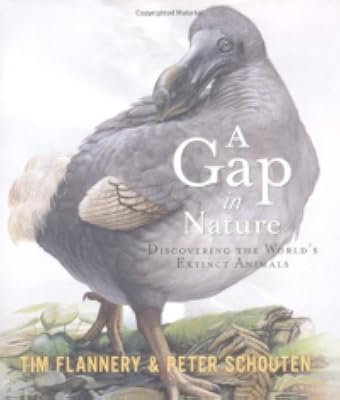
A Gap in Nature: Discovering the World's Extinct Animals
by Tim Flannery (Author), Peter Schouten (Illustrator)
On This Page
Description
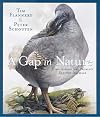
A short description of the extinct animal along with a color drawing.Tags
Recommendations











Member Reviews
One of the most beautiful yet incredibly sad books I've ever read. Beautiful because the paintings that adorn this book are simply breathtaking. Sad because these paintings are the only way that anyone will ever see these wonderul animals ever again. Particularly heartwrenching are the stories of the small, unnoticed creatures that lived their lives quietly and unobtrusively, and just as quietly and unobtrusively,almost apologetically, slipped out of existence with hardly anyone realising they were there in the first place. This book will smack you in the solar plexus with the absolute finality of extinction at the same time it will seduce your eyes with the beauty of these creatures now lost forever. The title of this book is show more absolutely apt - the loss of any creature really does leave a gap in nature than can never be filled, and this book brings that fact home with numbing power. show less
There is an apocryphal story about frogs and boiling water: Put a frog into a pan of boiling water, it will jump right out. But put a frog into a pan of cool water, and slowly heat it up, the frog will just sit there, until it slowly cooks itself. It is a cautionary fable about the way human beings condition themselves to unlivable circumstances.
The defining line between how good things were, and how bad things are is rarely distinct. It is a slow encroachment on the quality of life- a wooded lot makes way for housing. A neighborhood street gets an extra lane. A few less birds visit the backyard feeder. When they stop coming altogether, it is too late.
It might be a surprise to learn that many of the birds I can see out my kitchen show more window on a sunny afternoon are considered to be endangered or of special concern according to the North Carolina Natural Heritage Project. The relative rarity of eastern bluebirds and red-headed woodpeckers are signs that the water is heating up in this particular pot. The painted bunting, a small, bird so brilliantly colored it looks as if it should be stamped “made in Taiwan”, is considered endangered in this state, and of special concern on the national level because its population levels have been persistently declining. Even the brown pelican is losing ground- literally- as its habitat is overtaken by the inexorable development of coastal areas.
If there is a line here that shouldn’t be crossed, author Tim Flannery and artist Peter Schouten have found it in their new book; A Gap in Nature. This is a beautifully illustrated guide with pages of meticulous watercolors that would have made John Audubon proud. But this is no ordinary animal field guide: The full title is A Gap in Nature- Discovering the World’s Extinct Animal Species. In other words, the only chance to see any of these marvelous creatures is sitting dusty and stuffed on some obscure museum shelf.
Normally, the word “extinct” conjures up visions of toothy dinosaurs (which, let us admit, we are secretly relieved were long gone before we came on the scene). But A Gap in Nature doesn’t have pictures of dinosaurs- this is a guide to animals that have all disappeared from this planet within the last two hundred years, largely as a result of human interaction. Some vanished in the early 1800’s, others, like the Atitlan Grebe, were last reported in 1989. People living in parts of Guatemala must have seen it disappear.
The book represents a remarkable collaborative effort between author Tim Flannery and artist Peter Schouten, who traveled the world in search of documented extinct species. Pictures of each animal are scientifically accurate, based on carefully examined museum specimens, old journal accounts, photographs and drawings. Flannery says that Schouten’s original paintings were all done life-size, which must have been a little awesome when it came to portraying the eight-foot- long Stellar’s Sea Cow. By making the originals true-to-what-was-once-life, the authors ensured that the reproductions in the book were nothing short of exquisite. The result is a deceptively beautiful volume, a pleasure to look through if the record of each species weren’t so tragic.
Extinction is the ultimate fate of every species, a fact that many use to justify the way humans plunder their natural resources. It is only by frantically claiming their value to humanity that conservationists are able to make any real headway in preserving the existence of the rare and endangered plants and animals. The brown pelicans perched on what remains an old dock probably aren’t carrying the cure for cancer in their pouches. It is a little hard to quantify how much they may add to the property value of the houses along the creek. But wouldn’t you rather have them there than not? They, the bluebirds, and even the rattlesnakes are part of what makes this place uniquely this place- home. It is sobering to think that they could be in the next edition of A Gap in Nature. Extinction is forever. show less
The defining line between how good things were, and how bad things are is rarely distinct. It is a slow encroachment on the quality of life- a wooded lot makes way for housing. A neighborhood street gets an extra lane. A few less birds visit the backyard feeder. When they stop coming altogether, it is too late.
It might be a surprise to learn that many of the birds I can see out my kitchen show more window on a sunny afternoon are considered to be endangered or of special concern according to the North Carolina Natural Heritage Project. The relative rarity of eastern bluebirds and red-headed woodpeckers are signs that the water is heating up in this particular pot. The painted bunting, a small, bird so brilliantly colored it looks as if it should be stamped “made in Taiwan”, is considered endangered in this state, and of special concern on the national level because its population levels have been persistently declining. Even the brown pelican is losing ground- literally- as its habitat is overtaken by the inexorable development of coastal areas.
If there is a line here that shouldn’t be crossed, author Tim Flannery and artist Peter Schouten have found it in their new book; A Gap in Nature. This is a beautifully illustrated guide with pages of meticulous watercolors that would have made John Audubon proud. But this is no ordinary animal field guide: The full title is A Gap in Nature- Discovering the World’s Extinct Animal Species. In other words, the only chance to see any of these marvelous creatures is sitting dusty and stuffed on some obscure museum shelf.
Normally, the word “extinct” conjures up visions of toothy dinosaurs (which, let us admit, we are secretly relieved were long gone before we came on the scene). But A Gap in Nature doesn’t have pictures of dinosaurs- this is a guide to animals that have all disappeared from this planet within the last two hundred years, largely as a result of human interaction. Some vanished in the early 1800’s, others, like the Atitlan Grebe, were last reported in 1989. People living in parts of Guatemala must have seen it disappear.
The book represents a remarkable collaborative effort between author Tim Flannery and artist Peter Schouten, who traveled the world in search of documented extinct species. Pictures of each animal are scientifically accurate, based on carefully examined museum specimens, old journal accounts, photographs and drawings. Flannery says that Schouten’s original paintings were all done life-size, which must have been a little awesome when it came to portraying the eight-foot- long Stellar’s Sea Cow. By making the originals true-to-what-was-once-life, the authors ensured that the reproductions in the book were nothing short of exquisite. The result is a deceptively beautiful volume, a pleasure to look through if the record of each species weren’t so tragic.
Extinction is the ultimate fate of every species, a fact that many use to justify the way humans plunder their natural resources. It is only by frantically claiming their value to humanity that conservationists are able to make any real headway in preserving the existence of the rare and endangered plants and animals. The brown pelicans perched on what remains an old dock probably aren’t carrying the cure for cancer in their pouches. It is a little hard to quantify how much they may add to the property value of the houses along the creek. But wouldn’t you rather have them there than not? They, the bluebirds, and even the rattlesnakes are part of what makes this place uniquely this place- home. It is sobering to think that they could be in the next edition of A Gap in Nature. Extinction is forever. show less
Another heart breaking tribute to the amazing wildlife we have lost. A sobering read, with glorious illustrations.
A marvelous book about recent extinctions with terrific art- a must have for anyone interested in historical extinctions.
Ratings
Members
- Recently Added By
Lists

Extinct Animals
22 works; 1 member

Books discovered on LibraryThing
256 works; 36 members

Favorite Animal Non-Fiction
293 works; 144 members
Author Information

Some Editions
Common Knowledge
- Canonical title
- A Gap in Nature: Discovering the World's Extinct Animals
- Original publication date
- 2001
- First words
- In an account of a 1598 Dutch voyage to the Mascarene Islands is a crude drawing titled 'the destruction of the dodos.'
- Last words
- (Click to show. Warning: May contain spoilers.)By 1989 just two pairs of giant grebe inhabited the lake, and none have been seen since.
Classifications
Statistics
- Members
- 256
- Popularity
- 126,916
- Reviews
- 4
- Rating
- (4.37)
- Languages
- Dutch, English
- Media
- Paper
- ISBNs
- 4
- ASINs
- 1