
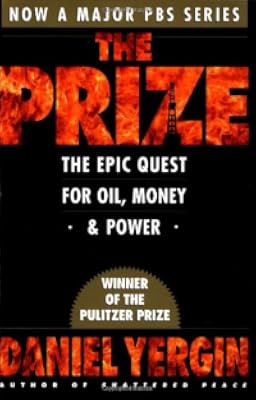
The Prize: The Epic Quest for Oil, Money, and Power [1992 TV miniseries]
by Daniel Yergin
On This Page
Description
The Prize recounts the panoramic history of oil - and the struggle for wealth and power that has always surrounded oil. This struggle has shaken the world economy, dictated the outcome of wars, and transformed the destiny of men and nations. The Prize is as much a history of the twentieth century as of the oil industry itself. The canvas of history is enormous - from the drilling of the first well in Pennsylvania through two great world wars to the Iraqi invasion of Kuwait and Operation show more Desert Storm. show lessTags
Recommendations




Member Reviews
Neither of the novels I’m currently reading is really going anywhere, so I started reading a history of the oil industry instead. As I’d expected, it was totally riveting. I find the role of oil in economic, political, and environmental development fascinating, so clearly was predisposed to like it. The book sustained my interest, even when recounting the technicalities of oil company mergers, through the use of a high quality journalistic approach. Each chapter began with a character vignette of some key figure, before explaining the bigger strategic picture. Whenever this wider picture started to pall, a new personality was introduced and their important role explained with the help of amusing anecdotes. Such a structure worked show more beautifully to convey a complicated and lengthy history entertainingly, without sacrificing density and rigour.
The whole book was compelling, but I would single out for particular praise the chapters on the two World Wars and how the role of oil differed in each. Oil utterly transformed the nature of war and its availability did much to determine who won and who lost. I hadn’t previously realised, for instance, that Japan’s defeat in the Second World War was precipitated by total oil deprivation. Nor that in the Pearl Harbour attack the fuel stores of the US fleet were not destroyed - which would have placed America in a much more fragile position in the Pacific. Oil came to be equated with mobility in society generally, but the shift was more striking and sudden in conditions of war. The First World War was largely static and began at least with the expectation that movement of troops would be by horse or train. By contrast, the Second World War involved near-constant and massive movements of troops, materiel, and battle lines, all powered by oil.
The genesis and fractious history of OPEC was also very well-told and informative. I’d wanted to know more about the extent to which OPEC has, at various times, been able to set world oil prices. Yergin demonstrates that its power has waxed and waned, whilst the structure of the world oil industry has altered considerably in the second half of the twentieth century. In fact, the only quibble I really have with this book is that the edition I read was published in 1993 and there have been massive oil-related changes since then. For a start, prices. When this was published, the record peak price for a barrel of crude was around $40; in 2008 it exceeded $100. According to Bloomberg, today a barrel of Brent crude would cost you $113. I’d love to read Yergin’s analysis of the twenty-first century price increases, so will try and get hold of his later book [b:The Quest: Energy, Security, and the Remaking of the Modern World|11447065|The Quest Energy, Security, and the Remaking of the Modern World|Daniel Yergin|https://images.gr-assets.com/books/1311282459s/11447065.jpg|16380870]. That should also include more detail on the environmental aspects of oil dependence, which this book only touches on briefly. Really, you have to be impressed with a densely printed 800 page non-fiction book that not only holds your attention but leaves you wanting more. show less
The whole book was compelling, but I would single out for particular praise the chapters on the two World Wars and how the role of oil differed in each. Oil utterly transformed the nature of war and its availability did much to determine who won and who lost. I hadn’t previously realised, for instance, that Japan’s defeat in the Second World War was precipitated by total oil deprivation. Nor that in the Pearl Harbour attack the fuel stores of the US fleet were not destroyed - which would have placed America in a much more fragile position in the Pacific. Oil came to be equated with mobility in society generally, but the shift was more striking and sudden in conditions of war. The First World War was largely static and began at least with the expectation that movement of troops would be by horse or train. By contrast, the Second World War involved near-constant and massive movements of troops, materiel, and battle lines, all powered by oil.
The genesis and fractious history of OPEC was also very well-told and informative. I’d wanted to know more about the extent to which OPEC has, at various times, been able to set world oil prices. Yergin demonstrates that its power has waxed and waned, whilst the structure of the world oil industry has altered considerably in the second half of the twentieth century. In fact, the only quibble I really have with this book is that the edition I read was published in 1993 and there have been massive oil-related changes since then. For a start, prices. When this was published, the record peak price for a barrel of crude was around $40; in 2008 it exceeded $100. According to Bloomberg, today a barrel of Brent crude would cost you $113. I’d love to read Yergin’s analysis of the twenty-first century price increases, so will try and get hold of his later book [b:The Quest: Energy, Security, and the Remaking of the Modern World|11447065|The Quest Energy, Security, and the Remaking of the Modern World|Daniel Yergin|https://images.gr-assets.com/books/1311282459s/11447065.jpg|16380870]. That should also include more detail on the environmental aspects of oil dependence, which this book only touches on briefly. Really, you have to be impressed with a densely printed 800 page non-fiction book that not only holds your attention but leaves you wanting more. show less
This is indeed an epic. In some ways, it is dated, e.g., spending too many pages on the 1990s and almost completely ignoring climate change—and this isn't the book's only blind spot. Yet the story is still amazing. Yergin writes in an accessible way, not drily at all, in the right level of detail, giving capsule portraits of the characters and often reminding the reader of past events and of bigger trends. Framing history through the perspective works extremely well, and I learned so much.
(For example, I'd never even heard of the Texas Railroad Commission, which set production levels as an early forerunner to OPEC. The story of OPEC's genesis was also fascinating.)
(For example, I'd never even heard of the Texas Railroad Commission, which set production levels as an early forerunner to OPEC. The story of OPEC's genesis was also fascinating.)
In thinking about whom I would *not* recommend read this book, I'm down to just those who have already read it, and even that's a little iffy. This is not a small book by any means, but it is fascinating, very well written, and provides the best level of business, military history, and cultural reporting. I do not recall ever felling a need to skip over or skim portions. I might point out that the author added an additional chapter and a new epilogue a few years after it was first published, so readers should make sure they pick up a later edition that includes significant updates. I started out reading an original edition hardback and switched to a more recent ebook edition. By the way, highly recommended, in case you were still wondering.
This is an excellent survey of the history of petroleum from 1860 to 1990. It focuses on politics and economics. There is essential no science or engineering here. There is mention of seismic mapping of underground structures and cracking to produce lighter fractions in the refining process, but not more than mentions. This is a steady march through the history. It's like surface mining. The first couple of layers are dug up, but it never gets very deep. The book seems pretty well balanced. There are surely many angles on the momentous events described here, but Yergin's isn't extreme at all. That's an aspect of the shallowness of the book. He touches on a broad range of topics, but just keeps moving. It's a great survey though, of one show more of the most important topics of our time. show less
This is an excellent book and one I recommend. It is a history of oil and the oil industry, covering about 150 years. If you want to learn about the evolution of oil and how it affects our world, then this is a super place to start.
Daniel Yergin divided his book into four distinct sections, which help you understand the phases of the oil industry. The tale began with discoveries, entrepreneurs, and growth from industries like automotive.
Then, he moved to World War I and Churchill's promotion of oil as a fuel in place of coal. It was then that coal truly became international. Daniel Yergin perfectly explained the importance of oil to a country's geopolitical strength and energy security.
What is missing? The role that traders like Marc show more Rich played in the industry.
I hope someone - or Daniel - writes a sequel. show less
Daniel Yergin divided his book into four distinct sections, which help you understand the phases of the oil industry. The tale began with discoveries, entrepreneurs, and growth from industries like automotive.
Then, he moved to World War I and Churchill's promotion of oil as a fuel in place of coal. It was then that coal truly became international. Daniel Yergin perfectly explained the importance of oil to a country's geopolitical strength and energy security.
What is missing? The role that traders like Marc show more Rich played in the industry.
I hope someone - or Daniel - writes a sequel. show less
Wonderful book, well written, flows well over what could be a dry subject. The retelling of the last 170 years of world history through the lens of the oil industry is fascinating. This is much more than a history of the oil industry, rather insight into how the oil industry and worldwide development and demand for oil shaped world history. Highly recommend!
As has been said for two decades now, it reads like a biography. Of a buccaneer. With historical and economic context and the development of technology adding to the excitement. It helps that so many of these oil men were so eccentric. Who knew that J Paul Getty would make Howard Hughes appear conventional?
I've read a fair amount about Iran and Saudi Arabia, the Shah's reign, etc., yet reading the history again thru the oil politics lens made me see it all differently. Who knew that the Saudis were so reasonable (and the Shah and Mossadegh so comparatively dense)? During the heights of OPEC's power, the Saudis (well, mostly one Western-educated envoy) always understood that jacking up prices so high could disrupt the consuming show more industrialized countries' economies with disastrous blowback on the suppliers.
Mine is the early 1990s' edition; is the 2008 edition an update or reissue? Because this is a cliff-hanger. show less
I've read a fair amount about Iran and Saudi Arabia, the Shah's reign, etc., yet reading the history again thru the oil politics lens made me see it all differently. Who knew that the Saudis were so reasonable (and the Shah and Mossadegh so comparatively dense)? During the heights of OPEC's power, the Saudis (well, mostly one Western-educated envoy) always understood that jacking up prices so high could disrupt the consuming show more industrialized countries' economies with disastrous blowback on the suppliers.
Mine is the early 1990s' edition; is the 2008 edition an update or reissue? Because this is a cliff-hanger. show less
Members
- Recently Added By
Lists

Top Five Books of 2015
811 works; 241 members

Geology - Oil/Energy
3 works; 1 member

Shaykh Hamza's Book Recommendations
439 works; 3 members

r/AskHistorians' Recommended Books
1,068 works; 17 members
Author Information

24 Works 4,522 Members
Daniel Yergin was born in Los Angeles on February 6, 1947. He received a B. A. from Yale University in 1968 and an M. A. and Ph. D. from Cambridge University. Yergin is the chairman of Cambridge Energy Research Associates, the vice chairman of the Global Decisions Group and has chaired the U. S. Department of Energy Task Force on the future of show more energy research. He is the author of The Prize: The Epic Quest for Oil, Money and Power, which won the 1992 Pulitzer Prize for General Nonfiction and was made into a PBS/BBC series. His other published works include Shattered Peace: The Origins of the Cold War and the National Security State, The U.S. Strategic Petroleum Reserve, and The Quest: Energy, Security, and the Remaking of the Modern World. (Bowker Author Biography) show less
All Editions
Awards and Honors
Awards
Distinctions
Notable Lists
Work Relationships
Has as a student's study guide
Common Knowledge
- Canonical title
- The Prize: The Epic Quest for Oil, Money, and Power; The Prize: The Epic Quest for Oil, Money, and Power [1992 TV miniseries]
- Original publication date
- 1991
- People/Characters
- Winston Churchill
- Important events
- Great Panic; Cold War
- Related movies
- The Prize: The Epic Quest for Oil, Money & Power (1992 | IMDb)
- Dedication
- To Angela, Alexander, and Rebecca
- First words
- Winston Churchill changed his mind almost overnight.
- Last words
- (Click to show. Warning: May contain spoilers.)Ours truly remains the age of oil.
- Blurbers
- Schama, Simon; Schlesinger, James; Goodwin, Doris Kearns; Levitt, Theodore; Samuelson, Paul A.; Chancellor, John
- Canonical DDC/MDS
- 338.272820904
- Canonical LCC
- HD9560.6
Classifications
- Genres
- History, Nonfiction, General Nonfiction, Business, Science & Nature
- DDC/MDS
- 338.272820904 — Society, government, & culture Economics Production Mineral Extraction By Product Carbonaceous materials Oil, oil shales, tar sands, natural gas Oil Standard subdivisions History, geographic treatment, biography
- LCC
- HD9560.6 — Social sciences Industries. Land use. Labor Industries. Land use. Labor Special industries and trades Mineral industries. Metal trade
- BISAC
Statistics
- Members
- 2,554
- Popularity
- 7,452
- Reviews
- 28
- Rating
- (4.28)
- Languages
- 8 — Chinese, English, German, Italian, Polish, Russian, Spanish, Portuguese (Portugal)
- Media
- Paper, Audiobook, Ebook
- ISBNs
- 29
- ASINs
- 25