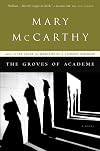
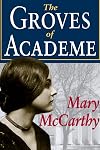
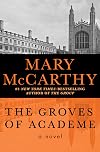
The Groves of Academe
by Mary McCarthy
On This Page
Description
A college instructor embarks on a fanatical quest to save his job-and enact righteous revenge-in this brilliantly acerbic satire of university politics during the early Cold War yearsHenry Mulcahy's future is in question. An instructor of literature at Jocelyn College, an institute of higher learning renowned for its progressive approach to education, he has just received word that he will not be teaching next semester. He strongly suspects that his dismissal has been engineered by his show more nemesis, the college president, who Henry believes resents his superior skills as an educator. Or perhaps he show lessTags
Recommendations




















Member Recommendations

giovannigf Both novels satirize academia, and both feature protagonists based on Paul De Man. Additionally, both are exquisitely written.
bluepiano Another enjoyable account from the 1950s of doings and misdoings at an American university. One of the characters in Jarrell's book was apparently based upon McCarthy.
Member Reviews
Every paragraph is a revelation as McCarthy turns the screw tighter and tighter on the absurdity of academic politics. Here is an excerpt describing the students at Jocelyn, her version of Bard College, where she once taught.
"[...] These youths, for the most part, were still squirming in the straitjacket of puberty; their hands trembled when they lit a cigarette; their wrists protruded from their very coat-sleeves; they lived in an existential extremity; every instant of communication was anguish. Besides the beer-and-convertible crowd--the ex-bootleggers' and racketeers' sons, movie-agents' sons, the heavy-walleted incorrigible sons of advertising geniuses who had been advised to try Jocelyn as a last resort--the male part of the show more college included an unusual number of child prodigies, mathematical wizards of fourteen, as well as some spastics and paraplegics, cripples of various sorts, boys with tics, polio victims. There were a deaf boy, a dumb boy, boys with several kinds of speech-defects; there were two boys who had fits, boys with unusual skin diseases with ordinary acne, with glasses, with poor teeth, a boy with a religious complex, boys who had grown too fast, with long, chickeny necks and quivering Adam's apples. The girls, by comparison, were blooming, healthy, often pretty specimens, with the usual desires and values, daughters of commercial artists, commercial writers, radio-singers, insurance-salesmen, dermatologists, girls who had failed to get into Smith or nearby Swarthmore, girls from the surrounding region, narcissistic, indolent girls wanting a good time and not choosey, girls who sculpted or did ceramics of animals or fashion-drawing, liverish girls, older than the rest, on scholarship."
The entire book is like this. Absolutely, undeniably brilliant. show less
"[...] These youths, for the most part, were still squirming in the straitjacket of puberty; their hands trembled when they lit a cigarette; their wrists protruded from their very coat-sleeves; they lived in an existential extremity; every instant of communication was anguish. Besides the beer-and-convertible crowd--the ex-bootleggers' and racketeers' sons, movie-agents' sons, the heavy-walleted incorrigible sons of advertising geniuses who had been advised to try Jocelyn as a last resort--the male part of the show more college included an unusual number of child prodigies, mathematical wizards of fourteen, as well as some spastics and paraplegics, cripples of various sorts, boys with tics, polio victims. There were a deaf boy, a dumb boy, boys with several kinds of speech-defects; there were two boys who had fits, boys with unusual skin diseases with ordinary acne, with glasses, with poor teeth, a boy with a religious complex, boys who had grown too fast, with long, chickeny necks and quivering Adam's apples. The girls, by comparison, were blooming, healthy, often pretty specimens, with the usual desires and values, daughters of commercial artists, commercial writers, radio-singers, insurance-salesmen, dermatologists, girls who had failed to get into Smith or nearby Swarthmore, girls from the surrounding region, narcissistic, indolent girls wanting a good time and not choosey, girls who sculpted or did ceramics of animals or fashion-drawing, liverish girls, older than the rest, on scholarship."
The entire book is like this. Absolutely, undeniably brilliant. show less
Meet Henry Mulcahy. He is a middle-aged (42) professor who teaches literature at a small progressive college in Pennsylvania. Taught literature, I should say. His contract was not renewed for the upcoming term. There is a philosophical argument to be had: is it better to be fired or just not have your contract renewed? Is there a difference? Is there a more acceptable option? Henry "Hen" Mulcahy thinks President Maynard Hoar has it out for him. The sad thing was I didn't care. When it came to intellectual liability, I thought they all were floating in egotistical backwater.
McCarthy is a crafty one. You are led to believe one thing about a character, but then, as the story unfolds, you hear the truth is something quite different. The show more reader is drawn into the manipulation. Mulcahy seems like a genuine person until you realize how far he is willing to go in order to save face.
McCarthy captures the snootiness of academia perfectly with all of its Proustian and Jamesian context. If Groves of Academe was a baking game show and the challenge was satire, McCarthy would have failed because her secret ingredient was too secret. The flavor was lost behind too many other ingredients like religion, philosophy, politics, literary greats, psychology, and let us not forget, human emotions like jealousy, competition, and hubris. At face value, Groves of Academe is a story about a man who doesn't want to lose his job. show less
McCarthy is a crafty one. You are led to believe one thing about a character, but then, as the story unfolds, you hear the truth is something quite different. The show more reader is drawn into the manipulation. Mulcahy seems like a genuine person until you realize how far he is willing to go in order to save face.
McCarthy captures the snootiness of academia perfectly with all of its Proustian and Jamesian context. If Groves of Academe was a baking game show and the challenge was satire, McCarthy would have failed because her secret ingredient was too secret. The flavor was lost behind too many other ingredients like religion, philosophy, politics, literary greats, psychology, and let us not forget, human emotions like jealousy, competition, and hubris. At face value, Groves of Academe is a story about a man who doesn't want to lose his job. show less
Interesting to wonder why Mary McCarthy's 'Groves' is so little read, while 'Stoner' is re-released to great acclaim seemingly every five years I hear my wife calling, she says, "Gee, why could this book by a woman that's just like that book by a man be less highly rated even though it's just as good and about the same tings: English department at a small regional school that's a little bit quirky and prone to infighting and incompetence. Gee, I wonder why? WHATEVER COULD IT BE, MISOGYNIST?.
Leaving aside routine sexism, which could well play a role, and the fact that Williams only admitted to writing 3 novels, whereas McCarthy wrote a lot about a lot: I suspect the reason is that 'Stoner' is the perfect, self-contained novel. It's show more about a guy, Stoner, and his college, and although it does take jabs at incompetent English faculty and students, it really is self-sufficient. This is what a lot of people want from their novels.
'Groves,' on the other hand, drags in McCarthyism, imitatio Christi, Joyce scholarship, the merits and demerits of modernism, and the tremendous moral complexities involved with all of this. In other words, Groves demands that you think, constantly, in a way that I, at least, found fairly uncomfortable. Just when I thought I had a good handle on the moral framework of the book, McCarthy compares the 'villain' to Christ, in a good way. Nobody's deeds are easily explicable, but they all seem perfectly realistic. That doesn't mean they're impossible to understand, just that there's a lot more going on than we usually want to think. Heroes and villains, in the right setting, swap roles without changing their behavior; the selfless are revealed as the most selfish and and vice versa.
And just when you think the you've got the point--the fathomless difficulty and complexity of morality!--it turns out that the 'moral' is really a very minor, almost unimportant way of thinking about the world. The closest thing we have to a hero is an ex-communist, now anarchist, poet, named Keogh (named by McCarthy, I assume, for a beloved Irish boxer in Ulysses). He's disgusted by the bickering and time-serving of the University faculty, and does the 'right' thing--in this case, helping the villain--but mainly just wants to get the heck out of the place.
Your beloved moral complexity looks very different to a man who's spent his life on the barricades for justice.
Also, McCarthy's syntax is complex and subtle. Not so long ago, that counted as good writing, and hopefully it soon will again.
I should add that my friend JP told me about this book, and he includes pertinent quotes in his review:
https://www.goodreads.com/review/show/977746344?book_show_action=false&page=... show less
Leaving aside routine sexism, which could well play a role, and the fact that Williams only admitted to writing 3 novels, whereas McCarthy wrote a lot about a lot: I suspect the reason is that 'Stoner' is the perfect, self-contained novel. It's show more about a guy, Stoner, and his college, and although it does take jabs at incompetent English faculty and students, it really is self-sufficient. This is what a lot of people want from their novels.
'Groves,' on the other hand, drags in McCarthyism, imitatio Christi, Joyce scholarship, the merits and demerits of modernism, and the tremendous moral complexities involved with all of this. In other words, Groves demands that you think, constantly, in a way that I, at least, found fairly uncomfortable. Just when I thought I had a good handle on the moral framework of the book, McCarthy compares the 'villain' to Christ, in a good way. Nobody's deeds are easily explicable, but they all seem perfectly realistic. That doesn't mean they're impossible to understand, just that there's a lot more going on than we usually want to think. Heroes and villains, in the right setting, swap roles without changing their behavior; the selfless are revealed as the most selfish and and vice versa.
And just when you think the you've got the point--the fathomless difficulty and complexity of morality!--it turns out that the 'moral' is really a very minor, almost unimportant way of thinking about the world. The closest thing we have to a hero is an ex-communist, now anarchist, poet, named Keogh (named by McCarthy, I assume, for a beloved Irish boxer in Ulysses). He's disgusted by the bickering and time-serving of the University faculty, and does the 'right' thing--in this case, helping the villain--but mainly just wants to get the heck out of the place.
Your beloved moral complexity looks very different to a man who's spent his life on the barricades for justice.
Also, McCarthy's syntax is complex and subtle. Not so long ago, that counted as good writing, and hopefully it soon will again.
I should add that my friend JP told me about this book, and he includes pertinent quotes in his review:
https://www.goodreads.com/review/show/977746344?book_show_action=false&page=... show less
This was a long intellectual slog.....which may have been sort of the point......but all this droning on and on about political and moral blather relating to absolutely nothing seemingly interesting, involving a whole host of characters i either did not like, or worse, did not care about at all.....please....NO!. If there was one high-brow literary reference, there seemed to be a thousand, at least to me. Now, granted, this was a story of scheming, dishonesty, and subterfuge involving the literature department at a liberal, non-traditional progressive small PA college (I mean, really, how exciting could this be??). Socialism, communism, Trotsky, Mann, Latin phrases, French phrases, Shakespeare, Tolstoy, Dostoevsky, poetry, poets, show more college administrative maneuverings, staff meetings...even Bret Harte & Jane Austen......!!! I mean, come on. I certainly get that the time of this novel's writing was surely influenced by the McCarthy era of blacklisting teachers and others due to political leanings, but it felt so endlessly tedious. Some pluses, although few: .....the ending was a little surprising, and i always like that; it appears that institutions of higher learning being populated by extreme forces of ridiculousness is obviously not a new phenomenon; I eventually figured out that McCarthy was actually mocking the ridiculousness of these lost souls, of which i heartily approve. I only wished it had been crafted in a way that i could have enjoyed it without having felt a complete fool for not knowing Latin, French, and all the nuanced intricacies of all of the literary & political philosophers of the last 400+ years! I applaud McCarthy's vast, expansive knowledge of all i just mentioned (assuming it is even accurate), but trying to show off to a guy like me that reads for pleasure and enjoyment....oh, and story......well, it just does not cut it. There's not going to be a test, is there?? show less
Mary McCarthy's "The Groves of Academe" is a perceptive novel of 1952 examining academic politics at a fictional medium-size experimental college in east-central Pennsylvania. It is informed by her experience teaching at two private liberal arts colleges. My (educated) guess is that McCarthy accurately characterizes a number of academic sorts and some students. It is lightly satiric but not unsympathetic.
The narrative follows the byzantine debates and evolving realizations among faculty in finding a fair response to a letter from the college administration to a professor announcing the non-renewal of his contract. The professor once had Communist associations, and the action is set in the (Joseph) McCarthy era, but that plot device set show more among others does not seriously outdate the novel.
This is commended primarily to academics and college graduates and students, especially of medium-size liberal arts colleges. show less
The narrative follows the byzantine debates and evolving realizations among faculty in finding a fair response to a letter from the college administration to a professor announcing the non-renewal of his contract. The professor once had Communist associations, and the action is set in the (Joseph) McCarthy era, but that plot device set show more among others does not seriously outdate the novel.
This is commended primarily to academics and college graduates and students, especially of medium-size liberal arts colleges. show less
Recognisable elements for academics of any generation, although the American context has its own peculiarities.
Political intriguing at a small progressive college in the 1950s--I like the situation but not the talkiness
Members
- Recently Added By
Lists

Best Campus Novels
99 works; 18 members

Anthony Burgess 99 Post War Novels
99 works; 7 members
Author Information

43+ Works 7,587 Members
Some Editions
Awards and Honors
Distinctions
Notable Lists
Work Relationships
Common Knowledge
- Canonical title
- The Groves of Academe
- Original publication date
- 1952
- Dedication
- To Jess, Kevin, Augusta, Jay
- First words
- When Henry Mulcahy, a middle-aged instructor of literature at Jocelyn College, Jocelyn, Pennsylvania, unfolded the President's letter and became aware of its contents, he gave a sudden sharp cry of impatience and irritation, ... (show all)as if such interruptions could positively be brooked no longer.
- Last words
- (Click to show. Warning: May contain spoilers.)At the other end of the phone, the young man signaled to his wife, who crept up and put her ear to the receiver as the President's noble voice rolled on.
- Disambiguation notice*
- The accurate orthography of the surname of the author of this work is NOT:
MacCarthy, but has to be:
McCarthy
*Some information comes from Common Knowledge in other languages. Click "Edit" for more information.
Classifications
Statistics
- Members
- 367
- Popularity
- 85,793
- Reviews
- 9
- Rating
- (3.22)
- Languages
- Dutch, English
- Media
- Paper, Ebook
- ISBNs
- 12
- ASINs
- 18