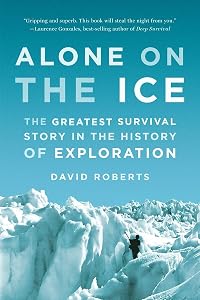
Alone on the Ice: The Greatest Survival Story in the History of Exploration
by David Roberts
On This Page
Description
His two companions were dead, his food and supplies had vanished in a crevasse, and Douglas Mawson was still one hundred miles from camp.On January 17, 1913, alone and near starvation, Mawson, leader of the Australasian Antarctic Expedition, was hauling a sledge to get back to base camp. The dogs were gone. Now Mawson himself plunged through a snow bridge, dangling over an abyss by the sledge harness. A line of poetry gave him the will to haul himself back to the surface. Mawson was show more sometimes reduced to crawling, and one night he discovered that the soles of his feet had completely detached from the flesh beneath. On February 8, when he staggered back to base, his features unrecognizably skeletal, the first teammate to reach him blurted out, "Which one are you?"
This thrilling and almost unbelievable account establishes Mawson in his rightful place as one of the greatest polar explorers and expedition leaders.
. show less
Tags
Recommendations









Member Reviews
After reading several classics in a row, I was ready for a change of pace, and happened across this book. I’m so glad I decided on it! As an avid history lover and someone who likes the odd survival/adventure story, this was the perfect book for me.
I realized, when reading this book, that I didn’t know that much about the history of exploring Antarctica. So from that perspective, I found this story fascinating. It helped to give me a slightly clearer idea of how the early exploration parties worked, and some of the struggles they encountered on their journeys. One thing I hadn’t spent much time considering before reading this book was what it would be like to overwinter in a place like Antarctica, especially back in the early 20th show more century, when they didn’t have any reliable way of communicating with the outside world—a terrifying prospect!
The story itself, of Mawson’s trip out into the Antarctic wastelands with two companions and his incredible return journey, alone, was both gripping and unbelievable. How someone could withstand the things he faced and not come out of them permanently imbalanced is amazing. This book is a testament to his grit, determination, and courage, and makes for an incredible read.
Parts of the story are slower-paced; I found some historical sections somewhat dry, and occasionally wished they’d get back to Mawson’s story. But I never really lost interest in the book, and I believe the historical sections were important to set the stage for what happened later. Plus, I feel like I’ve learned a lot more about that section of history now, so that’s a bonus!
Overall, I enjoyed this read. Gripping, heartbreaking, and inspiring, it isn’t for the faint of heart—hearing about how they had to kill dogs to have food to survive wasn’t fun, plus there was all the physical suffering that they endured—but if you’re interested in history and/or true survival stories, I’d highly recommend you check this book out. It’s well worth reading! show less
I realized, when reading this book, that I didn’t know that much about the history of exploring Antarctica. So from that perspective, I found this story fascinating. It helped to give me a slightly clearer idea of how the early exploration parties worked, and some of the struggles they encountered on their journeys. One thing I hadn’t spent much time considering before reading this book was what it would be like to overwinter in a place like Antarctica, especially back in the early 20th show more century, when they didn’t have any reliable way of communicating with the outside world—a terrifying prospect!
The story itself, of Mawson’s trip out into the Antarctic wastelands with two companions and his incredible return journey, alone, was both gripping and unbelievable. How someone could withstand the things he faced and not come out of them permanently imbalanced is amazing. This book is a testament to his grit, determination, and courage, and makes for an incredible read.
Parts of the story are slower-paced; I found some historical sections somewhat dry, and occasionally wished they’d get back to Mawson’s story. But I never really lost interest in the book, and I believe the historical sections were important to set the stage for what happened later. Plus, I feel like I’ve learned a lot more about that section of history now, so that’s a bonus!
Overall, I enjoyed this read. Gripping, heartbreaking, and inspiring, it isn’t for the faint of heart—hearing about how they had to kill dogs to have food to survive wasn’t fun, plus there was all the physical suffering that they endured—but if you’re interested in history and/or true survival stories, I’d highly recommend you check this book out. It’s well worth reading! show less
It's a toss up for me whether this or the classic [b:Mawson's Will|141357|Mawson's Will|Lennard Bickel|https://d.gr-assets.com/books/1172122417s/141357.jpg|136324] is the better book. While [a:Lennard Bickel|81489|Lennard Bickel|https://s.gr-assets.com/assets/nophoto/user/u_50x66-632230dc9882b4352d753eedf9396530.png]'s book is probably slightly more suspenseful, it is short on detail at times. That is not the case here, Roberts doesn't skimp on the detail while still maintaining the suspense of the story. In some cases the details increase the awe that Mawson's achievement was, since even particular days consisted of superhuman accomplishments. Roberts also has much more about the psychologically creepy nightmare that was wintering over show more a second year (with a lunatic no less) in "the windiest place on earth," basically skipped except for a few paragraphs in the Bickel book.
To summarize in the TV Guide tradition, in 1912 Dr. Douglas Mawson and Dr. Xavier Mertz are 300 miles from home base in Antarctica when their companion Belgrave Ninnis disappears down a crevasse with his sledge, dog team (most of their dogs), and most of their food and gear, including their tent. With a week and a half of food left for the two men and only a few of the dogs, Mawson and Mertz have to cross 300 miles man hauling a sledge with what's left of their gear and get back to the coast to be picked up. What Mawson and Mertz will undergo, and hopefully overcome, has been called the "greatest human survival story ever." This was from Sir Edmund Hillary and Sir Ernest Shackleton, no survival slouches either.
Mawson may also be the greatest polar explorer of the heroic era, but is always overshadowed by the better known Scott, Shackleton, and Amundsen. Every Australian knows of Mawson but few outside of Australia know of his feat and accomplishment.
The book has an extensive index (really valuable), maps, and a number of black and white photos from the heroic age of polar exploration. The book is extensively researched and Roberts sought out and had made available to him sources that Bickel hadn't. Roberts particularly calls into question Bickel's conclusion that Vitamin A poisoning from dog liver was the primary cause of Mertz's and Mawson's weakening, citing other factors such as exposure, scurvy, and just plain starvation as possibly equally to blame. We'll never know. show less
To summarize in the TV Guide tradition, in 1912 Dr. Douglas Mawson and Dr. Xavier Mertz are 300 miles from home base in Antarctica when their companion Belgrave Ninnis disappears down a crevasse with his sledge, dog team (most of their dogs), and most of their food and gear, including their tent. With a week and a half of food left for the two men and only a few of the dogs, Mawson and Mertz have to cross 300 miles man hauling a sledge with what's left of their gear and get back to the coast to be picked up. What Mawson and Mertz will undergo, and hopefully overcome, has been called the "greatest human survival story ever." This was from Sir Edmund Hillary and Sir Ernest Shackleton, no survival slouches either.
Mawson may also be the greatest polar explorer of the heroic era, but is always overshadowed by the better known Scott, Shackleton, and Amundsen. Every Australian knows of Mawson but few outside of Australia know of his feat and accomplishment.
The book has an extensive index (really valuable), maps, and a number of black and white photos from the heroic age of polar exploration. The book is extensively researched and Roberts sought out and had made available to him sources that Bickel hadn't. Roberts particularly calls into question Bickel's conclusion that Vitamin A poisoning from dog liver was the primary cause of Mertz's and Mawson's weakening, citing other factors such as exposure, scurvy, and just plain starvation as possibly equally to blame. We'll never know. show less
I love to read about explorers. Not the ones who traversed the world murdering indigenous people to fill the coffers of their respective countries, but those men who were larger than life, fighting against the elements in the name of science, discovery and documentation. Men like Sir Edmond Hillary and Tenzing Norgay struggling up Mount Everest, or Ernest Shackleton striking out across the ice to find the South Pole. Men struggling to fulfill their dreams, fighting to survive dangerous conditions while striving to go where no human being has ever been before.
Alone on the Ice is about Douglas Mowson and other explorers who struggled and died in the early 1900's exploring Antarctica. Many of their names are forgotten, overshadowed by the show more larger than life legends of Shackleton, Scott and Amundsen. I had never heard of Mowson before I read this book. I'm sure I had read his name before as part of Shackleton's Nimrod Expedition in 1907, but other than a name listed as part of Shackleton's party, I knew nothing about him. Mowson's story grabbed my complete attention immediately because he was driven, not by a sense of competition to be first (as Shackleton, Scott and others), but by a deep sense of wonder at being the first human being to traverse and scientifically document unexplored areas of the world.
The main portion of the story is about the Australasian Antarctic Expedition led by Mowson from 1911-1913. But it also gives information about other earlier expeditions, such as Shackleton's Nimrod Expedition, because the background is essential to understanding Mowson and the difficulties he and others had already faced in Antarctica. Roberts provides many details and excerpts from several explorer's personal journals, plus photographs.
I can't even imagine what it was like for these men struggling to walk miles each day, pulling sledges filled with supplies. These sledges could weigh 600-1000 lbs. Sometimes they had to move only part of their equipment at a time. That meant walking several miles, dumping off equipment and supplies, then doubling back to get the rest of their gear and walking those same miles again. All in subzero weather, across dangerous ice. Not only was the weather dangerously cold, but there was the constant threat of injury or illness. Many times they lost men, supplies and dogs when they broke through thin ice sheets covering deep crevasses in the arctic ice. Desperation and starvation brought about dangerous physical illnesses. At times when food stores were low, the men were forced to eat sled dogs. The men didn't know that husky liver contains too much vitamin A,and if ingested can cause severe illness. They were starving and ate injured or weak sled dogs to stay alive, not knowing that this very desperation was only making them more ill.
This book is not a fictionalized account. It is a non-fiction, true account of these men and their expeditions in Antarctica, giving lots of details about their daily challenges, deaths and extreme conditions. Roberts did an excellent job pulling information from various explorer's personal journals to give a true sense of who Mowson was and to document the expeditions leading up to the AAE and Mowson's survival after losing the rest of his party in 1913.
I highly recommend this book to anyone w ho enjoys reading about polar exploration. I definitely want to read more about the polar explorers who got lost in the shadow of more famous men like Shackleton and Scott. I want to know about the men who were out of the limelight and more focused on science and exploration. This story was a joy to read, and I am still in awe of men like Mowson who were willing to put their lives on the line over and over again to learn all they could about the Earth and its wonders. show less
Alone on the Ice is about Douglas Mowson and other explorers who struggled and died in the early 1900's exploring Antarctica. Many of their names are forgotten, overshadowed by the show more larger than life legends of Shackleton, Scott and Amundsen. I had never heard of Mowson before I read this book. I'm sure I had read his name before as part of Shackleton's Nimrod Expedition in 1907, but other than a name listed as part of Shackleton's party, I knew nothing about him. Mowson's story grabbed my complete attention immediately because he was driven, not by a sense of competition to be first (as Shackleton, Scott and others), but by a deep sense of wonder at being the first human being to traverse and scientifically document unexplored areas of the world.
The main portion of the story is about the Australasian Antarctic Expedition led by Mowson from 1911-1913. But it also gives information about other earlier expeditions, such as Shackleton's Nimrod Expedition, because the background is essential to understanding Mowson and the difficulties he and others had already faced in Antarctica. Roberts provides many details and excerpts from several explorer's personal journals, plus photographs.
I can't even imagine what it was like for these men struggling to walk miles each day, pulling sledges filled with supplies. These sledges could weigh 600-1000 lbs. Sometimes they had to move only part of their equipment at a time. That meant walking several miles, dumping off equipment and supplies, then doubling back to get the rest of their gear and walking those same miles again. All in subzero weather, across dangerous ice. Not only was the weather dangerously cold, but there was the constant threat of injury or illness. Many times they lost men, supplies and dogs when they broke through thin ice sheets covering deep crevasses in the arctic ice. Desperation and starvation brought about dangerous physical illnesses. At times when food stores were low, the men were forced to eat sled dogs. The men didn't know that husky liver contains too much vitamin A,and if ingested can cause severe illness. They were starving and ate injured or weak sled dogs to stay alive, not knowing that this very desperation was only making them more ill.
This book is not a fictionalized account. It is a non-fiction, true account of these men and their expeditions in Antarctica, giving lots of details about their daily challenges, deaths and extreme conditions. Roberts did an excellent job pulling information from various explorer's personal journals to give a true sense of who Mowson was and to document the expeditions leading up to the AAE and Mowson's survival after losing the rest of his party in 1913.
I highly recommend this book to anyone w ho enjoys reading about polar exploration. I definitely want to read more about the polar explorers who got lost in the shadow of more famous men like Shackleton and Scott. I want to know about the men who were out of the limelight and more focused on science and exploration. This story was a joy to read, and I am still in awe of men like Mowson who were willing to put their lives on the line over and over again to learn all they could about the Earth and its wonders. show less
Alone on the Ice: The Greatest Survival Story in the History of Exploration by David Roberts is a detailed account to the Antarctic of 1913. A brief description of other trips and the men who went there is in here also. Then the details of little things I would never have thought about being trapped in a tent with other people and how an A personality and a B personality could really get on each others nerves and how they dealt with it. Small things, but magnified when you are trapped in a tent for hours. Survival techniques are discussed, in the tent and out, amazing things they did. I would die for sure because I would never have thought of these things. Other more unpleasant things they did to live, ugh! It is all very fascinating, show more especially if you love history or exploration. If you don't then this would be a long dull read for you. The amazing trek Mawson made, by himself after his team mates died, and he almost died, to go back to camp and hope they hadn't left him. It took 37 days alone, falling in deep abyss, no food, feet in near shreds, deep despair, no tools and starving. Some men had waited for him as the ship had just sailed off a couple of hours before. It is a very interesting read. show less
This book conveys the true story of the Australasian Antarctic Expedition (AAE), led by Australian explorer Douglas Mawson. Mawson was a key contributor to the Heroic Age of Antarctic Exploration; however, many people do not carry his name on the “tip of the tongue” as they do the names of Shackleton, Scott, and Amundsen. While the title suggests this is the story of Mawson’s miraculous survival in the wake of the death of his two companions while on an exploratory excursion, it is, in fact, a great deal more comprehensive. It provides the background and context for the AAE, including past experiences, preparations for the trip, and details about the lives of several of the participants. The author is adept at selecting passages show more from the diaries of the crew without getting carried away with extraneous details. We get a sense of Mawson as a scientist at heart, not concerned with the competitive race to the pole, but interested in mapping uncharted territory and conducting experiments to understand this frozen continent. Overall, I enjoyed the book very much. To me, the most engrossing chapters were related to the survival story. The other parts were interesting but understandably not quite as riveting. Recommended to readers interested in survival stories and the history of polar exploration. show less
Prior to the publication of Mawson's Will in the mid 1970s, the story of Douglas Mawson was only well known among specialists. Thereafter he's had a renaissance and became probably the 4th most famous explorer of the "Heroic Age of Antarctic Exploration" (1893-1922) after Scott, Shackleton and Roald Amundsen. It was in Mawson's Will that his amazing survival story was first given proper treatment. Mawson did write about it in The Home of the Blizzard, a very long 2-volume work published in 1914, but the survival story is only a fairly short chapter (Chapter 13) that was largely overlooked at the time and then forgotten in the wake of the war. The problem with Mawson's Will, though it popularized Mawson, is it simplified events. Thus show more there has been a need for a more comprehensive retelling of the Mawson's expedition and that is what Alone on the Ice sets out to do.
Unlike most other expeditions which had a clear goal (eg. reach the south pole), this one contained no less then 7 different simultaneous expeditions with no set goal other than to explore blank spaces on the map along the coast. It thus presents a narrative challenge. Nevertheless I think it covers many different aspects and is highly readable. In fact I found the drama of the second overwinter involving Jeffrys to be gripping in a way I'd never read before in a polar account. I have not read Mawson's Will but plan on doing so since it was so influential. I did read chapter 13 in The Home of the Blizzard and it concurs with Alone on the Ice's retelling. show less
Unlike most other expeditions which had a clear goal (eg. reach the south pole), this one contained no less then 7 different simultaneous expeditions with no set goal other than to explore blank spaces on the map along the coast. It thus presents a narrative challenge. Nevertheless I think it covers many different aspects and is highly readable. In fact I found the drama of the second overwinter involving Jeffrys to be gripping in a way I'd never read before in a polar account. I have not read Mawson's Will but plan on doing so since it was so influential. I did read chapter 13 in The Home of the Blizzard and it concurs with Alone on the Ice's retelling. show less
Amazing survival story of Douglas Mawson, but also an interesting story of polar exploration centered around Mawson's Australasian Antarctic Expedition AAE, 1913. It was during the time of intense Antarctic exploration by Scott, Shackleton and Amundsen as they attempted to reach the south pole, but not many people know about the AAE and Mawson's place as its leader. AAE was more centered on exploring the continent and bringing back scientific information. The book gives side information on all these expeditions as it explores how many of the men were involved in more than one expedition. It gives background info on all the members of the AAE expedition and sometimes has difficulty maintaining a cohesive story as there are so many show more parallel enterprises going on at the same time. Still it was a gripping and at times horrifying story of the bravery and fortitude and difficult decisions required of these men, especially Mawson, as he barely survives 30 days alone on the ice trying to make his way back to base camp. show less
Members
- Recently Added By
Lists

Carole's List
445 works; 13 members

The Edge of Survival: Tales from Beyond
12 works; 1 member
Author Information

35+ Works 5,073 Members
David Roberts is a climber and mountaineer and the author of thirty books about mountaineering, exploration, and anthropology. His books have won the Boardman Tasker Award for Mountain Literature and the Grand Prize at the Banff Mountain Book Festival, and have been shortlisted for the PEN/ESPN Award for Literary Sports Writing. He lives in show more Massachusetts. show less
Awards and Honors
Common Knowledge
- Original publication date
- 2013
- People/Characters
- Douglas Mawson
- Important places
- Antarctica
Classifications
- Genres
- Nonfiction, Travel, General Nonfiction, History, Biography & Memoir
- DDC/MDS
- 919.8904 — History & geography Geography & travel Geography of and travel in Australasia, Pacific Ocean islands, Atlantic Ocean islands, Arctic islands, Antarctica and on extraterrestrial worlds Polar regions Antarctica
- LCC
- G850 — Geography, Anthropology and Recreation Geography (General) Arctic and Antarctic regions
- BISAC
Statistics
- Members
- 343
- Popularity
- 91,520
- Reviews
- 17
- Rating
- (3.84)
- Languages
- English
- Media
- Paper, Audiobook, Ebook
- ISBNs
- 13
- ASINs
- 4