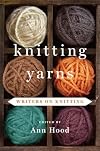
Knitting Yarns: Writers on Knitting
by Ann Hood (Editor)
On This Page
Description
A collection of essays about the transformative power of knitting from 27 contemporary authors, including Ann Patchett, Barbara Kingsolver, John Dufresne, and Joyce Maynard.Tags
Recommendations

Member Reviews
This isn't a book, it's a piece of crochet, haphazardly put together from random squares of indifferent colour combinations.
We may take a moral from it: no number of highly qualified birds does a swallow make.
This book has prize-winning and NYT best selling authors coming out of its what's it. But in the end it is that creature to be avoided at all costs, the one to which, ironically, knitting never descends: the crocheted blanket squares. The one everybody's grandmother made and 99% of the time they are a hodgepodge of the consequences of 'waste not, want not' with no concern whatsoever for the general notion of aesthetics or any particular person's sensibilities. Uggggh.
I cringed every time I read one of these writers talk about show more how amazingly impossible it is to knit and how they took twenty years, or isolation with their grandmother or some other extreme measure to learn - that's those who succeeded. Quite a few of them took up astro physics or open heart surgery instead because you know. Knitting is SO HARD.
It's not that I don't want to sympathise. I can look back to my first knitting day, my complete frustration because I couldn't figure out for myself how to do purl, this being just pre-internet - that is, there is no longer any excuse. But Simon showed me how and Simon hadn't even knitted before, he'd simply watched women knit 50 years earlier when he was a young boy and remembered. With all due respect to Simon, this means knitting is NOT THAT HARD.
Like most things in life, becoming a wonderfully accomplished practitioner is hard, but becoming competent is SO NOT HARD.
I couldn't do it. I couldn't sympathise with women talking about how it took them hours and hours and hours and years and generations to learn how to wind a bit of string over a stick. It's a time for embarrassment, not sympathy.
I wanted to sympathise with the writer who ended up giving somebody something that was complete shit, suddenly in the zen of the notion that it's THE THOUGHT THAT COUNTS. But I can't. If that's the thought: I've given you something perfect and you give me in return something shit, I get the thought and it isn't pretty. It's insulting. My friends reading this please take note. I never want to get a lousy meal in return for a good one, a lousy scarf in return for a beautiful one, a crap book in return for a magnificent work of art. Please give me nothing. I will take the message that you care. Not as much as if you'd given me something lovely, but more than if you'd given me something crappy. IMPORTANT NOTE: anybody reading this who is under the age of six is excluded from the above principle.
Rest here:
https://alittleteaalittlechat.wordpress.com/2015/03/18/knitting-yarns-writers-on... show less
We may take a moral from it: no number of highly qualified birds does a swallow make.
This book has prize-winning and NYT best selling authors coming out of its what's it. But in the end it is that creature to be avoided at all costs, the one to which, ironically, knitting never descends: the crocheted blanket squares. The one everybody's grandmother made and 99% of the time they are a hodgepodge of the consequences of 'waste not, want not' with no concern whatsoever for the general notion of aesthetics or any particular person's sensibilities. Uggggh.
I cringed every time I read one of these writers talk about show more how amazingly impossible it is to knit and how they took twenty years, or isolation with their grandmother or some other extreme measure to learn - that's those who succeeded. Quite a few of them took up astro physics or open heart surgery instead because you know. Knitting is SO HARD.
It's not that I don't want to sympathise. I can look back to my first knitting day, my complete frustration because I couldn't figure out for myself how to do purl, this being just pre-internet - that is, there is no longer any excuse. But Simon showed me how and Simon hadn't even knitted before, he'd simply watched women knit 50 years earlier when he was a young boy and remembered. With all due respect to Simon, this means knitting is NOT THAT HARD.
Like most things in life, becoming a wonderfully accomplished practitioner is hard, but becoming competent is SO NOT HARD.
I couldn't do it. I couldn't sympathise with women talking about how it took them hours and hours and hours and years and generations to learn how to wind a bit of string over a stick. It's a time for embarrassment, not sympathy.
I wanted to sympathise with the writer who ended up giving somebody something that was complete shit, suddenly in the zen of the notion that it's THE THOUGHT THAT COUNTS. But I can't. If that's the thought: I've given you something perfect and you give me in return something shit, I get the thought and it isn't pretty. It's insulting. My friends reading this please take note. I never want to get a lousy meal in return for a good one, a lousy scarf in return for a beautiful one, a crap book in return for a magnificent work of art. Please give me nothing. I will take the message that you care. Not as much as if you'd given me something lovely, but more than if you'd given me something crappy. IMPORTANT NOTE: anybody reading this who is under the age of six is excluded from the above principle.
Rest here:
https://alittleteaalittlechat.wordpress.com/2015/03/18/knitting-yarns-writers-on... show less
This isn't a book, it's a piece of crochet, haphazardly put together from random squares of indifferent colour combinations.
We may take a moral from it: no number of highly qualified birds does a swallow make.
This book has prize-winning and NYT best selling authors coming out of its what's it. But in the end it is that creature to be avoided at all costs, the one to which, ironically, knitting never descends: the crocheted blanket squares. The one everybody's grandmother made and 99% of the time they are a hodgepodge of the consequences of 'waste not, want not' with no concern whatsoever for the general notion of aesthetics or any particular person's sensibilities. Uggggh.
I cringed every time I read one of these writers talk about show more how amazingly impossible it is to knit and how they took twenty years, or isolation with their grandmother or some other extreme measure to learn - that's those who succeeded. Quite a few of them took up astro physics or open heart surgery instead because you know. Knitting is SO HARD.
It's not that I don't want to sympathise. I can look back to my first knitting day, my complete frustration because I couldn't figure out for myself how to do purl, this being just pre-internet - that is, there is no longer any excuse. But Simon showed me how and Simon hadn't even knitted before, he'd simply watched women knit 50 years earlier when he was a young boy and remembered. With all due respect to Simon, this means knitting is NOT THAT HARD.
Like most things in life, becoming a wonderfully accomplished practitioner is hard, but becoming competent is SO NOT HARD.
I couldn't do it. I couldn't sympathise with women talking about how it took them hours and hours and hours and years and generations to learn how to wind a bit of string over a stick. It's a time for embarrassment, not sympathy.
I wanted to sympathise with the writer who ended up giving somebody something that was complete shit, suddenly in the zen of the notion that it's THE THOUGHT THAT COUNTS. But I can't. If that's the thought: I've given you something perfect and you give me in return something shit, I get the thought and it isn't pretty. It's insulting. My friends reading this please take note. I never want to get a lousy meal in return for a good one, a lousy scarf in return for a beautiful one, a crap book in return for a magnificent work of art. Please give me nothing. I will take the message that you care. Not as much as if you'd given me something lovely, but more than if you'd given me something crappy. IMPORTANT NOTE: anybody reading this who is under the age of six is excluded from the above principle.
Rest here:
https://alittleteaalittlechat.wordpress.com/2015/03/18/knitting-yarns-writers-on... show less
We may take a moral from it: no number of highly qualified birds does a swallow make.
This book has prize-winning and NYT best selling authors coming out of its what's it. But in the end it is that creature to be avoided at all costs, the one to which, ironically, knitting never descends: the crocheted blanket squares. The one everybody's grandmother made and 99% of the time they are a hodgepodge of the consequences of 'waste not, want not' with no concern whatsoever for the general notion of aesthetics or any particular person's sensibilities. Uggggh.
I cringed every time I read one of these writers talk about show more how amazingly impossible it is to knit and how they took twenty years, or isolation with their grandmother or some other extreme measure to learn - that's those who succeeded. Quite a few of them took up astro physics or open heart surgery instead because you know. Knitting is SO HARD.
It's not that I don't want to sympathise. I can look back to my first knitting day, my complete frustration because I couldn't figure out for myself how to do purl, this being just pre-internet - that is, there is no longer any excuse. But Simon showed me how and Simon hadn't even knitted before, he'd simply watched women knit 50 years earlier when he was a young boy and remembered. With all due respect to Simon, this means knitting is NOT THAT HARD.
Like most things in life, becoming a wonderfully accomplished practitioner is hard, but becoming competent is SO NOT HARD.
I couldn't do it. I couldn't sympathise with women talking about how it took them hours and hours and hours and years and generations to learn how to wind a bit of string over a stick. It's a time for embarrassment, not sympathy.
I wanted to sympathise with the writer who ended up giving somebody something that was complete shit, suddenly in the zen of the notion that it's THE THOUGHT THAT COUNTS. But I can't. If that's the thought: I've given you something perfect and you give me in return something shit, I get the thought and it isn't pretty. It's insulting. My friends reading this please take note. I never want to get a lousy meal in return for a good one, a lousy scarf in return for a beautiful one, a crap book in return for a magnificent work of art. Please give me nothing. I will take the message that you care. Not as much as if you'd given me something lovely, but more than if you'd given me something crappy. IMPORTANT NOTE: anybody reading this who is under the age of six is excluded from the above principle.
Rest here:
https://alittleteaalittlechat.wordpress.com/2015/03/18/knitting-yarns-writers-on... show less
In Knitting Yarns, twenty-seven writers share how knitting healed, challenged, or helped them grow. There are twenty-six short stories, one poem, and five original patterns in this book, and I enjoyed almost every single one. They run the gamut from serious to light-hearted, and it's certainly possible to cry while reading one story only to laugh at the next.
My favorites? Sue Grafton's "Teaching a Child to Knit," Elinor Lipman's "I Bought This Pattern Book Last Spring," "The Clothes Make the Dog" by Taylor M. Polites, and "Knitted Goods: Notes from a Nervous Knitter" by Elizabeth Searles.
As a solitary knitter, I felt connected to these writers as I read their various relationships with yarn and needles. I also came away with several show more quotes that touched me, like this one from Andre Dubus III's "Blood, Root, Knit, Purl": "...I felt joined to all the men and women across cultures down through the ages who'd done something useful with their hands."
In the case of previous generations of women in my family, making things-- whether it be by sewing, crocheting, or knitting-- was often a matter of have to, not want to. But these busy women who cooked, cleaned, washed, ironed, birthed and raised children, and helped their husbands farm the land often found time to make something that's main purpose was purely decorative. They needed something pretty in their lives. Reading the stories in Knitting Yarns reconnected me with my roots and made me feel satisfied with the work of my own hands.
This is a good anthology for those who love to make things, and for those who don't who just might want to know what the fascination is all about. show less
My favorites? Sue Grafton's "Teaching a Child to Knit," Elinor Lipman's "I Bought This Pattern Book Last Spring," "The Clothes Make the Dog" by Taylor M. Polites, and "Knitted Goods: Notes from a Nervous Knitter" by Elizabeth Searles.
As a solitary knitter, I felt connected to these writers as I read their various relationships with yarn and needles. I also came away with several show more quotes that touched me, like this one from Andre Dubus III's "Blood, Root, Knit, Purl": "...I felt joined to all the men and women across cultures down through the ages who'd done something useful with their hands."
In the case of previous generations of women in my family, making things-- whether it be by sewing, crocheting, or knitting-- was often a matter of have to, not want to. But these busy women who cooked, cleaned, washed, ironed, birthed and raised children, and helped their husbands farm the land often found time to make something that's main purpose was purely decorative. They needed something pretty in their lives. Reading the stories in Knitting Yarns reconnected me with my roots and made me feel satisfied with the work of my own hands.
This is a good anthology for those who love to make things, and for those who don't who just might want to know what the fascination is all about. show less
Knitting Yarns by Ann Hood
Loved reading this author's other works and knew I'd like this. It is a compilation of other writers who also knit and why they knit and what knitting has done for them over the years.
Some find it calming, others do it to relieve grief, make gifts for those we love.
Don't think one of the stories really needed the swearing to get the point across....
Love that men authors are also included here in this anthology.
Patterns also included. Especially liked 20 people at the party were going to learn to knit, with their own set of needles and yarn pre assembled=each block will be sewn into an afghan for the new mother.
Enjoyed all the stories. Never realized the common things with these two crafts: writing and show more knitting.
I received this book from National Library Service for my BARD (Braille Audio Reading Device). show less
Loved reading this author's other works and knew I'd like this. It is a compilation of other writers who also knit and why they knit and what knitting has done for them over the years.
Some find it calming, others do it to relieve grief, make gifts for those we love.
Don't think one of the stories really needed the swearing to get the point across....
Love that men authors are also included here in this anthology.
Patterns also included. Especially liked 20 people at the party were going to learn to knit, with their own set of needles and yarn pre assembled=each block will be sewn into an afghan for the new mother.
Enjoyed all the stories. Never realized the common things with these two crafts: writing and show more knitting.
I received this book from National Library Service for my BARD (Braille Audio Reading Device). show less
I was a little disappointed with this one. The bulk of the stories are knitting horror stories from authors who could never quite figure the knitting out. I'm not a prolific knitter, but I never had the struggle learning the craft like the writers in the bulk of the stories. I'm mostly confused by the fact that a lot of the writers never really picked it up, but chose to write about how awful it was to try to learn. Some of them completely gave up and never knitted again, which begs the question of why they would be so inclined to write about it.
The format of the book is also a little odd, and, honestly, annoying. Each essay has a little two or three sentence blurb that introduces it, but while most books or periodicals that have this show more format generally give you information about the author or provide information outside of what you are about to read to provide some context, these blurbs simply tell you what the story is about. Couldn't I just read the story to find that out? Some of them felt a bit spoiler-y to be honest. By the third or fourth essay I started skipping over that little italicized bit completely.
Now, this isn't to say that I didn't enjoy it at all. The last handful (I'd say the last six or seven) of essays were much better than the first. I adored Taylor M. Polites' discussion about knitting for his little dog, Clovis, and his experiences of moving from the South to Cape Cod (of which I can relate to almost exactly), and the way Ann Shayne winds through some really great narrative of how knitting is wrapped up in some of her most interesting memories. Both of these authors (whom I had no experience with previously, but this book will cause me to seek them out for sure) wrote the stories that fulfilled my expectations of the whole collection: an interesting narrative that involves knitting in an integral way but gives you a sense of how the craft is usually so deeply ingrained in the lives of a knitter that it becomes meaningful in some other way. That's opposed to writers simply writing about knitting. I suppose it's like the bulk of the writers took the task on like an essay question on a test as opposed to a creative exercise.
Whatever the case, I was really hoping for more out of the collection. The few good essays at the end weren't enough to dramatically change my opinion, unfortunately. There seems to be a wealth of knitting writers though, so maybe there will be another collection some day that is a little more engaging. show less
The format of the book is also a little odd, and, honestly, annoying. Each essay has a little two or three sentence blurb that introduces it, but while most books or periodicals that have this show more format generally give you information about the author or provide information outside of what you are about to read to provide some context, these blurbs simply tell you what the story is about. Couldn't I just read the story to find that out? Some of them felt a bit spoiler-y to be honest. By the third or fourth essay I started skipping over that little italicized bit completely.
Now, this isn't to say that I didn't enjoy it at all. The last handful (I'd say the last six or seven) of essays were much better than the first. I adored Taylor M. Polites' discussion about knitting for his little dog, Clovis, and his experiences of moving from the South to Cape Cod (of which I can relate to almost exactly), and the way Ann Shayne winds through some really great narrative of how knitting is wrapped up in some of her most interesting memories. Both of these authors (whom I had no experience with previously, but this book will cause me to seek them out for sure) wrote the stories that fulfilled my expectations of the whole collection: an interesting narrative that involves knitting in an integral way but gives you a sense of how the craft is usually so deeply ingrained in the lives of a knitter that it becomes meaningful in some other way. That's opposed to writers simply writing about knitting. I suppose it's like the bulk of the writers took the task on like an essay question on a test as opposed to a creative exercise.
Whatever the case, I was really hoping for more out of the collection. The few good essays at the end weren't enough to dramatically change my opinion, unfortunately. There seems to be a wealth of knitting writers though, so maybe there will be another collection some day that is a little more engaging. show less
Stories about love and loss, about creation and destruction, about triumph and failure all knit together with yarn and knitting. Also has some patterns but no sketches or pictures of those patterns. I enjoyed them, interesting to see a few stories by men as well as women.
This is a heartwarming, poignant, and sometimes humorous collection of essays on knitting by authors who knit. There are stories on the every growing yarn stash, why they knit, unfinished projects, who they knit for, teaching grandchildren to knit, knitting to heal a grieving heart, and yes, even an essay on why an author knits for his Chihuahua. I enjoyed some stories more than others, but overall I enjoyed the book very much. It made me want to pick up my needles and listen as I knit.
I listened to the audio but if I had known there were knitting patterns included I would have bought the book instead.
I listened to the audio but if I had known there were knitting patterns included I would have bought the book instead.
Members
- Recently Added By
Lists

TBR of Books I Don't Own
132 works; 1 member
Author Information

Ann Hood was born on December 9, 1956, in West Warwick, R.I. She attended the University of Rhode Island and New York University. For several years, she worked as a flight attendant before pursuing her dream of becoming a writer. Ann Hood had a dream of writing ever since her first "novel" at the age of 11. It was not until 1987, with the show more publication of Somewhere off the Coast of Maine that she received the recognition she had been longing for. Set in the period from the 1960s to the 1980s, the story deals with the lives of three women of the Vietnam era and their children. Strong on emotion and personal growth, Hood's writing frequently examines the intricacies of various levels of relationships. Other works include Something Blue, which also involves the association between three friends. (Bowker Author Biography) show less
All Editions
Common Knowledge
- Original publication date
- 2013
- Dedication
- for Jen Silverman
Classifications
- Genres
- Home & Garden, Nonfiction, Biography & Memoir
- DDC/MDS
- 746.432 — Arts & recreation Drawing & decorative arts Fashion Design / Weaving, Knitting, Embroidery Needlework and handwork Knitting, crocheting, tatting Knitting
- LCC
- TT820 .K727 — Technology Handicrafts. Arts and crafts Handicrafts. Arts and crafts Home arts. Homecrafts
- BISAC
Statistics
- Members
- 310
- Popularity
- 102,231
- Reviews
- 16
- Rating
- (3.60)
- Languages
- English
- Media
- Paper, Audiobook, Ebook
- ISBNs
- 6
- ASINs
- 3