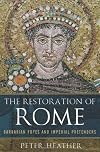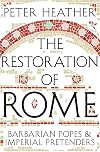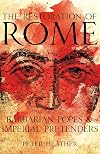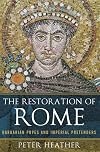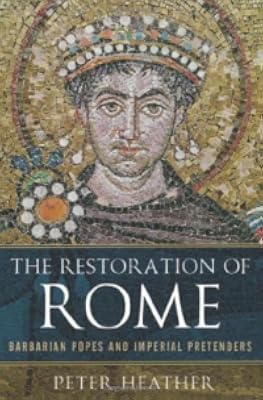
The Restoration of Rome : Barbarian Popes and Imperial Pretenders
by Peter Heather
On This Page
Description
"In 476 AD, the last of Rome's emperors, known as "Augustulus" was deposed by a barbarian general, the son of one of Attila the Hun's henchmen. With the imperial vestments dispatched to Constantinople, the curtain fell on the Roman empire in Western Europe, its territories divided among successor kingdoms constructed around barbarian military manpower. But, if the Roman Empire was dead, Romans across the old empire still lived, holding on to their lands, the values of their civilization, and show more their institutions. The conquering barbarians, witnessing the continuing psychological dominance of Rome, were ready to reignite the imperial flame and enjoy the benefits of its civilization. As Peter Heather shows in dazzling biographical portraits, each of the three greatest contenders--Theoderic, Justinian, and Charlemagne--operated with a different power base but was astonishingly successful in his own way. Though each in turn managed to put back together enough of the old Roman West to stake a plausible claim to the Western imperial title, none of their empires long outlived their founders' deaths. Not until the reinvention of the papacy in the eleventh century would Europe's barbarians find the means to establish a new Roman Empire, one that has lasted a thousand years"-- show lessTags
Recommendations


Member Reviews
It took me longer than normal to get through this - there is a lot in this book - but I enjoyed it greatly. It draws themes from the post-Roman world and traces them through to the Carolingian era and the rise of the Papacy as a true pan-European force in medieval times; the great strength of the book, however, is in tracing why this was not some inevitable and seamless transition of power from Roman Empire to Roman Church. The anti-Whiggish tone is refreshing and thought-provoking, and Heather's writing style keeps you engaged even when the themes being explored are very complex and full of contingencies.
In 476 AD the last vestiges of imperial authority of the Western Roman Empire were cast aside, with there being few obvious reasons why Rome should become yet again a major political center. Flash forward about five hundred years and the Papacy of the Roman Catholic Church is effectively the font of authority in most of Europe. How this highly contingent development came to be is the subject of this book, as Peter Heather (best known as a historian of the barbarian kingdoms of the ‘Dark Ages’) examines the twists and turns of how this became the dominant outcome to the search for stability and security in Europe.
Heather first examines the processes by which Theodoric the Goth, Justinian of Byzantium and Charles the Great apparently show more pulled together the core of the old Western Roman Empire, only for events to overtake these empires. Sometimes this was a result of systems failure, sometimes this was a result of greater forces swamping the imperial initiative, but force and transitory personal ability were never enough to get the job done. The forces aligned at creating a new super power were just too great.
This brings us to the fourth part of Heather’s examination of the reestablishment of legitimate authority in the West, dealing with how the Imperial Papacy emerged from the Carolingian Renaissance, making for an empire based essentially on ideology. The interesting thing for Heather is that this empire was not really a creation of the Roman aristocracy that tended to control the Papacy; it was created by the Church intelligentsia as a response to the fragmentation of imperial authority and the efforts of local kings seeking to control Church resources.
Much of what makes this book a pleasure is that I suspect that Heather has become aware that there is a public readership with the appetite for an involved tale of personal intrigue in the face of tectonic forces, and while I might think that Heather is a little too casual in his language at some points, he does make clear the need for a bit of enlightened skepticism about received theories and ideologies does not mean that there isn’t a great deal to say about events that are often glossed over because the alleged documentation doesn’t exist; call it an example of a well-honed historical imagination in action. show less
Heather first examines the processes by which Theodoric the Goth, Justinian of Byzantium and Charles the Great apparently show more pulled together the core of the old Western Roman Empire, only for events to overtake these empires. Sometimes this was a result of systems failure, sometimes this was a result of greater forces swamping the imperial initiative, but force and transitory personal ability were never enough to get the job done. The forces aligned at creating a new super power were just too great.
This brings us to the fourth part of Heather’s examination of the reestablishment of legitimate authority in the West, dealing with how the Imperial Papacy emerged from the Carolingian Renaissance, making for an empire based essentially on ideology. The interesting thing for Heather is that this empire was not really a creation of the Roman aristocracy that tended to control the Papacy; it was created by the Church intelligentsia as a response to the fragmentation of imperial authority and the efforts of local kings seeking to control Church resources.
Much of what makes this book a pleasure is that I suspect that Heather has become aware that there is a public readership with the appetite for an involved tale of personal intrigue in the face of tectonic forces, and while I might think that Heather is a little too casual in his language at some points, he does make clear the need for a bit of enlightened skepticism about received theories and ideologies does not mean that there isn’t a great deal to say about events that are often glossed over because the alleged documentation doesn’t exist; call it an example of a well-honed historical imagination in action. show less
Mr. Heather has linked biographies of Theoderic the Ostrogoth ,Justinian, and Charlemagne with an essay on the growth of the Papal Curia to discuss his opinion of the mechanisms and reasons for the replacement of the Roman Empire with the late Medieval Papacy. The prose is crisp though with a little striving for epigrams on occasion.
He is good on the degree to which the Papacy expanded to create a new kind of theocracy setting a lot of the terms and expectations of what we call "Western Christian Civilization". Following the amount of created, rather than actual documentation for the pretensions of the Papacy provides a certain level of sustained irony, that I find entertaining. Does he provide a definitive argument for his show more conclusions?
I'm not yet sure of that. Upon rereading, the book holds up well, both in style and arguments, and not many do. I am tempted to add, for what it is worth, another half star. show less
He is good on the degree to which the Papacy expanded to create a new kind of theocracy setting a lot of the terms and expectations of what we call "Western Christian Civilization". Following the amount of created, rather than actual documentation for the pretensions of the Papacy provides a certain level of sustained irony, that I find entertaining. Does he provide a definitive argument for his show more conclusions?
I'm not yet sure of that. Upon rereading, the book holds up well, both in style and arguments, and not many do. I am tempted to add, for what it is worth, another half star. show less
A very interesting and nicely written book about the various attempts (deliberate or accidental) of the Roman Empire by imperial pretenders and barbarian popes including all the messy politics and the subsequent fall out. Enough details to know what is going on, but not bog the reader down with irrelevant fluff. I managed to stay awake through this book and enjoyed it immensely, which is more than I can say on any other book on Rome by any other author that I have read so far.
La edad media y la caída del imperio romano. De allí la lucha de Europa para lograr de nuevo la centralidad en la historia.
Apr 15, 2022Spanish
Ratings
Members
- Recently Added By
Published Reviews
ThingScore 83
"Rather than the grim, almost polemic, cut-and-thrust of many academic publications, Heather’s style is never disagreeable, often witty, and always engaging."
added by bookfitz
"When Mr. Heather does not have colorful scandals to report, as in his long discussions of Carolingian institutional reform or canon-law collections, 'The Restoration of Rome' reads more like a textbook."
added by bookfitz
"Heather’s style is seductive and his British wit enlivens this engrossing history of the piecemeal 'restoration' of a Rome that lingers still."
added by bookfitz
Lists

Recommend the 20 best books you've read in the last five years
2,168 works; 606 members
Author Information

15+ Works 3,180 Members
Peter Heather is Professor of Medieval History at King's College London, and author of The Fall of the Roman Empire, Empires and Barbarians, and The Restoration of Rome.
Common Knowledge
- Canonical title
- The Restoration of Rome : Barbarian Popes and Imperial Pretenders
- Original title
- The Restoration of Rome : Barbarian Popes and Imperial Pretenders
- Original publication date
- 2014
- People/Characters
- Theoderic; Justinian I, Emperor; Belisarius
- Important places
- Constantinople, Byzantine Empire; Rome, Italy
- Dedication
- For Anita Holm Sawyer
- First words
- On or about 4 September 476, a senior officer of the Roman army of Italy called Odovacar arrested and executed the uncle of the reigning Western emperor Romulus, known as 'Augustulus': the little Augustus.
- Last words
- (Click to show. Warning: May contain spoilers.)That, of course, may be one reason why the new Roman Empire has so far lasted approximately twice as long as its predecessor.
- Blurbers
- Jones, Peter; Jones, Dan; Wilson, Ben; Sarris, Peter
- Original language
- English
Classifications
Statistics
- Members
- 267
- Popularity
- 121,017
- Reviews
- 5
- Rating
- (4.18)
- Languages
- 5 — Chinese, English, German, Polish, Spanish
- Media
- Paper, Audiobook, Ebook
- ISBNs
- 14
- ASINs
- 7