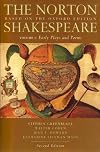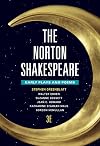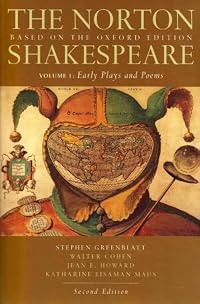
The Norton Shakespeare Vol. 1: Early Plays and Poems
by Stephen Greenblatt (Editor)
On This Page
Description
The attractive print and digital bundle offers students a great reading experience at an affordable price in two ways-a hardcover volume for their dorm shelf and lifetime library, and a digital edition ideal for in-class use. Students can access the ebook from their computer, tablet, or smartphone via the registration code included in the print volume at no additional charge. As one instructor summed it up, "It's a long overdue step forward in the way Shakespeare is taught."Tags
Recommendations








Member Reviews
For a two volume edition (divided chronologically) these hefty Norton paperbacks are lightweight enough, without sacrificing a pencil-friendly page density and readable typeface. That is to say nothing of solid footnotes and competent introductions throughout. Some readers have complained of errant scholarship such as some poems and portions of plays being falsely attributed to Shakespeare. That's a small matter considering that this is otherwise the most readable and well presented two volume edition of Shakespeare available to university students. My reviews of the individual plays in this first volume will follow below as I read them:
TITUS ANDRONICUS
***1/2
Shakespeare's first tragedy, and some say his worst play, makes up what it show more lacks in high poetry with base vengeance and nonstop bloodshed and gore. As tragic as a mangling highway accident, Shakespeare allows not a soul to be spared in this completely fabricated and historically inaccurate fall of Rome. I make it sound like this is a horrible read, but I underplay its clever turns and wordplay which abound throughout. If not Shakespeare's best play, that hardly means anything within the wider context of modern drama. It's bloody and witty in a way that few could pull off.
RICHARD II
****
On reading Richard's monologue in III.ii.140 two things occurred to me. The first was that this was by far the most deftly poetic monoluge I've encountered in our reading this semester. Richard is a character with great psychological depth that Shakespeare forges this through carefully crafted and emotive language, and this speaks to his development as a playwright. You don't see those dimensions in Titus, for example. The other thing that this monologue and the play as a whole demonstrates is a critique of the monarchy's claim to divine and infallible power. Richard is flawed and corrupt ruler who is usurped by another that is foreshadowed to be no better. I found it surprising that this play has a fairly detailed performance history from Shakespeare's day because of such connotations. Was the performance of the play utilized as critique in specific political contexts at later points perhaps? How were these received? show less
TITUS ANDRONICUS
***1/2
Shakespeare's first tragedy, and some say his worst play, makes up what it show more lacks in high poetry with base vengeance and nonstop bloodshed and gore. As tragic as a mangling highway accident, Shakespeare allows not a soul to be spared in this completely fabricated and historically inaccurate fall of Rome. I make it sound like this is a horrible read, but I underplay its clever turns and wordplay which abound throughout. If not Shakespeare's best play, that hardly means anything within the wider context of modern drama. It's bloody and witty in a way that few could pull off.
RICHARD II
****
On reading Richard's monologue in III.ii.140 two things occurred to me. The first was that this was by far the most deftly poetic monoluge I've encountered in our reading this semester. Richard is a character with great psychological depth that Shakespeare forges this through carefully crafted and emotive language, and this speaks to his development as a playwright. You don't see those dimensions in Titus, for example. The other thing that this monologue and the play as a whole demonstrates is a critique of the monarchy's claim to divine and infallible power. Richard is flawed and corrupt ruler who is usurped by another that is foreshadowed to be no better. I found it surprising that this play has a fairly detailed performance history from Shakespeare's day because of such connotations. Was the performance of the play utilized as critique in specific political contexts at later points perhaps? How were these received? show less
Ratings
Members
- Recently Added By
Author Information

Stephen Greenblatt is a literary critic, theorist and scholar. He is the author of Three Modern Satirists: Waugh, Orwell, and Huxley (1965); Renaissance Self-Fashioning: From More to Shakespeare (1980); Learning to Curse: Essays in Early Modern Culture (1990); Redrawing the Boundaries: The Transformation of English and American Literary Studies show more (1992); The Norton Shakespeare (1997); Will in the World: How Shakespeare Became Shakespeare (2004); Shakespeare's Freedom (2010); and The Swerve: How the World Became Modern (2011). (Bowker Author Biography) show less
Series
Belongs to Publisher Series
Work Relationships
Is contained in
Contains
Common Knowledge
- Canonical title
- The Norton Shakespeare Vol. 1: Early Plays and Poems
- People/Characters
- William Shakespeare; Henry VI, King of England; Titus Andronicus; Richard III, King of England; Edward III, King of England; Venus (show all 20); Adonis; Lucretia (Lucrece); Passionate Pilgrim; Richard II, King of England; Romeo Montague; Juliet Capulet; John, King of England; Henry IV, King of England; Shylock; Sir John Falstaff; Henry V, King of England; Julius Caesar; Phoenix; Turtle Dove
Classifications
Statistics
- Members
- 100
- Popularity
- 322,628
- Reviews
- 1
- Rating
- (4.30)
- Languages
- English
- Media
- Paper
- ISBNs
- 2
- ASINs
- 3