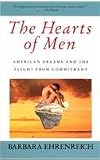
The Hearts of Men: American Dreams and the Flight from Commitment
by Barbara Ehrenreich
On This Page
Description
From the bestselling author of Nickel and Dimed, an explanation of recent sexual culture and the loosening of marriage bonds in recent history. "Finally someone is offering a new, utterly plausible explanation...of loosening marriage bonds. According to Barbara Ehrenreich...it is men who started walking off, in search of freedom from their stifling role of breadwinner/success-machine. The shock--and exhilaration--of this book comes from the recognition that here is a woman who has dared to show more look beyond the everyday assumptions about love and commitment to examine which bonds between men and women can endure and which may last forever."--Vogue show lessTags
Recommendations



















Member Recommendations
Member Reviews
What The Feminine Mystique was for women, this book is for men. The back cover critics explain my sentiments so well, I'll present them here:
[The book] not only explodes some pervasive beliefs, it affords an invigorating reading of American culture through the last three decades."
Ehrenreich explores new relationships between men and women and explains why the old way is no longer acceptable. My favorite quote from this book, which once resided on my refrigerator for months, is "Roles...are not fit aspirations for adults, but the repetitive performances of people who have forgotten that it is only other people who write the scripts."
Awesome, enlightening book. Will help change your perspective about gender roles and relationships between show more the sexes. show less
[The book] not only explodes some pervasive beliefs, it affords an invigorating reading of American culture through the last three decades."
Ehrenreich explores new relationships between men and women and explains why the old way is no longer acceptable. My favorite quote from this book, which once resided on my refrigerator for months, is "Roles...are not fit aspirations for adults, but the repetitive performances of people who have forgotten that it is only other people who write the scripts."
Awesome, enlightening book. Will help change your perspective about gender roles and relationships between show more the sexes. show less
Now a period piece, feminist-socialist Barbara Ehrenreich analyzes the social and economic forces at play from the mid-1960s to the mid-1980s loosening marriage bonds. In her conclusion, she argues for a non-patriarchal family and a different welfare policy.
Reviewer: Steven Menzer
For men who think that feminism is a threat to the male sex, this book will open eyes and minds in the same way abolition liberated white slave-owners from their barbaric addiction to controlling other human beings against their will. And for women who see feminism as a threat to families, this book will either help relieve them of their ignorance of history, or only further convince them that a woman can have no other meaningful purpose than to bear and rear children.
This book addresses the disconnect between traditional gender roles and reality that has been building up steadily since the industrial revolution. The trend toward industrialization came to a head during WWI and especially WWII when many women show more worked in factories to produce munitions used by their husbands to kill. As the sudden return of men from great carnage sparked the baby boom, the notion of the "housewife" came to describe women's return to domesticity aided with a new arsenal of household gadgets and appliances. Betty Friedan wrote "The Feminine Mystique", in response to the vacuousness of this newly created paradigm of the suburban housewife paradise. Her book pointed out the absurdity of the domestic female role when modern conveniences had rendered them obsolete. Even childrearing was becoming usurped from the domain of women by the increasing institutionalization of public schools as day care centers.
A quarter century after Betty Friedan's landmark book, Barbara Ehrenreich finally gave men the same insight into how their roles have become outmoded in response to historical changes. If the feminist protest was against viewing females as mere baby-factories, this book critiques the socialization of men into being either breadwinners, or soldiers willing to sacrifice their lives in war. In a purely economic sense - with the vanishing of agriculture, women had ceased to contribute to the finances of the family as men competed in an increasingly specialized labor force. For the first time in history, in 1950's America, women had become purely concerned with reproduction thus forcing men to be even more focused on production, at the expense of leisure time. The blandness of this female domestic tranquility was matched by the sense of "pseudo" power men had over their wives as "kept" women. This books shows that the other side of the coin of feminist rage over female oppression was no picnic for men either.
Men were oppressed in an opposite but equally intolerable way. Taken to its logical extreme, the male gender role had become equivalent to greed. No other instinct could better serve a man in a world where male success was defined purely in financial terms. More so than ever, men were encouraged to be workaholic machines, denying their emotions. In this context, any sensitivity or weakness in a man was tantamount to a betrayal of his family in his role as provider. But in "The Hearts of Men", there was a longing for something deeper than the accumulation of wealth as expressed by the beat writers and 1960's counterculture. As long as a woman's place remained at home, marriage and family increasingly appeared to be a death sentence of hard labor. They rejected this heart attack-inducing life of the breadwinner. The elevation of sex and free love for its own sake in the 1960's was in part a reaction against this prostitution-like relation between the sexes whereby the husband had to pay for the privilege of having a "housewife".
This book rightly takes some of the blame for the breakdown of the family off the shoulders of feminism, and perhaps suggests that some of the blame should go to the insensitivity of American wage labor capitalism toward the personal lives of employees, in the relentless pursuit of profit over people. This book is essential reading for anyone interested in gender, history, and yes - family values. show less
For men who think that feminism is a threat to the male sex, this book will open eyes and minds in the same way abolition liberated white slave-owners from their barbaric addiction to controlling other human beings against their will. And for women who see feminism as a threat to families, this book will either help relieve them of their ignorance of history, or only further convince them that a woman can have no other meaningful purpose than to bear and rear children.
This book addresses the disconnect between traditional gender roles and reality that has been building up steadily since the industrial revolution. The trend toward industrialization came to a head during WWI and especially WWII when many women show more worked in factories to produce munitions used by their husbands to kill. As the sudden return of men from great carnage sparked the baby boom, the notion of the "housewife" came to describe women's return to domesticity aided with a new arsenal of household gadgets and appliances. Betty Friedan wrote "The Feminine Mystique", in response to the vacuousness of this newly created paradigm of the suburban housewife paradise. Her book pointed out the absurdity of the domestic female role when modern conveniences had rendered them obsolete. Even childrearing was becoming usurped from the domain of women by the increasing institutionalization of public schools as day care centers.
A quarter century after Betty Friedan's landmark book, Barbara Ehrenreich finally gave men the same insight into how their roles have become outmoded in response to historical changes. If the feminist protest was against viewing females as mere baby-factories, this book critiques the socialization of men into being either breadwinners, or soldiers willing to sacrifice their lives in war. In a purely economic sense - with the vanishing of agriculture, women had ceased to contribute to the finances of the family as men competed in an increasingly specialized labor force. For the first time in history, in 1950's America, women had become purely concerned with reproduction thus forcing men to be even more focused on production, at the expense of leisure time. The blandness of this female domestic tranquility was matched by the sense of "pseudo" power men had over their wives as "kept" women. This books shows that the other side of the coin of feminist rage over female oppression was no picnic for men either.
Men were oppressed in an opposite but equally intolerable way. Taken to its logical extreme, the male gender role had become equivalent to greed. No other instinct could better serve a man in a world where male success was defined purely in financial terms. More so than ever, men were encouraged to be workaholic machines, denying their emotions. In this context, any sensitivity or weakness in a man was tantamount to a betrayal of his family in his role as provider. But in "The Hearts of Men", there was a longing for something deeper than the accumulation of wealth as expressed by the beat writers and 1960's counterculture. As long as a woman's place remained at home, marriage and family increasingly appeared to be a death sentence of hard labor. They rejected this heart attack-inducing life of the breadwinner. The elevation of sex and free love for its own sake in the 1960's was in part a reaction against this prostitution-like relation between the sexes whereby the husband had to pay for the privilege of having a "housewife".
This book rightly takes some of the blame for the breakdown of the family off the shoulders of feminism, and perhaps suggests that some of the blame should go to the insensitivity of American wage labor capitalism toward the personal lives of employees, in the relentless pursuit of profit over people. This book is essential reading for anyone interested in gender, history, and yes - family values. show less
Ratings
Members
- Recently Added By
Author Information

35+ Works 22,934 Members
Barbara Ehrenreich is the author of "Blood Rites"; "The Worst Years of Our Lives"; "Fear of Falling", which was nominated for a National Book Critics Circle Award, & eight other books. A frequent contributor to Time, Harper's, Esquire, The New Republic, Mirabella, The Nation, The New York Magazine, she lives near Key West, Florida. (Publisher Fact show more Sheets) Political activist and writer Barbara Ehrenreich was born in Butte, Montana on August 26, 1941. She studied physics at Reed College and graduated in 1963. She received a Ph.D. in Cell Biology from Rockefeller University in 1968. Rather than pursuing a career in science, however, she decided to focus on social change. Ehrenreich has written columns and contributed articles to publications including Time Magazine, The Progressive, The New York Times, Mother Jones, The Atlantic Monthly, Ms, The New Republic, Harper's Magazine, and The Nation. She taught essay writing at the Graduate School of Journalism at the University of California, Berkeley in 1998 and 2000. Ehrenreich has written many books, with 2001's Nickel and Dimed: On (Not) Getting by in America and 2005's Bait and Switch, The (Futile) Pursuit of the American Dream both becoming New York Times bestsellers. Nickel and Dimed examines working-class poverty, while Bait and Switch discusses white-collar unemployment. Her next bestseller was in 2014 with Living With a Wild God: A Nonbeliever's Search for the Truth about Everything. In 1998 Ehrenreich was named Humanist of the Year by the American Humanist Association, and she received the Nation Institute/Puffin Foundation Prize for Creative Citizenship in 2004. (Bowker Author Biography) show less
Classifications
- Genres
- Nonfiction, Sociology, Sexuality and Gender Studies, General Nonfiction, History
- DDC/MDS
- 305.31 — Society, government, & culture Social sciences, sociology & anthropology Social group - Age, Gender, Ethnicity People by gender or sex Men
- LCC
- HQ1090 .E36 — Social sciences The family. Marriage, Women and Sexuality The Family. Marriage. Women Men
- BISAC
Statistics
- Members
- 289
- Popularity
- 111,903
- Reviews
- 3
- Rating
- (3.98)
- Languages
- Dutch, English, German
- Media
- Paper, Ebook
- ISBNs
- 6
- ASINs
- 3