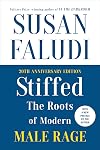
Stiffed: The Betrayal of the American Man
by Susan Faludi
On This Page
Description
This 20th-anniversary edition of the extraordinary New York Times bestseller features a new introduction from the author! "Stiffed is a brilliant, important book.. Faludi's reportorial and literary skills unfold with breathtaking confidence and beauty... She goes a long way toward eliminating the black and white, good and evil, male and female polarities that have riven the sexes in the past three decades..." -Time In 1991, internationally renowned feminist journalist Susan Faludi ignited show more a revival of the women's movement with her revelatory investigative reportage: Backlash was nothing less than a landmark, uncovering an "undeclared war" against women's equality in the media, advertising, Hollywood, the workplace, and government--a war that is still being fought today. Stiffed may be even more essential than Backlash to understanding the cultural riptides that led to Trumpian America. Here, Faludi turns her attention to the so-called "Angry Male" politics plaguing the nation. Through deeply researched, nuanced, and empathetic character studies of distressed industrial workers, laid-off aerospace engineers, combat veterans, football fans, evangelical husbands, suburban and inner-city teenage boys, and Hollywood and porn actors, Stiffed goes beyond the easy explanations of male misbehavior--that it's driven by chromosomes or hormones--to lay bare the powerful social and economic forces that have shattered the postwar compact defining American manhood. Faludi's vivid storytelling illuminates the historic and traumatic paradigm shift from a "utilitarian" manliness, grounded in civic and communal service, to an "ornamental" masculinity shaped by entertainment, marketing, and performance values. Read in the light of Trumpian politics and the #MeToo movement, Faludi's analysis speaks acutely to our present crisis, and to a foreboding future. Stiffed delivers a searing portrait of modern-day male America, and traces the provenance of a gender war that continues to rage, unabated. show lessTags
Recommendations







































Member Recommendations

Member Reviews
Excellent thesis and insight, but I didn't have the patience for the anecdotal story telling that was used to illustrate the thesis. Still there are hugely important things I want to remember: From page 10 "The man controlling his environment is today the prevailing American image of masculinity. A man is expected to prove himself not by being part of society but by being untouched by it, soaring above it....He is to be in the driver's seat, the king of the road..." And from page 35 "Ornamental culture has no such counterparts. Constructed around celebrity and image, glamour and entertainment, marketing and consumerism, it is a ceremonial gateway to nowhere. Its essence is not just the selling act but the act of selling the self, and in show more this quest every man is essentially on his own, a lone sales rep marketing his own image with no paternal Catain Waskows to guide him. In an age of celebrity, the father has no body of knowledge or authority to transmit to the son. Each son must father his own image, create his own Adam." "It’s often been observed that the economic transition from industry to service, or from production to consumption, is symbolically a move from the traditional masculine to the traditional feminine. But in gender terms, the transition is far more than a simple sex change and, so, more traumatic for men than we realize. A society of utility, for all the indisputable ways that it exploited men’s health and labor, and in an industrial context broke the backs and spirits of factory workers and destroyed the lungs of miners, had one saving grace: it defined manhood by character, by the inner qualities of stoicism, integrity, reliability, the ability to shoulder burdens, the willingness to put others first, the desire to protect and provide and sacrifice. These are the same qualities, recoded as masculine, that society has long recognized in women as the essence of motherhood. Men were publicly useful insofar as they mastered skills associated with the private realm of maternal femininity. Like mothers tending selflessly to their babes, men were not only to take care of their families but also their society without complaint; that was, in fact, what made them men.…
In a culture of ornament, by contrast, manhood is defined by appearance, by youth and attractiveness, by the curled lip and petulant sulk and flexed biceps, by the glamour of the cover boy, and by the market-bartered ‘individuality’ that sets one astronaut or athlete or gangster above another. These are the same traits that have long been designated as the essence of feminine vanity, the public face of the feminine as opposed to the private caring, maternal one. The aspects of this public ‘femininity’—objectification, passivity, infantilization, pedestal-perching, and mirror-gazing—are the very ones that women have in modern times denounced as trivializing and humiliating qualities imposed on them by a misogynist culture. No wonder men are in such agony. Not only are they losing the society they were once essential to, they are ‘gaining’ the very world women so recently shucked off as demeaning and dehumanizing." [pp. 38-39] And in conclusion from p 607 "Social responsibility is not the special province of masculinity; it's the lifelong work of all citizens in a community where people are knit together by meaningful and mutual concerns. But if husbanding a society is not the exclusive calling of "husbands," all the better for men's future. Because men struggle to free themselves from their crisis, their task is not, in the end, to figure out how to be masculine—rather, their masculinity lies in figuring out how to be human....[the men from the Navel shipyard's]...where seeking something worthwhile to *do*.....Their sense of their own manhood flowed out of their utility in a society, not the other way around. Conceiving of masculinity as something to *be* turns manliness into a detachable entity, at which point it instantly becomes ornamental, and about as innately "masculine" as fake eyelashes are inherently "feminine." show less
In a culture of ornament, by contrast, manhood is defined by appearance, by youth and attractiveness, by the curled lip and petulant sulk and flexed biceps, by the glamour of the cover boy, and by the market-bartered ‘individuality’ that sets one astronaut or athlete or gangster above another. These are the same traits that have long been designated as the essence of feminine vanity, the public face of the feminine as opposed to the private caring, maternal one. The aspects of this public ‘femininity’—objectification, passivity, infantilization, pedestal-perching, and mirror-gazing—are the very ones that women have in modern times denounced as trivializing and humiliating qualities imposed on them by a misogynist culture. No wonder men are in such agony. Not only are they losing the society they were once essential to, they are ‘gaining’ the very world women so recently shucked off as demeaning and dehumanizing." [pp. 38-39] And in conclusion from p 607 "Social responsibility is not the special province of masculinity; it's the lifelong work of all citizens in a community where people are knit together by meaningful and mutual concerns. But if husbanding a society is not the exclusive calling of "husbands," all the better for men's future. Because men struggle to free themselves from their crisis, their task is not, in the end, to figure out how to be masculine—rather, their masculinity lies in figuring out how to be human....[the men from the Navel shipyard's]...where seeking something worthwhile to *do*.....Their sense of their own manhood flowed out of their utility in a society, not the other way around. Conceiving of masculinity as something to *be* turns manliness into a detachable entity, at which point it instantly becomes ornamental, and about as innately "masculine" as fake eyelashes are inherently "feminine." show less
A long, dense book, though the writing flowed with plenty of live scenes, e.g., in restaurants, with storytelling and dialog.
As an aside... I came of age during the women's movement of the '60s but *never* blamed men. Instead, I saw our toxic culture oppressing both women and men. I always hoped for a men's movement where men could bond in a safe place and become their authentic selves. A men's movement was started some time ago (a few of my friends were involved), though the groups have drawn only a small percentage so far. Perhaps this book will help spread the word.
I especially liked the chapters on Vietnam, the Promise Keepers, and, surprisingly, Sylvester Stallone. My own family fit right in, with my silent veteran dad and my show more unfathered brother. So the stories were eerily familiar.
A long slog, but worth it. Recommended. show less
As an aside... I came of age during the women's movement of the '60s but *never* blamed men. Instead, I saw our toxic culture oppressing both women and men. I always hoped for a men's movement where men could bond in a safe place and become their authentic selves. A men's movement was started some time ago (a few of my friends were involved), though the groups have drawn only a small percentage so far. Perhaps this book will help spread the word.
I especially liked the chapters on Vietnam, the Promise Keepers, and, surprisingly, Sylvester Stallone. My own family fit right in, with my silent veteran dad and my show more unfathered brother. So the stories were eerily familiar.
A long slog, but worth it. Recommended. show less
Following very much in the path broken by Barbara Ehrenreich's Hearts of Men, Susan Faludi’s massive and moving chronicle of American masculinity, Stiffed, draws on the experiences of a wide variety of men: aerospace industry engineers, dockyard workers, professional football coaches, Viet Nam vets, astronauts and convicts, porn stars and (a surprisingly sympathetic) Sylvester Stallone. The overarching trajectory of Faludi’s analysis is that postwar America made, and then broke, a series of implicit promises to men of all races and all classes: that they would be active participants in society, that they would have work which provided them not just a livelihood but self-worth and dignity, that they would be able to achieve a stable show more and coherent manhood. What they got instead, Faludi details in scores of interviews, is the profound disappointment of inhabiting a superficial culture in which status has replaced substance and consumption has replaced achievement. All of the men in Stiffed are haunted, to varying degrees, by this sense of loss, and though all look around them for those responsible (feminists, the New World Order) none places the blame where it lies, on a culture interested more in finding new ways to sell products than in offering its inhabitants meaningful roles. Again, though, as Ehrenreich before her, Faludi takes solace in the notion that out of crisis will emerge progressive change in men’s sense of themselves and their relations with women: “Social responsibility is not the special province of masculinity; it’s the lifelong work of all citizens in a community where people are knit together by meaningful and mutual concerns. But if husbanding a society is not the exclusive calling of ‘husbands,’ so much the better for men’s future. Because as men struggle to free themselves from their crisis, their task is not, in the end, figuring out how to be masculine – rather, their masculinity lies in figuring out how to be human” (607). show less
An excellent dissection of how an unequal society that privileges men can end up screwing them over along with women. Also, a great book to share with someone who thinks feminism must, by improving things for women, make things worse for men.
A deep and powerful insight is flogged, thrashed, and beaten to death. Susan Faludi is incredibly smart, and just doesn't seem to know when she's won the argument. I admire her-- and I would never, ever, debate her!
Ms. Faludi tackles economics, culture, pychology and gender. She addresses the collapes of the American New Deal, the expectations of the Boomers, the shocks of overshoring and outsourcing manufacturing and the disappearance of the jobs that had supported a hope of affluance for the working and middle classes. She assumes that the popular psychology of the late 20th century is right - that men lack hope and self-respect, and can blame society and absent fathers for their unhappiness but instead lash out against women and others. Her stories of the collapse of the aircraft building industries and shipyards of southern California are solid, and the manouevers of the fans millionaire owners of the NFL Cleveland Browsn, although I do not show more agree with the pop psychology that permeates her analysis. Whileshe writes fairly respectfully about working class men, she maintains they have a false consciousness (i.e. they are deluded to think that traditional male occupations - making things and fighing wars matters - what matters is making money). She writes well about some books, writers, movies, producers and actors famous or somewhat popular in the 80s and 90s. show less
well...
I guess it's worth reading...
I have just read an interview of her...
But I think that's enough to make me read her new book..!
:)
I guess it's worth reading...
I have just read an interview of her...
But I think that's enough to make me read her new book..!
:)
Members
- Recently Added By
Lists

HarperCollins Publishers
144 works; 3 members

Club Read's Recommended Nonfiction Written by Women
618 works; 30 members
Author Information

8+ Works 4,906 Members
Susan Faludi is an American journalist and author, was born in 1959. She graduated from Harvard University. In 1991, she won a Pulitzer Prize for Explanatory Journalism. Her work can be read in numerous publications, including The New York Times, The Wall Street Journal, The New Yorker, The Los Angeles Times, and The Nation. She is the author of show more Backlash: The Undeclared War Against Women and the winner of the National Book Critics Circle Award for Nonfiction, The Terror Dream: Myth and Misogyny in an Insecure America, and In the Darkroom, which won the 2016 Kirkus Prize for nonfiction. (Bowker Author Biography) show less
Awards and Honors
Distinctions
Common Knowledge
- Original publication date
- 1999
Classifications
- Genres
- Sexuality and Gender Studies, Sociology, Nonfiction, General Nonfiction, History
- DDC/MDS
- 305.310973 — Society, government, & culture Social sciences, sociology & anthropology Social group - Age, Gender, Ethnicity People by gender or sex Men History, geographic treatment, biography North America United States
- LCC
- HQ1090.3 .F35 — Social sciences The family. Marriage, Women and Sexuality The Family. Marriage. Women Men
- BISAC
Statistics
- Members
- 927
- Popularity
- 28,693
- Reviews
- 8
- Rating
- (3.63)
- Languages
- English, Norwegian (Bokmål), Portuguese, Swedish
- Media
- Paper, Audiobook, Ebook
- ISBNs
- 16
- ASINs
- 4