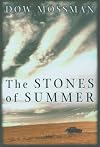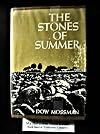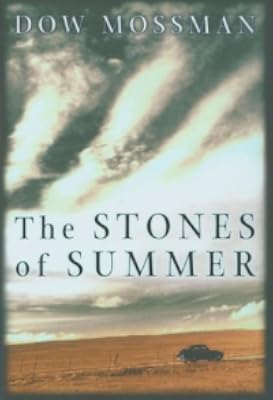
The Stones of Summer
by Dow Mossman
On This Page
Description
This stream-of-consciousness novel is the story of Dawes Williams, who grows up in Iowa and enters the world of the '60s as a hell-raising counterculture figure. In the process, he grows as a writer. A film about Dow Mossman, "Stone Reader," was released in 2002.Tags
Recommendations






















Member Reviews
So, having grown up in Cedar Rapids myself, I was really curious to read this underground and rediscovered saga. It includes writing that is flat-out brilliant, with layers of prose that build scenes that are somewhat fuzzy in a close-up reading but which, after one has set the book down, bloom into unexpected clarity. Haunting. Real and surreal all at once.
And there is writing that is maddeningly silly, puffed-up nonsense. If some of that was simply to fill out the character, we could have had about 200 pages less of it and still gotten the point.
The last section was a slog, but the first two sections will stay with me and made it worth the effort.
Guess I'll now be watching The Stone Reader...
And there is writing that is maddeningly silly, puffed-up nonsense. If some of that was simply to fill out the character, we could have had about 200 pages less of it and still gotten the point.
The last section was a slog, but the first two sections will stay with me and made it worth the effort.
Guess I'll now be watching The Stone Reader...
Picking up the Stone Reader hype, the blurb proclaimed ‘The Rediscovery of a Great American Novel’.
But is it? When The Stones of Summer first appeared in 1972, some critics thought so. The public apparently didn’t, but now the book is reborn, thanks to the publicity from Mark Moskowitz’s movie.
This work of almost 600 pages is split into 3 phases in the life of Dawes Williams. It starts promisingly, if slowly, with his boyhood on the plains of Iowa. The prose is languid, lyrical, with landscape, wind and sky all powerful elements of the child’s consciousness.
I liked this part best. The early rash of opaque imagery was irritating (‘He was heavy with rivers, with coming.’ - sophomore confusion of obscurity with profundity!), show more but it passed.
The second phase skipped to the adolescence of Dawes Williams. This was all about obnoxious teenage boys being obnoxious – getting drunk, fighting, vandalising, wrecking their parents’ cars – all in the pursuit of Cool. The only law was feigned indifference to everything, even beer.
This is where the book started turning sour on me. Mossman’s subliminal message was: ain’t these kids cool? – such free spirits! Er - no, actually.
In developing the freedom theme, the final phase sent the story completely off the rails. It is an interminable, barely readable, self-indulgent, incoherent, mad, chaotic, drunken acid trip as the young adult Dawes Williams drops out into a Mexican tequila nightmare. Yuk!
Dow Mossman is a very smart guy. He is acutely aware of the faults of his writing. A reproach springs to the reader’s mind, then 2 pages later, he self-mockingly voices it in the text! Uncanny.
Most memorably, Dawes Williams (his name is always written in full that way) recalls the advice of his fourth grade teacher to would-be writers: the first task of the writer is to befriend the reader. Alas, Mossman never gets that far.
Stones of Summer is a book of its time – the awful Sixties. But it’s timing was out. By 1972 the hippies were putting their suits on and going to the office.
No wonder it didn’t sell then, and it won’t now. This is NOT a great American novel, but it may make it onto the “Most Unread” list. My advice: don’t bother!
Note: William Dawes was the other guy who, like Paul Revere, rode from Boston to Lexington. Only Revere is remembered. show less
But is it? When The Stones of Summer first appeared in 1972, some critics thought so. The public apparently didn’t, but now the book is reborn, thanks to the publicity from Mark Moskowitz’s movie.
This work of almost 600 pages is split into 3 phases in the life of Dawes Williams. It starts promisingly, if slowly, with his boyhood on the plains of Iowa. The prose is languid, lyrical, with landscape, wind and sky all powerful elements of the child’s consciousness.
I liked this part best. The early rash of opaque imagery was irritating (‘He was heavy with rivers, with coming.’ - sophomore confusion of obscurity with profundity!), show more but it passed.
The second phase skipped to the adolescence of Dawes Williams. This was all about obnoxious teenage boys being obnoxious – getting drunk, fighting, vandalising, wrecking their parents’ cars – all in the pursuit of Cool. The only law was feigned indifference to everything, even beer.
This is where the book started turning sour on me. Mossman’s subliminal message was: ain’t these kids cool? – such free spirits! Er - no, actually.
In developing the freedom theme, the final phase sent the story completely off the rails. It is an interminable, barely readable, self-indulgent, incoherent, mad, chaotic, drunken acid trip as the young adult Dawes Williams drops out into a Mexican tequila nightmare. Yuk!
Dow Mossman is a very smart guy. He is acutely aware of the faults of his writing. A reproach springs to the reader’s mind, then 2 pages later, he self-mockingly voices it in the text! Uncanny.
Most memorably, Dawes Williams (his name is always written in full that way) recalls the advice of his fourth grade teacher to would-be writers: the first task of the writer is to befriend the reader. Alas, Mossman never gets that far.
Stones of Summer is a book of its time – the awful Sixties. But it’s timing was out. By 1972 the hippies were putting their suits on and going to the office.
No wonder it didn’t sell then, and it won’t now. This is NOT a great American novel, but it may make it onto the “Most Unread” list. My advice: don’t bother!
Note: William Dawes was the other guy who, like Paul Revere, rode from Boston to Lexington. Only Revere is remembered. show less
I made myself finish this book (with much cussing of Dawes Williams) because of I made a rule to finish a book I start and because there was promise in the first section of the book. Less promise in the 2nd section made me nervous. By the time I was well into the final section, I wanted so badly to break my own self-imposed rule. I stuck it out and found beauty were I could in his writing - which there was some. Unfortunately, the whole struggle for these 581 pages of oft-times random words, forces me to give this a low-rating. I could not wish it on anyone I liked.
Ramona's first addition to Jim's Desert Island Shelf. This is the book that inspired the film "Stone Reader." Talk about an obsession! After reading "Stones of Summer," Mark Moskowitz investigates the author to see if he's written anything else. Finding nothing, he goes on a trek to find Mossman. The entire film is a tribute to books and reading. Jim and I loved it and became obsessed with finding the book. As a librarian, I turned first to OCLC WorldCat and discovered there was a copy in a library nearby! We put ourselves on the waiting list at Barnes & Noble, who reprinted the book. Jim's read it and loved it. I haven't read it yet, but intend to. --RJM 10/10/05
One note of caution: the first 100 pages are tough sledding, but stick show more with it, because once you understand what Mossman is doing, the rest is a weightless glide into the stratosphere of fiction. The ending will blow you away! When I was 50 pages from the end, I could not believe he could finish this work in such a short span, but he did. I will read this again and again! --JJM, 10/11/05 show less
One note of caution: the first 100 pages are tough sledding, but stick show more with it, because once you understand what Mossman is doing, the rest is a weightless glide into the stratosphere of fiction. The ending will blow you away! When I was 50 pages from the end, I could not believe he could finish this work in such a short span, but he did. I will read this again and again! --JJM, 10/11/05 show less
I heard so much about this book and I liked the cover, so I had to buy it. I was greatly disappointed!!!!!!! The book was long and boring. The main character was to self-centerd. I know that sounds strange,because a story is often told by the main character. I was just annoyed by him and towards the end started skimming pages instead of reading just to be finished. This book made a trip to Half Price Books and was sold. Maybe someone else will buy it and like it.
ugh! i was working at barnes & noble when steve riggio decided to drag this back out of the grave it had been rightfully buried in. i remember when our store manager came over and told us it was a corporate initiative for everyone to "at least try to read it." we tried...we failed. and many of our colleagues around the country failed also. sometimes good books get overlooked their first go round, but not many. this one should have never been resurrected. long, long over-descriptive scenes, poor writing and that's just the first page ;-). i don't usually write reviews because i'm a pretty simple girl-i liked it, it didnt do it for me, i LOVED it! one word sums up dow mossman's (give credit where credit's due) stones of summer...ugh!
BOOOOOOOOOOOOORING!
Members
- Recently Added By
Lists

Great American Novels
158 works; 42 members
Author Information

2+ Works 647 Members
Dow Mossman received his B.A. from Coe College, in his hometown of Cedar Rapids, Iowa, and his M.F.A. from the University of Iowa Writers' Workshop. He is the recipient of numerous awards, including a Book-of-the-Month Club Fellowship
Common Knowledge
- Original publication date
- 1972
- People/Characters
- Dawes Williams
- Important places
- Iowa, USA
- First words
- When August came, thick as a dream of falling timbers, Dawes Williams and his mother would pick Simpson up at his office, and then they would all drive west, all evening, the sun before them dying like the insides of a stone ... (show all)melon, split and watery, halving with blood.
- Blurbers
- McElroy, Joseph
Classifications
Statistics
- Members
- 646
- Popularity
- 44,579
- Reviews
- 8
- Rating
- (3.06)
- Languages
- English
- Media
- Paper, Audiobook
- ISBNs
- 5
- ASINs
- 8