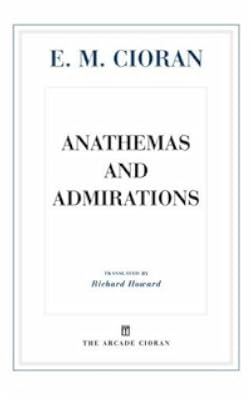
Anathemas and Admirations
by E. M. Cioran
On This Page
Description
In this collection of essays and epigrams, E.M. Cioran gives us portraits and evaluations--which he calls "admirations"--of Samuel Beckett, Jorge Luis Borges, F. Scott Fitzgerald, the poet Paul Valery, and Mircea Eliade, among others. In alternating sections of aphorisms--his "anathemas"--he delivers insights on such topics as solitude, flattery, vanity, friendship, insomnia, music, mortality, God, and the lure of disillusion.Tags
Recommendations















Member Reviews
Të lexosh është të lësh dikë tjetër të lodhet për ty. Forma më delikate e shfrytëzimit.
Nëse dikush e urren atë që bëjmë, ne, pak a shumë, e pranojmë këtë gjë. Por nëse përçmon një libër që i kemi rekomanduar, kjo është shumë më e rëndë, dhe na plagos si një sulm tinëzar. Sepse vendos në dyshim shijet tona, madje edhe gjykimet!
Sërish për Krishtin: sipas një tregimi gnostik, nga urrejtja për fatlum – in, ai do të ngjitej në qiell për ta shprishur mënyrën e vendosjes së sferave, me qëllim që të mos hetoheshin yjet. Në këtë rrokopujë, ç't'i ketë ngjarë vallë yllit tim të gjorë?
Nëse dikush e urren atë që bëjmë, ne, pak a shumë, e pranojmë këtë gjë. Por nëse përçmon një libër që i kemi rekomanduar, kjo është shumë më e rëndë, dhe na plagos si një sulm tinëzar. Sepse vendos në dyshim shijet tona, madje edhe gjykimet!
Sërish për Krishtin: sipas një tregimi gnostik, nga urrejtja për fatlum – in, ai do të ngjitej në qiell për ta shprishur mënyrën e vendosjes së sferave, me qëllim që të mos hetoheshin yjet. Në këtë rrokopujë, ç't'i ketë ngjarë vallë yllit tim të gjorë?
E.M. Cioran writes:
Every impulse of renovation, at the very moment when it approaches its goal, when it realizes itself through the State, creeps towards the automatism of the old institutions and assumes the face of tradition. As it defines and confirms itself, it loses energy, and this is also true of ideas: the more formulated and explicit they are, the more their efficacy diminishes. A distinct idea is an idea without a future. Beyond their virtual status, thought and action degrade and annul themselves: one ends up as system, the other as power: two forms of sterility and failure. Though we can endlessly debate the destiny of revolutions, political or otherwise, a single feature is common to them all, a single certainty: the show more disappointment they generate in all who have believed in them with some fervor.
– show less
Every impulse of renovation, at the very moment when it approaches its goal, when it realizes itself through the State, creeps towards the automatism of the old institutions and assumes the face of tradition. As it defines and confirms itself, it loses energy, and this is also true of ideas: the more formulated and explicit they are, the more their efficacy diminishes. A distinct idea is an idea without a future. Beyond their virtual status, thought and action degrade and annul themselves: one ends up as system, the other as power: two forms of sterility and failure. Though we can endlessly debate the destiny of revolutions, political or otherwise, a single feature is common to them all, a single certainty: the show more disappointment they generate in all who have believed in them with some fervor.
– show less
cioran is one of my favorite authors. this is my favorite book of his although it lacks the sardonic despair characteristic of most his work.
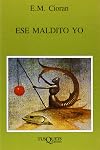
Al igual que los cínicos de la antigua Grecia, a los que tanto admiró, la trayectoria de Cioran ha constituido un intento desesperado de responder a una inquietud: cómo vivir en un mundo desquiciado y en el que la razón se ha revelado como un mito. Con la implacable precisión de un silogismo, cada uno de sus libros ha revelado minuciosamente, entre el sarcasmo y la lucidez, la nada que somos. «Todo el mundo me exaspera. Pero me gusta reír solo.» Es posible que en este aforismo resida todo el espíritu que sustenta este último libro de E. M. Cioran. Ese maldito yo contiene, pues, aforismos sin temas predominantes, salvo el yo, un yo maldito como todo lo que respira, probablemente porque, como reza en algún lugar de este libro, show more «si el hombre olvida con tanta facilidad que es un ser maldito, es por que lo es desde siempre». show less
Jul 20, 2022Spanish
Ratings
Members
- Recently Added By
Author Information

131+ Works 6,874 Members
Some Editions
Series
Belongs to Publisher Series
Common Knowledge
- Canonical title*
- Bekentenissen & banvloeken
- Original title
- Aveux et Anathèmes
- Original publication date
- 1987
*Some information comes from Common Knowledge in other languages. Click "Edit" for more information.
Classifications
- Genres
- Fiction and Literature, Literature Studies and Criticism
- DDC/MDS
- 848.91402 — Literature & rhetoric French Literature French miscellaneous writings 1900- 1900-1999 1945-1999 Anecdotes, epigrams, graffiti, jokes, quotations
- LCC
- PN6282 .C62 — Language and Literature Literature (General) Literature (General) Collections of general literature Epigrams
- BISAC
Statistics
- Members
- 348
- Popularity
- 90,669
- Reviews
- 4
- Rating
- (4.15)
- Languages
- 9 — Dutch, English, French, German, Italian, Japanese, Romanian, Russian, Spanish
- Media
- Paper, Ebook
- ISBNs
- 23
- ASINs
- 1