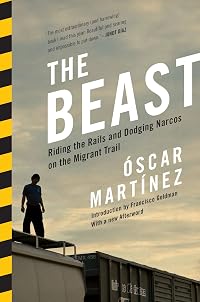
The Beast: Riding the Rails and Dodging Narcos on the Migrant Trail
by Oscar Martínez
On This Page
Description
One day a few years ago, 300 migrants were kidnapped between the remote desert towns of Altar, Mexico, and Sasabe, Arizona. A local priest got 120 released, many with broken ankles and other marks of abuse, but the rest vanished. Óscar Martínez, a young writer from El Salvador, was in Altar soon after the abduction, and his account of the migrant disappearances is only one of the harrowing stories he garnered from two years spent traveling up and down the migrant trail from show more Central America and across the US border. More than a quarter of a million Central Americans make this increasingly dangerous journey each year, and each year as many as 20,000 of them are kidnapped. Martínez writes in powerful, unforgettable prose about clinging to the tops of freight trains; finding respite, work and hardship in shelters and brothels; and riding shotgun with the border patrol. Illustrated with stunning full-color photographs, The Beast is the first book to shed light on the harsh new reality of the migrant trail in the age of the narcotraficantes. show lessTags
Recommendations





































Member Reviews
This account is immediately gripping & I have great respect for the author & his photographer trekking along with the migrants -- it could almost be considered the same as war reporters on the front lines.
While I'm not within immediate access of the Mexican/US border, I am in the South, so we have a relatively large migrant population here. Not everything I read is new to me -- I was aware that there were dangers & knew some of what was faced. But, it's one thing to know that the dangers exist, but quite another to read very detailed & personal stories attached to those dangers (whether the trains, the authorities, the cartels, the rapes, the kidnappings, the terrain, etc...). I guess the sheer number of hurdles, the extreme show more pervasiveness of the dangers, just the enormity of it all is what is eye-opening & shocking. It's like an up-front seat vs. viewing something from a distance.
The Beast needs to be required reading for everyone who resides in the Americas. show less
While I'm not within immediate access of the Mexican/US border, I am in the South, so we have a relatively large migrant population here. Not everything I read is new to me -- I was aware that there were dangers & knew some of what was faced. But, it's one thing to know that the dangers exist, but quite another to read very detailed & personal stories attached to those dangers (whether the trains, the authorities, the cartels, the rapes, the kidnappings, the terrain, etc...). I guess the sheer number of hurdles, the extreme show more pervasiveness of the dangers, just the enormity of it all is what is eye-opening & shocking. It's like an up-front seat vs. viewing something from a distance.
The Beast needs to be required reading for everyone who resides in the Americas. show less
While reading this book I also read two light funny mysteries that take place in Key West.
I mention this because this is a very difficult book to get through. It details the migration of people from Central America trying to reach the USA, by first crossing through Mexico. There are plenty of books that detail Mexicans trying to cross over, and while you would think there would be some camaraderie between the Central Americans and Mexicans there really isn’t.
It is impossible to imagine what is required mentally to leave your home in Guatemala, El Salvador, or Honduras, and begin a trek through Mexico, hoping to eventually cross into the United States. All of this is done illegally.
The migrants face assault, robbery, rape, and being show more murdered the entire way.
No one is safe.
This book details phenomenally well, how brutally,and hopelessly corrupt and complicit the Mexican government is and sadly this is also true of so many Mexican citizens who see these migrants as easy prey.
Mexico unfortunately is so hopelessly corrupt, and and the same time horrendously inept at running there country, that there is no hope for this situation to ever get better.
This book doesn’t seek to provide answers. The author emphatically states people will continue to try and get into the United States, no matter what, the USA tries to do to stop it.
He acknowledges that sadly many who make it to America learn the hard way it isn’t what they were led to believe, but they still continue to come.
Sadly as usual it is The women who fair the worst, trying to get to the United States.
While I think Everyone should read this book, understand it is sad, brutal and graphic, as well as being true, it is an eye opener, it is going on everyday and it isn’t going to stop! show less
I mention this because this is a very difficult book to get through. It details the migration of people from Central America trying to reach the USA, by first crossing through Mexico. There are plenty of books that detail Mexicans trying to cross over, and while you would think there would be some camaraderie between the Central Americans and Mexicans there really isn’t.
It is impossible to imagine what is required mentally to leave your home in Guatemala, El Salvador, or Honduras, and begin a trek through Mexico, hoping to eventually cross into the United States. All of this is done illegally.
The migrants face assault, robbery, rape, and being show more murdered the entire way.
No one is safe.
This book details phenomenally well, how brutally,and hopelessly corrupt and complicit the Mexican government is and sadly this is also true of so many Mexican citizens who see these migrants as easy prey.
Mexico unfortunately is so hopelessly corrupt, and and the same time horrendously inept at running there country, that there is no hope for this situation to ever get better.
This book doesn’t seek to provide answers. The author emphatically states people will continue to try and get into the United States, no matter what, the USA tries to do to stop it.
He acknowledges that sadly many who make it to America learn the hard way it isn’t what they were led to believe, but they still continue to come.
Sadly as usual it is The women who fair the worst, trying to get to the United States.
While I think Everyone should read this book, understand it is sad, brutal and graphic, as well as being true, it is an eye opener, it is going on everyday and it isn’t going to stop! show less
This book presents itself with a cover photo of a migrant on a freight car and says it's about "riding the rails". True enough, the book starts out in Guatemala and Honduras with the migrants working themselves into southern Mexico to start the migration up to the U.S. Like the non-documentary film, Sin Nombre, it does an excellent job of explaining why so many people feel compelled to flee their homelands and confront so many serious obstacles to reach America. The first part of the book could have been the basis for the film's screenplay. It's that similar. Both the book and the movie state very clearly that it's as much, if not more, of a factor of how untenable the existence is in Central America for migrants as it is how much show more America offers. Yet, about midway through the book, the author shifts focus to the vast Mexican border and the million and one obstacles that migrants face in crossing over into America. The U.S. Border Patrol is, in many respects, the least of those obstacles. This book covers the migrant experience is great depth. The feature that most distinguishes this book, however, is that this is almost entirely first person reporting. The author and a companion photographer place themselves throughout, in the midst of the migrants, their families, and those supporting or conflicting or merely observing those same migrants. This is not an historians perspective, nor that of a reporter showing up at an event and then rushing off to write a story. This is journalistic immersion. The reader will respect and admire what the author has done to tell this story. I very much look forward to reading his next work. show less
Claro que este hombre tiene huevos. This is searing reportage from the ground on the desperate lives of migrants finding there way through Mexico to the USA border. Martinez accompanies them along the way and lives their plight, he is a brave guy who academics and activists swoon over. But leaving that aside, the writing itself quickly gets flat and repetitive about the trials and tribulations of negotiating with traffickers without giving any emotional depth or connection. Also provides hardly any analysis or context, it is just a series of encounters. Partially this is a problem of how a bunch of short articles have been cobbled together without a decent edit. Maybe the translation is not so good, but he is an uninspired writer and show more analyst. show less
Thorough investigative journalism studying the lives and deaths of migrants traveling from Central America to the northern border of Mexico.
Here is the old story of the undertrodden taking their misery out on those even more miserable than themselves:
".. at the beginning of 2009, the government of the state of Chiapas finally started paying attention to the violence on these trails. The bandits of today were once day laborers and ranch hands, who for years watched lines and lines of Central American migrants sneaking fearfully through, always ready to duck into the scrub. And then one day one of the laborers must have got an idea: the migrants are walking these trails in order to hide from the authorities, so if there were to be an show more assault, a rape, say, or a robbery, nobody would report it."
Migrants trying to cross from their towns in Central America through Mexico to El Norte, face kidnapping by the cartels, the Zetas, the ones who have control of this territory:
"At la Victoria ranch, the kidnappers put on a show. They arranged the victims into five groups, lined them up to face the wall and forced them to their knees. Then they started paddling them in the small of their backs. It's a method of military torture used in Mexico, and it's one of the identifying marks of los Zetas. The verb to paddle, tablear, is well known in the overlapping world of both los Zetas and undocumented migrants passing through Mexico.
Any attempt to break los Zetas' rules is punished by death. Two of the kidnapped migrants learned this when, making the best of an unusually inattentive guard, they escaped from the ranch. The men ran for the mountains: an area their captors knew like the back of their hands, but that they didn't know it all. One of the Zetas soldiers went to hunt them down. He shortly returned with one of the migrants, who was marched in front of the other captives and forced to his knees.
'see what happens if you f*** with us!'
Melesit Jimenez, from Honduras, was shot dead in the back of the neck.
Only a few minutes after the body of jimenez fell, two more shots rang out from the hills. The second fugitive was hit once in the neck and once in the stomach.
In the next few days, while the group now numbering 50 learned to submit to their captors, los Zetas entertained themselves by raping the two women in the group, both from honduras, and occasionally paddling the men in the back. They were waiting for the ransom money: between $1,500 and $5,000 apiece, wired from each of the victims' families."
When my girls were little, and they were being naughty, I had one of those little paddle ball toys, that I would cut the paddle ball off of. And I would threaten them with being paddled, but I would only hit the paddle against my thigh, so it would make a big sound, and they would right away stop misbehaving.
So when they talk about paddling the men in the back, I had to look up what they meant on the internet. What I found was not like a little toy paddle ball: a man has his wrists tied together, while one of his captors holds him up, and another man smacks him at the bottom of his back with a block of wood, over and over.
The Imperial power, understanding that there will be no end to migrants trying to escape their poverty and the violence in their hometowns, have created a funnel, that directs the crossers to the hostile environment where there are mountains and desert, and in these mountains and desert are also crossing narcos, bandits, and coyotes, all waiting to kill you, rape you, rob you, and kidnap you, if the environment doesn't.
"... He's starting to understand frontier reality. How the wall and new security technologies have enveloped and overtaken this border in the past 12 years. How everybody who wants to Cross or get something across ( migrants, narcos, and bandits ) have been funneled to the few areas left where there are no walls and it's not too far to run to a city or a highway on the US side. This means that many ( migrants, narcos, and bandits ) are crossing at the same point. It's a game of chance, this border. Sometimes you get lucky and sometimes you don't.
Tijuana is where the wall starts its 1,800-mile trip. This wall is crossed by mexicans, Central americans, South americans, and even chinese. From here to Ciudad Juarez there are nearly 400 miles of walls, bars, or vehicle barriers, that funnel these people into the deserts. In Tijuana is where the routes that lead to some of the most violent cities in the world begin. And everybody ( at least every migrant ) is asking this one question: where is it safe to cross? And the answer is: nowhere. The US government has made sure of that."
Let's say in the unlikely circumstance that you managed to cross over the border. Chances are you are going to be picked up by a border agent, because they have vibration sensors buried in the ground, they have radar towers tracking movement, and they have agents looking through night vision binoculars. Now, you are going to be deported. But that's not the worst of it: The worst of it is that your group, your family or your friends, will be split up and deported into different cities:
"receiving apprehended migrants from other border sectors as well, Tijuana has also become a city of deportees. The Mexican National Institute of Migration ( INM ) calculates that about 900 persons are deported to the city every day. The US department of Homeland Security deports migrants to Tijuana ( in what is called lateral deportation ) because it supposedly deters them from reattempting to cross by separating them from their coyotes and support groups. But deportations don't just break up pollo and pollero. Even families are divided: a mother sent to Nogales, a father to Tijuana, an uncle to Juarez. Central Americans are usually flown all the way back to their country, which often means they have to wait a lot longer ( sometimes months ) in detention centers to get flown out and eventually released."
After this book was written, the Obama and Trump administrations both started the practice of taking children away from their migrant families, in a despicable method of deterrence.
We don't know what happened to those children, but chances are good that they were sold into slavery. And we have no idea if this practice still continues into the present of 2022.
Dog eat dog:
"The plaza is the best place to swindle migrants. One classic stunt is to sell a migrant's information to the people who work in the 'call centers.' Coyote agents, who are typically pretty chatty guys, like to squeeze names, numbers, destinations in the United states, and any other info they can out of migrants. They listen in, build up trust, redial phone numbers, whatever it takes. The call centers pay 1,000 pesos for a family member's phone number. They call migrants families and tell them their loved one has been kidnapped, and is going to be beaten or killed unless they wire 5000 pesos through Western union.
It's a cutthroat money game here. There are no sales and no special offers. It's like the whole town and all the crossing zones are being taken over by parasites, by anybody who can leach off the system. The whole package to cross costs $2,400 and includes a grueling 7-night walk across the desert. If the migrant is a Central American, the coyotes charge an extra $600, just because they can: because in Mexico most Central Americans have nowhere to go but north. on top of this each migrant has to pay the $70 Narco tax once they get over the line. There's usually another tariff as well-$100 for the marijuana farmer or cattle rancher who lets the groups cross through their land."
The border is a violent zone that is constantly being battled over for supremacy by the different cartels:
"they're not gangs and they're not corner hoodlums. They're organizations that cross hundreds of tons of South American cocaine and Mexican marijuana and methamphetamine to the United states. The Juarez cartel was the largest in Mexico during the 1990s. Back then it was led by Amado Carrillo, known as El Señor de Los Cielos, the Lord of the Skies. Carrillo Was something like the Mexican version of Colombia's Pablo Escobar. He earned his nickname because he used his Boeing 727 to cross loads of cocaine every week, sold at 200 million US dollars. The Mexican government alleged that an unrecognizable body found in 1997 in a clinic specializing in plastic surgery, was Carrillo's. Since his death or disappearance his relatives have led the Juarez cartel, but it has been weakened by the Sinaloa and gulf cartels' power surge.
The Sinaloa cartel has its hands in both Central and South America. this cartel is led by the most famous Mexican narco trafficker, Joaquin 'El Chapo' Guzman Loera, who wants to strip the Juarez cartel of its last bit of armor in the city that gives it its name. El Chapo became a household name in 2001 when he escaped from a maximum security prison by supposedly hiding in a crate of dirty laundry. Now he wants to snatch the throne that the Lord of the Skies left empty."
This book is obviously dated; it was written in 2009. Since then much has changed. You may remember that before El Chapo was recaptured, he threatened to assassinate trumpedo, who was very outspoken about his hate of mexicans.
Also of note, there is a telenovela called El Señor de Los Cielos, about Amado Carrillo on netflix, and it's pretty entertaining. I didn't finish watching all of the chapters; it's pretty lengthy.
I just learned from my sister that there was a documentary made from this book, called The Beast. I will be watching that, if I can find it. show less
Here is the old story of the undertrodden taking their misery out on those even more miserable than themselves:
".. at the beginning of 2009, the government of the state of Chiapas finally started paying attention to the violence on these trails. The bandits of today were once day laborers and ranch hands, who for years watched lines and lines of Central American migrants sneaking fearfully through, always ready to duck into the scrub. And then one day one of the laborers must have got an idea: the migrants are walking these trails in order to hide from the authorities, so if there were to be an show more assault, a rape, say, or a robbery, nobody would report it."
Migrants trying to cross from their towns in Central America through Mexico to El Norte, face kidnapping by the cartels, the Zetas, the ones who have control of this territory:
"At la Victoria ranch, the kidnappers put on a show. They arranged the victims into five groups, lined them up to face the wall and forced them to their knees. Then they started paddling them in the small of their backs. It's a method of military torture used in Mexico, and it's one of the identifying marks of los Zetas. The verb to paddle, tablear, is well known in the overlapping world of both los Zetas and undocumented migrants passing through Mexico.
Any attempt to break los Zetas' rules is punished by death. Two of the kidnapped migrants learned this when, making the best of an unusually inattentive guard, they escaped from the ranch. The men ran for the mountains: an area their captors knew like the back of their hands, but that they didn't know it all. One of the Zetas soldiers went to hunt them down. He shortly returned with one of the migrants, who was marched in front of the other captives and forced to his knees.
'see what happens if you f*** with us!'
Melesit Jimenez, from Honduras, was shot dead in the back of the neck.
Only a few minutes after the body of jimenez fell, two more shots rang out from the hills. The second fugitive was hit once in the neck and once in the stomach.
In the next few days, while the group now numbering 50 learned to submit to their captors, los Zetas entertained themselves by raping the two women in the group, both from honduras, and occasionally paddling the men in the back. They were waiting for the ransom money: between $1,500 and $5,000 apiece, wired from each of the victims' families."
When my girls were little, and they were being naughty, I had one of those little paddle ball toys, that I would cut the paddle ball off of. And I would threaten them with being paddled, but I would only hit the paddle against my thigh, so it would make a big sound, and they would right away stop misbehaving.
So when they talk about paddling the men in the back, I had to look up what they meant on the internet. What I found was not like a little toy paddle ball: a man has his wrists tied together, while one of his captors holds him up, and another man smacks him at the bottom of his back with a block of wood, over and over.
The Imperial power, understanding that there will be no end to migrants trying to escape their poverty and the violence in their hometowns, have created a funnel, that directs the crossers to the hostile environment where there are mountains and desert, and in these mountains and desert are also crossing narcos, bandits, and coyotes, all waiting to kill you, rape you, rob you, and kidnap you, if the environment doesn't.
"... He's starting to understand frontier reality. How the wall and new security technologies have enveloped and overtaken this border in the past 12 years. How everybody who wants to Cross or get something across ( migrants, narcos, and bandits ) have been funneled to the few areas left where there are no walls and it's not too far to run to a city or a highway on the US side. This means that many ( migrants, narcos, and bandits ) are crossing at the same point. It's a game of chance, this border. Sometimes you get lucky and sometimes you don't.
Tijuana is where the wall starts its 1,800-mile trip. This wall is crossed by mexicans, Central americans, South americans, and even chinese. From here to Ciudad Juarez there are nearly 400 miles of walls, bars, or vehicle barriers, that funnel these people into the deserts. In Tijuana is where the routes that lead to some of the most violent cities in the world begin. And everybody ( at least every migrant ) is asking this one question: where is it safe to cross? And the answer is: nowhere. The US government has made sure of that."
Let's say in the unlikely circumstance that you managed to cross over the border. Chances are you are going to be picked up by a border agent, because they have vibration sensors buried in the ground, they have radar towers tracking movement, and they have agents looking through night vision binoculars. Now, you are going to be deported. But that's not the worst of it: The worst of it is that your group, your family or your friends, will be split up and deported into different cities:
"receiving apprehended migrants from other border sectors as well, Tijuana has also become a city of deportees. The Mexican National Institute of Migration ( INM ) calculates that about 900 persons are deported to the city every day. The US department of Homeland Security deports migrants to Tijuana ( in what is called lateral deportation ) because it supposedly deters them from reattempting to cross by separating them from their coyotes and support groups. But deportations don't just break up pollo and pollero. Even families are divided: a mother sent to Nogales, a father to Tijuana, an uncle to Juarez. Central Americans are usually flown all the way back to their country, which often means they have to wait a lot longer ( sometimes months ) in detention centers to get flown out and eventually released."
After this book was written, the Obama and Trump administrations both started the practice of taking children away from their migrant families, in a despicable method of deterrence.
We don't know what happened to those children, but chances are good that they were sold into slavery. And we have no idea if this practice still continues into the present of 2022.
Dog eat dog:
"The plaza is the best place to swindle migrants. One classic stunt is to sell a migrant's information to the people who work in the 'call centers.' Coyote agents, who are typically pretty chatty guys, like to squeeze names, numbers, destinations in the United states, and any other info they can out of migrants. They listen in, build up trust, redial phone numbers, whatever it takes. The call centers pay 1,000 pesos for a family member's phone number. They call migrants families and tell them their loved one has been kidnapped, and is going to be beaten or killed unless they wire 5000 pesos through Western union.
It's a cutthroat money game here. There are no sales and no special offers. It's like the whole town and all the crossing zones are being taken over by parasites, by anybody who can leach off the system. The whole package to cross costs $2,400 and includes a grueling 7-night walk across the desert. If the migrant is a Central American, the coyotes charge an extra $600, just because they can: because in Mexico most Central Americans have nowhere to go but north. on top of this each migrant has to pay the $70 Narco tax once they get over the line. There's usually another tariff as well-$100 for the marijuana farmer or cattle rancher who lets the groups cross through their land."
The border is a violent zone that is constantly being battled over for supremacy by the different cartels:
"they're not gangs and they're not corner hoodlums. They're organizations that cross hundreds of tons of South American cocaine and Mexican marijuana and methamphetamine to the United states. The Juarez cartel was the largest in Mexico during the 1990s. Back then it was led by Amado Carrillo, known as El Señor de Los Cielos, the Lord of the Skies. Carrillo Was something like the Mexican version of Colombia's Pablo Escobar. He earned his nickname because he used his Boeing 727 to cross loads of cocaine every week, sold at 200 million US dollars. The Mexican government alleged that an unrecognizable body found in 1997 in a clinic specializing in plastic surgery, was Carrillo's. Since his death or disappearance his relatives have led the Juarez cartel, but it has been weakened by the Sinaloa and gulf cartels' power surge.
The Sinaloa cartel has its hands in both Central and South America. this cartel is led by the most famous Mexican narco trafficker, Joaquin 'El Chapo' Guzman Loera, who wants to strip the Juarez cartel of its last bit of armor in the city that gives it its name. El Chapo became a household name in 2001 when he escaped from a maximum security prison by supposedly hiding in a crate of dirty laundry. Now he wants to snatch the throne that the Lord of the Skies left empty."
This book is obviously dated; it was written in 2009. Since then much has changed. You may remember that before El Chapo was recaptured, he threatened to assassinate trumpedo, who was very outspoken about his hate of mexicans.
Also of note, there is a telenovela called El Señor de Los Cielos, about Amado Carrillo on netflix, and it's pretty entertaining. I didn't finish watching all of the chapters; it's pretty lengthy.
I just learned from my sister that there was a documentary made from this book, called The Beast. I will be watching that, if I can find it. show less
This depth and breadth of this book is amazing.
A companion book, En el Camino: México, la ruta de los migrantes que no importan
https://www.goodreads.com/book/show/10682141-en-el-camino,
A companion book, En el Camino: México, la ruta de los migrantes que no importan
https://www.goodreads.com/book/show/10682141-en-el-camino,
Ratings
Members
- Recently Added By
Published Reviews
ThingScore 100
Salvadoran journalist Óscar Martinez got this story the old-fashioned way: He followed it, on foot over the trails and by jumping and riding the freight train called “The Beast” that takes Central American migrants north through Mexico to the United States. ... Audaciously reported and, in this translation at least, clearly written, The Beast is one of the best book-length pieces of show more journalism on the topic. It’s a must-read for anyone with an interest in immigration and the narco-economy and narco-war that is tearing apart Mexico—and, by extension, the United States. show less
added by KelMunger
Lists

Recommend the 20 best books you've read in the last five years
2,168 works; 606 members

Central America
14 works; 1 member

High School Novels about Immigration
40 works; 1 member
Author Information
4 Works 339 Members
Some Editions
Awards and Honors
Common Knowledge
- Important places
- Mexico; Latin America
Classifications
- Genres
- Nonfiction, General Nonfiction, History
- DDC/MDS
- 305.9 — Society, government, & culture Social sciences, sociology & anthropology Social group - Age, Gender, Ethnicity People by occupation and miscellaneous social statuses
- LCC
- JV7402 .M3713 — Political Science Colonies and colonization. Emigration and immigration. International migration Colonies and colonization. Emigration and Emigration and immigration. International Canada, Latin America, etc.
- BISAC
Statistics
- Members
- 185
- Popularity
- 177,374
- Reviews
- 6
- Rating
- (4.42)
- Languages
- English
- Media
- Paper, Ebook
- ISBNs
- 4
- ASINs
- 1