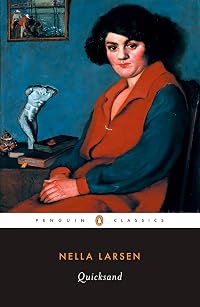
Quicksand
by Nella Larsen
On This Page
Description
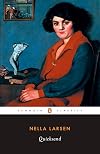
Nella Larsen's first novel tells the story of Helga Crane, a fictional character loosely based on Larsen's own early life. Crane is the lovely and refined daughter of a Danish mother and a West Indian black father who abandons Helga and her mother soon after Helga is born. Unable to feel comfortable with any of her white-skinned relatives, Helga lives in various places in America and visits Denmark in search of people among whom she feels at home. The work is a superb psychological study of show more a complicated and appealing woman, Helga Crane, who, like Larsen herself, is the product of a liaison between a black man and a white woman. In one sense, Quicksand might be called an odyssey; however, instead of overcoming a series of obstacles and finally arriving at her native land, Larsen's protagonist has a series of adventures, each of which ends in disappointment. show lessTags
Recommendations




























Member Recommendations
jscape2000 The struggles of a bi-racial American (Caribbean in Rhys) woman trying to survive in Europe. Central issues are identity, displacement, and loneliness.
Member Reviews
This was a great find from the 1001 books to read before you die list. The brief googling I did about Nella Larsen made me interested to read her work. She was an American writer in the 1920s and is considered part of the Harlem Renaissance. She was mixed race, with a black father, possibly of Caribbean descent, and a Danish immigrant mother. I had never heard of her, which I find sad.
[Quicksand] is largely autobiographical and explores Helga's search for identity. When the novel opens, Helga is teaching at a black college in the South. She quickly becomes disillusioned, though, and wonders what this closed community is really achieving or even trying to achieve. This disillusionment will follow Helga through all of the different show more communities she subsequently belongs to. She first goes back to Chicago, where she was raised, thinking she will get aid from her white Uncle who has helped her in the past. But he has a new wife who won't acknowledge Helga at all. Helga is helped by a wealthy black woman who gives her some connections in Harlem and Helga moves to New York. There she is happy at first, living among educated and creative black society, but she again becomes disillusioned, partially with their isolation from wider American culture. She travels to Denmark to live with her Aunt. There she is fully welcomed, but realizes that she is treated mainly like a novelty. At first she appreciates the freedom she has to fully participate in Danish society, unlike in America, but again she becomes disillusioned. So she returns to New York.
At the end she falls into the most common and expected trap of religion, marriage, and childbearing. A sad and disappointing ending for this bright and yearning young woman.
I found the writing beautiful and mature and the themes of race and belonging explored deeply and subtly. This was a really excellent surprise and I look forward to reading [[Nella Larsen]]'s other novel, [Passing]. show less
[Quicksand] is largely autobiographical and explores Helga's search for identity. When the novel opens, Helga is teaching at a black college in the South. She quickly becomes disillusioned, though, and wonders what this closed community is really achieving or even trying to achieve. This disillusionment will follow Helga through all of the different show more communities she subsequently belongs to. She first goes back to Chicago, where she was raised, thinking she will get aid from her white Uncle who has helped her in the past. But he has a new wife who won't acknowledge Helga at all. Helga is helped by a wealthy black woman who gives her some connections in Harlem and Helga moves to New York. There she is happy at first, living among educated and creative black society, but she again becomes disillusioned, partially with their isolation from wider American culture. She travels to Denmark to live with her Aunt. There she is fully welcomed, but realizes that she is treated mainly like a novelty. At first she appreciates the freedom she has to fully participate in Danish society, unlike in America, but again she becomes disillusioned. So she returns to New York.
At the end she falls into the most common and expected trap of religion, marriage, and childbearing. A sad and disappointing ending for this bright and yearning young woman.
I found the writing beautiful and mature and the themes of race and belonging explored deeply and subtly. This was a really excellent surprise and I look forward to reading [[Nella Larsen]]'s other novel, [Passing]. show less
I just finished Quicksand, and it's a great read. All Helga Crane's choices are impetuous, and I think Nella Larsen sacrifices the character for the opportunity to describe the many ways a mixed race woman could live in 1920's United States. There's the "squeeze all the native out of them" school where all attempts as self expression are squashed. After reading a little about the Indians under British rule, I think this is the sort of school she was after where the Indians end up more British than the British. She takes just a little time to explore the lack of opportunities for a black woman in a northern city where the only jobs open to her are menial. Helga Crane, well educated and proper, loves to read and thinks she can therefore show more get a job as a librarian without further education. In fact, Larsen was a librarian, but she must have found a way to get the proper credentials.
Then there's the wonderful stay in Harlem. I love this description:
For the hundredth time she marveled at the gradations within this oppressed race of hers. A dozen shades slid by. There was sooty black, shiny black, taupe, mahogany, bronze, copper, gold orange, yellow, peach, ivory, pinky white, pastry white. There was yellow hair, brown hair, black hair, straight hair, straightened hair, curly hair, crinkly hair, woolly hair. She saw black eyes in white faces, brown eyes in yellow faces, gray eyes in brown faces, blue eyes in tan faces. Africa, Europe, perhaps with a pinch of Asia, in a fantastic motley of ugliness and beauty, semibarbaric, sophisticated, exotic, were here.
This would seem to be the exact right place for Helga Crane, but she never seemed to be able to comfortably intermingle the Helga and the Crane parts of herself. Unlike the ideal Audrey Denney who fit with both races, Helga Crane never felt she fit with either. In Harlem she was "passing" as black. In Denmark she was surrounded by whites but valued only for her exotic otherness. Her job was to tantalize with her sensuality. She longed to have "that blessed sense of belonging to herself alone and not to a race."
Then Larsen adds the religious sharecropper to the mix, lest we forget what the African Americans were migrating away from.
This is such a wonderful work. What a loss that for whatever reason Larsen was not able to continue with her art. show less
Then there's the wonderful stay in Harlem. I love this description:
For the hundredth time she marveled at the gradations within this oppressed race of hers. A dozen shades slid by. There was sooty black, shiny black, taupe, mahogany, bronze, copper, gold orange, yellow, peach, ivory, pinky white, pastry white. There was yellow hair, brown hair, black hair, straight hair, straightened hair, curly hair, crinkly hair, woolly hair. She saw black eyes in white faces, brown eyes in yellow faces, gray eyes in brown faces, blue eyes in tan faces. Africa, Europe, perhaps with a pinch of Asia, in a fantastic motley of ugliness and beauty, semibarbaric, sophisticated, exotic, were here.
This would seem to be the exact right place for Helga Crane, but she never seemed to be able to comfortably intermingle the Helga and the Crane parts of herself. Unlike the ideal Audrey Denney who fit with both races, Helga Crane never felt she fit with either. In Harlem she was "passing" as black. In Denmark she was surrounded by whites but valued only for her exotic otherness. Her job was to tantalize with her sensuality. She longed to have "that blessed sense of belonging to herself alone and not to a race."
Then Larsen adds the religious sharecropper to the mix, lest we forget what the African Americans were migrating away from.
This is such a wonderful work. What a loss that for whatever reason Larsen was not able to continue with her art. show less
Helga Crane is a mixed-race woman, who never feels she fits into either world that is offered her--that of the Southern blacks in the school at which she teaches in the beginning of the story, that of that progressive blacks who befriend her in Harlem, nor that of her Danish white relatives, who treat her as an oddity when she flees to Denmark. She is a person without a racial identity, and that, for Nella Larsen, is worse than perhaps any other fate she could be sentenced to.
It is sad to watch Helga’s descent from a respectable job and a possible good marriage to a life that could not be deemed acceptable for any of us. The novel is well-titled, for Helga steps into the quicksand of her life and is pulled under slowly, even as she show more struggles mentally with how to break the cycle and pull free.
In addition to tackling the complex world of race relations and racial identity, Larsen addresses religion as the great panacea that she sees as a method of keeping the black population contented with their unacceptable lives and focused on rewards that can only come in the hereafter. The Reverend Pleasant Green is as unpleasant as can be, but one cannot help thinking he is but another victim of the situation and of Helga’s innate dissatisfaction.
We are given an array of female characters with which to contrast Helga. Anne Grey, a black woman who hates white people and has a position of importance in the black community, and Miss Denny, a black woman who seems to accept people in terms of who they are individually and without consideration of their skin color, are two of the most interesting. The women are complete opposites, but both seem to have found what Helga cannot, a place of belonging.
So much of this novel feels like an autobiography. I could not help thinking Nella Larsen must have lived many of these feelings of alienation and being treated as an oddity herself, considering how her own life story parallels Helga’s fictional one in so many details.
Like [b:Passing|349929|Passing|Nella Larsen|https://i.gr-assets.com/images/S/compressed.photo.goodreads.com/books/1388214730l/349929._SY75_.jpg|2369306], this novel is a wonderful insight into the mind and attitudes of blacks in the 1920s, particularly those of mixed race. Nella Larsen is required reading in my view. Her books are short, but her stories have a between-the-eyes impact that is unforgettable. show less
It is sad to watch Helga’s descent from a respectable job and a possible good marriage to a life that could not be deemed acceptable for any of us. The novel is well-titled, for Helga steps into the quicksand of her life and is pulled under slowly, even as she show more struggles mentally with how to break the cycle and pull free.
In addition to tackling the complex world of race relations and racial identity, Larsen addresses religion as the great panacea that she sees as a method of keeping the black population contented with their unacceptable lives and focused on rewards that can only come in the hereafter. The Reverend Pleasant Green is as unpleasant as can be, but one cannot help thinking he is but another victim of the situation and of Helga’s innate dissatisfaction.
We are given an array of female characters with which to contrast Helga. Anne Grey, a black woman who hates white people and has a position of importance in the black community, and Miss Denny, a black woman who seems to accept people in terms of who they are individually and without consideration of their skin color, are two of the most interesting. The women are complete opposites, but both seem to have found what Helga cannot, a place of belonging.
So much of this novel feels like an autobiography. I could not help thinking Nella Larsen must have lived many of these feelings of alienation and being treated as an oddity herself, considering how her own life story parallels Helga’s fictional one in so many details.
Like [b:Passing|349929|Passing|Nella Larsen|https://i.gr-assets.com/images/S/compressed.photo.goodreads.com/books/1388214730l/349929._SY75_.jpg|2369306], this novel is a wonderful insight into the mind and attitudes of blacks in the 1920s, particularly those of mixed race. Nella Larsen is required reading in my view. Her books are short, but her stories have a between-the-eyes impact that is unforgettable. show less
Worst of all was the fact that she understood and sympathized with Mrs. Nilssen’s point of view, as she always had been able to understand her mother’s, her stepfather’s, and his children’s points of view. She saw herself for an obscene sore in all their lives, at all costs to be hidden. She understood, even while she resented. It would have been easier if she had not.
Someone at the helm of NYRB Classics fell asleep at the wheel, for the fact that this work has not yet been granted a rebirth in their gorgeous editions is a travesty. Penguin Classics may have it, as does the 1001 Books Before You Die, but neither place implies the incisive ferocity of these pages, a whirlwind of fervent life and unbearable insight embodied in the show more body and mind of one black woman. The power of this book is the like of which I have never seen, least not in its entirety, and it is no wonder I had to stumble across it in search of something far more popular. I've picked up parts in Walker, Rhys, Maugham, carefully collegiated categories that must never, ever, intersect, certainly not within the work written 86 years ago. That would prove too inspiring a thing by far.
But gradually this zest was blotted out, giving place to a deep hatred for the trivial hypocrisies and careless cruelties that were, unintentionally perhaps, a part of the Naxos policy of uplift.
I do not claim to be Helga Crane, or even Nella Larsen for that matter, but familial blood is a desiccated thing next to the kinship I've through them found. It is a matter of minds in different worlds that for all the voids of time and skin convene here, in this place of the written word and the life it spawns. It is my unyielding effort to balance the hard-earned uplift with the rapid descent, the nightmare of thought and the inability to give even that up for the world. It is what I know of my privilege and what I feel of my pain, the exacting measures I have put myself through to translate both into a single language, and the ultimate reassurance that I may live so long as I let everyone else do the same. Neither Helga nor Larsen had happy endings; it is their living by truth I must look to.
“And the white men dance with the colored women. Now you know, Helga Crane, that can mean only one thing.” Anne’s voice was trembling with cold hatred. As she ended, she made a little clicking noise with her tongue, indicating an abhorrence too great for words.
“Don’t the colored men dance with the white women, or do they sit about, impolitely, while the other men dance with their women?” inquired Helga very softly, and with a slowness approaching almost to insolence. Anne’s insinuations were too revolting. She had a slightly sickish feeling, and a flash of anger touched her. She mastered it and ignored Anne’s inadequate answer.
It is the everyday hypocrisy that leads the lambs to the slaughter. Half black, half white, female, sensitive, pretty, intelligence as sharp as a whip if life would let it. Anyone at all would learn something from it if they weren't stopped by the usual bigotries, the patriarchal tendencies to denigrate the efforts of the "weaker sex" to exist in full acknowledgement of mind and lust, the white-washing over the two options of death sentence or selling of self for the most practical price, the oppressed cutting each other down to size in hopes of the fruits of their religion fed to them by the oppressors. It is the same old story, but so rarely told with such keen cutting and beautiful strength of self. It is a story that belongs to today, giving the lie to all that self-gratifying talk of progress, making it all nothing but appropriation, silence, and gilt.
…he was not the sort of man who would for any reason give up one particle of his own good opinion of himself. Not even for her. Not even though he knew that she had wanted so terribly something special from him.
I will never regret having been born far too late to have experienced the Harlem of Helga's time. The technology of the modern age means I have the resources to come to grips with any instances of hypocrisy, a network with which to imbibe and put forth any thoughts at all that are necessary for the building of my own self, a bulwark with no need for the customary solutions of travel, career change, whatever commitment to the unknown which shows its true colors as a path towards damnation only when I no longer have the means to escape it. Were I to live in the midst of this book, my quicksand would be quicker. That coming to terms of the self is far more worthwhile than any seeming happiness of an ending.
For Helga Crane wasn’t, after all, a rebel from society, Negro society. It did mean something to her. She had no wish to stand alone.show less
A bit uneven and a little too much telling rather than showing, but these are minor quibbles in a really interesting story coming out of the Harlem Renaissance of a woman trying to find her place throughout her life, with some surprisingly (though I shouldn't have been surprised) contemporary-sounding musings on race and culture and relationships and religion and family. I think I will check out her other book, Passing.
Larsen's prose is crisp and elegant. There is a beautiful simplicity in some of her descriptive passages. It feels light, delicate, effortless.
Some trouble I had with the book is that the main character, Helga Crane, feels elusive and distant. Her thoughts often feel overdetermined and abstract, though in some instances it works well, as in when Larsen is finding a way to make the the political personal, inflecting Helga's thoughts with the philosophy and thinking of black radical politics and activism. Larsen also does this to emphasise Helga's bourgeois yearnings and the chasm between politics and what she desires; she loves art and solitude and beautiful things, and is often torn between contempt for the communal activities of her show more people vs the life she thinks she should adore in Copenhagen: "meeting only pale serious faces when she longed for brown laughing ones".
There's some structural issues due to disjointed time jumps and abrupt shifts, as well; whole years pass between one chapter and the next whereas other chapters follow a time period more closely.
I'm glad I read it because it's searingly honest about the effects of racism on the psyche and the split consciousness it engenders. It's short and brutal and the ending is quite devastating considering that Helga walked into it with her eyes open. It's a book well worth reading. show less
Some trouble I had with the book is that the main character, Helga Crane, feels elusive and distant. Her thoughts often feel overdetermined and abstract, though in some instances it works well, as in when Larsen is finding a way to make the the political personal, inflecting Helga's thoughts with the philosophy and thinking of black radical politics and activism. Larsen also does this to emphasise Helga's bourgeois yearnings and the chasm between politics and what she desires; she loves art and solitude and beautiful things, and is often torn between contempt for the communal activities of her show more people vs the life she thinks she should adore in Copenhagen: "meeting only pale serious faces when she longed for brown laughing ones".
There's some structural issues due to disjointed time jumps and abrupt shifts, as well; whole years pass between one chapter and the next whereas other chapters follow a time period more closely.
I'm glad I read it because it's searingly honest about the effects of racism on the psyche and the split consciousness it engenders. It's short and brutal and the ending is quite devastating considering that Helga walked into it with her eyes open. It's a book well worth reading. show less
Quicksand was a fascinating depiction of a woman who can't fit in. Much like Nella Larsen herself, Helga Crane is a black woman, brought up unhappily in a white family (her mother is white, her black father is no longer around, and her mother has remarried a white man). Some of the references to her childhood were heartbreaking, knowing that Larsen was writing from her life. Helga Crane is not a very likeable character - far too prickly and difficult - but a fascinating character.
Helga finds it difficult to fit in with white people (with her obviously black ancestry), but also finds it difficult to fit into the black community. She has a fascinating friendship with a black woman, Anne, who is very concerned with the "race issue" (which show more I think is one of those very multi-faceted issues, because I couldn't pin it down to one particular aspect!). This lack of being able to identify with other people, for Helga, leads to her tragic ending. show less
Helga finds it difficult to fit in with white people (with her obviously black ancestry), but also finds it difficult to fit into the black community. She has a fascinating friendship with a black woman, Anne, who is very concerned with the "race issue" (which show more I think is one of those very multi-faceted issues, because I couldn't pin it down to one particular aspect!). This lack of being able to identify with other people, for Helga, leads to her tragic ending. show less
Members
- Recently Added By
Lists

1,001 BYMRBYD Concensus
723 works; 27 members

Schwob Nederland
207 works; 2 members

Zora Canon
100 works; 6 members

The Zora Canon
98 works; 4 members
Author Information

11+ Works 6,096 Members
Nella Larsen was associated with the Harlem Renaissance. She also worked as a librarian and a nurse in New York City, pursuing nursing after her brief, successful writing career until her death in 1964. Larsen's mother was Danish, and her father was West Indian; she used her experience as the child of middle-class parents in a mixed marriage to show more create characters in two novels who are stranded, caught between two cultures and unable to feel wholly at home in either. In each of Larsen's novels, the heroine suffers suffocating constrictions of her identity in both African American and white European culture. These crises in both Quicksand (1928) and Passing (1929) are further complicated by the heroine's quest for sexual as well as social identity, and both novels end without hopeful resolution. Both contain autobiographical elements, but Quicksand, the more successful, reproduced in fictional form many of the circumstances of Larsen's own early life. Although her work had been out of print for many years, she has recently been rediscovered. (Bowker Author Biography) show less
Some Editions
Awards and Honors
Series
Belongs to Publisher Series
Work Relationships
Is contained in
Is abridged in
Has as a reference guide/companion
Common Knowledge
- Canonical title
- Quicksand
- Original title
- Quicksand
- Original publication date
- 1928
- People/Characters
- Helga Crane
- Important places
- Chicago, Illinois, USA; Copenhagen, Denmark; USA; Denmark
- Epigraph
- My old man died in a fine big house.
My ma died in a shack.
I wonder where I'm gonna die,
Being neither white nor black?
LANGSTON HUGHES - Dedication
- For E. S. I.
- First words
- Helga Crane sat alone in her room, which at that hour, eight in the evening, was in soft gloom.
- Last words*
- (Click to show. Warning: May contain spoilers.)E aveva appena lasciato il letto e ripreso a camminare senza sentire dolore, i bambini avevano appena fatto ritorno dalle case dei vicini, che rimase incinta del suo quinto figlio.
- Original language
- English
*Some information comes from Common Knowledge in other languages. Click "Edit" for more information.
Classifications
Statistics
- Members
- 728
- Popularity
- 38,863
- Reviews
- 24
- Rating
- (3.60)
- Languages
- 5 — Dutch, English, French, Italian, Spanish
- Media
- Paper, Audiobook, Ebook
- ISBNs
- 42
- UPCs
- 1
- ASINs
- 17