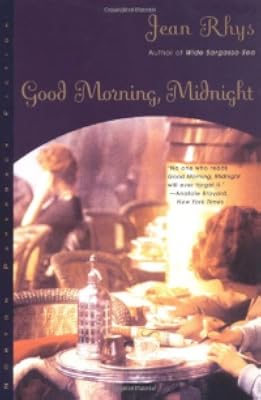
Good Morning, Midnight
by Jean Rhys
On This Page
Description
""As sharp and lucent and alarming as a piece of broken crystal."- Deborah Eisenberg, author of Your Duck Is My Duck. The last of the four novels Jean Rhys wrote in interwar Paris, Good Morning, Midnight is the culmination of a searing literary arc, which established Rhys as an astute observer of human tragedy. Her everywoman heroine, Sasha, must confront the loves- and losses- of her past in this mesmerizing and formally daring psychological portrait"--Tags
Recommendations




























Member Reviews
Having now soldiered through the fourth of Jean Rhys’s autobiographical, alcohol-and-female-dependency-themed novels, I really don’t see its author as “one of the foremost writers of the twentieth-century.” Tales of passive, suggestible, self-pitying, depressive protagonists drifting through life, attempting to sponge off, cling to, and be saved by a succession of invariably unworthy men—sordid dramas which unfold in seedy, sometimes bedbug-infested hotels and squalid boarding houses—don’t do much for me. Stylistically, Rhys may have been a competent enough writer, but style can only take bleak content so far. I don’t see good evidence here that it can turn dark material into literature worth reading. While pushing show more through these novels over the last couple of weeks, I frequently thought how unfortunate it was for Rhys that she didn’t have access to Alcoholics Anonymous or quality psychotherapy. Hers was no way to go through life. Given the abuse her body suffered, it’s a marvel she was able to write at all and very surprising that she lived into her late eighties.
I think Good Morning, Midnight is Rhys’s most nihilistic work. In it, the depressive protagonist, “Sasha”—observed by a London friend to be laid ever lower by age and drink—is sent to Paris for a couple of weeks’ rest on that friend’s dime. How anyone could believe that a woman in this state might benefit from such a solitary trip is beyond me. Perhaps the friend needed respite from witnessing the spiral of addiction. Once in France, Sasha encounters random men in bars or on the streets—a couple of Russians; a young man, René, a French-Canadian who has recently escaped from his Foreign Legion post in Morocco; and a repugnant commercial traveller who is staying in the same hotel.
The slim plot Rhys offers consists of Sasha drifting from café to café, or restaurant to cabaret, with one or another of these men, a drink at every stop. The reader is also given the woman’s hazy recollections of a failed marriage years before to the shifty Enno, whom she wed when young in order to escape London. Once hopeful that the marriage would be for all-time, in looking back, Sasha regards its end—with Enno’s abandonment of her after the (merciful) death of their infant son—as entirely foreseeable and inevitable. One of the few diversions from a seemingly endless series of scenes in which Sasha fails to connect can be found in the two hours she spends in a Parisian hat shop. (The right hat is critical for preserving any vestige of dignity that remains. The goal: “look normal enough so people won’t stare at you.”) Not surprisingly, though, the episode doesn’t add much interest overall.
I think I knew early on that Rhys wasn’t going to be for me; nevertheless, I effortfully worked through the complete novels in the order that Diana Athill arranged them in the Norton edition. It didn’t take me long to know that, with the possible exception of Wide Sargasso Sea, I was reading them to have read them—to be done with them. And now, thank God, I am. For good. show less
I think Good Morning, Midnight is Rhys’s most nihilistic work. In it, the depressive protagonist, “Sasha”—observed by a London friend to be laid ever lower by age and drink—is sent to Paris for a couple of weeks’ rest on that friend’s dime. How anyone could believe that a woman in this state might benefit from such a solitary trip is beyond me. Perhaps the friend needed respite from witnessing the spiral of addiction. Once in France, Sasha encounters random men in bars or on the streets—a couple of Russians; a young man, René, a French-Canadian who has recently escaped from his Foreign Legion post in Morocco; and a repugnant commercial traveller who is staying in the same hotel.
The slim plot Rhys offers consists of Sasha drifting from café to café, or restaurant to cabaret, with one or another of these men, a drink at every stop. The reader is also given the woman’s hazy recollections of a failed marriage years before to the shifty Enno, whom she wed when young in order to escape London. Once hopeful that the marriage would be for all-time, in looking back, Sasha regards its end—with Enno’s abandonment of her after the (merciful) death of their infant son—as entirely foreseeable and inevitable. One of the few diversions from a seemingly endless series of scenes in which Sasha fails to connect can be found in the two hours she spends in a Parisian hat shop. (The right hat is critical for preserving any vestige of dignity that remains. The goal: “look normal enough so people won’t stare at you.”) Not surprisingly, though, the episode doesn’t add much interest overall.
I think I knew early on that Rhys wasn’t going to be for me; nevertheless, I effortfully worked through the complete novels in the order that Diana Athill arranged them in the Norton edition. It didn’t take me long to know that, with the possible exception of Wide Sargasso Sea, I was reading them to have read them—to be done with them. And now, thank God, I am. For good. show less
Rhys is such a good writer, never a wasted word, such nuanced observations of people and places. She captures the inner lives of her main characters with devastating clarity and intensity, reaching a peak with Good Morning, Midnight.
Sasha is alone in Paris. She had lived there in her youth, when she could rely on her looks to find a man to look after her, but now she is in her forties, conscious of losing her looks, and is not having the same success. A relative has lent her money to move from London to Paris, out of the way. Sasha's life has been so sad and she has been treated so cruelly so often that she expects to be.
This sounds so bleak, and it is, but Sasha sees herself clearly, with wit, and doesn't take herself too seriously. show more Her story is an interior monologue told with flashbacks. A room today reminds her of rooms years ago, the life she lived then, the man she was with. show less
Sasha is alone in Paris. She had lived there in her youth, when she could rely on her looks to find a man to look after her, but now she is in her forties, conscious of losing her looks, and is not having the same success. A relative has lent her money to move from London to Paris, out of the way. Sasha's life has been so sad and she has been treated so cruelly so often that she expects to be.
This sounds so bleak, and it is, but Sasha sees herself clearly, with wit, and doesn't take herself too seriously. show more Her story is an interior monologue told with flashbacks. A room today reminds her of rooms years ago, the life she lived then, the man she was with. show less
“What happened to you, what happened?” he says. “Something bad must have happened to make you like this.”
“One thing? It wasn’t one thing. It took years. It was a slow process.”
When I closed this book with a thud and looked around my dimly lit room then out the window I realised the rain hasn’t stopped since morning. I then silently mourned for Good Morning, Midnight for its tangible and despairing sadness. The excruciating aimless wandering and temporary respite fumbled, rolled, and clung upon pleasure on different, lonely beds, shots of forgetting through alcohol, and the close company of death through sleep. This novel pelted with tears and grovelled with wanting; wanting without knowing, crying with knowing too much. show more The aftermath of a failed marriage with prematurely cut motherhood consistently questioned and hunted for both purpose and reason. Their persistence gnawed on the novel’s distinct structure which effectively ignited the burden of longing and loneliness. Perhaps, at the same time, it has set itself on fire and burned hope and love to ashes. Although it can frustrate with its frenzied agitation and confuse with its somewhat nonlinear narration, Good Morning, Midnight meanders in its gloomy skies and lets it all rain down without much care for flooding and landslide. All the whilst living slowly drowns within its confines. show less
“One thing? It wasn’t one thing. It took years. It was a slow process.”
When I closed this book with a thud and looked around my dimly lit room then out the window I realised the rain hasn’t stopped since morning. I then silently mourned for Good Morning, Midnight for its tangible and despairing sadness. The excruciating aimless wandering and temporary respite fumbled, rolled, and clung upon pleasure on different, lonely beds, shots of forgetting through alcohol, and the close company of death through sleep. This novel pelted with tears and grovelled with wanting; wanting without knowing, crying with knowing too much. show more The aftermath of a failed marriage with prematurely cut motherhood consistently questioned and hunted for both purpose and reason. Their persistence gnawed on the novel’s distinct structure which effectively ignited the burden of longing and loneliness. Perhaps, at the same time, it has set itself on fire and burned hope and love to ashes. Although it can frustrate with its frenzied agitation and confuse with its somewhat nonlinear narration, Good Morning, Midnight meanders in its gloomy skies and lets it all rain down without much care for flooding and landslide. All the whilst living slowly drowns within its confines. show less
Considered by many critics to be amongst the best books written in the last century, Good Morning, Midnight is about one woman's descent into the depths of despair. It's true, as another reviewer has written, that this is "the ultimate sad-sack self-manufactured-hard-luck gutter-eyed wine-swilling melancholy lady book," and I'd certainly encourage interested readers and fans of Rhys to consult Carole Angier's biographical study for insight into how Rhys transformed her personal demons into art while using art to confront, understand, and to some degree overcome her personal demons. Rhys' books, however - Wide Sargasso Sea and Good Morning, Midnight in particular - transcend the merely personal: they are pristine exemplars of a certain show more aspect of the human condition. Her style is minimalistic; every line is cut to the quick: the result is beautifully controlled and powerful writing. I think of her as being the female counterpart to authors such as Bukowski and Jim Thompson: if those writers appeal to you, Rhys is likely to do so as well. I sympathize, however, with the reviewer who called the book "senseless." The first time I read it, it seemed to me a mass of barely coherent fragments. When, following a mysterious compulsion, I re-read the book several years later, all the pieces suddenly fell into place, I saw the book as a whole, and knew I had tumbled upon something very potent and quite special.
Here's a final interesting tidbit. It's said that Jean Rhys was the favorite author of Jaqueline Kennedy Onassis - a telling choice for her to have made, to say the least. show less
Here's a final interesting tidbit. It's said that Jean Rhys was the favorite author of Jaqueline Kennedy Onassis - a telling choice for her to have made, to say the least. show less
This is a deceptively short and easy book. While it can be read quickly, the constant morphing of reality makes the simple story difficult to read, to the point where the ending hovers between a dream-state and reality. Alcohol, despair, and loneliness are all themes that permeate this novel and while it is bleak and grim, it is also punctuated with hope and liveliness, which brings the reader back for more... only to create a vortex back into the depths of sadness.
While I can't say I loved the book, it certainly didn't leave me indifferent, more a sense of unease than a revelation of the human heart. There was also a feeling that none of us are immune to such a fate.
While I can't say I loved the book, it certainly didn't leave me indifferent, more a sense of unease than a revelation of the human heart. There was also a feeling that none of us are immune to such a fate.
One of my favorite novels of all time.
Each of Rhys' four autobiographical novels are the story of the same kind of woman, each another decade into the disaster of her life. This, naturally, is the last of them - Sasha is the most broken, the most broke, and the most haunted by the many ways her life has disappointed her expectations. Written in a fragmented internal dialogue, deeply indebted to Joyce and Woolf the swirling of memory, of drunken present, and broken thoughts is my ideal.
Each of Rhys' four autobiographical novels are the story of the same kind of woman, each another decade into the disaster of her life. This, naturally, is the last of them - Sasha is the most broken, the most broke, and the most haunted by the many ways her life has disappointed her expectations. Written in a fragmented internal dialogue, deeply indebted to Joyce and Woolf the swirling of memory, of drunken present, and broken thoughts is my ideal.
Having read After Leaving Mr MacKenzie and Sleep It Off, Lady, this book wears out its welcome fairly quickly. We have another broke (but not really!) woman living in semi-squalor in Paris, unable to befriend other women and terrified (but not really!) of becoming involved with men.
It all wears pretty thin. Making things worse, in this novel, is Rhys clearly demonstrating just how incompetent and mentally unstable the narrator is: she works in a boutique, yet cannot find the cashier because she is too flustered after her ability to perform simple tasks is questioned; she takes a man back to her hotel, makes him leave once they have started to get down to business, then frantically wishes for him to return and finish the job; she tries show more her hand at guiding tourists, and does not know any of the places they ask her to take them; she tries to impress two foreigners and ends up taking them to a cafe where she is despised by the staff. All this in the midst of copious drinking and feeling sorry for herself.
Yawn. It worked better when it was tragic; here, it just feels inevitable. show less
It all wears pretty thin. Making things worse, in this novel, is Rhys clearly demonstrating just how incompetent and mentally unstable the narrator is: she works in a boutique, yet cannot find the cashier because she is too flustered after her ability to perform simple tasks is questioned; she takes a man back to her hotel, makes him leave once they have started to get down to business, then frantically wishes for him to return and finish the job; she tries show more her hand at guiding tourists, and does not know any of the places they ask her to take them; she tries to impress two foreigners and ends up taking them to a cafe where she is despised by the staff. All this in the midst of copious drinking and feeling sorry for herself.
Yawn. It worked better when it was tragic; here, it just feels inevitable. show less
Members
- Recently Added By
Lists

Backlisted
109 works; 9 members

50 Books by Women Authors
50 works; 10 members

1,001 BYMRBYD Concensus
723 works; 27 members

A Novel Cure
742 works; 23 members

Cooper
79 works; 1 member

1930s
262 works; 5 members

Books Read in 2017
4,249 works; 130 members

Anti-heroines in fiction
59 works; 9 members
Backlisted Podcast
65 works; 3 members

Retrospective of 20th- and 21st-century literature
154 works; 1 member

Reading LIst
648 works; 1 member

el
1,139 works; 1 member
Talk Discussions
Past Discussions
2. Good Morning, Midnight by Jean Rhys in Backlisted Book Club (March 2022)
Author Information

36+ Works 16,454 Members
Jean Rhys, 1890 - 1979 Writer Jean Rhys was born in Roseau, Dominica, West Indies. Her father was a Welsh doctor and her mother was a Dominican Creole. Her heritage deeply influenced her life as well as her writing. At seventeen, her father sent her to England to attend the Perse School, Cambridge and the Royal Academy of Dramatic Art in London. show more Unfortunately, she was forced to abandon her studies when her father died. Rhys worked as a chorus girl and ghostwrote a book on furniture. During World War I, she volunteered in a soldier canteen and, in 1918, worked in a pension office. In 1919, she went to Holland and married the French-Dutch journalist and songwriter Jean Langlet. They had two children, a daughter and a son who died as an infant. She began writing under the patronage of Ford Madox Ford. Her husband was sentenced to prison for illegal financial transactions. Her affair ended badly with Ford, and her marriage ended in divorce. In 1934, she married Leslie Tilden Smith who died in 1945. Two years later, she married Max Hamer who died in 1966. Rhys lived many years in the West Country, most often in great poverty. In 1927, Rhys' first collection of stories, "The Left Bank and Other Stories," was published. Her first novel, "Quartet" (1928), is considered to be an account of her affair with Ford Madox Ford told through Marya, a young English woman. In "Voyage in the Dark" (1934), the character is a young chorus girl involved with an older lover. She has also written "Good Morning, Midnight" (1939) and "Sleep It Off Lady" (1976) and the internationally acclaimed "Wide Sargasso Sea" (1960). Rhys was made a CBE in 1978 and received the W.H. Smith Award, the Royal Society of Literature Award and an Arts Council Bursart. Rhys died on May 14, 1979 in Exeter. In the same year, her unfinished autobiography "Smile Please" appeared. (Bowker Author Biography) show less
Some Editions
Awards and Honors
Series
Belongs to Publisher Series
Work Relationships
Common Knowledge
- Canonical title
- Good Morning, Midnight
- Original title
- Good Morning, Midnight
- Original publication date
- 1939
- People/Characters
- Sasha Jansen
- Important places
- Paris, France
- Epigraph
- Good Morning—Midnight—
I'm coming Home—
Day—got tired of Me—
How could I—of Him?
Sunshine was a sweet place—
I liked to stay—
But Morn—didn't want me—now—
So—Goodnight—Day!
Emily Dickinson - First words
- 'Quite like old times, the room says. 'Yes? No?'
- Last words
- (Click to show. Warning: May contain spoilers.)Then I put my arms around him and pull him down on to the bed, saying: 'Yes - yes - yes....'
- Original language
- English
Classifications
Statistics
- Members
- 1,656
- Popularity
- 13,533
- Reviews
- 41
- Rating
- (3.74)
- Languages
- 11 — Catalan, Dutch, English, Finnish, French, German, Italian, Portuguese, Spanish, Swedish, Turkish
- Media
- Paper, Audiobook, Ebook
- ISBNs
- 31
- ASINs
- 15