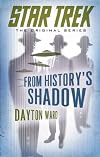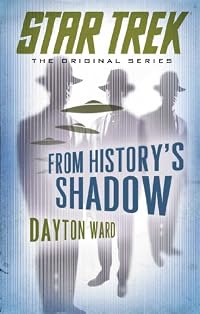
From History's Shadow
by Dayton Ward
From History's Shadow (1), Star Trek: The Original Series (Unnumbered novels — 2013), Star Trek (novels) (2013.07), Star Trek (2013.08)
On This Page
Description
Captain James T. Kirk discovers two intruders from Earth in the year 1968 on the Enterprise in 2268, a Vulcan and a member of an unknown race who has spent twenty years trying to bring about the destruction of humanity.Tags
Recommendations

Member Reviews
There are certain subgenres of Star Trek episodes: the studied-by-omnipotent-aliens story, the planet-of-the-hats story, the estranged father story. One I'd never really given much thought to before picking up From History's Shadow is the "secret history" subgenre of Star Trek: Vulcans giving us vel-kroh (Enterprise's "Carbon Creek"), aliens guiding us through the 20th-century Cold War (the original's "Assignment: Earth"), 29th-century technology giving us the microprocessor (Voyager's "Future's End"), and so on. From History's Shadow, like its literary predecessor The Eugenics Wars by Greg Cox, expands on those episodes to present a whole story of 20th-century secret history. For James Wainwright, this novel begins just after the show more events of Deep Space Nine's "Little Green Men" in 1947 and ends with the events of the original's "Tomorrow is Yesterday" in 1969 (plus a 1996 coda based around "Future's End"), threading its events into episodes like "Carbon Creek" and "Assignment: Earth" in between. It's not all references, though, as Dayton Ward works in a new alien race, the Certoss Ajahlan, who are combatants in the Temporal Cold War working to rewrite Earth's history in order to prevent their own destruction.
On the one hand, it's clever and fan-pleasing how From History's Shadow weaves all these references together, emulating what The Eugenics Wars did with the later parts of the 20th century. I appreciated the return of Mestral ("Carbon Creek" is one of the better Enterprise episodes) and I've always loved Roberta Lincoln andvI find the Aegis tantalizing. And the intricacies of the Temporal Cold War always have a certain appeal as well. Ward comes up with a compelling, seemingly unified history. Also interestingly, this book almost creates a secret history's secret history, revealing that behind-the-scenes there was more going on in "Assignment: Earth" than we were told on screen.
But I found that the story often lacked energy. Big chunks of time periodically pass, and I don't think they always do so in elegant ways; there are a number of scenes where Wainwright sits around thinking about things that have happened, things which sound more interesting than the things that are happening. The rise and fall of his department seems key to this story, but it's glossed over more than it's explored. I particularly wanted more of Wainwright himself. This is a man who's dedicated himself to a cause for over twenty years that's wrecked his personal life, but up until the very end, I had little sense of his own inner drive. His emotions and motivation always seem muted. A determination to discover the truth could have provided the unity that this kind of transhistorical epic needs. But the novel lacked cohesion, coming across more as a series of disparate incidents. I did really like Wainwright's last two scenes; his confrontation with Captain Christopher and his recognizing Voyager on the television give us a window into a man obsessed and pushed around too long, but up until then there'd been little hint of what made him go.
I'm also uncertain about the 23rd-century interstices on the Enterprise. I get why they're there, but at the beginning of the book they lack incident (it's a lot of Kirk and Spock talking to people) and dissipate momentum of the main story. They also give away some of its revelations: it's okay for a reader to be ahead of a character, but information from the frame story puts the reader too far ahead of the characters on some occasions. If we knew as little as Wainwright did, this might have made his investigations a bit more compelling. I did like how the Enterprise segments wrapped up, but it took too long to get there.
Continuity Notes:
On the one hand, it's clever and fan-pleasing how From History's Shadow weaves all these references together, emulating what The Eugenics Wars did with the later parts of the 20th century. I appreciated the return of Mestral ("Carbon Creek" is one of the better Enterprise episodes) and I've always loved Roberta Lincoln andvI find the Aegis tantalizing. And the intricacies of the Temporal Cold War always have a certain appeal as well. Ward comes up with a compelling, seemingly unified history. Also interestingly, this book almost creates a secret history's secret history, revealing that behind-the-scenes there was more going on in "Assignment: Earth" than we were told on screen.
But I found that the story often lacked energy. Big chunks of time periodically pass, and I don't think they always do so in elegant ways; there are a number of scenes where Wainwright sits around thinking about things that have happened, things which sound more interesting than the things that are happening. The rise and fall of his department seems key to this story, but it's glossed over more than it's explored. I particularly wanted more of Wainwright himself. This is a man who's dedicated himself to a cause for over twenty years that's wrecked his personal life, but up until the very end, I had little sense of his own inner drive. His emotions and motivation always seem muted. A determination to discover the truth could have provided the unity that this kind of transhistorical epic needs. But the novel lacked cohesion, coming across more as a series of disparate incidents. I did really like Wainwright's last two scenes; his confrontation with Captain Christopher and his recognizing Voyager on the television give us a window into a man obsessed and pushed around too long, but up until then there'd been little hint of what made him go.
I'm also uncertain about the 23rd-century interstices on the Enterprise. I get why they're there, but at the beginning of the book they lack incident (it's a lot of Kirk and Spock talking to people) and dissipate momentum of the main story. They also give away some of its revelations: it's okay for a reader to be ahead of a character, but information from the frame story puts the reader too far ahead of the characters on some occasions. If we knew as little as Wainwright did, this might have made his investigations a bit more compelling. I did like how the Enterprise segments wrapped up, but it took too long to get there.
Continuity Notes:
- Some post-foreshadowing here: Kirk and Spock mention a mysterious Commodore Antonio Delgado in connection with the Temporal Cold War. I assume we will hear more about this man in time travel stories going forward.
- Probably some savvy fellow could put or has put together a Gary Seven/Roberta Lincoln timeline. This novel predates Roberta's trip to the 23rd century in Assignment: Eternity, but here she seems a little more au fait with the Aegis agent lifestyle than I remember from Eternity.
- Much of the action in this novel takes place at Wright Patterson Air Force Base in Dayton, Ohio, which is just over an hour from where I grew up. I have fond memories of the airplane displays there, which I saw many times as a child. I never noticed any Ferengi shuttles or Vulcan probes, however. There's not really any local color beyond names, though. (Does Jim Wainright like Skyline chili? Or is he more of a Gold Star man? Does he root for the Reds? Or does he stick to the more local Dayton Dragons?)
The Trekathon continues! The cover of this novel tempted me - I know, I'm shallow - but I wisely decided to borrow and not buy. Based on the standard Trek premise of going back to the 'past', i.e. twentieth century Earth, Dayton Ward has written a plodding spin-off novelisation which runs on from the original series episode Assignment: Earth. The Enterprise and her crew are the lynchpin of the story, granted, but most of the 'action' is spread between secondary/minor characters of the author's own creation, which is not why I read these things. I did like the circular ending, but battling through all the exposition to get there took some determination!
Part X-Files, part Men In Black, with a dash of The Champions thrown in for good show more measure, Ward has crafted an intricate time travel story about a 'temporal war' between two alien factions, the terrestrial fallout of the battle on Earth (one word: Roswell), and an all seeing, all powerful agency trying to keep the peace. Kirk and co. get drawn back into the action when two of the alien arch-meddlers suddenly appear on board the ship, with Roberta Lincoln (of Assignment: Earth) in hot pursuit, but ultimately, Ward seems to be using the captain and his ship as a licence to publish under the Star Trek banner. Deathly dull, for those readers not into UFOs and alien sightings, which - ironically - I'm really not. Ward also seems to be one of those writers who prefer in-jokes over characterisation, referring to past episodes and the quirks of the series ('I really hope our next mission isn't quite so .. odd'), rather than building on the personalities of Kirk, Spock and the others in the context of the story. And on a pedantic level, the author's Yoda-esque sentence structure on occasion was very distracting ('already had pledged', instead of 'had already pledged', for instance).
Ah, well - onward ever onward! show less
Part X-Files, part Men In Black, with a dash of The Champions thrown in for good show more measure, Ward has crafted an intricate time travel story about a 'temporal war' between two alien factions, the terrestrial fallout of the battle on Earth (one word: Roswell), and an all seeing, all powerful agency trying to keep the peace. Kirk and co. get drawn back into the action when two of the alien arch-meddlers suddenly appear on board the ship, with Roberta Lincoln (of Assignment: Earth) in hot pursuit, but ultimately, Ward seems to be using the captain and his ship as a licence to publish under the Star Trek banner. Deathly dull, for those readers not into UFOs and alien sightings, which - ironically - I'm really not. Ward also seems to be one of those writers who prefer in-jokes over characterisation, referring to past episodes and the quirks of the series ('I really hope our next mission isn't quite so .. odd'), rather than building on the personalities of Kirk, Spock and the others in the context of the story. And on a pedantic level, the author's Yoda-esque sentence structure on occasion was very distracting ('already had pledged', instead of 'had already pledged', for instance).
Ah, well - onward ever onward! show less
Nice blend of real and Trek history.
Ratings
Members
- Recently Added By
Lists

Star Trek: The Typhon Pact and Beyond
33 works; 1 member
Author Information

60+ Works 4,388 Members
Awards and Honors
Awards
Series


Work Relationships
Is an expanded version of
Common Knowledge
- Canonical title
- From History's Shadow
- Original publication date
- 2013
- People/Characters
- James T. Kirk; Spock; James Wainwright; Nyota Uhura; Mestral; Gary Seven (show all 9); Montgomery Scott; Gejalik; Roberta Lincoln
- Important places
- USS Enterprise NCC-1701 (spaceship)
- Dedication
- For Ira, Robert, Toni, and Jack:
Thanks for making us believe in the "Little Green Men." - First words
- "General quarters! Intruder alert, Deck 8!"
- Last words
- (Click to show. Warning: May contain spoilers.)"Those things aren't real."
Classifications
Statistics
- Members
- 108
- Popularity
- 298,994
- Reviews
- 3
- Rating
- (3.69)
- Languages
- English
- Media
- Paper, Ebook
- ISBNs
- 2
- ASINs
- 2