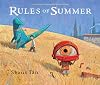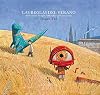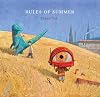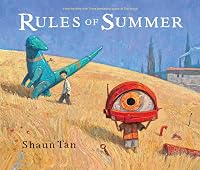
Rules of Summer
by Shaun Tan
On This Page
Description
Two boys explain the occasionally mysterious "rules" they learned over the summer, like never eat the last olive at a party, never ruin a perfect plan, and never give your keys to a stranger.Tags
Recommendations





Member Reviews
I don't really know what kids would think of this book. The story is a little hard to find, and the pictures are surreal and occasionally dark in tone. But I honestly don't care. Because I loved this book. I, in all my adultness, looking back on years of being an older sibling---of competition and confidences; of hair-pulling, nail-scratching slug-fests and standing shoulder-to-shoulder against all comers; of trading cruel, cutting words and whispering about crushes; of jealousy and dreams; of dismissive judgment and traversing imaginary worlds together---I loved this book.
I remember being that older boy, full of arbitrary assertions and grand plans, quick to lose my temper when my younger siblings failed to do as I wished...and just as show more quick to protect them from anyone who tried to hurt them. And I remember being that younger boy, confused, shut out, clumsy and annoying in my eagerness to participate, but so ready to forgive any wrong. I've injured and been injured by my siblings...and I know what it's like to stand in a stark winter of my life and know that the only ones coming for me are them.
This book, with its handful of words, its submerged story, its enigmatic, fanciful illustrations, holds a mirror to its reader and invites him or her to recognize themselves and their siblings within the pages. And because of that, I will always find something honest, something worthy of thought and consideration, each time I read it. show less
I remember being that older boy, full of arbitrary assertions and grand plans, quick to lose my temper when my younger siblings failed to do as I wished...and just as show more quick to protect them from anyone who tried to hurt them. And I remember being that younger boy, confused, shut out, clumsy and annoying in my eagerness to participate, but so ready to forgive any wrong. I've injured and been injured by my siblings...and I know what it's like to stand in a stark winter of my life and know that the only ones coming for me are them.
This book, with its handful of words, its submerged story, its enigmatic, fanciful illustrations, holds a mirror to its reader and invites him or her to recognize themselves and their siblings within the pages. And because of that, I will always find something honest, something worthy of thought and consideration, each time I read it. show less
I am getting obsessed with Shaun Tan's books. This was a great picture book. Basically its rules what not to do during the summer and it shows two boys getting in a lot of trouble. The artwork is just simply stunning and it is what keeps me coming back to read more from this author.
Rules of Summer by Shaun Tan is another example of how he uses his keen insight into the human condition to tell a beautiful story. I love when he uses entire two page spreads to illustrate his stories without any words whatsoever. In this book, he does this several times and it is breathtaking. Once again, I want to put his work up on my walls and just stare at it all the time. This is the story of two little boys who are basically listing out all of the things one cannot do during the summer months. You know basic preventative aids in case giant monsters attack planet earth. Normal stuff. It's an extremely quick read but honestly it's one that I pondered over for quite some time because it's just so visually stunning. If anyone is show more wondering what to get me for Christmas you could just get me the set of Tan's books and I'd be eternally grateful. Kidding! (Not really. Family, if you're reading this you know what to do. Hahahaha now I'm kidding. My family doesn't read this.) All in all, this was a winner which came as no surprise to you guys I'm sure. 10/10 show less
Sometimes I give away my illustrated books. But this one, is a keeper. Two boys working their way into summer and trying to find fun.
The older brother teaches the younger that there are rules that can be broken. The young stands by and disbelieves.
The illustrations are unique, and the book brought back memories of summers with my sisters. And, as the oldest, I too tried to make them break the rules.
I loved this book!
The older brother teaches the younger that there are rules that can be broken. The young stands by and disbelieves.
The illustrations are unique, and the book brought back memories of summers with my sisters. And, as the oldest, I too tried to make them break the rules.
I loved this book!
This book has absolutely beautiful painted illustrations that tell the story of the silly, often painful things that an older brother teaches his younger brother.
Brilliant, this SPB (Sophisticated Picture Book) through the use of pictures gives us interpretations of unspoken rules. The pictures are interpretative by your current schema, reminding us of what the causes or consequences might be when we break the rules, thus reminding us not to break the rules when we don't understand them.
The very first picture is a silhouette of two boys, one older and the other younger, i take this to mean that we learn vicariously from other others, our elders, so therefore we need to be role models and act how we want others to act.
One rule depicted in the book is "Never eat the last olive at a party" and the picture shows the elder brother pulling the younger away from the plate while an audience of show more vultures look on scornfully. While there is no rule at functions about eating the last piece of food on a plate we are well aware that it is not the done thing because we are not to appear as gluttons and we are to put others and their needs before our own. Funnily enough when attending functions you will always see people doing this.
This book is full of pictures and unspoken rules, some not so easy to define while others are as clear as day.
Towards the end the pictures depict the tension felt by the elder brother as he constantly has to keep the younger on the right track and on the right side of the rules. This building up of tension is shown through use of a the rule ' Never ask for a reason" and sees the elder trying to control the anger of the younger leading onto the next page where the younger is tethered to a leash and the older accepts a crown from a crow 'Never lose a fight' meaning don't give up, fight the good fight.
The black crows get thicker and thicker on each page showing it will get worse before it gets better ending with the older boy extending his hand and hauling the younger one up a ladder.
A great book to share with students who enjoyed discussing these rules and their validity. Each time you revisit the pictures the ideas build - FANTASTIC show less
The very first picture is a silhouette of two boys, one older and the other younger, i take this to mean that we learn vicariously from other others, our elders, so therefore we need to be role models and act how we want others to act.
One rule depicted in the book is "Never eat the last olive at a party" and the picture shows the elder brother pulling the younger away from the plate while an audience of show more vultures look on scornfully. While there is no rule at functions about eating the last piece of food on a plate we are well aware that it is not the done thing because we are not to appear as gluttons and we are to put others and their needs before our own. Funnily enough when attending functions you will always see people doing this.
This book is full of pictures and unspoken rules, some not so easy to define while others are as clear as day.
Towards the end the pictures depict the tension felt by the elder brother as he constantly has to keep the younger on the right track and on the right side of the rules. This building up of tension is shown through use of a the rule ' Never ask for a reason" and sees the elder trying to control the anger of the younger leading onto the next page where the younger is tethered to a leash and the older accepts a crown from a crow 'Never lose a fight' meaning don't give up, fight the good fight.
The black crows get thicker and thicker on each page showing it will get worse before it gets better ending with the older boy extending his hand and hauling the younger one up a ladder.
A great book to share with students who enjoyed discussing these rules and their validity. Each time you revisit the pictures the ideas build - FANTASTIC show less
This fantastical, quirky picture book has mesmerizing illustrations and a seemingly simple format: a repetitive rule book for getting through summer adventures. Larger topics such as bullying and the arbitranary nature of some rules can be discussed with older students.
Members
- Recently Added By
Lists

Red Dot 2014 - Younger Readers - Longlist
16 works; 3 members

Summer
24 works; 2 members

Books Read in 2017
4,249 works; 130 members

Best Australian Books of the 21st Century
88 works; 2 members

Favorite Picture Books
479 works; 160 members

The Five Books That Represent Us
391 works; 149 members
Author Information

40+ Works 10,890 Members
Shaun Tan was born in 1974 in Fremantle, Western Australia. He is an artist, writer, and film maker. In 2006, his wordless graphic novel The Arrival won the "Book of the Year" prize as part of the New South Wales Premier's Literary Awards. The same book won the Children's Book Council of Australia "Picture Book of the Year" award in 2007 and the show more Western Australian Premier's Book Awards Premier's Prize in 2006. For his career contribution to "children's and young adult literature in the broadest sense" Tan won the 2011 Astrid Lindgren Memorial Award from the Swedish Arts Council, the biggest prize in children's literature. In 2015 his title, Rules of Summer, was one of four books selected for the United States Board of Books for Young People list of Outstanding International Books for children and young adults. His book, The Singing Bones, won the 2015 Aurealis Awards for Best Graphic Novel/Illustrated work. He had two books published in 2018, Cicada. and Tales From the Inner City (Bowker Author Biography) show less
Some Editions
Awards and Honors
Awards
Distinctions
Common Knowledge
- Canonical title*
- Regels van de zomer
- Original title
- Rules of Summer
- Original publication date
- 2013
- First words
- This is what I learned last summer:
- Last words
- (Click to show. Warning: May contain spoilers.)That's it.
- Original language*
- Engels
*Some information comes from Common Knowledge in other languages. Click "Edit" for more information.
Classifications
Statistics
- Members
- 483
- Popularity
- 62,976
- Reviews
- 56
- Rating
- (4.04)
- Languages
- 9 — Dutch, English, French, German, Multiple languages, Portuguese (Brazil), Spanish, Swedish, Turkish
- Media
- Paper, Ebook
- ISBNs
- 17
- ASINs
- 2