Locomotive
by Brian Floca
On This Page
Description
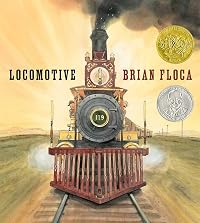
It is the summer of 1869, and trains, crews, and families are traveling together, riding America's brand new transcontinental railroad. The pages come alive with the details of the trip and the sounds, speed, and strength of the mighty locomotives; the work that keeps them moving; and the thrill of travel from plains to mountain to ocean. Come hear the hiss of the steam, feel the heat of the engine, watch the landscape race by. Come ride the rails, come cross the young country!Tags
Recommendations






Member Reviews
Breathtakingly beautiful, effortlessly informative, and intensely engaging, Brian Floca's Locomotive is a work of picture-book history that deserves all the accolades that it has won, from the Caldecott Medal it received for the artwork, to the Robert F. Sibert Honor it was awarded for content. The story of the building of the transcontinental railroad, which was built east from the Pacific coast by the Central Pacific Railroad Company, and built west from Omaha by the Union Pacific Railroad, its main text imagines the very first journey undertaken by rail passengers, after the line met at Promontory Summit in 1869, and the line was completed.
The poetic text here builds the sense of excitement that passengers would have felt, taking show more that historic journey, and captures the changing beauty of the various landscapes through which they would have passed. The artwork captures the hot and backbreaking work that went into both building and running such a rail line. The decorative endpapers, and an extensive afterword give more information, providing maps (in the case of endpapers), and more details about how the railroad impacted native peoples. I really appreciated the fact that Locomotive was a celebration of an important achievement in American history, one that had a huge impact on our development as a nation, but that the "not so nice" bits of that history were also included, for those wanting more in-depth information. All in all, I really enjoyed this one, and think it would make an excellent introduction to the topic of the railroads in American history, and how the transcontinental railroad changed the face of the nation and the course of history. show less
The poetic text here builds the sense of excitement that passengers would have felt, taking show more that historic journey, and captures the changing beauty of the various landscapes through which they would have passed. The artwork captures the hot and backbreaking work that went into both building and running such a rail line. The decorative endpapers, and an extensive afterword give more information, providing maps (in the case of endpapers), and more details about how the railroad impacted native peoples. I really appreciated the fact that Locomotive was a celebration of an important achievement in American history, one that had a huge impact on our development as a nation, but that the "not so nice" bits of that history were also included, for those wanting more in-depth information. All in all, I really enjoyed this one, and think it would make an excellent introduction to the topic of the railroads in American history, and how the transcontinental railroad changed the face of the nation and the course of history. show less
If easy, nonfiction read-alouds are some of the hardest children's books to write (and I think they are) then historical subjects have to be the hardest to tackle. Young children don't have any context for historical events or figures, most of which are oriented to adult concerns and ideas. I was skeptical about this book, although it features a train, since it tackles a complicated era in history (what historical era isn't complicated?) and I haven't always been a fan of Floca's watercolors in the past.
I am won over, proved wrong, and in awe. Brian Floca has written a book that will appeal not only to the youngest of train fans, but also to history buffs, both young and old.
The history of the railroad is framed around a journey a woman show more and two children take, going west on the train. As they travel, information about the building of the railroad, the various people who worked on the railroads and trains and the mechanical operation of the train itself are all woven into the journey.
The book is written in flowing free verse, separated into chunks of text. The text is further separated by the watercolors sprinkled throughout the book, scenes of railroad stops, gazelles racing the trains, explosions, and the wild landscape that the train races through. You can pick and choose sections to read aloud to the youngest children, while they ooh and aah over the train-filled landscapes or read the book at one sitting with an older listener, especially one who can sit still for a long time. Independent readers will want to pore over the text and illustrations themselves, especially the history-rich endpapers, with information closely packed together. The book ends with a lengthy author's note and extensive sources.
Verdict: This is a beautifully illustrated and accessible story of the building and growth of the railroad. It will be appreciated by both children and adults and find a wide audience. Highly recommended.
ISBN: 9781416994152; Published 2013 by Atheneum/Simon & Schuster; Borrowed from another library in my consortium; Purchased for the library show less
I am won over, proved wrong, and in awe. Brian Floca has written a book that will appeal not only to the youngest of train fans, but also to history buffs, both young and old.
The history of the railroad is framed around a journey a woman show more and two children take, going west on the train. As they travel, information about the building of the railroad, the various people who worked on the railroads and trains and the mechanical operation of the train itself are all woven into the journey.
The book is written in flowing free verse, separated into chunks of text. The text is further separated by the watercolors sprinkled throughout the book, scenes of railroad stops, gazelles racing the trains, explosions, and the wild landscape that the train races through. You can pick and choose sections to read aloud to the youngest children, while they ooh and aah over the train-filled landscapes or read the book at one sitting with an older listener, especially one who can sit still for a long time. Independent readers will want to pore over the text and illustrations themselves, especially the history-rich endpapers, with information closely packed together. The book ends with a lengthy author's note and extensive sources.
Verdict: This is a beautifully illustrated and accessible story of the building and growth of the railroad. It will be appreciated by both children and adults and find a wide audience. Highly recommended.
ISBN: 9781416994152; Published 2013 by Atheneum/Simon & Schuster; Borrowed from another library in my consortium; Purchased for the library show less
Locomotive, a Caldecott-winning picture book written and illustrated by Brian Floca, is a beautiful product. Slightly oversized, the book contains detailed paintings of historical trains and the places they passed through from Nebraska to California. The muted colors fit well with conveying the idea of times past, but there are also illustrations that convey the speed and joy of the journey. Fanciful lettering allows certain words to jump from the page, looking beautiful while engaging the reader's attention.
The story itself is both slight and meaty. It is slight in that the characters are not named or given much by way of a story. All you know is that they are travelling from one place to another in the coach class of a steam show more locomotive during the summer of 1869, right after the first transcontinental railroad was built. But then the text is also meaty in terms of providing historical details and lots of information on how the railway was built and how the train itself runs. We see how the train stops at various places and switches engines, and the mechanics that must be in place for the train to continue to run along to its destination without any problems. This is a little bit where the book loses it for me. While I appreciate all the fun historical tidbits, I wasn't necessarily enamored of learning all about the pistons, rods, boilers, etc. that make the steam train successfully run. I admit that I found these parts a little bit dull. However, that being said, I think for children (and adults) who are big train aficionados, this book is sure to be a hit precisely because it does contain all those details. The book ends with a lengthy note describing even more details about steam locomotives during this time frame.
Locomotive is billed as a book for ages 4 to 10, probably based on it being a picture book. However, I think it unlikely that you'd find many 4-year-olds with the attention span needed for the level of detail and sheer length of this book. This book seems best suited for children ages 7 to 10, those who might think that are getting too old for picture books -- but who will be pleasantly surprised by how much they will learn from and enjoy this book. show less
The story itself is both slight and meaty. It is slight in that the characters are not named or given much by way of a story. All you know is that they are travelling from one place to another in the coach class of a steam show more locomotive during the summer of 1869, right after the first transcontinental railroad was built. But then the text is also meaty in terms of providing historical details and lots of information on how the railway was built and how the train itself runs. We see how the train stops at various places and switches engines, and the mechanics that must be in place for the train to continue to run along to its destination without any problems. This is a little bit where the book loses it for me. While I appreciate all the fun historical tidbits, I wasn't necessarily enamored of learning all about the pistons, rods, boilers, etc. that make the steam train successfully run. I admit that I found these parts a little bit dull. However, that being said, I think for children (and adults) who are big train aficionados, this book is sure to be a hit precisely because it does contain all those details. The book ends with a lengthy note describing even more details about steam locomotives during this time frame.
Locomotive is billed as a book for ages 4 to 10, probably based on it being a picture book. However, I think it unlikely that you'd find many 4-year-olds with the attention span needed for the level of detail and sheer length of this book. This book seems best suited for children ages 7 to 10, those who might think that are getting too old for picture books -- but who will be pleasantly surprised by how much they will learn from and enjoy this book. show less
Really impressive. Beautiful, creative, poetic, and mostly pretty awesome. [return][return]Maybe, my one critique would be the perspective. It's in there, but it's subtle; so there's a lot of shifting between the "you and your experience" vibe and the historical reality. I think maybe a stronger sense of perspective, and/or one that somehow shifted perspectives so that gender and race signifiers -- which were subtle -- could have permitted identification with multiple characters. For instance, the discussion of the Native peoples who lived in places, and the people who built the trains, were really minimal -- almost place-holders. ... And the millions of buffalo described as previously inhabiting the plains, I think, at this historic show more point (1869) they were probably still there. So then is the perspective really 20th century America? Clearly not. [return][return]Anyway, this was an awesome and amazing work of art and historicity and poetry, and while I might have liked it to be different in some particulars, I still loved reading it and discussing it with my 5yo, and it drew in my partner who noted that she had learned more about trains listening to this one book than she ever had before. [return][return]So, highly recommended! Train lover or not. show less
Brian Floca takes the reader on an immersive journey from Omaha to Sacramento on America's first transcontinental railroad. It reads as verse, with playful language full of onomatopoeia for a fully engaging experience. Detailed illustrations give readers a lot to look at and contemplate. Learn more about the history and creation of the railroad on the front and back covers, as well as the author's note, which also discusses the enormous and irreversible changes the railroad had on the nation, including the Native tribes whose lands it bisected.
Really impressive. Beautiful, creative, poetic, and mostly pretty awesome.
Maybe, my one critique would be the perspective. It's in there, but it's subtle; so there's a lot of shifting between the "you and your experience" vibe and the historical reality. I think maybe a stronger sense of perspective, and/or one that somehow shifted perspectives so that gender and race signifiers -- which were subtle -- could have permitted identification with multiple characters. For instance, the discussion of the Native peoples who lived in places, and the people who built the trains, were really minimal -- almost place-holders. ... And the millions of buffalo described as previously inhabiting the plains, I think, at this historic point (1869) they show more were probably still there. So then is the perspective really 20th century America? Clearly not.
Anyway, this was an awesome and amazing work of art and historicity and poetry, and while I might have liked it to be different in some particulars, I still loved reading it and discussing it with my 5yo, and it drew in my partner who noted that she had learned more about trains listening to this one book than she ever had before.
So, highly recommended! Train lover or not. show less
Maybe, my one critique would be the perspective. It's in there, but it's subtle; so there's a lot of shifting between the "you and your experience" vibe and the historical reality. I think maybe a stronger sense of perspective, and/or one that somehow shifted perspectives so that gender and race signifiers -- which were subtle -- could have permitted identification with multiple characters. For instance, the discussion of the Native peoples who lived in places, and the people who built the trains, were really minimal -- almost place-holders. ... And the millions of buffalo described as previously inhabiting the plains, I think, at this historic point (1869) they show more were probably still there. So then is the perspective really 20th century America? Clearly not.
Anyway, this was an awesome and amazing work of art and historicity and poetry, and while I might have liked it to be different in some particulars, I still loved reading it and discussing it with my 5yo, and it drew in my partner who noted that she had learned more about trains listening to this one book than she ever had before.
So, highly recommended! Train lover or not. show less
Locomotive was a very well-written book, however I had mixed feelings about it. I really enjoyed the illustrations and the design of the book, but I was uninterested in the plot so it made it a little difficult to read. I loved the complex illustrations that really told the story for me; the different illustrations of characters and the train driving through the west were so amazing and were definitely my favorite part. I especially loved the image of the train on the "Dale Creek Bridge" which is large wooden structure. This image was so well-drawn and it really enhanced the story. Another thing I enjoyed about this Caldecott winner was the design of the book. Instead of just words and pictures on pages, there were different fonts and show more additional features that really interested the reader. There was an image of a menu on the train that really didn't have anything to do with the story, but was a very cool special feature. Since the actual text didn't really peak my interest, the design of the book was definitely necessary to keep my attention. The plot was very well-developed and would be great for many readers, however I personally was uninterested in it which made it harder for me to read. It was a story about the history of the railroad; how it was built, it's early uses, and the Pacific railroad that people took out west. It was definitely a good story if you wanted to learn about trains or the Pacific railroad, but the plot didn't keep my attention. The main idea in this book was to tell an accurate story of the history of trains and the Pacific railroad in 1869. It definitely told an interesting story and was very informative. show less
Members
- Recently Added By
Published Reviews
ThingScore 100
I purchased this book from BarnesandNoble.com
If you haven't checked out this year's Caldecott Award Winner, then you absolutely must! Along with my newfound appreciation for Children's Literature, I decided to purchase this book as a deal I had through my B&N membership. I had so much fun reading it and enjoying the illustrations, whilst being introduced to the writings and artwork of show more Brian Floca. You will not be disappointed!
Locomotive journeys through a family's travelings from Omaha, Nebraska to Sacramento, California in 1869 as a result of Abraham Lincoln's involvement in the Pacific Railway Act. This act connects the east to the west by railroad, and the project was completed 5 years ahead of schedule. Through the reading and illustrations, Floca transports us across the US and provides the reader a learning experience along the way. There's just enough history and detailed illustration for older children to observe, while younger children can chug along with the rhythm of free-verse and onomatopoeia.
Floca also provides a curriculum guide to use Locomotive as a tool for educational purposes. He shows how to develop a sense of integration between text and illustration to build knowledge for students and children. Resources can be found in the sleeves and inside covers to establish foundational learning and maximize comprehension. Floca has taken the time and effort to provide readers and educators multiple options for retention.
Honestly, I am very impressed with Brian Floca's ability to balance text and illustration. Most authors I come across who attempt to wear both hats of "Illustrator" and "Wordsmith" tend to lack in one of the areas. Not in this case. Not only does Floca succeed in accomplishing both, rightfully being accompanied by the Caldecott Award, but he also goes above and beyond to ensure that it is a true learning experience complete with vehemently researched facts. He purposefully changes font, size, and color to keep the reader interested and retain a mental image of the information.
In my opinion, Floca's artwork is beautiful. Just an interesting little tidbit, it took him 4 years to produce Locomotive. Although, in his own opinion, watercolor isn't his forte nor his first choice, he's produced amazing work worthy of reward. show less
If you haven't checked out this year's Caldecott Award Winner, then you absolutely must! Along with my newfound appreciation for Children's Literature, I decided to purchase this book as a deal I had through my B&N membership. I had so much fun reading it and enjoying the illustrations, whilst being introduced to the writings and artwork of show more Brian Floca. You will not be disappointed!
Locomotive journeys through a family's travelings from Omaha, Nebraska to Sacramento, California in 1869 as a result of Abraham Lincoln's involvement in the Pacific Railway Act. This act connects the east to the west by railroad, and the project was completed 5 years ahead of schedule. Through the reading and illustrations, Floca transports us across the US and provides the reader a learning experience along the way. There's just enough history and detailed illustration for older children to observe, while younger children can chug along with the rhythm of free-verse and onomatopoeia.
Floca also provides a curriculum guide to use Locomotive as a tool for educational purposes. He shows how to develop a sense of integration between text and illustration to build knowledge for students and children. Resources can be found in the sleeves and inside covers to establish foundational learning and maximize comprehension. Floca has taken the time and effort to provide readers and educators multiple options for retention.
Honestly, I am very impressed with Brian Floca's ability to balance text and illustration. Most authors I come across who attempt to wear both hats of "Illustrator" and "Wordsmith" tend to lack in one of the areas. Not in this case. Not only does Floca succeed in accomplishing both, rightfully being accompanied by the Caldecott Award, but he also goes above and beyond to ensure that it is a true learning experience complete with vehemently researched facts. He purposefully changes font, size, and color to keep the reader interested and retain a mental image of the information.
In my opinion, Floca's artwork is beautiful. Just an interesting little tidbit, it took him 4 years to produce Locomotive. Although, in his own opinion, watercolor isn't his forte nor his first choice, he's produced amazing work worthy of reward. show less
added by TheIndigoQuill
Lists

Caldecott Medal Books
91 works; 15 members

Books Read in 2023
5,547 works; 145 members

Beautiful Feet Books
304 works; 7 members

Book Review Roundup
254 works; 2 members

Robert F. Sibert Informational Book Medal
102 works; 1 member

The Playful Pioneers
166 works; 1 member
Author Information

9+ Works 3,880 Members
Brian Floca was born and raised in Temple, Texas. He graduated from Brown University and received his MFA from the School of Visual Arts. Brian Floca is the author and illustrator of Locomotive, winner of the 2014 Caldecott Medal. He has also written and illustrated Moonshot: The Flight of Apollo 11, Lightship, The Racecar Alphabet, and Five show more Trucks. He is the illustrator of the Poppy Stories series, by Avi; Ballet for Martha: Making Appalachian Spring, by Jan Greenberg and Sandra Jordan; Kate Messner's Marty McGuire novels; and Lynne Cox's forthcoming Elizabeth, Queen of the Seas. His books have received four Robert F. Sibert Honor awards, an Orbis Pictus Award, an Orbis Pictus Honor, a silver medal from the Society of Illustrators, and have twice been selected for The New York Times' annual 10 Best Illustrated Books list. (Bowker Author Biography) show less
Awards and Honors
Awards
Distinctions
Notable Lists
Common Knowledge
- Canonical title
- Locomotive
- Original publication date
- 2013
- Dedication
- For Avi
- First words
- Here is a road made for crossing the country, a new road of rails made for people to ride.
- Last words
- (Click to show. Warning: May contain spoilers.)On the Pacific, by that new sea, you have found a new place to call home.
Classifications
- Genre
- Children's Books
- DDC/MDS
- 385.0973 — Society, government, & culture Commerce, communications & transportation regulations Railroad transportation Subdivisions History, geographic treatment, biography North America United States
- LCC
- TJ603.2 .F56 — Technology Mechanical engineering and machinery Mechanical engineering and machinery Steam engineering Locomotives
- BISAC
Statistics
- Members
- 1,607
- Popularity
- 14,111
- Reviews
- 152
- Rating
- (4.27)
- Languages
- English, Spanish
- Media
- Paper, Audiobook, Ebook
- ISBNs
- 18
- ASINs
- 3