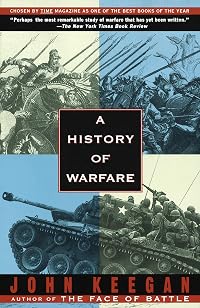
A History of Warfare
by John Keegan
On This Page
Description
Examines the place of warfare in human culture and the human impulse toward violence.Tags
Recommendations






Member Recommendations
Member Reviews
By sheer coincidence I was halfway through this book when its author Sir John Keegan passed away on August 2nd. That lends a bit of extra weight to the care of my assessment. It's my first read of this author and I've no strong background in military history, although I'm a history buff in general so I could follow nearly every historical context and eagerly investigated the bits I didn't.
The author introduces the work with his declaration that there is a single warrior culture and the evolution of this culture constitutes the history of warfare. He challenges the classic (I gather) Clausewitz statement that war is "an extension of policy by other means." Poking holes in a theory said to be universal is relatively easy: you need only show more provide one counterexample. Keegan provides four for good measure. I'm not standing on firm enough ground with respect to the definitions of 'policy' and 'culture' to judge how convincing these examples are, although I understand the author didn't win a lot of converts among his peers.
Supporting his 'warrior culture' theory, the author observes that the warrior spirit distinguishes that culture within the larger social order surrounding it, characterized by its own motivations and rewards. But in the interlude section 'Armies,' "warriors" is only one among six types of army makeup that he defines. That seems to cost his argument, unless he meant to present these six as a spectrum rather than distinct categories, with a flavouring of warrior culture sprinkled across all of them.
Theories and their arguments aside, I was primarily reading for the historical overview. It isn't until halfway through the book that events begin receiving coverage in chronological order, presenting the dates and players of various battles. This is not really a narrative of what battles took place and when; it's the story of the evolution of warfare through scientific advance and its pairing with (or reflection of) developments and varieties in society and culture. Warfare as we understand it today began in Sumer, what we recognize as the first civilization. The author makes the observation that this is not merely coincidental, but that the capacity for bloody, campaign-style warfare is a key part of what produces a recognizable state. Animal domestication, metal-working, centralized government and a number of other advances identified with civilization were required before organized campaigns against political neighbours became possible.
It's implied that general historians are uncomfortable with according a central role to military history as a force in civilization's advance, and he seems to enjoy tweaking their noses about it. Natural evolutionary steps in how war was conducted, springing from cultural or economic advances, led to the rise of the war-making state and fed in turn the further development of those societies. Keegan asserts that "the legacy of the chariot was the war-making state." Of the dawning of the Iron Age, he writes "Had stone, bronze and horse remained the means by which war was fought ... [civilization] might never have evolved beyond pastoralism and primitive husbandry." Of the Romans: "Rome's principle contribution to mankind's understanding of how life may be made civilised was its institution of a disciplined and professional army." Of the crusaders: "In schooling the European knightly class to the disciplines of purposive war-making, they laid the basis for the rise of effective kingdoms."
Ancient civilizations (Egypt, Sumeria, etc.) were largely peaceful until conquered by their charioteer neighbours, who then adopted the local culture. The local culture in turn, after overthrowing these conquerors from within, adopted their conquerors' war-making methods in the new states that resulted (Egypt's New Kingdom, Assyria, etc.). It interested me to learn that horse-back riding followed chariots rather than the reverse; in retrospect I can see how this is the more logical progression. The author attributes a great deal of influence to the steppe peoples (Turks and Mongols) for introducing a more unrestrained approach to warfare that overrode influential primitive approaches where utter destructive conquest had rarely been the goal of armed confrontation. I would formerly have defined 'primitive' as inherently more violent, but Keegan argues convincingly that the earliest civilizations lacked motive or the power to conduct anything we would recognize as their equivalent to modern war.
I can see why it's called "A History" and not "The History", propelled as it is by conjecture (however well cited) formed around his direct challenge to Clausewitz. I'd have to read a lot more military history to determine whose side I'm on. Lacking that, I believe this work and its author are held in high enough general esteem - and there's so many great links drawn between various events and developments in this work of such vast scope, not to mention a wonderful conclusion - that it's well worth anyone's time to read who has even a general interest in the subject. show less
The author introduces the work with his declaration that there is a single warrior culture and the evolution of this culture constitutes the history of warfare. He challenges the classic (I gather) Clausewitz statement that war is "an extension of policy by other means." Poking holes in a theory said to be universal is relatively easy: you need only show more provide one counterexample. Keegan provides four for good measure. I'm not standing on firm enough ground with respect to the definitions of 'policy' and 'culture' to judge how convincing these examples are, although I understand the author didn't win a lot of converts among his peers.
Supporting his 'warrior culture' theory, the author observes that the warrior spirit distinguishes that culture within the larger social order surrounding it, characterized by its own motivations and rewards. But in the interlude section 'Armies,' "warriors" is only one among six types of army makeup that he defines. That seems to cost his argument, unless he meant to present these six as a spectrum rather than distinct categories, with a flavouring of warrior culture sprinkled across all of them.
Theories and their arguments aside, I was primarily reading for the historical overview. It isn't until halfway through the book that events begin receiving coverage in chronological order, presenting the dates and players of various battles. This is not really a narrative of what battles took place and when; it's the story of the evolution of warfare through scientific advance and its pairing with (or reflection of) developments and varieties in society and culture. Warfare as we understand it today began in Sumer, what we recognize as the first civilization. The author makes the observation that this is not merely coincidental, but that the capacity for bloody, campaign-style warfare is a key part of what produces a recognizable state. Animal domestication, metal-working, centralized government and a number of other advances identified with civilization were required before organized campaigns against political neighbours became possible.
It's implied that general historians are uncomfortable with according a central role to military history as a force in civilization's advance, and he seems to enjoy tweaking their noses about it. Natural evolutionary steps in how war was conducted, springing from cultural or economic advances, led to the rise of the war-making state and fed in turn the further development of those societies. Keegan asserts that "the legacy of the chariot was the war-making state." Of the dawning of the Iron Age, he writes "Had stone, bronze and horse remained the means by which war was fought ... [civilization] might never have evolved beyond pastoralism and primitive husbandry." Of the Romans: "Rome's principle contribution to mankind's understanding of how life may be made civilised was its institution of a disciplined and professional army." Of the crusaders: "In schooling the European knightly class to the disciplines of purposive war-making, they laid the basis for the rise of effective kingdoms."
Ancient civilizations (Egypt, Sumeria, etc.) were largely peaceful until conquered by their charioteer neighbours, who then adopted the local culture. The local culture in turn, after overthrowing these conquerors from within, adopted their conquerors' war-making methods in the new states that resulted (Egypt's New Kingdom, Assyria, etc.). It interested me to learn that horse-back riding followed chariots rather than the reverse; in retrospect I can see how this is the more logical progression. The author attributes a great deal of influence to the steppe peoples (Turks and Mongols) for introducing a more unrestrained approach to warfare that overrode influential primitive approaches where utter destructive conquest had rarely been the goal of armed confrontation. I would formerly have defined 'primitive' as inherently more violent, but Keegan argues convincingly that the earliest civilizations lacked motive or the power to conduct anything we would recognize as their equivalent to modern war.
I can see why it's called "A History" and not "The History", propelled as it is by conjecture (however well cited) formed around his direct challenge to Clausewitz. I'd have to read a lot more military history to determine whose side I'm on. Lacking that, I believe this work and its author are held in high enough general esteem - and there's so many great links drawn between various events and developments in this work of such vast scope, not to mention a wonderful conclusion - that it's well worth anyone's time to read who has even a general interest in the subject. show less
Egyszerűen nincs pofám nem öt csillagot adni, pedig néhol leegyszerűsítőnek éreztem Keegan megállapításait – de végtére is egy ilyen nagy szándékú összefoglaló munka törvényszerűen egyszerűsít, hogy jobban csússzon a szöveg. És hát ez a könyv annyira alap, ha a hadtudományról van szó, és annyira mázli, hogy egy ilyen kiváló pedagógus írta meg, hogy fokozottan hálás vagyok érte. Keegan áttekinti a hadászat fejlődését onnantól kezdve, hogy mamuttrágyával hajigáltuk egymást a bizsergető tavaszi alkonyatban – egészen a hidrogénbombáig. (Most merje valaki mondani, hogy nincs fejlődés…) Szemet gyönyörködtető az ív, amit belevisz a történetbe – nem puszta kronológiai show more felsorolásról van itt szó, hanem logikusan felépített ok-okozati viszonyokról. Bravúrosan kezeli azt, hogy 1.) sokrétű problémakörről van itt szó, amelynek szálait szinte lehetetlennek tűnik egyetlen ívben áttekinteni – ennek okáért külön „közjátékokban” foglalkozik a hadtudomány olyan járulékos, de nem megkerülhető elemeivel, mint az erődépítés vagy a hadtápvonalak 2.) a könyvben tárgyalt események térben és időben elképesztően szórtan helyezkednek el, és előfordulhat, hogy amíg a bolygó egyik felén a hadtudomány forradalmian új alkalmazása (a lőpor, teszem azt) már leváltotta elődjét, addig a bolygó másik felén ugyanezen előd éppen most készül elérni zenitjét. Hogy ebbe ne gabalyodjunk bele, Keegan nagyon okosan függeszti fel a szoros értelemben vett időrendet.
Amúgy meg ez a munka vállaltan Clausewitz kritikája – cáfolata annak, hogy a „háború a politika folytatása más eszközökkel”. Keegan szerint ugyanis a háború sokkal inkább a politika kudarca, hiszen a politika célja nem lehet a tágabb értelemben vett politika intézményeinek felszámolása* – viszont amikor a clausewitz-i doktrínát követve a „valóságos háborút” az „abszolút háború” felé közelítjük (ami egy eufemizmus arra, hogy a földre hozzuk a poklot), akkor a modern fegyverrendszereknek hála tulajdonképpen mindennek az elpusztítására törekszünk, beleértve a politikai intézményeket is. Meg aztán Clausewitz fejtegetései során annyira nyugat-központú, hogy észre sem veszi, saját elmélete nem univerzálható – a nem-európai népek ugyanis sajátos kulturális tényezőiknek hála teljesen más stratégiákat építettek ki maguknak.
* A „tágabb értelemben vett” kitétel azért fontos, mert a saját szemünkkel is láthatjuk, hogy a politika ugyanakkor sajna minden további nélkül törekedhet arra, hogy a szűkebb értelemben vett politikát (vö.: demokratikus intézmények) felszámolja. show less
Amúgy meg ez a munka vállaltan Clausewitz kritikája – cáfolata annak, hogy a „háború a politika folytatása más eszközökkel”. Keegan szerint ugyanis a háború sokkal inkább a politika kudarca, hiszen a politika célja nem lehet a tágabb értelemben vett politika intézményeinek felszámolása* – viszont amikor a clausewitz-i doktrínát követve a „valóságos háborút” az „abszolút háború” felé közelítjük (ami egy eufemizmus arra, hogy a földre hozzuk a poklot), akkor a modern fegyverrendszereknek hála tulajdonképpen mindennek az elpusztítására törekszünk, beleértve a politikai intézményeket is. Meg aztán Clausewitz fejtegetései során annyira nyugat-központú, hogy észre sem veszi, saját elmélete nem univerzálható – a nem-európai népek ugyanis sajátos kulturális tényezőiknek hála teljesen más stratégiákat építettek ki maguknak.
* A „tágabb értelemben vett” kitétel azért fontos, mert a saját szemünkkel is láthatjuk, hogy a politika ugyanakkor sajna minden további nélkül törekedhet arra, hogy a szűkebb értelemben vett politikát (vö.: demokratikus intézmények) felszámolja. show less
Keegan is still the preeminent military history, and in this grand and sprawling book he attempts a synthetic history of warfare from the pre-historic dawn to the atomic age. Boldly staking a claim that Clausewitz's famous epigram "war is the continuation of politics by other means" is substantially misguided, a parallel to Marx's misguided grand theory of history, he instead provides a tour through four different types of warfare that is a lot of fun, but on the whole not terribly convincing.
Keegan begins in pre-history. Although the anthropological record makes it difficult to draw precise conclusions about prehistorical warfare, the extinction of North American megafauna provides clear evidence that mankind was a deadly killer, while show more ancient burials of people killed by flint points indicates that these tools were used against humans. Anthropological studies of hunter-gatherers in the Amazon and Papua New Guinea reveal that violence is endemic, though war is carefully circumscribed by rituals and taboos that describe how violence can be escalated, and where its limits are. This war is typically an arranged skirmish with relatively flimsy ranged weapons which can be easily dodged, and is fought to avenge an insult or for the sheer joy of it.
The first military technology revolution was the combination of the composite bow and chariot, which along with bronze armor and weapons, made a small military elite truly invincible in combat, able to circle masses of foot-soldiers and pick them off at will. Cavalry replaced chariots, but the light missile cavalry solidified as one of the dominant military strategies on Earth, as waves of steppe nomads from the Scythians to the Mongols poured out from endless plains to raid settled lands, occasionally invading and supplanting the existing rulers. In Keegan's reading, steppe nomads fought war not to rule, but because they enjoyed war itself, and the plunder was more lucrative than trading. When they did conquer, as in Turkey, they set up microcosmic steppe camps in the center of their palaces.
Against the Oriental style of the steppe nomads, Keegan puts the Western style of the Greek phalanx and Roman legion, where armored infantry (and later heavy cavalry) sought a decisive clash of arms. The Western style was not without it's mysticism. Keegan suggests the Greeks sought to limit wars to battles which could be resolved quickly, on prearranged flat spaces, rather than lengthy campaigns to despoil the countryside. Rome raised infantry to an imperial power, while the Dark Ages successors were caught between precepts of Christian pacifism and feudal notions of honor.
Western and Oriental styles of war existed in uneasy equilibrium. Heavy infantry could not successful invade steppe lands, but nomadic forces required huge herds of remounts, and could not sustain themselves in settled territories. The fourth style of army, the gunpowder armies that developed from the mercenary companies of 15th central Europe into the royal regiments of new nation-states, were something different. Drill and technology combined the ranged firepower of nomads with the endurance of heavy infantry. Military discipline could be mastered in a matter of weeks, as opposed to a lifetime of training. Only in the Napoleonic Wars does Keegan see Clausewitz's unit of politics and warfare, as the French revolution mobilized the entire people for military purposes. The logic of mass mobilization reached its zenith in the total wars of the 20th century: the slaughter along the Western Front of WW1, the genocides and aerial bombings of WW2, and the atomic apocalypse of a future WW3.
Written in the wake of the fall of the Berlin Wall and the triumph of high-tech interventionism that the Gulf War, Keegan can't foresee the rise of terrorism and the endless 'hybrid wars' of the 21st century. And while the book is enjoyable, if so very Orientalist, Keegan's argument is weakened by the narrowness of his definition of politics, which seem to be something only states and ministers can engage in. Rather, a more expansive definition of politics (I like the "art of reconciling human aspirations") shows that organized violence, even in the absence of states, can be political, and that cannons speak when words cannot be reconciled. As much as he claims to banish a false 'grand theory', Keegan raises another one weakly grounded on culture, that does not bear much rigor. show less
Keegan begins in pre-history. Although the anthropological record makes it difficult to draw precise conclusions about prehistorical warfare, the extinction of North American megafauna provides clear evidence that mankind was a deadly killer, while show more ancient burials of people killed by flint points indicates that these tools were used against humans. Anthropological studies of hunter-gatherers in the Amazon and Papua New Guinea reveal that violence is endemic, though war is carefully circumscribed by rituals and taboos that describe how violence can be escalated, and where its limits are. This war is typically an arranged skirmish with relatively flimsy ranged weapons which can be easily dodged, and is fought to avenge an insult or for the sheer joy of it.
The first military technology revolution was the combination of the composite bow and chariot, which along with bronze armor and weapons, made a small military elite truly invincible in combat, able to circle masses of foot-soldiers and pick them off at will. Cavalry replaced chariots, but the light missile cavalry solidified as one of the dominant military strategies on Earth, as waves of steppe nomads from the Scythians to the Mongols poured out from endless plains to raid settled lands, occasionally invading and supplanting the existing rulers. In Keegan's reading, steppe nomads fought war not to rule, but because they enjoyed war itself, and the plunder was more lucrative than trading. When they did conquer, as in Turkey, they set up microcosmic steppe camps in the center of their palaces.
Against the Oriental style of the steppe nomads, Keegan puts the Western style of the Greek phalanx and Roman legion, where armored infantry (and later heavy cavalry) sought a decisive clash of arms. The Western style was not without it's mysticism. Keegan suggests the Greeks sought to limit wars to battles which could be resolved quickly, on prearranged flat spaces, rather than lengthy campaigns to despoil the countryside. Rome raised infantry to an imperial power, while the Dark Ages successors were caught between precepts of Christian pacifism and feudal notions of honor.
Western and Oriental styles of war existed in uneasy equilibrium. Heavy infantry could not successful invade steppe lands, but nomadic forces required huge herds of remounts, and could not sustain themselves in settled territories. The fourth style of army, the gunpowder armies that developed from the mercenary companies of 15th central Europe into the royal regiments of new nation-states, were something different. Drill and technology combined the ranged firepower of nomads with the endurance of heavy infantry. Military discipline could be mastered in a matter of weeks, as opposed to a lifetime of training. Only in the Napoleonic Wars does Keegan see Clausewitz's unit of politics and warfare, as the French revolution mobilized the entire people for military purposes. The logic of mass mobilization reached its zenith in the total wars of the 20th century: the slaughter along the Western Front of WW1, the genocides and aerial bombings of WW2, and the atomic apocalypse of a future WW3.
Written in the wake of the fall of the Berlin Wall and the triumph of high-tech interventionism that the Gulf War, Keegan can't foresee the rise of terrorism and the endless 'hybrid wars' of the 21st century. And while the book is enjoyable, if so very Orientalist, Keegan's argument is weakened by the narrowness of his definition of politics, which seem to be something only states and ministers can engage in. Rather, a more expansive definition of politics (I like the "art of reconciling human aspirations") shows that organized violence, even in the absence of states, can be political, and that cannons speak when words cannot be reconciled. As much as he claims to banish a false 'grand theory', Keegan raises another one weakly grounded on culture, that does not bear much rigor. show less
Filled with useful information, exciting stories and strange paradoxes. Is really one long argument with Clausewitz about why war is NOT always a continuation of policy with other means, and why this outlook actually is a recipe for disaster. War is much more related to cultural matters than Clausewitz allowed.
Eminent Military Historian John Keegan does not endeavor to give us a chronology of wars and battles -- that has been done many times over by lesser authors. Instead, he begins with a look Clausowitz' On War, and expands on some of the German historian's fundamental concepts -- mostly that war is an extension of politics.
The course of the book is a winding one -- while there is some marching order through time, Keegan will often take an example from stone age through Classical through Medieval to modern -- discussing Rome at one moment, Napoleon the next. Why there are wars is as important as studying the wars themselves -- especially if we ever hope to evolve past them.
This book was written after the first Gulf war. In the 20 years show more since, I wonder what additional commentary Keegan might have. While "mutually assured destruction" might have helped avert a third world war during the second half of the 20th centuries, conventional was are as numerous now as they ever have been. While damaging to the societies of the combatants as a whole, motivation and driving force is often a cult of personality where the few stand to profit the most. show less
The course of the book is a winding one -- while there is some marching order through time, Keegan will often take an example from stone age through Classical through Medieval to modern -- discussing Rome at one moment, Napoleon the next. Why there are wars is as important as studying the wars themselves -- especially if we ever hope to evolve past them.
This book was written after the first Gulf war. In the 20 years show more since, I wonder what additional commentary Keegan might have. While "mutually assured destruction" might have helped avert a third world war during the second half of the 20th centuries, conventional was are as numerous now as they ever have been. While damaging to the societies of the combatants as a whole, motivation and driving force is often a cult of personality where the few stand to profit the most. show less
history of warfare told by Britain's foremost military historian.
John Keegan's masterpiece is a work of breath-taking scope that not only chronicles the history of warfare from the Empire of Babylon to the Somme, A History of Warfare studies civilisations, psychology, archaeology, genetics, history and strategy with an expert's eye.
John Keegan's masterpiece is a work of breath-taking scope that not only chronicles the history of warfare from the Empire of Babylon to the Somme, A History of Warfare studies civilisations, psychology, archaeology, genetics, history and strategy with an expert's eye.
Keegan has a unique insight, understanding and knowledge, from a point of view all too rare in the analysis of war and warriors. He makes numerous points very clearly that change my outlook and insight significantly. So many things in history we look at are viewed in a current context, and so many fail to look from the time perspective of the participant, but to look as it takes place over time and it place in development is most insightful. You may not agree with his conclusions or viewpoints, and he may not talk about your subject but as an overview it covers a lot of ground, his analysis gives you more than enough to understand better for yourself.
Members
- Recently Added By
Lists

Best General History Books
103 works; 21 members

501 Must-Read Books
529 works; 72 members
Non-Fiction Worth Reading
1,025 works; 264 members

Big History
72 works; 1 member
Author Information

60+ Works 22,266 Members
John Keegan, May 15, 1934 - August 2, 2012 John Keegan was born in London, England on May 15, 1934. He received a degree in history from Balliol College, Oxford in 1953. After graduation, he went to the United States on a grant to study the Civil War. When he returned to London, he wrote political reports for the United States Embassy and in 1960 show more was appointed as a lecturer at the Royal Military Academy at Sandhurst, England, a post he held for 25 years. During this time he also held visiting professorships at Princeton University and Vassar College. In 1997, he began working for the Daily Telegraph as a defense correspondent and then military affairs editor. He also contributed to the American website National Review Online. During his lifetime, he wrote more than 20 books about military history, the majority of which focus on warfare from the 14th to the 21st centuries. His works included Barbarossa: Invasion of Russia, The Face of Battle, A History of Warfare, Who Was Who in World War II, The Second World War, The American Civil War, The Mask of Command, and The Iraq War. He was knighted in 2000. He died on August 2, 2012 at age of 78. (Bowker Author Biography) show less
Some Editions
Awards and Honors
Common Knowledge
- Original title
- A History of Warfare
- Alternate titles
- Savaş Sanatı Tarihi
- Original publication date
- 1993; 2014. España
- Dedication
- In memory of Winter Bridgman
Lieutenant in the Régiment de Clare
killed at the battle of Lauffeld
July 2, 1747 - First words
- War is not the continuation of policy by other means. The world would be a simpler place to understand it this dictum of Chausewitz's were true.
- Last words
- (Click to show. Warning: May contain spoilers.)There is a wisdom in the principles of intellectual restraint and even of symbolic ritual that needs to be rediscovered. There is an even greater wisdom in the denial that politics and war belong within the same continuum. Unless we insist on denying it, our future, like that of the last Easter Islanders, may belong to the men with the bloodied hands.
- Canonical DDC/MDS
- 355.009
Classifications
Statistics
- Members
- 2,749
- Popularity
- 6,733
- Reviews
- 23
- Rating
- (3.94)
- Languages
- 14 — Danish, English, Estonian, Finnish, French, German, Hungarian, Italian, Polish, Slovenian, Spanish, Swedish, Turkish, Portuguese (Portugal)
- Media
- Paper, Audiobook, Ebook
- ISBNs
- 52
- UPCs
- 1
- ASINs
- 13