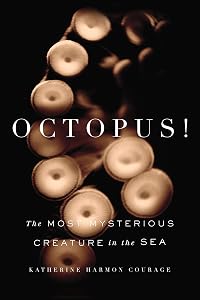
Octopus!: The Most Mysterious Creature in the Sea
by Katherine Harmon Courage
On This Page
Description
Veteran journalist and contributing editor for 'Scientific American,' Katherine Harmon Courage dives into the mystifying underwater world of the octopus, sharing new scientific discoveries and demonstrating deep cultural ties that connect us all to this alien-like creature.Tags
Recommendations







Member Reviews
This book has so many problems it isn't even funny, well it kind of is, unless you paid for this or your tax dollars paid to put it in a library. Let's get started:
1. Chatty magazine-ish prose. Like a People magazine article on octopuses (yes, that is correct, there is no "i" in octopi). Words like "gazillion," "cool," and "bejesus" just don't belong in a natural science book. I cringe.
2. The first two chapters and half of the Introduction deals with, I kid you not, eating octopus. 60 pages including recipes. The first chapters! We are treated to both the details of the author's peregrinations to the various restaurants and then the gourmandizing itself. Complete with the live suckers sticking to her gums! Yeah! Good book so far.
3. Who show more is this book written for? Page 66: "The mouth is hidden away at the center of the eight arms. But be careful up there - it has a sharp beak and a scary toothed radula for drilling into hard shells. This chitin structure awkwardly positioned on the octopus's underside, at the center of all its appendages, almost evokes the strange myth of the vagina dentata. (But don't worry; because the female octopus accepts sperm from a male directly into her mantle, she keeps the chance for love bites to a minimum.)" Woo-who
4. Bad Science. Page 159. "A sucker's strength depends in part on how much volume it holds." Hmmm, volume of what? Presumably water. The murk becomes inkier. "Under water, that force is limited by the weakness of the water molecule itself." What? The suction force driven by a sucker is dependent on the "weakness" of the water molecules themselves.
'Once a sucker is stuck onto something, "if you reach the point where water capitates (sic) - where you're actually breaking apart the molecular structure of the water - so it is not holding itself together anymore, it will break" he says. So in theory,the octopus could generate more force of attachment if the water itself were stronger'
Where to start? Well the correct word would be cavitate not capitate. Cavitation creates suction by forcing a fluid to cavitate, form a lower pressure vapor by mechanical means instead of thermal means. Like when a propeller in a liquid turns fast enough to start cavitation, small unstable vapor bubbles are formed mechanically.
You are not at any point creating enough mechanical cavitation force to be "breaking apart the molecular structure of the water." There are forces between water molecules that are affected by cavitation, but the structures of the water molecules themselves never break apart. This would require truly tremendous mechanical forces no organic creature could manage.
Journalists should all be required to take at least one science course as an elective.
5. Plain absurdity: Page 97 Caption under a black & white photo that reads thus: "Woods Hole Octopus flashing its blue ring at me." I suppose we're to guess just exactly where this blue ring is on the b&w photo.
6. Dumbed down. The prior quote about vagina dentata excluded, this is written for a ten year old's reading level. It is just cringingly full of childish simile.
I'm not going to savage the author since this will get me flagged and it will serve no good purpose otherwise let it simply do to say Ms. Courage had great courage to attempt to write a science book that is clearly above her depth. (he, he, he) show less
1. Chatty magazine-ish prose. Like a People magazine article on octopuses (yes, that is correct, there is no "i" in octopi). Words like "gazillion," "cool," and "bejesus" just don't belong in a natural science book. I cringe.
2. The first two chapters and half of the Introduction deals with, I kid you not, eating octopus. 60 pages including recipes. The first chapters! We are treated to both the details of the author's peregrinations to the various restaurants and then the gourmandizing itself. Complete with the live suckers sticking to her gums! Yeah! Good book so far.
3. Who show more is this book written for? Page 66: "The mouth is hidden away at the center of the eight arms. But be careful up there - it has a sharp beak and a scary toothed radula for drilling into hard shells. This chitin structure awkwardly positioned on the octopus's underside, at the center of all its appendages, almost evokes the strange myth of the vagina dentata. (But don't worry; because the female octopus accepts sperm from a male directly into her mantle, she keeps the chance for love bites to a minimum.)" Woo-who
4. Bad Science. Page 159. "A sucker's strength depends in part on how much volume it holds." Hmmm, volume of what? Presumably water. The murk becomes inkier. "Under water, that force is limited by the weakness of the water molecule itself." What? The suction force driven by a sucker is dependent on the "weakness" of the water molecules themselves.
'Once a sucker is stuck onto something, "if you reach the point where water capitates (sic) - where you're actually breaking apart the molecular structure of the water - so it is not holding itself together anymore, it will break" he says. So in theory,the octopus could generate more force of attachment if the water itself were stronger'
Where to start? Well the correct word would be cavitate not capitate. Cavitation creates suction by forcing a fluid to cavitate, form a lower pressure vapor by mechanical means instead of thermal means. Like when a propeller in a liquid turns fast enough to start cavitation, small unstable vapor bubbles are formed mechanically.
You are not at any point creating enough mechanical cavitation force to be "breaking apart the molecular structure of the water." There are forces between water molecules that are affected by cavitation, but the structures of the water molecules themselves never break apart. This would require truly tremendous mechanical forces no organic creature could manage.
Journalists should all be required to take at least one science course as an elective.
5. Plain absurdity: Page 97 Caption under a black & white photo that reads thus: "Woods Hole Octopus flashing its blue ring at me." I suppose we're to guess just exactly where this blue ring is on the b&w photo.
6. Dumbed down. The prior quote about vagina dentata excluded, this is written for a ten year old's reading level. It is just cringingly full of childish simile.
I'm not going to savage the author since this will get me flagged and it will serve no good purpose otherwise let it simply do to say Ms. Courage had great courage to attempt to write a science book that is clearly above her depth. (he, he, he) show less
Rating: 3.75* of five
I received an ARC from Current Books for review, but I don't remember why.
The Publisher Says: We eat, study, copy, and idealize the octopus. Yet this strange creature still eludes our understanding. With eight arms, three hearts, camouflaging skin, and a disarmingly intelligent look behind its eyes, it appears utterly alien. But octopuses have been captivating humans for as long as we’ve been catching them. Cultures have created octopus-centric creation myths, art, and, of course, cuisine. For all of our ancient fascination and modern research, however, we still haven’t been able to get a firm grasp on these slippery beasts.
Now journalist Katherine Harmon Courage dives into the fascinating underwater world of show more these mysterious cephalopods. From her transatlantic adventures to Spain and Greece, expeditions in the Caribbean and back to Brooklyn, she invites readers to experience the scientific discoveries, deep cultural ties, and delicious meals connected to the octopus.
Courage deftly interweaves personal narrative with interviews with leading octopus experts. She provides an entertaining yet informative romp through the world of these infinitely interesting creatures.
My Review: Anyone who's paid me the slightest bit of attention over the years knows I'm a fan of Tentacled Americans. They're delicious. They're delightfully ookie. They're probably the closest things I'll ever have to soul mates: They don't like their own kind, regard other species as prey or enemies, and possess a deeply misunderstood intelligence.
All I lack is six more arms.
And now Katherine Harmon, a writer for Scientific American who appears to have married into the coolest last name ever, writes a [[Mary Roach]]-esque monograph on the 'pus! Oh frabjous day callooh callay! I dived (!) into the book the instant the mailman shoved it into the door-slot.
What a dive that was. I landed in the sea-water off Vigo, Galicia, with the seasick Harmon Courage (love that new name!), thinking about the *a*maz*ing* octopus preparations prevalent in the region. The trip to Greece's Octotropolis Gythio was a drool-inducing litany of same-ol' same-ol' octopus preparation: wail on the dead body on the ever-present beach rocks, hurry home and saute the tentacles in olive oil and then make a tasty accompanying sauce. You can not go wrong doing this. It is never-fail deliciousness, with the added bonus of being nutritious and heart-healthy.
I'm drooling. Pardon me, need to clean the keyboard.
So for sixty pages, I existed in a haze of hunger and longing for some fresh octopus instead of the canned smoked stuff from Vigo. Page sixty-one began the lessons, or as a pal of mine says, "the eat-your-spinach part."
Fortunately, I enjoy "eating my spinach" and learning about stuff. The only television I'm really interested in is informational/educational stuff...if I'm going to do something I don't enjoy (sit still in front of a screen and stare fixedly), I'm at least going to get something memorable out of it....so I trotted happily along in Harmon Courage's wake as she chatted up the scientists who study these fascinating creatures. The locations she gets herself sent to are anathema to me, being largely warm-water beachy places, locales I'd pay good money never to have to visit. But the scientists are opening an immense realm of knowledge by living and working there, and no one's making me do it, so here I sit in air-conditioned splendor reading about the fascinating conclusions from this research.
Modern life, for a first-worlder, is excellent.
Octopus skin is near-miraculous in its mimetic ability. Octopus brains are only barely beginning to be studied but are already causes for fascinating discoveries. Octopus bodies are marvels of efficiency, and inspiring research into imitative robotic design.
Wondrous stuff, and that's not even half of the scientific amazement. How does a delicious creature without a shell avoid being din-din for every hungry thing in the sea? We've all heard about the ink-squirting defense, we've all heard of the prodigies of camouflage, but who knew that the wriggly ones could emit a *sound* that distracts vibration-sensitive predators? How? From WHERE?! Still being studied, stay tuned....
All of the above is my yodel of praise and my warble of enticement for you to dash out and buy a copy of this informative, enjoyable book. But the attentive reader will note that my rating is under four stars, while my enthusiasm is (I hope) evident. My rating might then seem ungenerous.
I feel bad about it, but I have to be a little ungenerous. The first sixty pages, with recipes and culinary enticements, do not fit comfortably with the science and research bits in the second part. The transition is handled as smoothly as it can be, but still isn't comfortable, because the nature of the book changes completely at that point. Harmon Courage's amusing, light touch doesn't change. She has a bit less to work with in humor terms. Not to say that, all of a sudden, we're in a textbook. It's simply a change from chatty, dinner-table food discussion, to after-dinner talk with slides and charts. Both are pleasurable, but in very different ways.
I want to be clear: This book gave me a lot of pleasure to read. I immersed myself in the lore and the science and the witty banter like they were a warm, salty bath, easing my literary aches and pains from reading so much forgettable snack-food in search of a good reader's meal. I got what I wanted from this read, and I suspect that any fan of light, amusing, informative reads will as well.
But like an octopus, I'm sensitive to the subtle shifts in my natural medium. Octopus blood is copper-based, which is why the darlings bleed blue. It's a less robust base for oxygen transmission than mammailan iron, and renders the octopus very vulnerable to changes in the ocean's acidity...too far outside its comfort zone, and the octopus dies. The climate change issues we've wished on the world include acidifying oceans.
The problem isn't a disaster, like the mismatch within the book isn't a disaster. But it's there, and it's something that needs mentioning, so that it might be cured for the future.
This work is licensed under a Creative Commons Attribution-NonCommercial-ShareAlike 3.0 Unported License. show less
I received an ARC from Current Books for review, but I don't remember why.
The Publisher Says: We eat, study, copy, and idealize the octopus. Yet this strange creature still eludes our understanding. With eight arms, three hearts, camouflaging skin, and a disarmingly intelligent look behind its eyes, it appears utterly alien. But octopuses have been captivating humans for as long as we’ve been catching them. Cultures have created octopus-centric creation myths, art, and, of course, cuisine. For all of our ancient fascination and modern research, however, we still haven’t been able to get a firm grasp on these slippery beasts.
Now journalist Katherine Harmon Courage dives into the fascinating underwater world of show more these mysterious cephalopods. From her transatlantic adventures to Spain and Greece, expeditions in the Caribbean and back to Brooklyn, she invites readers to experience the scientific discoveries, deep cultural ties, and delicious meals connected to the octopus.
Courage deftly interweaves personal narrative with interviews with leading octopus experts. She provides an entertaining yet informative romp through the world of these infinitely interesting creatures.
My Review: Anyone who's paid me the slightest bit of attention over the years knows I'm a fan of Tentacled Americans. They're delicious. They're delightfully ookie. They're probably the closest things I'll ever have to soul mates: They don't like their own kind, regard other species as prey or enemies, and possess a deeply misunderstood intelligence.
All I lack is six more arms.
And now Katherine Harmon, a writer for Scientific American who appears to have married into the coolest last name ever, writes a [[Mary Roach]]-esque monograph on the 'pus! Oh frabjous day callooh callay! I dived (!) into the book the instant the mailman shoved it into the door-slot.
What a dive that was. I landed in the sea-water off Vigo, Galicia, with the seasick Harmon Courage (love that new name!), thinking about the *a*maz*ing* octopus preparations prevalent in the region. The trip to Greece's Octotropolis Gythio was a drool-inducing litany of same-ol' same-ol' octopus preparation: wail on the dead body on the ever-present beach rocks, hurry home and saute the tentacles in olive oil and then make a tasty accompanying sauce. You can not go wrong doing this. It is never-fail deliciousness, with the added bonus of being nutritious and heart-healthy.
I'm drooling. Pardon me, need to clean the keyboard.
So for sixty pages, I existed in a haze of hunger and longing for some fresh octopus instead of the canned smoked stuff from Vigo. Page sixty-one began the lessons, or as a pal of mine says, "the eat-your-spinach part."
Fortunately, I enjoy "eating my spinach" and learning about stuff. The only television I'm really interested in is informational/educational stuff...if I'm going to do something I don't enjoy (sit still in front of a screen and stare fixedly), I'm at least going to get something memorable out of it....so I trotted happily along in Harmon Courage's wake as she chatted up the scientists who study these fascinating creatures. The locations she gets herself sent to are anathema to me, being largely warm-water beachy places, locales I'd pay good money never to have to visit. But the scientists are opening an immense realm of knowledge by living and working there, and no one's making me do it, so here I sit in air-conditioned splendor reading about the fascinating conclusions from this research.
Modern life, for a first-worlder, is excellent.
Octopus skin is near-miraculous in its mimetic ability. Octopus brains are only barely beginning to be studied but are already causes for fascinating discoveries. Octopus bodies are marvels of efficiency, and inspiring research into imitative robotic design.
Wondrous stuff, and that's not even half of the scientific amazement. How does a delicious creature without a shell avoid being din-din for every hungry thing in the sea? We've all heard about the ink-squirting defense, we've all heard of the prodigies of camouflage, but who knew that the wriggly ones could emit a *sound* that distracts vibration-sensitive predators? How? From WHERE?! Still being studied, stay tuned....
All of the above is my yodel of praise and my warble of enticement for you to dash out and buy a copy of this informative, enjoyable book. But the attentive reader will note that my rating is under four stars, while my enthusiasm is (I hope) evident. My rating might then seem ungenerous.
I feel bad about it, but I have to be a little ungenerous. The first sixty pages, with recipes and culinary enticements, do not fit comfortably with the science and research bits in the second part. The transition is handled as smoothly as it can be, but still isn't comfortable, because the nature of the book changes completely at that point. Harmon Courage's amusing, light touch doesn't change. She has a bit less to work with in humor terms. Not to say that, all of a sudden, we're in a textbook. It's simply a change from chatty, dinner-table food discussion, to after-dinner talk with slides and charts. Both are pleasurable, but in very different ways.
I want to be clear: This book gave me a lot of pleasure to read. I immersed myself in the lore and the science and the witty banter like they were a warm, salty bath, easing my literary aches and pains from reading so much forgettable snack-food in search of a good reader's meal. I got what I wanted from this read, and I suspect that any fan of light, amusing, informative reads will as well.
But like an octopus, I'm sensitive to the subtle shifts in my natural medium. Octopus blood is copper-based, which is why the darlings bleed blue. It's a less robust base for oxygen transmission than mammailan iron, and renders the octopus very vulnerable to changes in the ocean's acidity...too far outside its comfort zone, and the octopus dies. The climate change issues we've wished on the world include acidifying oceans.
The problem isn't a disaster, like the mismatch within the book isn't a disaster. But it's there, and it's something that needs mentioning, so that it might be cured for the future.
This work is licensed under a Creative Commons Attribution-NonCommercial-ShareAlike 3.0 Unported License. show less
Katherine Harmon Courage begins her discussion in Octopus!: The Most Mysterious Creature in the Sea with a necessary clarification on nomenclature: "The ancient Greeks christened the animal októpous...thanks to this Greek origin, the preferred common plural is octopuses - not octopi, octopodes, or even octopussies" (p. 1). From there, Courage examines the human "taste for octopus - scientifically, culturally, and culinarily" (p. 208). In her examination of the eight-legged denizen of the deep, Courage interviews and follows biologists, geneticists, engineers, and more as they try to understand how octopuses think, know how to change color, move their arms, eat, and reproduce. The very alienness of her subject leads Courage to adopt an show more anthropocentric view of octopuses, focusing on what they can teach human researchers with occasional asides to the animals' lives as well as references to popular culture (Dr. Octopus from Spider-Man appears regularly). It is, perhaps, best that Courage begins with her extensive culinary exploration as it would likely appear cruel to discuss the animals place in various foods after her readers had learned more about and begun to anthropomorphize them. Octopus! is a readable, well-researched introduction for those interested in the titular subject with an extensive notes section for further reading/researching. show less
Reading the reviews and blurbs on the cover of this book I was expecting to be fascinated by these wonderful creatures. And in many ways I was. They are indeed intelligent, powerful,and mysterious almost beyond comprehension. The only problem I had with this book was in the way it started. The first two chapters were all about capturing and then eating octopuses. In my opinion, beginning a book celebrating the wonders of octopuses, by focusing on how to kill and eat them, is in pretty bad taste(pun intended). That being said, one of the most fascinating passages in this book was when the author went to a restaurant in New York and was served a live octopus. Her description of that meal and the way it effected her, stands alone, and is show more by itself, worth the price of the book. I mean, the cut up arms of the octopus fought her all the way into her mouth and down her stomach !
"Many American diners seem generally creeped out by their encounters with this dish. But strangely , as revolting as it might look to to the amateur eater, the dish left me thinking about it and, dare I say, missing it for days afterward. It was the most intimate eating experience I've ever had. Although for the poor octopus it was not the best of times, to me, it felt almost as if we shared the dining experience."
After reading that passage I wanted to hop on a train to Queens, visit that restaurant, and experience that meal myself. show less
"Many American diners seem generally creeped out by their encounters with this dish. But strangely , as revolting as it might look to to the amateur eater, the dish left me thinking about it and, dare I say, missing it for days afterward. It was the most intimate eating experience I've ever had. Although for the poor octopus it was not the best of times, to me, it felt almost as if we shared the dining experience."
After reading that passage I wanted to hop on a train to Queens, visit that restaurant, and experience that meal myself. show less
The octopus, often portrayed as vengeful and horrifying giant sea-monsters, are really shy and solitary creatures, preferring to hide in dark crevices on the ocean floor. They continue to fascinate us because they are so elusive and so difficult to study both in and out of their natural environments. They have made invaluable contributions to the advancement of in robotics, military camouflage research, nerve regeneration, and even Japanese manga.
This is an incredibly fascinating study into the lives and intelligence of these magnificent and unassuming creatures. The author maintains a good balance in providing scientific data in a journalistic style that appeals to the layperson. This is likely to be a little too simplistic for the show more marine biologists among us, but for the general public curious about this elegant benthic creature, it is an engrossing page-turner. She's even included a few octopus recipes, although after learning how they are prepared, I doubt there will be many American suburban kitchens where fresh octopus is likely to be served at the dining table. show less
This is an incredibly fascinating study into the lives and intelligence of these magnificent and unassuming creatures. The author maintains a good balance in providing scientific data in a journalistic style that appeals to the layperson. This is likely to be a little too simplistic for the show more marine biologists among us, but for the general public curious about this elegant benthic creature, it is an engrossing page-turner. She's even included a few octopus recipes, although after learning how they are prepared, I doubt there will be many American suburban kitchens where fresh octopus is likely to be served at the dining table. show less
This rather thin book on octopuses is delivered in an easy-to-read, informal and occasionally juvenile style more suited to a magazine article than a science book, even a popular science book. There are some interesting facts (ok there are lots of interesting facts) but there is also too much space dedicated to travelogue "stuff", eating octopuses (recipes are included) and being sea-sick. Did I mention there was a ridiculous amount of space dedicated to murdering and eating octopuses? A reference section is included, as well as some bad quality black & white photographs. There really should have been some colour photographs of these magnificent animals. Suitable for children and teenagers.
PS: Promoted from 2 to 3 stars for the simple show more reason that the science chapters were very interesting and I learned new things. show less
PS: Promoted from 2 to 3 stars for the simple show more reason that the science chapters were very interesting and I learned new things. show less
This book tantalized and frustrated me: I picked it up to learn something more about octopuses but found she could not decide whether to write a popular science book or a foodie paean to octopus (she even includes recipes). There are some interesting facts about octopuses presented clearly and with caveats when necessary, but I was distracted be the shift to and from "great octopus meals I have eaten in the course of researching this book". I have enjoyed various octopus dishes in my time, usually much more than I enjoyed this book.
Members
- Recently Added By
Author Information

2+ Works 211 Members
Awards and Honors
Awards
Common Knowledge
- Canonical title
- Octopus!: The Most Mysterious Creature in the Sea
- Epigraph
- Does the complete understanding of a natural phenomenon strip away its miraculous qualities? It is certainly a risk. But it should at least maintain all of its poetry, for poetry subverts reason and is never dulled by repetit... (show all)ion. Besides, a few gaps in our knowledge will always allow for a joyous confusion of the mysteries, the unknown, and the miraculous. -- Jean Painleve, filmmaker, "Mysteries and Miracles of Nature." Vu 1931
- Dedication
- To my grandfather Ted Rogers, the most amazing (human) specimen I've met
- First words
- The octopus is a tough beast to grasp.
- Blurbers
- Zimmer, Carl; de Waal, Frans
Classifications
Statistics
- Members
- 166
- Popularity
- 197,380
- Reviews
- 16
- Rating
- (3.20)
- Languages
- English
- Media
- Paper, Ebook
- ISBNs
- 3
- ASINs
- 1