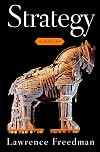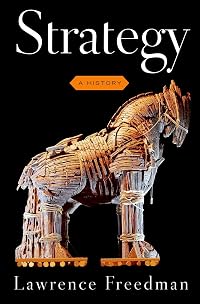
Strategy: A History
by Lawrence Freedman
On This Page
Description
In Strategy: A History, Sir Lawrence Freedman, one of the world's leading authorities on war and international politics, captures the vast history of strategic thinking, in a consistently engaging and insightful account of how strategy came to pervade every aspect of our lives. The range of Freedman's narrative is extraordinary, moving from the surprisingly advanced strategy practiced in primate groups, to the opposing strategies of Achilles and Odysseus in The Iliad, the strategic advice of show more Sun Tzu and Machiavelli, the great military innovations of Baron Henri de Jomini and Carl von Clausewit show lessTags
Recommendations

Member Reviews
“The Economist” magazine referred to Lawrence Freedman’s book, “Strategy,” as ‘magisterial’ and, for once, I agree with something the publication wrote.
This book is heavy, not for the faint-hearted, and I recommend only a chapter a day if you wish to digest the material. Unlike many authors who do not justify their Western focus, Sir Lawrence started by explaining his rationale for focusing on Western literature: his choice made his job easy.
This book’s scope is mind-boggling. He starts in the distant past, when humans began organizing themselves into tribes and when strategy first evolved to win wars and battles. During this evolution, the strategy became a catch-all phrase for achieving any aim, with applications in show more politics, religion, business, and social movements.
The book has a few central themes. First, that strategy is not a plan, and I concur after having interacted with many ‘strategic planners’ in corporations. Strategy is a way of dealing with conflict and uncertainty.
Second, politics is always integral to strategy, and you cannot always separate means from ends. Obviously, this applies to war as well, as Clausewitz said: politics by other means.
Three, strategy is about power creation and thus goes much beyond the scope of war. What happens after the war? You attempt to seize and hold power.
The myth of the master strategist is just that: a myth. No single person, strategic planner, or leader can control events; it is about how a team perceives events and forces, and how it copes with them to achieve its objectives.
The section on storytelling and narrative is fascinating. Storytelling is not a strategy, but it can sell a strategic objective to people and get them to rally around the flag.
I also found the section on corporate strategy intriguing, especially as the ‘gurus’ do not actually shed light but use narrative, the stage, and their personalities to market poorly conceived and poorly researched ideas and concepts–Taylor, Friedman, Prahlad, etc.
There are sections when you wonder if the connection to strategy is tenuous but, a re-reading of this book will always be helpful. show less
This book is heavy, not for the faint-hearted, and I recommend only a chapter a day if you wish to digest the material. Unlike many authors who do not justify their Western focus, Sir Lawrence started by explaining his rationale for focusing on Western literature: his choice made his job easy.
This book’s scope is mind-boggling. He starts in the distant past, when humans began organizing themselves into tribes and when strategy first evolved to win wars and battles. During this evolution, the strategy became a catch-all phrase for achieving any aim, with applications in show more politics, religion, business, and social movements.
The book has a few central themes. First, that strategy is not a plan, and I concur after having interacted with many ‘strategic planners’ in corporations. Strategy is a way of dealing with conflict and uncertainty.
Second, politics is always integral to strategy, and you cannot always separate means from ends. Obviously, this applies to war as well, as Clausewitz said: politics by other means.
Three, strategy is about power creation and thus goes much beyond the scope of war. What happens after the war? You attempt to seize and hold power.
The myth of the master strategist is just that: a myth. No single person, strategic planner, or leader can control events; it is about how a team perceives events and forces, and how it copes with them to achieve its objectives.
The section on storytelling and narrative is fascinating. Storytelling is not a strategy, but it can sell a strategic objective to people and get them to rally around the flag.
I also found the section on corporate strategy intriguing, especially as the ‘gurus’ do not actually shed light but use narrative, the stage, and their personalities to market poorly conceived and poorly researched ideas and concepts–Taylor, Friedman, Prahlad, etc.
There are sections when you wonder if the connection to strategy is tenuous but, a re-reading of this book will always be helpful. show less
This is a wise and highly intelligent, if very long, attempt to come to grips with the slippery term 'strategy' by a prominent British academic distilling at least two decades of thinking on the subject.
Although a Professor of War Studies, Freedman does not restrict himself to the conduct of war but reviews revolutionary and dissident stategy on the one hand and business strategy on the other.
He is highly critical of some of the nonsense (he is too kind to call it that) from business gurus and I can only be pleased that I smelled the rat throughout the 1980s and 1990s and read few of them.
Where he gets to is a sceptical view of what we can possibly know about our own futures or control them.
He outlines, in the final section, the role show more of narratives and scripts in giving us the illusion of control.
This is not a counsel of despair. There is no fatalism in Freedman's approach but he does suggest that 'real life' requires a degree of detachment from scripts and narratives while making use of them as tools.
Educated readers will probably not be surprised by the general thrust of the section on war where there is a sort of master in Clausewitz (and the influence of Jomini) but it will bring you up to date.
As we write, a rather odd crisis between the 'West' (whatever that is) and Russia, after some egregious blundering by the European Union, has allowed all sorts of absurd 'narratives' free rein.
Trying to rein in historic stories about fascism and appeasement as well as more recent tales of humanitarian intervention and self determination has been part of the problem for intelligent diplomats.
The Ukraine remains unresolved as we write but the undoubted strategic skills of Putin and Lavrov on the one hand and Obama and Kerry might be enhanced by having this text at their sides.
The second section on the strategic attempts to overturn elites and systems gives due weight to the role of Marxism but is perhaps too easily seduced into a highly US-centred picture of political struggle.
This provides us with one of the few 'strategic' criticisms of the book - the elephant in the room that Freedman assiduously dances around: the State.
Military strategy is the expression of the force of the State, revolutionary strategies seek to overturn or capture the State and business strategies compete with the State ... but what of the State?
The State, emergent out of warlordism and dynasticism (or small trading communities), is the thing that should interest us most because we are most stuck inside its narratives and scripts.
Perhaps it was simply a matter of space (the book is over 600 pages long) but one senses sometimes that the broader academic community is always nervous of telling us the truth about what feeds it.
But this may be unfair. The book is mostly easy reading (though the idiocies of academic social scientists often cause one to lose patience) and the assessments are honest and fair to all parties.
Indeed, it is good to find a book that both gives due to the troubled struggle by educated revolutionaries to speak for the masses and to the games businessmen play to try to control what cannot be controlled.
A book which treats Rockefeller of Standard Oil and Karl Marx fairly, let alone Tom Hayden, has a lot going for it though maybe Freedman should throw up his hands at Sun Tzu as perpetual strategic cliche.
Will this book make you a better 'strategist'? Well, it will do a service if it makes you sceptical about books that claim to offer that particular pot of gold.
Strategists are probably born rather than made but many of the skills can be learned - or rather 'bad' unstrategic narratives might be unlearned and 'scripts' recognised.
His story of continuous failures to 'get it right' becomes a bit cheerier when rationalist progressives begin to be challenged by the behaviourial economists.
Though I remain unconvinced by this particular discipline - and consider political science to be an utterly absurd concept - cognitive psychology has helped us here.
Increasingly, we are beginning to stop whining that we are not 'rational' (or rather autistic academics are) and beginning to see our mentalities as extremely good survival machines for uncertainty.
Freedman is persuasive that we have a sort of double action mind where intuition and 'art' working in real time gets things right most of the time under most conditions (his System 1 strategic thinking).
Habit and narratives and scripts can get in our way in a crisis and the reasoning abilities of his System 2 thinking enable us analytically and critically correct our own biases and errors.
However, we can only do this in real time, constantly adjusting to realities that are, in themselves, way beyond any form of reasonable long term analysis because of so many variables and unknowns.
Perhaps the thinking started with John Boyd's simple but productive concept of OODA (observation, orientation, decision, action) but Freedman here develops a more interesting model of struggle.
In essence, the only strategy is the intuitive positioning of oneself to win each battle as it comes within a general vision of where one wants to be - and this is not a matter for mathematicians. show less
Although a Professor of War Studies, Freedman does not restrict himself to the conduct of war but reviews revolutionary and dissident stategy on the one hand and business strategy on the other.
He is highly critical of some of the nonsense (he is too kind to call it that) from business gurus and I can only be pleased that I smelled the rat throughout the 1980s and 1990s and read few of them.
Where he gets to is a sceptical view of what we can possibly know about our own futures or control them.
He outlines, in the final section, the role show more of narratives and scripts in giving us the illusion of control.
This is not a counsel of despair. There is no fatalism in Freedman's approach but he does suggest that 'real life' requires a degree of detachment from scripts and narratives while making use of them as tools.
Educated readers will probably not be surprised by the general thrust of the section on war where there is a sort of master in Clausewitz (and the influence of Jomini) but it will bring you up to date.
As we write, a rather odd crisis between the 'West' (whatever that is) and Russia, after some egregious blundering by the European Union, has allowed all sorts of absurd 'narratives' free rein.
Trying to rein in historic stories about fascism and appeasement as well as more recent tales of humanitarian intervention and self determination has been part of the problem for intelligent diplomats.
The Ukraine remains unresolved as we write but the undoubted strategic skills of Putin and Lavrov on the one hand and Obama and Kerry might be enhanced by having this text at their sides.
The second section on the strategic attempts to overturn elites and systems gives due weight to the role of Marxism but is perhaps too easily seduced into a highly US-centred picture of political struggle.
This provides us with one of the few 'strategic' criticisms of the book - the elephant in the room that Freedman assiduously dances around: the State.
Military strategy is the expression of the force of the State, revolutionary strategies seek to overturn or capture the State and business strategies compete with the State ... but what of the State?
The State, emergent out of warlordism and dynasticism (or small trading communities), is the thing that should interest us most because we are most stuck inside its narratives and scripts.
Perhaps it was simply a matter of space (the book is over 600 pages long) but one senses sometimes that the broader academic community is always nervous of telling us the truth about what feeds it.
But this may be unfair. The book is mostly easy reading (though the idiocies of academic social scientists often cause one to lose patience) and the assessments are honest and fair to all parties.
Indeed, it is good to find a book that both gives due to the troubled struggle by educated revolutionaries to speak for the masses and to the games businessmen play to try to control what cannot be controlled.
A book which treats Rockefeller of Standard Oil and Karl Marx fairly, let alone Tom Hayden, has a lot going for it though maybe Freedman should throw up his hands at Sun Tzu as perpetual strategic cliche.
Will this book make you a better 'strategist'? Well, it will do a service if it makes you sceptical about books that claim to offer that particular pot of gold.
Strategists are probably born rather than made but many of the skills can be learned - or rather 'bad' unstrategic narratives might be unlearned and 'scripts' recognised.
His story of continuous failures to 'get it right' becomes a bit cheerier when rationalist progressives begin to be challenged by the behaviourial economists.
Though I remain unconvinced by this particular discipline - and consider political science to be an utterly absurd concept - cognitive psychology has helped us here.
Increasingly, we are beginning to stop whining that we are not 'rational' (or rather autistic academics are) and beginning to see our mentalities as extremely good survival machines for uncertainty.
Freedman is persuasive that we have a sort of double action mind where intuition and 'art' working in real time gets things right most of the time under most conditions (his System 1 strategic thinking).
Habit and narratives and scripts can get in our way in a crisis and the reasoning abilities of his System 2 thinking enable us analytically and critically correct our own biases and errors.
However, we can only do this in real time, constantly adjusting to realities that are, in themselves, way beyond any form of reasonable long term analysis because of so many variables and unknowns.
Perhaps the thinking started with John Boyd's simple but productive concept of OODA (observation, orientation, decision, action) but Freedman here develops a more interesting model of struggle.
In essence, the only strategy is the intuitive positioning of oneself to win each battle as it comes within a general vision of where one wants to be - and this is not a matter for mathematicians. show less
Extremely short on details because it covers a ridiculously broad range of time and topics. It's really well written, without pointless flourishes - it keeps you interested by writing about interesting things. Not sure it's about strategy but there's certainly a lot of history in it and I enjoyed it for that. The business chapters were the weakest but still worth it.
March 20th, nearing the end of Part II:
Rather disappointing so far. I think my problem is that it's caught at a no-man's-land level of abstraction. It's not concrete enough to be engaging at the 'human' level, or as a series of interlinked narratives. But neither is it up at that clean level of abstraction where everything seems to make logical sense, and you get a satisfying feeling of high-level insight. And it's far too long-winded to be an enjoyably breezy overview. I'm reminded of a lot of boring writing on philosophy: the kind where the author tells you that Plato thought this, and Aristotle thought that, and so on and so on, never giving enough detail for you to genuinely understand the ideas, but somehow going on at great length show more and with an air of authority. ('Magisterial' indeed, /The Economist/!)
Sentence-by-sentence the writing is fine, but structurally it seems fairly aimless, and as I said above it's hardly compelling. I'll continue anyway, partly because of the sunk-cost fallacy and my completionist tendency, but also because (despite my whinging above) it's not /that/ bad, and I've heard that the final 200 pages or so are more interesting than the first 400. Also I have the audiobook, so when reading feels like a chore I can listen instead.
Caveats: so far the main focus has been military strategy, on which I have no prior knowledge and no particular interest. Also, at times when I've been listening rather than reading, I've been less attentive than usual, accepting that some bits are going to go over my head while I'm distracted by my own thoughts. I blame the book for that -- if it were less tedious I'd be more inclined to focus -- but it does mean my complaints might not be entirely fair.
March 27th: Part 3 is proving a bit more interesting so far -- maybe because it has some more compelling narrative threads, maybe because 20th-century politics feels more real to me than abstract discussion of military strategy. This still doesn't seem like a very focused or coherent history of strategy, though.
April 2nd: Having finished the book, I haven't really changed my opinion. The section on business strategy suffered from similar flaws as the section on military strategy, and the final section seemed rather perfunctory. It also contained a small but strange error, which made me wonder about the author's credibility on other topics:
"One researcher suggested that the “experience of taking a course in microeconomics actually altered students’ conceptions of the appropriateness of acting in a self-interested manner, not merely their definition of self-interest.” In studies of traders in financial markets, it transpired that while the inexperienced might be influenced by Thaler’s “endowment effect,” for example, the experienced were not. This might not be flattering to economists, but it did show that egotistical behavior could also be quite natural."
Overall I don't recommend this. It contains a few interesting or thought-provoking nuggets, but is largely a not-particularly-coherent grab-bag of other people's ideas, covered at enough length to be tedious but in insufficient depth to be enlightening. If the book has one big point to make, I think it's something to do with the hubris and naivety of overly rationalistic (and optimistic) attempts to turn strategy into a precise science & to rely on it to solve complex and fluid problems. I can readily believe that, but I don't think the case was made clearly or coherently or comprehensively enough to convince someone inclined to believe the opposite.
(The audiobook also has its flaws -- my opinion on the narrator's voice and style isn't really relevant, but he makes quite a few errors, including some that suggest neither he nor whoever signed off on the finished product were following the meaning of what he was saying.) show less
Rather disappointing so far. I think my problem is that it's caught at a no-man's-land level of abstraction. It's not concrete enough to be engaging at the 'human' level, or as a series of interlinked narratives. But neither is it up at that clean level of abstraction where everything seems to make logical sense, and you get a satisfying feeling of high-level insight. And it's far too long-winded to be an enjoyably breezy overview. I'm reminded of a lot of boring writing on philosophy: the kind where the author tells you that Plato thought this, and Aristotle thought that, and so on and so on, never giving enough detail for you to genuinely understand the ideas, but somehow going on at great length show more and with an air of authority. ('Magisterial' indeed, /The Economist/!)
Sentence-by-sentence the writing is fine, but structurally it seems fairly aimless, and as I said above it's hardly compelling. I'll continue anyway, partly because of the sunk-cost fallacy and my completionist tendency, but also because (despite my whinging above) it's not /that/ bad, and I've heard that the final 200 pages or so are more interesting than the first 400. Also I have the audiobook, so when reading feels like a chore I can listen instead.
Caveats: so far the main focus has been military strategy, on which I have no prior knowledge and no particular interest. Also, at times when I've been listening rather than reading, I've been less attentive than usual, accepting that some bits are going to go over my head while I'm distracted by my own thoughts. I blame the book for that -- if it were less tedious I'd be more inclined to focus -- but it does mean my complaints might not be entirely fair.
March 27th: Part 3 is proving a bit more interesting so far -- maybe because it has some more compelling narrative threads, maybe because 20th-century politics feels more real to me than abstract discussion of military strategy. This still doesn't seem like a very focused or coherent history of strategy, though.
April 2nd: Having finished the book, I haven't really changed my opinion. The section on business strategy suffered from similar flaws as the section on military strategy, and the final section seemed rather perfunctory. It also contained a small but strange error, which made me wonder about the author's credibility on other topics:
"One researcher suggested that the “experience of taking a course in microeconomics actually altered students’ conceptions of the appropriateness of acting in a self-interested manner, not merely their definition of self-interest.” In studies of traders in financial markets, it transpired that while the inexperienced might be influenced by Thaler’s “endowment effect,” for example, the experienced were not. This might not be flattering to economists, but it did show that egotistical behavior could also be quite natural."
Overall I don't recommend this. It contains a few interesting or thought-provoking nuggets, but is largely a not-particularly-coherent grab-bag of other people's ideas, covered at enough length to be tedious but in insufficient depth to be enlightening. If the book has one big point to make, I think it's something to do with the hubris and naivety of overly rationalistic (and optimistic) attempts to turn strategy into a precise science & to rely on it to solve complex and fluid problems. I can readily believe that, but I don't think the case was made clearly or coherently or comprehensively enough to convince someone inclined to believe the opposite.
(The audiobook also has its flaws -- my opinion on the narrator's voice and style isn't really relevant, but he makes quite a few errors, including some that suggest neither he nor whoever signed off on the finished product were following the meaning of what he was saying.) show less
A good survey of the history of strategy, but one that may leave the reader more confused than enlightened because the term has been used in so many slippery ways.
The last chapter is insightful and useful, but the history is in a matter of reality, haphazard and confused, and as such hard to really remember and take onboard.
The last chapter is insightful and useful, but the history is in a matter of reality, haphazard and confused, and as such hard to really remember and take onboard.
While i was really hyped to read this book as i saw this was often recommend and praised as a monumental work that covered the topic, thus the name; nope while this book contained a lot of essays that brought light into what is the etymological meaning of the term, and makes a lot of philosophical distinctions it also avoided doing any application or analysis of the concepts mentioned. It crtizices Plato for ignoring the real world while also not taking in account the dialogue Laches. It mentions Thucydides and instead of looking into the vast account of battles and similar situations makes philosophical Explorations concerning other things, rather than the tactics and strategies he wrote. He then goes to write extensively about how he show more hates Hart and that.
Talks about the geometric nature of military campaigns and certain doctrines of thought, and doesn't provide diagrams, he discusses tropes of military leaders, but not their actual patterns of thought.
Then he introduces with a lot wording the concept of theory of games without even explaining anything or again, how the theory is applied to situations where planning is vital.
After that is could end this book, for even if it's dressed with a lot of words it doesn't really say much of tacit value .
This books is more of a long essay a English professor would enjoy, it is not a textbook on militar strategy. show less
Talks about the geometric nature of military campaigns and certain doctrines of thought, and doesn't provide diagrams, he discusses tropes of military leaders, but not their actual patterns of thought.
Then he introduces with a lot wording the concept of theory of games without even explaining anything or again, how the theory is applied to situations where planning is vital.
After that is could end this book, for even if it's dressed with a lot of words it doesn't really say much of tacit value .
This books is more of a long essay a English professor would enjoy, it is not a textbook on militar strategy. show less
Abandoned about 1/3 through. Tremendously boring and lacking in much insight.
Members
- Recently Added By
Lists

To Read List
21 works; 1 member
Author Information

45+ Works 2,043 Members
Lawrence Freedman is an emeritus professor of war studies at King's College London. He is the author of Strategy, a Financial Times Best Book of 2013, and A Choice of Enemies, winner of the 2009 Lionel Gelber Prize.
Awards and Honors
Common Knowledge
- First words
- Everyone needs a strategy. [Preface]
In this chapter I argue that there are elemental features of human strategy that are common across time and space. - Last words
- (Click to show. Warning: May contain spoilers.)The dramatist knows from the start whether she is writing comedy or a tragedy: the strategist aims for comedy but risks tragedy.
Classifications
Statistics
- Members
- 750
- Popularity
- 37,602
- Reviews
- 8
- Rating
- (3.64)
- Languages
- English, Estonian, Spanish, Turkish
- Media
- Paper, Audiobook, Ebook
- ISBNs
- 9
- ASINs
- 8