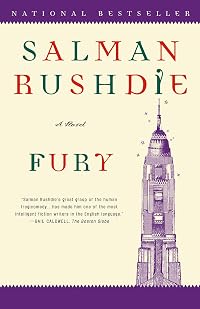
Fury
by Salman Rushdie
On This Page
Description
Malik Solanka, a middle-aged ex-philosophy professor and millionaire creator of a hugely popular doll, seeks refuge from his unwanted fame and disintegrating marriage in New York City.Tags
Recommendations













Member Recommendations
thorold Rushdie's Fury is an ironic 21st century take on the professor-as-victim theme, with a whole string of references back to Herzog.
Member Reviews
A revamp of the tired old formula of the professor-as-victim novel, a Herzog for the 21st century, but with a very Rushdie twist to it. Definitely not one of his major works, but an entertaining read, cleverly pitched just a tiny bit beyond the conventions of realism. There is some lively satire of the shallowness of early 21st century values and some splendidly overdone running jokes. Rushdie is well aware of the old rule that showing a man slipping on a banana-skin or stepping on a rake gets funnier the more often it is repeated. In this case, we have the absurdly beautiful woman who makes men trip over their feet or walk into street furniture whenever she goes out in public: Rushdie doesn't just use this as a throwaway observation of show more another character, but actually shows her doing it every time she appears, even in the big, serious confrontation scene in the penultimate chapter.
There are plenty of references to Bellow's classic (which struck me because I coincidentally read Herzog a few days ago), not least in the names — a Malik is a king and a Herzog is a duke, and it can't be coincidence that one is Moses and the other "Solly". Herzog and Fury are also the only novels in which I can recall coming across the Yiddish word "landsman". Whilst both Bellow and Rushdie start out with a professor who has run away from his wife and child, Rushdie inevitably takes the story — and the resulting balance of power between the sexes — in a completely different direction from Bellow's conventional 1960s approach. show less
There are plenty of references to Bellow's classic (which struck me because I coincidentally read Herzog a few days ago), not least in the names — a Malik is a king and a Herzog is a duke, and it can't be coincidence that one is Moses and the other "Solly". Herzog and Fury are also the only novels in which I can recall coming across the Yiddish word "landsman". Whilst both Bellow and Rushdie start out with a professor who has run away from his wife and child, Rushdie inevitably takes the story — and the resulting balance of power between the sexes — in a completely different direction from Bellow's conventional 1960s approach. show less
Salman Rushdie uses words the way some 4-year-olds use Play-Doh: squeeze it, mold it, roll it, braid it and, in a few cases, eat it. Language is pliable in Mr. Rushdie’s hands; syllables stretch, vowels leap to new heights, consonants turn cartwheels.
You can see what he does with prose on every page of his new novel, Fury. It is a festering boil of a book—restless, energetic and, yes, furious. This is Rushdie’s letter to America and it is full of vitriol. It’s also one of his slimmest, weighing in around 260 pages. But don’t let size fool you—this is compact, complex and condensed magical realism at its best.
The cast of characters sometimes comes off as types to be used at Rushdie’s disposal to put forth his big, boiling show more ideas. They are as much puppets as they are people. After all, no one in real life speaks in gargantuan monologues that go on for pages; but realism hardly seems to matter when we settle in with Rushdie. Sometimes it’s a welcome relief to read Play-Doh literature.
The author moved to this country at the beginning of 2000 and Fury takes on an autobiographical slant as its protagonist, Malik Solanka, also moves here from England (no fatwa nipping at the character’s heels, though). Other novels (The Ground Beneath Her Feet) have had U.S. settings, but this is the first of his which can truly be called American. Like a modern de Tocqueville, Rushdie has taken notes on America, from sea to shining sea, and has set his observations loose on the page.
Here, we get pages and pages of jazz-like riffs on everything from Elian Gonzalez to the presidential contest between “Gush and Bore.âÂ? This is a time capsule for the first few days of our new millennium and itâÂÂs about as perfect as they come. (Though I do have to wonder: Because this is a novel loaded with contemporary references, itâÂÂs difficult to determine how future readers will appreciate it. ItâÂÂs thrilling pop cult music to our ears, but 100âÂÂor even 25âÂÂyears from now, theyâÂÂre going to need a lot of footnotes.)
Fury is about Professor SolankaâÂÂs Summer of 2000 in New York City. HeâÂÂs come there to sort things out after abandoning his wife and young son back in London. He is plagued by feelings of intense anger, triggered by a word here or a word there, which rise up like inner volcanoes and itâÂÂs all he can do to keep himself in check. Like a roving camera, the narrative follows the 55-year-old Solanka as he walks the mean streets teeming with angry cab drivers and rap-talking stoop-loungers. Solanka has a lot to think aboutâÂÂheâÂÂs a celebrity puppeteer whose creation, Little Brain, has become a victim of commercialization, and then thereâÂÂs the failed marriage of his close friend, not to mention his own withering relationship with his wife and son. Solanka bounces like a pinball from one torment to the next.
But what Fury is about is less important than what it is. The novel is paced like a long monologue of someone trying to get all the words out before a blood vessel bursts in his forehead. In fact, it sounds very much like a sweaty-browed, spittle-spitting participant at a poetry slam. Just listen:
Everybody, as well as everything, was for sale. Advertisements had become colossi, clambering like Kong up the walls of buildings. What was more, they were loved. When he was watching TV, Solanka still turned the sound down at commercial breaks, but everyone else, he was sure, turned it up. The girls in the adsâÂÂEsther, Bridget, Elizabeth, Halle, Gisele, Tyra, Isis, Aphrodite, KateâÂÂwere more desirable than the actresses in the show in between; hell, the guys in the adsâÂÂMark Vanderloo, Marcus Schenkenberg, Marcus, Aurelius, Marc Antony, Marky MarkâÂÂwere more desirable than the actresses in the shows. And as well as presenting the dream of an ideally beautiful America in which all women were babes and all men were Marks, after doing the basic work of selling pizza and SUVs and I CanâÂÂt Believe ItâÂÂs Not Butter, beyond money management and the new ditditdit of the dotcoms, the commercials soothed AmericaâÂÂs pain, its head pain, its gas pain, its heartache, its loneliness, the pain of babyhood and old age, of being a parent and of being a child, the pain of manhood and womenâÂÂs pain, the pain of success and that of failure, the good pain of the athlete and the bad pain of the guilty, the anguish of loneliness and of ignorance, the needle-sharp torment of the cities and the dull, mad ache of the empty plains, the pain of wanting without knowing what was wanted, the agony of the howling void within each watching, semiconscious self.
I apologize: I should have warned you to keep all arms and legs inside the ride at all times. You can unbuckle now and take a few deep breaths if necessary.
Just make sure you have plenty of oxygen on hand when you open Fury. ItâÂÂs one hell of a ride through SolankaâÂÂs mind. He is an angry, impulsive man; but he is also pitiable and, at bookâÂÂs end, a bit desperate for love and acceptance. Most of the book chronicles SolankaâÂÂs attempts to fit himself, the odd puzzle piece, into the mosaic of society. HeâÂÂs none too successful (âÂÂSomething was amiss with the worldâÂ?), not even in the two relationships he strikes up with two women that summer. He has come to America to erase himself,
To be free of attachment and so also of anger, fear, and pain. Eat me, Professor Solanka silently prayed. Eat me, America, and give me peace.
Instead of being erased, however, heâÂÂs like a furious scribble (perhaps done by our 4-year-old who has graduated from Play-Doh). At times, he borders on downright frightening: âÂÂHe had come in search of silence and found a loudness greater than the one he left behind. The noise was inside him now.âÂ? Did I mention that thereâÂÂs a so-called Concrete Killer whoâÂÂs on the loose, bashing in the heads of young women with chunks of concrete? YouâÂÂre allowed to shudder when you meet Malik Solanka on the page. A more unsettledâÂÂand unsettlingâÂÂcharacter you arenâÂÂt likely to find in this FallâÂÂs lineup of fresh-pressed novels. show less
You can see what he does with prose on every page of his new novel, Fury. It is a festering boil of a book—restless, energetic and, yes, furious. This is Rushdie’s letter to America and it is full of vitriol. It’s also one of his slimmest, weighing in around 260 pages. But don’t let size fool you—this is compact, complex and condensed magical realism at its best.
The cast of characters sometimes comes off as types to be used at Rushdie’s disposal to put forth his big, boiling show more ideas. They are as much puppets as they are people. After all, no one in real life speaks in gargantuan monologues that go on for pages; but realism hardly seems to matter when we settle in with Rushdie. Sometimes it’s a welcome relief to read Play-Doh literature.
The author moved to this country at the beginning of 2000 and Fury takes on an autobiographical slant as its protagonist, Malik Solanka, also moves here from England (no fatwa nipping at the character’s heels, though). Other novels (The Ground Beneath Her Feet) have had U.S. settings, but this is the first of his which can truly be called American. Like a modern de Tocqueville, Rushdie has taken notes on America, from sea to shining sea, and has set his observations loose on the page.
Here, we get pages and pages of jazz-like riffs on everything from Elian Gonzalez to the presidential contest between “Gush and Bore.âÂ? This is a time capsule for the first few days of our new millennium and itâÂÂs about as perfect as they come. (Though I do have to wonder: Because this is a novel loaded with contemporary references, itâÂÂs difficult to determine how future readers will appreciate it. ItâÂÂs thrilling pop cult music to our ears, but 100âÂÂor even 25âÂÂyears from now, theyâÂÂre going to need a lot of footnotes.)
Fury is about Professor SolankaâÂÂs Summer of 2000 in New York City. HeâÂÂs come there to sort things out after abandoning his wife and young son back in London. He is plagued by feelings of intense anger, triggered by a word here or a word there, which rise up like inner volcanoes and itâÂÂs all he can do to keep himself in check. Like a roving camera, the narrative follows the 55-year-old Solanka as he walks the mean streets teeming with angry cab drivers and rap-talking stoop-loungers. Solanka has a lot to think aboutâÂÂheâÂÂs a celebrity puppeteer whose creation, Little Brain, has become a victim of commercialization, and then thereâÂÂs the failed marriage of his close friend, not to mention his own withering relationship with his wife and son. Solanka bounces like a pinball from one torment to the next.
But what Fury is about is less important than what it is. The novel is paced like a long monologue of someone trying to get all the words out before a blood vessel bursts in his forehead. In fact, it sounds very much like a sweaty-browed, spittle-spitting participant at a poetry slam. Just listen:
Everybody, as well as everything, was for sale. Advertisements had become colossi, clambering like Kong up the walls of buildings. What was more, they were loved. When he was watching TV, Solanka still turned the sound down at commercial breaks, but everyone else, he was sure, turned it up. The girls in the adsâÂÂEsther, Bridget, Elizabeth, Halle, Gisele, Tyra, Isis, Aphrodite, KateâÂÂwere more desirable than the actresses in the show in between; hell, the guys in the adsâÂÂMark Vanderloo, Marcus Schenkenberg, Marcus, Aurelius, Marc Antony, Marky MarkâÂÂwere more desirable than the actresses in the shows. And as well as presenting the dream of an ideally beautiful America in which all women were babes and all men were Marks, after doing the basic work of selling pizza and SUVs and I CanâÂÂt Believe ItâÂÂs Not Butter, beyond money management and the new ditditdit of the dotcoms, the commercials soothed AmericaâÂÂs pain, its head pain, its gas pain, its heartache, its loneliness, the pain of babyhood and old age, of being a parent and of being a child, the pain of manhood and womenâÂÂs pain, the pain of success and that of failure, the good pain of the athlete and the bad pain of the guilty, the anguish of loneliness and of ignorance, the needle-sharp torment of the cities and the dull, mad ache of the empty plains, the pain of wanting without knowing what was wanted, the agony of the howling void within each watching, semiconscious self.
I apologize: I should have warned you to keep all arms and legs inside the ride at all times. You can unbuckle now and take a few deep breaths if necessary.
Just make sure you have plenty of oxygen on hand when you open Fury. ItâÂÂs one hell of a ride through SolankaâÂÂs mind. He is an angry, impulsive man; but he is also pitiable and, at bookâÂÂs end, a bit desperate for love and acceptance. Most of the book chronicles SolankaâÂÂs attempts to fit himself, the odd puzzle piece, into the mosaic of society. HeâÂÂs none too successful (âÂÂSomething was amiss with the worldâÂ?), not even in the two relationships he strikes up with two women that summer. He has come to America to erase himself,
To be free of attachment and so also of anger, fear, and pain. Eat me, Professor Solanka silently prayed. Eat me, America, and give me peace.
Instead of being erased, however, heâÂÂs like a furious scribble (perhaps done by our 4-year-old who has graduated from Play-Doh). At times, he borders on downright frightening: âÂÂHe had come in search of silence and found a loudness greater than the one he left behind. The noise was inside him now.âÂ? Did I mention that thereâÂÂs a so-called Concrete Killer whoâÂÂs on the loose, bashing in the heads of young women with chunks of concrete? YouâÂÂre allowed to shudder when you meet Malik Solanka on the page. A more unsettledâÂÂand unsettlingâÂÂcharacter you arenâÂÂt likely to find in this FallâÂÂs lineup of fresh-pressed novels. show less
As always, I am a bit breathless when I finish a novel by Rushdie. The vigor of his ideas and the multitude of analogies he draws from contemporary events, history, and mythology are nothing short of astonishing. This novel, set in New York City, traces one academic man's journey from an existential crisis to efforts to drown out his fury, to his effort to face it and make meaning in his life. In my opinion, this novel is one of the more generally accessible reads because the plot is more clearly discernible than in several of his other works. Per usual, the characters are at once humorous and terrifying in their humanity. So take the ride, by all means, and hold onto your hat. You will run smack into pathos, rage, passion, fear, with a show more smattering of love and hope. Great novel! show less
I am putting this one down. I have vacillated between finishing/not finishing long enough, and reached my decision this morning.
Why put it down? Because it's an exhausting read. It's the non-stop self-pitying rant of an extremely wealthy man who can't find happiness. A man who abandons his wife and son (after thinking seriously of murdering the former) in London for the fury of New York. In a nutshell, he wants the fury of New York to overpower the fury he feels within himself.
What I suspect is a thinly veiled autobiography (and you know how I hate those, Holden Caulfield), Fury is full of beautiful writing and wonderful quotes for publishers about the excess of America. However, it descends quickly into whining. Beautifully written, show more irrepressible whining.
It is not very popular to dislike Rushdie's writing. People think of him as so esoteric, on a different plane, writing at a higher level than most. Perhaps his vocabulary is larger than the average fiction reader, but that only serves to give his writing a sense of arrogance. I can imagine him writing and thinking, "No one understands me. No one will "get" this."
This was the first Rushdie book I have tried, and I will more than likely try another one. After all, perhaps some of his earlier writing, before he was jaded by wealth and beautiful women half his age, will prove to be a bit more accessible for us common folk.
Not recommended. show less
Why put it down? Because it's an exhausting read. It's the non-stop self-pitying rant of an extremely wealthy man who can't find happiness. A man who abandons his wife and son (after thinking seriously of murdering the former) in London for the fury of New York. In a nutshell, he wants the fury of New York to overpower the fury he feels within himself.
What I suspect is a thinly veiled autobiography (and you know how I hate those, Holden Caulfield), Fury is full of beautiful writing and wonderful quotes for publishers about the excess of America. However, it descends quickly into whining. Beautifully written, show more irrepressible whining.
It is not very popular to dislike Rushdie's writing. People think of him as so esoteric, on a different plane, writing at a higher level than most. Perhaps his vocabulary is larger than the average fiction reader, but that only serves to give his writing a sense of arrogance. I can imagine him writing and thinking, "No one understands me. No one will "get" this."
This was the first Rushdie book I have tried, and I will more than likely try another one. After all, perhaps some of his earlier writing, before he was jaded by wealth and beautiful women half his age, will prove to be a bit more accessible for us common folk.
Not recommended. show less
This is the story of Malik Solanka, who is angry. He has a fury inside of him -- a fury that has led to blackouts, which in turn have Malik finding himself shouting in public, and standing over the sleeping bodies of his wife and beloved son with a knife. Partly to protect them, he runs away, but the fury stays with him. He begins to question his sanity, and even wonders if he is the serial killer stalking beautiful young women.
As we learn more about Professor Solanka, and about the women who are part of his life, Salmon Rushdie also has us contemplating modern society and the role than anger plays in actions ranging from personal ambition to civil war.
The main character is a dollmaker and writer, and Mr. Rushdie uses the plots and show more characters he devises to explore the themes of fury more deeply. I must say I was less interested in the goings on on Planet Galileo-1 than in the rest of the novel.
Very well written, and Mr. Rushdie's plays on words were both entertaining and insightful.
Loved the ending, which is like a beginning..... show less
As we learn more about Professor Solanka, and about the women who are part of his life, Salmon Rushdie also has us contemplating modern society and the role than anger plays in actions ranging from personal ambition to civil war.
The main character is a dollmaker and writer, and Mr. Rushdie uses the plots and show more characters he devises to explore the themes of fury more deeply. I must say I was less interested in the goings on on Planet Galileo-1 than in the rest of the novel.
Very well written, and Mr. Rushdie's plays on words were both entertaining and insightful.
Loved the ending, which is like a beginning..... show less
Malik Solanka is mad. Not just irritated or cranky, but filled with fury, and not just his own fury, but the everyman fury that characterises his age. At 55, the Indian born, NY dwelling protagonist of Rushdie's latest novel Fury, has the kind of rage which causes him to stand with a knife over the sleeping bodies of his wife and son, scream in public, and slip between the red heat of anger to blackouts which leave him questioning his sanity and public safety. His anger is also part of the broader anger of the world - the human condition, which prefigures recent terrorist attacks, and hints at the kind of anger which makes anything possible. Fury is used in many contexts in this novel, which is blackly funny, engaging, easy to read, and show more as verbose and modern as anything Rushdie has written. Fury is everything which is evil in man - the mythical flies; ugly sisters; Erinnyes; Eumenides; vengeful wrath: Terror, strife, Lies, Vengeance, Intemperance; Altercation, Fear and Battle. They are the pursuers of Orestes, guilt, hounding those deserving of their hunger. On the simplest level, the fury is Solanka's guilt at leaving behind his 3 year old son Asmaan, who "twisted in him like a knife", his fear of his self, and anger at the unspoken act performed on him by his stepfather long ago. There is also that empty, self-loathing at the heart of a fearful but prosperous America; a land of sitcoms and shopping malls, and superficial everything, leaving a deep and unfulfilled longing. This longing, also the impetus for creation in its highest form, is also part of that fury. Then there is the broader world's fury; the fury of nations and religious fanatics fighting one another. This is the fury which Mila Milo's father flies into - the Serbias and Croatias and Fiji or Lilliput-Blefuscu as Rushdie names it, or the middle east - the anger of a taxi driver screaming obscenities in his mother tongue, or the anger and ugliness of Eddie Ford's father in Nowheresville, Nix. Tragedy; emptiness; murder for kicks, loneliness; death. This is all at the heart of Solanka's fury. While the book is as rich in linguistic skill and wordplay as any of Rushdie's material, there are some problems with Fury. The number of references are so extensive, especially the references to current pop icon figures, that the book threatens to collapse from the number of names dropped. Few cultural icons escape mention, from Al Pacino, Jennifer Lopez (multiple mentions), Puff-Daddy, N'Sync, Lord of the Rings, Butch Cassidy, Madonna, Star Wars, Gandhi, Max Headroom, Tiger Woods, The Clinton/Lewinsky scandal, the Bush and Gore election ("Gush vs Bore"), Finnegan's Wake, Robbe-Grillet, Butor, Amazon books, you name it. Piled into the novel so tightly, the ongoing references are tedious, and strain credulity, rendering the novel so heavily anchored to today, that it may become meaningless within a few years, despite the universality of the themes. In its attempt to assimilate youth culture, and pick up on all of its radio signals, while still continuing to bring together diverse themes such as the nature of academia, myth, history, political conflict, philosophy, fairy tales, children's stories, science fiction, jingles and rock and roll, Rushdie dilutes his story and makes for an overly convoluted book, where the potential richness of its substance is marred by its reliance on known names and linguistic puns. show less
A decent ending didn’t justify the long slog to get there. So much filler—useless and mind-numbing. The bones of the story were good! But that would have made for a short book indeed. So it felt like words were thrown at the wall to fill in spaces between a decent plot. The two main female characters jabbered on and on and were mostly indistinguishable but for their age and race. So it seems Rushdie is not for me.
Members
- Recently Added By
Published Reviews
Set mostly in New York Fury is perhaps the fruit of Rushdie’s move to the US after the restrictions necessitated by the fatwā made life in the UK less than congenial for him.
It is not a vintage work, no Midnight’s Children nor Shame. Too much is told, not shown. It also begins inauspiciously; with a very Dan Brownesque first sentence, “Professor Malik Solanka, retired historian of show more ideas, irascible dollmaker, and since his fifty-fifth birthday celibate and solitary by his own (much criticised) choice, in his silvered years found himself living in a golden age.”
Now, it could be said that Rushdie is playing with the reader, essaying a fable, but, really, three of those crudely dumped slivers of information are examples of newspaper prose and the knowledge they bring us ought to have emerged more organically during the course of the novel.
The novel deals with Solanka’s life after leaving his second wife. He was so full of fury he had almost killed her and their young son and he fled to New York to escape that horror becoming reality. He was also the creator of a TV series in which a doll called Little Brain hosted a kind of chat show where various historical and philosophical figures were interviewed. It became a cult hit, was taken up further, spawning the usual commercial opportunities attendant on success, but in the process was dumbed down. The doll masks which are one of the manifestations of the show’s popularity later become a plot point.
Rushdie’s usual scatter shot referencing is present, not only to the Erinyes (Furies) of Greek myth - along with allusions to more popular culture - but also copious descriptions of SF stories (eg The Nine Billon Names of God) and films (Solaris, even - heaven help us - Star Wars.) The three Furies have their counterparts in the three women whom Solanka is involved with in the course of the book.
There is a sub-plot involving a republic known as Lilliput-Blefescu (where the doll masks take on a political significance) and which allows Rushdie ample scope for Swiftian allusions.
As a novel, Fury is too tied up in itself. Rushdie is riffing on his concerns but here his orotund, fabular style is distracting, the characters are not as rounded as in his earlier works and the plot not as engaging. show less
It is not a vintage work, no Midnight’s Children nor Shame. Too much is told, not shown. It also begins inauspiciously; with a very Dan Brownesque first sentence, “Professor Malik Solanka, retired historian of show more ideas, irascible dollmaker, and since his fifty-fifth birthday celibate and solitary by his own (much criticised) choice, in his silvered years found himself living in a golden age.”
Now, it could be said that Rushdie is playing with the reader, essaying a fable, but, really, three of those crudely dumped slivers of information are examples of newspaper prose and the knowledge they bring us ought to have emerged more organically during the course of the novel.
The novel deals with Solanka’s life after leaving his second wife. He was so full of fury he had almost killed her and their young son and he fled to New York to escape that horror becoming reality. He was also the creator of a TV series in which a doll called Little Brain hosted a kind of chat show where various historical and philosophical figures were interviewed. It became a cult hit, was taken up further, spawning the usual commercial opportunities attendant on success, but in the process was dumbed down. The doll masks which are one of the manifestations of the show’s popularity later become a plot point.
Rushdie’s usual scatter shot referencing is present, not only to the Erinyes (Furies) of Greek myth - along with allusions to more popular culture - but also copious descriptions of SF stories (eg The Nine Billon Names of God) and films (Solaris, even - heaven help us - Star Wars.) The three Furies have their counterparts in the three women whom Solanka is involved with in the course of the book.
There is a sub-plot involving a republic known as Lilliput-Blefescu (where the doll masks take on a political significance) and which allows Rushdie ample scope for Swiftian allusions.
As a novel, Fury is too tied up in itself. Rushdie is riffing on his concerns but here his orotund, fabular style is distracting, the characters are not as rounded as in his earlier works and the plot not as engaging. show less
added by jackdeighton
Lists

1001 Books You Must Read Before You Die
1,448 works; 1,134 members

Books Set in New York City
127 works; 21 members

Biggest Disappointments
606 works; 168 members

Books Read in 2018
4,360 works; 110 members
Author Information

84+ Works 69,963 Members
Salman Rushdie was born in India on June 19, 1947. He was raised in Pakistan and educated in England. His novels include Grimus, Shame, The Satanic Verses, Haroun and the Sea of Stories, The Moor's Last Sigh, The Ground Beneath Her Feet, Fury, Shalimar the Clown, The Enchantress of Florence, Luka and the Fire of Life, and The Golden House. His show more non-fiction works include Joseph Anton, Imaginary Homelands, The Jaguar Smile, and Step across This Line. He also wrote a collection of short stories entitled East, West. He has received numerous awards including the Whitbread Prize for Best Novel twice, the James Tait Black Prize, the French Prix du Meilleur Livre Étranger, the Booker Prize in 1981 for Midnight's Children, and the 2014 PEN/Pinter Prize. (Bowker Author Biography) show less
Some Editions
Awards and Honors
Series
Belongs to Publisher Series
Boekenweekgeschenk (2001)
Gallimard, Folio (5162)
Common Knowledge
- Canonical title
- Fury
- Original title
- Fury
- Alternate titles
- Woede
- Original publication date
- 2001
- People/Characters
- Malik Solanka; Eleanor Masters; Little Brain
- Important places
- New York, New York, USA; Bombay, India; London, England, UK
- Dedication
- For Padma
- First words
- Professor Malik Solanka, retired historian of ideas, irascible dollmaker, and since his recent fifty-fifth brithday celibate and solitary by his own (much criticized) choice, in his silvered years found himself living in a go... (show all)lden age.
- Last words
- (Click to show. Warning: May contain spoilers.)"Look at me, Asmaan! I'm bouncing very well! I'm bouncing higher and higher!"
- Original language*
- Engels
- Disambiguation notice
- Dutch translation published earlier than English original.
*Some information comes from Common Knowledge in other languages. Click "Edit" for more information.
Classifications
Statistics
- Members
- 2,892
- Popularity
- 6,239
- Reviews
- 38
- Rating
- (3.23)
- Languages
- 18 — Catalan, Danish, Dutch, English, Finnish, French, German, Hungarian, Italian, Japanese, Norwegian (Bokmål), Polish, Portuguese, Romanian, Croatian, Spanish, Swedish, Turkish
- Media
- Paper, Audiobook, Ebook
- ISBNs
- 60
- ASINs
- 19