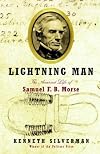
Lightning Man: The Accursed Life of Samuel F. B. Morse
by Kenneth Silverman
On This Page
Description
Profiles Morse as a gifted artist, political prospect, and innovator responsible for the American electromagnetic telegraph, describing the painful defeats that overshadowed his successes.Tags
Recommendations

















Member Reviews
Ten months before his death in 1872, Samuel Finley Breese Morse was treated to a unique honor: an informal “Samuel Morse Day” held in New York City. Organized by a group of Western Union employees, it involved a parade, a boat ride in New York Harbor, and the unveiling of a statue of the man in Central Park. The celebration culminated that evening at the Academy of Music, where in the presence of Morse himself a series of testimonials were delivered. At the end, the original telegraphic apparatus was wheeled out, giving Morse the opportunity to send out a final message through the network – one that he ended by tapping out his own name in the code that he had devised in order to communicate on it.
For Morse the celebrations were show more not just a touching tribute but a public confirmation of his status as the “father of the telegraph.” In this respect it was a fitting coda for the last part of his life, one that was consumed with Morse’s determination to receive the sole credit for the invention of the electric telegraph. The description of this quest takes up much of the latter part of Kenneth Silverman’s fluid and engrossing biography of the man, which shows not just how intently Morse worked to secure his place in history, but how that quest overshadowed many other aspects of his long and accomplished life.
The descendant of Puritan settlers, Morse was born in Massachusetts in 1789. His father Jedediah was a minister at a Congregationalist church in Charlestown and the author of several popular geographies and travel guides. Consumed with his work, he had little time for his son, who at the age of eight was packed off to be educated at a series of boarding schools. Though an indifferent student, young Morse discovered a gift for drawing, which soon evolved into a budding career as an artist. After graduating from Yale in 1810 he convinced his parents to support his interest in becoming an artist, which entailed traveling to London as the understudy of Washington Allston, then emerging as one of the leading artists of the young republic.
Morse returned in 1815 determined to revisit Europe at the earliest opportunity. Instead, he settled into the routine of a portrait painter and started a family with his new wife Lucretia. These were years of struggle for Morse, as his remunerative work painting portraits of planters and preachers in Charleston and New England did not measure up to his aspirations of greatness. Silverman notes that Morse’s classical style of painting was increasingly out of step with the more Romantic approach then in vogue, which caused his work to be eclipsed by other artists. While Morse did much to improve the standing of American art, this was through his efforts to organize the National Academy of Design, which offered lectures that Silverman credits with introducing the American public to more sophisticated ways of evaluating American art. Yet Morse’s efforts to earn money by showing his own epic paintings failed to recoup their expenses, while the death of his wife left him adrift. Frustrated both professionally and personally, Morse decided to return to Europe, where he toured the major art galleries for another two years.
This second trip proved momentous in a number of respects. Witnessing the turmoil of European politics during the revolutionary year of 1830 confirmed many of Morse’s prejudices against Catholicism and the Roman Catholic Church, and led him to begin his occasional engagement with American politics. It was on his return voyage, though, that Morse began contemplating how to send messages electrically over long distances. Though telegraphs existed in a number of places, these were semaphores requiring towers of arms and flaps to relay messages. Morse envisioned sending messages using electrical current, and by the time the ship returning him to America in 1832 had docked he claimed to have worked out the basics for such as system. This Silverman qualifies by noting the contributions of others who Morse consulted and employed, all of whom furthered his understanding of the operation of such a telegraph and helped him establish the basic apparatus for it. By 1838 Morse was demonstrating his invention in the hope of gaining government funding for a network.
Morse spent the better part of a decade winning support for his telegraph. This involved him in the grubby world of lobbying and business, for which he had little affinity. Silverman sees Morse’s partnership with Amos Kendall, a former postmaster general in Andrew Jackson’s administration, which proved key to the telegraph’s success. By the end of the 1840s the telegraph was establishing itself rapidly throughout the country, with Morse beginning to enjoy the fruits of his labors. Nevertheless, the battles establishing credit for the telegraph – which were vital to the questions of patents and profit – consumed much of his attention in his later years, with the lawsuits from former associates and the public relations battles with their families fueling a sense in Morse of a life accursed.
As an award-wining biographer, Silverman is well-versed in the art. His skills are on full display in this book, which weaves his arguments into a lively study that strikes a good balance between narrative and analysis, though occasionally favoring the former at the expense of the latter. His portrayal of Morse is sympathetic, yet one that acknowledges freely Morse’s many flaws, most notably his alienating pettiness, his lamentable politics, and his neglectful parenting of his children. It’s an admirable study of the man and his accomplishments, one that is a good starting point for anyone seeking to learn about Morse and the full range of his many achievements. show less
For Morse the celebrations were show more not just a touching tribute but a public confirmation of his status as the “father of the telegraph.” In this respect it was a fitting coda for the last part of his life, one that was consumed with Morse’s determination to receive the sole credit for the invention of the electric telegraph. The description of this quest takes up much of the latter part of Kenneth Silverman’s fluid and engrossing biography of the man, which shows not just how intently Morse worked to secure his place in history, but how that quest overshadowed many other aspects of his long and accomplished life.
The descendant of Puritan settlers, Morse was born in Massachusetts in 1789. His father Jedediah was a minister at a Congregationalist church in Charlestown and the author of several popular geographies and travel guides. Consumed with his work, he had little time for his son, who at the age of eight was packed off to be educated at a series of boarding schools. Though an indifferent student, young Morse discovered a gift for drawing, which soon evolved into a budding career as an artist. After graduating from Yale in 1810 he convinced his parents to support his interest in becoming an artist, which entailed traveling to London as the understudy of Washington Allston, then emerging as one of the leading artists of the young republic.
Morse returned in 1815 determined to revisit Europe at the earliest opportunity. Instead, he settled into the routine of a portrait painter and started a family with his new wife Lucretia. These were years of struggle for Morse, as his remunerative work painting portraits of planters and preachers in Charleston and New England did not measure up to his aspirations of greatness. Silverman notes that Morse’s classical style of painting was increasingly out of step with the more Romantic approach then in vogue, which caused his work to be eclipsed by other artists. While Morse did much to improve the standing of American art, this was through his efforts to organize the National Academy of Design, which offered lectures that Silverman credits with introducing the American public to more sophisticated ways of evaluating American art. Yet Morse’s efforts to earn money by showing his own epic paintings failed to recoup their expenses, while the death of his wife left him adrift. Frustrated both professionally and personally, Morse decided to return to Europe, where he toured the major art galleries for another two years.
This second trip proved momentous in a number of respects. Witnessing the turmoil of European politics during the revolutionary year of 1830 confirmed many of Morse’s prejudices against Catholicism and the Roman Catholic Church, and led him to begin his occasional engagement with American politics. It was on his return voyage, though, that Morse began contemplating how to send messages electrically over long distances. Though telegraphs existed in a number of places, these were semaphores requiring towers of arms and flaps to relay messages. Morse envisioned sending messages using electrical current, and by the time the ship returning him to America in 1832 had docked he claimed to have worked out the basics for such as system. This Silverman qualifies by noting the contributions of others who Morse consulted and employed, all of whom furthered his understanding of the operation of such a telegraph and helped him establish the basic apparatus for it. By 1838 Morse was demonstrating his invention in the hope of gaining government funding for a network.
Morse spent the better part of a decade winning support for his telegraph. This involved him in the grubby world of lobbying and business, for which he had little affinity. Silverman sees Morse’s partnership with Amos Kendall, a former postmaster general in Andrew Jackson’s administration, which proved key to the telegraph’s success. By the end of the 1840s the telegraph was establishing itself rapidly throughout the country, with Morse beginning to enjoy the fruits of his labors. Nevertheless, the battles establishing credit for the telegraph – which were vital to the questions of patents and profit – consumed much of his attention in his later years, with the lawsuits from former associates and the public relations battles with their families fueling a sense in Morse of a life accursed.
As an award-wining biographer, Silverman is well-versed in the art. His skills are on full display in this book, which weaves his arguments into a lively study that strikes a good balance between narrative and analysis, though occasionally favoring the former at the expense of the latter. His portrayal of Morse is sympathetic, yet one that acknowledges freely Morse’s many flaws, most notably his alienating pettiness, his lamentable politics, and his neglectful parenting of his children. It’s an admirable study of the man and his accomplishments, one that is a good starting point for anyone seeking to learn about Morse and the full range of his many achievements. show less
A thorough and excellent biography of Samuel F. B. Morse. The man's not always (or even often) an appealing subject, but Silverman does a grand job.
Ratings
Members
- Recently Added By
Lists

Books in the Bibliography of The Alchemy of Us by Ainissa Ramirez
181 works; 1 member
Author Information

10+ Works 1,120 Members
Awards and Honors
Distinctions
Common Knowledge
- People/Characters
- Samuel Morse
- Important events
- Invention of the Telegraph
- First words
- On April 30, 1789, Jedediah Morse was installed as pastor of the First Congregational Church of Charlestown, Massachusetts.
- Last words
- (Click to show. Warning: May contain spoilers.)And it is being revived as a means of communications for persons who have little or no ability to move, or who cannoy speak or sign-who are ventilator-depdendent or who suffer from severe cerebral palsy or some other devastating impairment.
Classifications
- Genres
- Nonfiction, Biography & Memoir, History, General Nonfiction, Technology, Science & Nature, Art & Design
- DDC/MDS
- 621.383 — Applied science & technology Engineering Applied physics Electronics & Computers Electronics, communications engineering Telegrapy
- LCC
- TK5243 .M7 .S55 — Technology Electrical engineering. Electronics. Nuclear engineering Electrical engineering. Electronics. Nuclear Telecommunication
- BISAC
Statistics
- Members
- 185
- Popularity
- 177,379
- Reviews
- 2
- Rating
- (3.93)
- Languages
- English
- Media
- Paper, Ebook
- ISBNs
- 5
- ASINs
- 1