On This Page
Description
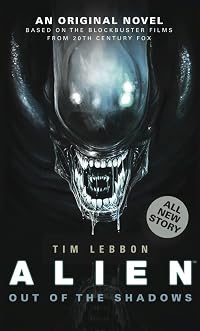
Featuring the iconic Ellen Ripley in a terrifying new adventure that bridges the gap between Alien and Aliens. Officially sanctioned and true to the Alien cannon, Alien: Out of the Shadows expands upon the well-loved mythos and is a must for all Alien fans.Tags
Recommendations






Member Reviews
My original Alien: Out of the Shadows audiobook review and many others can be found at Audiobook Reviewer.
In 2014, Titan Books released the first in a new series of books set in the Alien film franchise under the supervision of the movie studio 20th Century Fox. These novels are considered part of the film canon and help expand and flesh out the movie universe, and they launched with Tim Lebbon’s Alien: Out of the Shadows, set between the first two movies and featuring the series’ heroine, Lt. Ellen Ripley.
Following the destruction of the Nostromo in the first Alien movie, Ripley put herself into hypersleep and drifted through space. Movie buffs know that 57 years passed between Alien and Aliens, but Lebbon has crafted a nicely show more fitting story that slots itself directly into the middle of this time gap. In Out of the Shadows, the damaged mining vessel Marion picks up a distress call from Ripley’s lifeboat, while the crew contends with the discovery of a vicious life-form on the planet LV-178. It’s not long before Ripley is pressed back into action, haunted by the events aboard the Nostromo, and hellbent on saving the crew of the Marion.
Rather than taking Lebbon’s novel and producing a straight-up audiobook, Audible Studios and director Dirk Maggs have turned Out of the Shadows into a brilliant audio drama, crafting a production that may well be the best Alien production since James Cameron’s own Aliens. Using an ensemble cast of voice actors, including actor Rutger Hauer in his first audio performance as the now-disembodied ghost in the machine of the android Ash, and an array of sound effects and musical score, the production quality on display here is downright phenomenal.
Actor Corey Johnson brings to life Chief Engineering Hooper, while Laurel Lefkow voices Ripley. The chemistry between these two is terrific and you get a great sense of camaraderie as they form a fast friendship under the threat of the alien menace. Lefkow in particular wowed the heck out of me, and a few times I could have positively sworn that Maggs had gotten Sigourney Weaver to reprise her role. Lefkow absolutely nails the tone, inflection, and speech patterns of Weaver’s Ellen Ripley and it’s mighty damn impressive to listen to.
Rounding out the voice talent is the full-fledged sonic experience of the work itself. From the familiar not-quite dot matrix noises of the computers as they display text, to the ferocious grunts, hisses, and screams of the aliens, and the attendant instrumental score, Out of the Shadows is a frighteningly immersive experience, and one that is very audibly an Alien story. Dirk Maggs has been credited with turning the audio drama into an audio movie for his BBC productions, and that particular knack is on full display here. Lebbon’s prose work has been stripped away, although the story and dialogue, with a bit of finessing for this dramatization, remain intact and is lovingly crafted in a highly cinematic experience for the mind. With the accompanying audio you can really let your imagination run wild and set the scene in your mind’s eye on this one. This is as much an audio movie as it as a movie of the mind, and it’s scarily effective. Be sure to listen to this one with a good set of headphones to fully appreciate the layers and depth that went into constructing this audio drama, but be careful not to fall off the edge of your seat.
Some may argue that by placing this story between the first two Alien films that it’s not an entirely necessary work. To this, and with a shoulder shrug, I can only say, “meh.” I, for one, don’t care a whit about this works “necessity” because it’s just too damn good to ignore. This is a fun listening experience, and one of the best Alien productions we’ve gotten in a long, long while. It’s great to see, or rather, hear, Ellen Ripley back in action and kicking butt on land and in space.
If I have to post one complaint, it’s that the inclusion of Ash serves mostly as story recaps. While Hauer is a great choice to voice this iconic character, a lot of the information Ash relays, in the form of status update reports to the Weyland-Yutani corporation, is redundant to the unfolding plot, and given the frequency at which this is done over the course of the production’s 4 hours and 28 minutes it often times feel highly repetitive. If you’re spreading this listen out over multiple days or longer, these updates may serve as helpful story recaps, but if you’re digesting the story in large chunks they ultimately add little. Like a television show’s “previously on” segment, these recaps don’t eat up a lot of time, so this is ultimately a very minor complaint in the grander scheme of things.
As they did with last year’s adaptation of Joe Hill’s Locke & Key, Audible Studios has delivered a knock-out win of an audio drama – and for a work set in one of my favorite film series, no less! I had read and enjoyed Lebbon’s novel of this work when it came out a few years ago, but I absolutely loved listening to this adaptation. Dirk Maggs and his cast and crew have created a very special production for Alien fans with this dramatization, released on Alien Day (4-26, as in LV-426), and it’s a work that I highly recommend. Now go give it a listen!
Audiobook was provided for review by the publisher. show less
In 2014, Titan Books released the first in a new series of books set in the Alien film franchise under the supervision of the movie studio 20th Century Fox. These novels are considered part of the film canon and help expand and flesh out the movie universe, and they launched with Tim Lebbon’s Alien: Out of the Shadows, set between the first two movies and featuring the series’ heroine, Lt. Ellen Ripley.
Following the destruction of the Nostromo in the first Alien movie, Ripley put herself into hypersleep and drifted through space. Movie buffs know that 57 years passed between Alien and Aliens, but Lebbon has crafted a nicely show more fitting story that slots itself directly into the middle of this time gap. In Out of the Shadows, the damaged mining vessel Marion picks up a distress call from Ripley’s lifeboat, while the crew contends with the discovery of a vicious life-form on the planet LV-178. It’s not long before Ripley is pressed back into action, haunted by the events aboard the Nostromo, and hellbent on saving the crew of the Marion.
Rather than taking Lebbon’s novel and producing a straight-up audiobook, Audible Studios and director Dirk Maggs have turned Out of the Shadows into a brilliant audio drama, crafting a production that may well be the best Alien production since James Cameron’s own Aliens. Using an ensemble cast of voice actors, including actor Rutger Hauer in his first audio performance as the now-disembodied ghost in the machine of the android Ash, and an array of sound effects and musical score, the production quality on display here is downright phenomenal.
Actor Corey Johnson brings to life Chief Engineering Hooper, while Laurel Lefkow voices Ripley. The chemistry between these two is terrific and you get a great sense of camaraderie as they form a fast friendship under the threat of the alien menace. Lefkow in particular wowed the heck out of me, and a few times I could have positively sworn that Maggs had gotten Sigourney Weaver to reprise her role. Lefkow absolutely nails the tone, inflection, and speech patterns of Weaver’s Ellen Ripley and it’s mighty damn impressive to listen to.
Rounding out the voice talent is the full-fledged sonic experience of the work itself. From the familiar not-quite dot matrix noises of the computers as they display text, to the ferocious grunts, hisses, and screams of the aliens, and the attendant instrumental score, Out of the Shadows is a frighteningly immersive experience, and one that is very audibly an Alien story. Dirk Maggs has been credited with turning the audio drama into an audio movie for his BBC productions, and that particular knack is on full display here. Lebbon’s prose work has been stripped away, although the story and dialogue, with a bit of finessing for this dramatization, remain intact and is lovingly crafted in a highly cinematic experience for the mind. With the accompanying audio you can really let your imagination run wild and set the scene in your mind’s eye on this one. This is as much an audio movie as it as a movie of the mind, and it’s scarily effective. Be sure to listen to this one with a good set of headphones to fully appreciate the layers and depth that went into constructing this audio drama, but be careful not to fall off the edge of your seat.
Some may argue that by placing this story between the first two Alien films that it’s not an entirely necessary work. To this, and with a shoulder shrug, I can only say, “meh.” I, for one, don’t care a whit about this works “necessity” because it’s just too damn good to ignore. This is a fun listening experience, and one of the best Alien productions we’ve gotten in a long, long while. It’s great to see, or rather, hear, Ellen Ripley back in action and kicking butt on land and in space.
If I have to post one complaint, it’s that the inclusion of Ash serves mostly as story recaps. While Hauer is a great choice to voice this iconic character, a lot of the information Ash relays, in the form of status update reports to the Weyland-Yutani corporation, is redundant to the unfolding plot, and given the frequency at which this is done over the course of the production’s 4 hours and 28 minutes it often times feel highly repetitive. If you’re spreading this listen out over multiple days or longer, these updates may serve as helpful story recaps, but if you’re digesting the story in large chunks they ultimately add little. Like a television show’s “previously on” segment, these recaps don’t eat up a lot of time, so this is ultimately a very minor complaint in the grander scheme of things.
As they did with last year’s adaptation of Joe Hill’s Locke & Key, Audible Studios has delivered a knock-out win of an audio drama – and for a work set in one of my favorite film series, no less! I had read and enjoyed Lebbon’s novel of this work when it came out a few years ago, but I absolutely loved listening to this adaptation. Dirk Maggs and his cast and crew have created a very special production for Alien fans with this dramatization, released on Alien Day (4-26, as in LV-426), and it’s a work that I highly recommend. Now go give it a listen!
Audiobook was provided for review by the publisher. show less
Sometimes you have to start a review with: in all fairness.
In all fairness you can actually compare airport novels to literary works. Here's why. I have a friend who is a very good and well established poet. She will frequently say: the reason I can't write fiction is because I don't have that knack to make the magic trick work, the one where from the first sentence you transport someone into a different world and won't let them go until it's all said and done.
Sure, you probably won't learn anything about the depths of the human soul. But do we really need to? We already have millions and millions of books trying to do just that. In fact, at least with a novel like this you won't have a life lesson forced down your throat (pun sort of show more intended).
You may think that I'm trying to defend this novel in some way by disparaging works of heavy literature. I'm not, I'm trying to make the point that those writers who create spinoff-novels, off-shoots and novelizations might actually know very well what they are doing. Maybe even more so than someone writing an article for let's say Antioch or Granta. Why? Because pieces published in literary journals don't have to have that magic trick, it's ok if people who read the pieces know it's a literary piece. In fact it helps.
Over the hundreds of books I've read and thousands of short stories submitted to the literary journal I was an editor of, I've come to greatly appreciate the authors like Tim Waggoner or Tim Lebbon or Alex White. They have mastered their craft and they are making a contribution to entertainment. They are keeping our minds occupied and entertained and that's quite a compliment. show less
In all fairness you can actually compare airport novels to literary works. Here's why. I have a friend who is a very good and well established poet. She will frequently say: the reason I can't write fiction is because I don't have that knack to make the magic trick work, the one where from the first sentence you transport someone into a different world and won't let them go until it's all said and done.
Sure, you probably won't learn anything about the depths of the human soul. But do we really need to? We already have millions and millions of books trying to do just that. In fact, at least with a novel like this you won't have a life lesson forced down your throat (pun sort of show more intended).
You may think that I'm trying to defend this novel in some way by disparaging works of heavy literature. I'm not, I'm trying to make the point that those writers who create spinoff-novels, off-shoots and novelizations might actually know very well what they are doing. Maybe even more so than someone writing an article for let's say Antioch or Granta. Why? Because pieces published in literary journals don't have to have that magic trick, it's ok if people who read the pieces know it's a literary piece. In fact it helps.
Over the hundreds of books I've read and thousands of short stories submitted to the literary journal I was an editor of, I've come to greatly appreciate the authors like Tim Waggoner or Tim Lebbon or Alex White. They have mastered their craft and they are making a contribution to entertainment. They are keeping our minds occupied and entertained and that's quite a compliment. show less
First off, I have to admit that this is the first audio book that I've read that's in this format. So with that said, this was an interesting read. I liked the production. It was acted (?) well. This would be more accurately described as a radio drama. There wasn't any real narraration, just dialog, sound effects and music. That was ok though. It was like listening to a movie which I have done many times.
The main problem with this (I started reading it before I saw the subtitle of Canonical Alien Trilogy) was that it had to shoehorn itself into the narrative of the Alien franchise. I would have preferred it to be retconned. It was interesting and held my attention. I would try other books in this style.
The main problem with this (I started reading it before I saw the subtitle of Canonical Alien Trilogy) was that it had to shoehorn itself into the narrative of the Alien franchise. I would have preferred it to be retconned. It was interesting and held my attention. I would try other books in this style.
3.5
Thirty-seven years of nightmares, she thought. And now that I’m awake, the nightmare has woken with me.
I’m not the type to usually jump on the bandwagon for Sci-fi series, but the Alien series has always been my soft spot. I’ve watched the first two several times, collected the expensive but irresistibly huge DVD box set when it was released, and a few EBay collector items and limited figures. I’ve always wanted to read books on the series – the only thing that’s surprised me is I waited this long.
I’ve rea d a few books by Tim Lebbon and he’s a gifted author who usually dabbles in the horror or thriller scene. I’ve always found the Alien scene particularly creepy and an excellent example of how well science fiction show more and horror make a fascinating marriage of genres. There aren’t any complains about the writing style, dialogue or the characterization. No one comes across flat and all serve their appropriate purpose for the most part.
It’s fitting to start an Alien series with Ripley, and the way this was done to squeeze it in between the first and second movies cannon was creative and stylish. Sometimes there was an overdose of flashbacks to her daughter Amanda and imagined horror scenarios for her child. This especially got heavy later on – a bit too much so – but I think the point of that was setting up a particular technological technique to be seductive and reassuring rather than unrealistic.
He was the stuff of the stars, and when he was a young boy—dreaming of monsters, and looking to space in the hope that he would find them—that had made him feel special. Now, it only made him feel small.
If you got chills from the android Ash from the original movie, you’ll get plenty of him here – not in physical form, of course, but that’s not even needed with the communication with him and Ripley and some of the “letters”.
The start is interesting with a different group, and I dug the dynamics of the people when they all merged, but it did tend to slow down and drag on a bit when they were at the heart of the Alien trouble. It almost stopped feeling like a genuine alien story and it’s mainly a game of cat and mouse chasing.
The idea is creative and well executed, although the details can sometimes be a bit lackluster. It was nice to see Ripley in between voyages and how the mother angle would tie in so highly in the second movie (story) by bringing up her daughter so often and strongly. I did think the romantic element was a little false, but it also made sense because desperation and loneliness make people clatch on to any new person they can, especially to replace personal loss.
We don’t get many cool scenes with the alien mouth-thing, but we get tons of emphasis on the acid blood and the chest incubation. show less
Thirty-seven years of nightmares, she thought. And now that I’m awake, the nightmare has woken with me.
I’m not the type to usually jump on the bandwagon for Sci-fi series, but the Alien series has always been my soft spot. I’ve watched the first two several times, collected the expensive but irresistibly huge DVD box set when it was released, and a few EBay collector items and limited figures. I’ve always wanted to read books on the series – the only thing that’s surprised me is I waited this long.
I’ve rea d a few books by Tim Lebbon and he’s a gifted author who usually dabbles in the horror or thriller scene. I’ve always found the Alien scene particularly creepy and an excellent example of how well science fiction show more and horror make a fascinating marriage of genres. There aren’t any complains about the writing style, dialogue or the characterization. No one comes across flat and all serve their appropriate purpose for the most part.
It’s fitting to start an Alien series with Ripley, and the way this was done to squeeze it in between the first and second movies cannon was creative and stylish. Sometimes there was an overdose of flashbacks to her daughter Amanda and imagined horror scenarios for her child. This especially got heavy later on – a bit too much so – but I think the point of that was setting up a particular technological technique to be seductive and reassuring rather than unrealistic.
He was the stuff of the stars, and when he was a young boy—dreaming of monsters, and looking to space in the hope that he would find them—that had made him feel special. Now, it only made him feel small.
If you got chills from the android Ash from the original movie, you’ll get plenty of him here – not in physical form, of course, but that’s not even needed with the communication with him and Ripley and some of the “letters”.
The start is interesting with a different group, and I dug the dynamics of the people when they all merged, but it did tend to slow down and drag on a bit when they were at the heart of the Alien trouble. It almost stopped feeling like a genuine alien story and it’s mainly a game of cat and mouse chasing.
The idea is creative and well executed, although the details can sometimes be a bit lackluster. It was nice to see Ripley in between voyages and how the mother angle would tie in so highly in the second movie (story) by bringing up her daughter so often and strongly. I did think the romantic element was a little false, but it also made sense because desperation and loneliness make people clatch on to any new person they can, especially to replace personal loss.
We don’t get many cool scenes with the alien mouth-thing, but we get tons of emphasis on the acid blood and the chest incubation. show less
Not a bad ALIEN story. A pretty decent one, actually, but where it fails is in trying to shoehorn itself in between the first two movies. It works great as a sequel to ALIEN, but shoots itself in the foot somewhat trying to hit the reset button to set up ALIENS. Much of the problem comes from trying to one-up the second film, which often comes off as just retreading old ground. That said, I have no problem seeing this as a kind of alternate-universe sequel. (Much like the Dark Horse comics branched off of ALIENS but were rendered non-canon by subsequent films.) It'll be interesting to see where the rest of this trilogy goes.
An Alien story that adds nothing to the franchise.
Ripley is reused instead of concentrating on the new characters coming to grips with these inimical creatures, requiring an awkward non-sensical adjustment at the end to forcibly shoehorn this in between the first two Alien films.
Ripley has many (a dozen?) redundant daymares about her daughter. I read them all but after the first two, you could skip the italicized sections without missing anything. They’re all basically the same.
Several times, a new character, “Hoop” inexplicably knows what Ripley (who he’s just met) is thinking. This is not the omniscient narrator voice, it is Hoops’ observations presented as factual and is jarring when it occurs.
Ash is also reused, this time show more as an omnipotent AI that effortlessly spreads through every computer and blogs about his schemes. He’s inexplicably managed to bring Ripley’s slooow lifeboat to the system where miners have encountered Aliens within weeks of the discovery.
One missed opportunity involves the wrecked alien ship, which appears to have been organically grown — what monstrosity would result if the Aliens mingled genes with THAT?
There are a number of other Alien novels out there that add new dimensions to the franchise (e.g. Alien royal jelly, warring queens, etc.) but sadly, this is not one.
(note: This review was also posted to Amazon today) show less
Ripley is reused instead of concentrating on the new characters coming to grips with these inimical creatures, requiring an awkward non-sensical adjustment at the end to forcibly shoehorn this in between the first two Alien films.
Ripley has many (a dozen?) redundant daymares about her daughter. I read them all but after the first two, you could skip the italicized sections without missing anything. They’re all basically the same.
Several times, a new character, “Hoop” inexplicably knows what Ripley (who he’s just met) is thinking. This is not the omniscient narrator voice, it is Hoops’ observations presented as factual and is jarring when it occurs.
Ash is also reused, this time show more as an omnipotent AI that effortlessly spreads through every computer and blogs about his schemes. He’s inexplicably managed to bring Ripley’s slooow lifeboat to the system where miners have encountered Aliens within weeks of the discovery.
One missed opportunity involves the wrecked alien ship, which appears to have been organically grown — what monstrosity would result if the Aliens mingled genes with THAT?
There are a number of other Alien novels out there that add new dimensions to the franchise (e.g. Alien royal jelly, warring queens, etc.) but sadly, this is not one.
(note: This review was also posted to Amazon today) show less
Serviceable story that does what they all do in repeating main beats from 1&2. The production has great SFX, pretty good acting and a weak story with a giant reset button at the end of it (perhaps unavoidable in the mission brief writing this). The actress doing Weaver sounds dead on. Strangely they never seem to nail fear/horror in these performances, they're always of the theatrical talk-louder variety.
Members
- Recently Added By
Lists

Books Read in 2015
3,299 works; 129 members
Author Information

125+ Works 6,905 Members
Some Editions
Series


Work Relationships
Common Knowledge
Classifications
Statistics
- Members
- 412
- Popularity
- 75,413
- Reviews
- 26
- Rating
- (3.44)
- Languages
- English, German, Polish, Portuguese (Brazil)
- Media
- Paper, Audiobook, Ebook
- ISBNs
- 8
- ASINs
- 14