
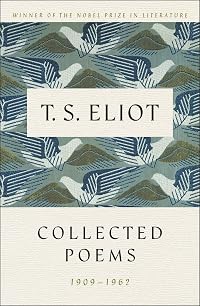
Collected Poems, 1909–1962
by T. S. Eliot
On This Page
Description
This volume contains the works Eliot personally selected to be preserved.Tags
Recommendations






Member Reviews
T.S. Eliot surely resides in history as one of the greatest twentieth-century poets in the English language. He spanned the American-English landscape in life as well as in literature. His poetry is replete with imagery yet relatively devoid of obvious meaning. Even a poem entitled “Ash Wednesday” (a seemingly religious topic) skirts on just conjuring a sense of beauty in the reader and avoiding a tone traditionally reminiscent of a church.
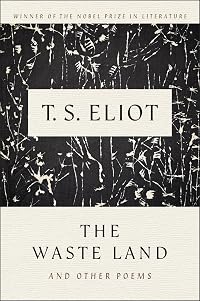
Of course, one poem in particular stands out as embodying this persona: “The Wasteland.” This five-part poem consists of a collection of beautiful images that require readers to slow down and to contemplate in order to read. As one of my friends once remarked, “It’s so beautiful, yet I show more have no clue what it means!” That’s what’s so majestic about Eliot’s poetic sense.
Generally, his verse inspires an other-worldliness and transcendence. His mastery of language was so that he evoked awe without resorting to silly tricks and without relying on prior experience. His poems draw out the universal humanity in us and lure us into psychological archetypes that define us as a species.
Perhaps future generations will see Eliot as being a part of some twentieth-century, modernist-type movement. Perhaps. But my reading of Eliot is that he is always gone out to sea (one of his favorite settings in life and in verse). He lived alone on a plane where the only humanity was inside his soul. He was the idealized solitary genius.
It’s ironic that Eliot converted to Christianity in mid-life. Though I share in confessing this creed, I lack the overwhelming sense of universal humanity that Eliot possesses. Most of expressed Christianity is peculiar to one place, one time, one denomination, one church, or one preacher. Eliot either neglected his Christianity in his writings or saw the world differently than anyone else who has taken up the English language. The way he expressed his vision of the world belongs to the ages.
That’s why its worth anyone’s time to slow down and pick their way through Eliot’s imaginary wordsmithry. From within, his poems elucidate a reality as only he saw it, alone in his expedition, metaphorically out at sea. show less
Of course, one poem in particular stands out as embodying this persona: “The Wasteland.” This five-part poem consists of a collection of beautiful images that require readers to slow down and to contemplate in order to read. As one of my friends once remarked, “It’s so beautiful, yet I show more have no clue what it means!” That’s what’s so majestic about Eliot’s poetic sense.
Generally, his verse inspires an other-worldliness and transcendence. His mastery of language was so that he evoked awe without resorting to silly tricks and without relying on prior experience. His poems draw out the universal humanity in us and lure us into psychological archetypes that define us as a species.
Perhaps future generations will see Eliot as being a part of some twentieth-century, modernist-type movement. Perhaps. But my reading of Eliot is that he is always gone out to sea (one of his favorite settings in life and in verse). He lived alone on a plane where the only humanity was inside his soul. He was the idealized solitary genius.
It’s ironic that Eliot converted to Christianity in mid-life. Though I share in confessing this creed, I lack the overwhelming sense of universal humanity that Eliot possesses. Most of expressed Christianity is peculiar to one place, one time, one denomination, one church, or one preacher. Eliot either neglected his Christianity in his writings or saw the world differently than anyone else who has taken up the English language. The way he expressed his vision of the world belongs to the ages.
That’s why its worth anyone’s time to slow down and pick their way through Eliot’s imaginary wordsmithry. From within, his poems elucidate a reality as only he saw it, alone in his expedition, metaphorically out at sea. show less
I am not an expert in poetry, but I enjoy reading some of it when the poet knows how to use the language. T. S. Eliot does that. Many of these poems were not to my taste, or beyond my understanding. The early poems are full of darkness, bleak and without hope; written in the chaotic way of modern art. The later poems, while still having a dim view of humanity, have a spark of hope in them. Their themes had an underlying order to them and many of the thoughts expressed were profound. It was in the later poems that I found my favorites. One early poem I loved was "The Hollow Men." Haunting. The following are what I discovered in my favorites, you might find other things because as all excellent writing, the reader can discover what it show more means to them.
"Ash Wednesday VI" A lovely picture of wanting God & coming to the point of accepting Him, and at the same time an ode to Christ and how He might have felt during His ordeal of manhood. I love the last stanza:
"...Suffer us not to mock ourselves with falsehood
Teach us to care and not to care
Teach us to sit still
Even among these rocks,
Our peace in His will
And even among these rocks
Sister, mother
And spirit of the river, spirit of the sea,
Suffer me not to be separated
And let my cry come unto Thee."
"Journey of the Magi" The first part reminds us that they were actual men on a real journey with all the trials and joy of a long trip. The second reminds us that we are all travelers on a journey of discovery. When we reach our destination we find both life and death.
"Choruses from The Rock" - Damn good sermons. I was afraid that the climax of these poems, which seem to highlight our failures towards God and the world, would end depressing. But the final one is a beautiful praise of thanks unto Light Invisible for the light given.
"Four Quartets" - These seem to be all about time, eternity, past, future, present, the words wrap around one, flow in and out of our mind. For me, they were like quicksilver; lovely, but cannot quite be grasped.
My favorite was Little Gidding. It starts with a faerie place, never-never, midwinter spring. The second part revolves around Air, Earth, Water & Fire; beautiful stanzas of eternity and the littleness of time.
The third, I felt that the beginning described the state of my being, a duality, but the insight with the answer eludes me.
The last might be my favorite lines of all:
"We shall not cease from exploration
and the end of all our exploring
Will be to arrive where we started
And know the place for the first time."
"To Walter de la Mare" is a lovely tribute to a storyteller. Made me search out and buy a couple of his works to find out about him. show less
"Ash Wednesday VI" A lovely picture of wanting God & coming to the point of accepting Him, and at the same time an ode to Christ and how He might have felt during His ordeal of manhood. I love the last stanza:
"...Suffer us not to mock ourselves with falsehood
Teach us to care and not to care
Teach us to sit still
Even among these rocks,
Our peace in His will
And even among these rocks
Sister, mother
And spirit of the river, spirit of the sea,
Suffer me not to be separated
And let my cry come unto Thee."
"Journey of the Magi" The first part reminds us that they were actual men on a real journey with all the trials and joy of a long trip. The second reminds us that we are all travelers on a journey of discovery. When we reach our destination we find both life and death.
"Choruses from The Rock" - Damn good sermons. I was afraid that the climax of these poems, which seem to highlight our failures towards God and the world, would end depressing. But the final one is a beautiful praise of thanks unto Light Invisible for the light given.
"Four Quartets" - These seem to be all about time, eternity, past, future, present, the words wrap around one, flow in and out of our mind. For me, they were like quicksilver; lovely, but cannot quite be grasped.
My favorite was Little Gidding. It starts with a faerie place, never-never, midwinter spring. The second part revolves around Air, Earth, Water & Fire; beautiful stanzas of eternity and the littleness of time.
The third, I felt that the beginning described the state of my being, a duality, but the insight with the answer eludes me.
The last might be my favorite lines of all:
"We shall not cease from exploration
and the end of all our exploring
Will be to arrive where we started
And know the place for the first time."
"To Walter de la Mare" is a lovely tribute to a storyteller. Made me search out and buy a couple of his works to find out about him. show less
This collection of poetry is a perfect choice to read as the year winds down. Eliot's themes of cyclical time, endings leading to beginnings, and of religion form a symbiosis to the mood of the Dead Days where time slows and speeds at once in a nonlinear fashion that eventually culminates with the clock striking midnight at the dawning of a New Year.
The collected poems of one of the greatest poets of the twentieth century includes several of the greatest poems of any age. Eliot was a distinctive modernist whose cerebral poetry was often moving as well. I return to this as it is in my personal pantheon of great literature.
In general, if there's some sort of sliding scale of poetic appreciation, I'm somewhere near -∞. The first forewarning of a couplet makes me cringe, and other than the subject matter, I can't really distinguish Longfellow from a limerick. One of my few--very few-- exceptions is T.S. Eliot. He embeds incredibly evocative phrases within a bewildering twisting medley of free verse. His poems use assonance and alliteration to twine disparate commonplaces with sudden poignant truths so that the whole is somehow imbued with the tones and significance of alien moods. This particular collection contains several gems that didn't make it into the various books of "selected poems."
Some of phrases from these excluded (if I remember correctly) show more poems:
"La Figlia Che Piange":
"Gerontion":
"Preludes":
"Whispers of Immortality":
Some of phrases from these excluded (if I remember correctly) show more poems:
"La Figlia Che Piange":
Weave, weave the sunlight in your hair
...
So he would have left
As the soul leaves the body torn and bruised,
As the mind deserts the body it has used.
"Gerontion":
Here I am, an old man in a dry month,
Being read to by a boy, waiting for rain.
...
These tears are shaken from the wrath-bearing tree.
...
With pungent sauces, multiply variety
In a wilderness of mirrors.
"Preludes":
You lay upon your back, and waited;
You dozed, and watched the night revealing
The thousand sordid images
Of which your soul was constituted;
They flickered against the ceiling.
...
His soul stretched tight across the skies
That fade behind a city block,
Or trampled by insistent feet
At four and five and six o'clock;
And short square fingers stuffing pipes,
And evening newspapers, and eyes
Assured of certain certainties,
The conscience of a blackened street
Impatient to assume the world.
...
The notion of some infinitely gentle
Infinitely suffering thing.
"Whispers of Immortality":
show less
[He] was much possessed by death
And saw the skull beneath the skin
...
He knew that thought clings round dead limbs
Tightening its lusts and luxuries.
...
No contact possible to flesh
Allayed the fever of the bone.
While I love some of the poems, others I didn't care for at all. So it is hard to rate the book as a whole... These poems were selected by Eliot himself just a few years before he died as the best of his work and it certainly contains all of his most famous work EXCEPT for the fact it doesn't even have one poem from "Old Possum's Book of Practical Cats". With that in mind, I cannot whole-heartedly recommend it as a single sole volume of Eliot's poetry.
I am not much of a modernist, so it is perhaps not surprising that I found many of the so-called "minor poems" more enjoyable than the more serious (and to me often more obscure) verses. My favorites:
- The Love Song of J. Alfred Prufrock
- Portrait of a Lady
- The Waste Land (reviewed show more separately)
- Ahe-Wednesday V (If the lost word is lost, if the spent word is spent)
- Five-finger Exercises (esp. I Lines to a Persian Cat)
- Landscapes (esp. V Cape Ann)
- Burnt Norton from Four Quartets
- To the Indians Who Died in Africa show less
I am not much of a modernist, so it is perhaps not surprising that I found many of the so-called "minor poems" more enjoyable than the more serious (and to me often more obscure) verses. My favorites:
- The Love Song of J. Alfred Prufrock
- Portrait of a Lady
- The Waste Land (reviewed show more separately)
- Ahe-Wednesday V (If the lost word is lost, if the spent word is spent)
- Five-finger Exercises (esp. I Lines to a Persian Cat)
- Landscapes (esp. V Cape Ann)
- Burnt Norton from Four Quartets
- To the Indians Who Died in Africa show less
T.S Eliot is my favorite poet of those that I have read so far. This collection has very few duds, and The Waste Land and Prufrock are amongst the best poems ever written in English. A hidden gem is Whispers of Immortality which has the fantastic lines 'the couched Brazilian Jaguar, compels the scampering marmoset, with subtle effluence of cat, Grishkin has a mainsonette' The man was in my opinion a genius with words.
Members
- Recently Added By
Lists

Books That Changed Me
157 works; 47 members

20th Century Literature
1,161 works; 55 members
1001 Books You Must Read Before You Die
1,448 works; 1,133 members

Poetry Corner
187 works; 15 members

Literary Works Read in College
316 works; 15 members

American Lit for Eng 11 Research Project
368 works; 6 members

Art of Reading
188 works; 5 members

Modernism
140 works; 8 members

Philip Ward's Lifetime Reading Plan
592 works; 22 members

1960s, Best books published therein
254 works; 22 members

New Lifetime Reading Plan by Fadiman and Major
225 works; 5 members
Favourite Books
1,817 works; 308 members

Books We'd Want on a Desert Island
203 works; 131 members

In Our Time books
4,934 works; 2 members
Author Information

504+ Works 47,862 Members
T. S. Eliot is considered by many to be a literary genius and one of the most influential men of letters during the half-century after World War I. He was born on September 26, 1888, in St. Louis, Missouri. Eliot attended Harvard University, with time abroad pursuing graduate studies at the Sorbonne, Marburg, and Oxford. The outbreak of World War show more I prevented his return to the United States, and, persuaded by Ezra Pound to remain in England, he decided to settle there permanently. He published his influential early criticism, much of it written as occasional pieces for literary periodicals. He developed such doctrines as the "dissociation of sensibility" and the "objective correlative" and elaborated his views on wit and on the relation of tradition to the individual talent. Eliot by this time had left his early, derivative verse far behind and had begun to publish avant-garde poetry (including "The Love Song of J. Alfred Prufrock" (1915), which exploited fresh rhythms, abrupt juxtapositions, contemporary subject matter, and witty allusion. This period of creativity also resulted in another collection of verse (including "Gerontian") and culminated in The Waste Land, a masterpiece published in 1922 and produced partly during a period of psychological breakdown while married to his wife, Vivienne Haigh-Wood Eliot. In 1922, Eliot became a director of the Faber & Faber publishing house, and in 1927 he became a British citizen and joined the Church of England. Thereafter, his career underwent a change. With the publication of Ash Wednesday in 1930, his poetry became more overtly Christian. As editor of the influential literary magazine The Criterion, he turned his hand to social as well as literary criticism, with an increasingly conservative orientation. His religious poetry culminated in Four Quartets, published individually from 1936 onward and collectively in 1943. This work is often considered to be his greatest poetic achievement. Eliot also wrote poetry in a much lighter vein, such as Old Possum's Book of Practical Cats (1939), a collection that was used during the early 1980s as the basis for the musical, Cats. In addition to his contributions in poetry and criticism, Eliot is the pivotal verse dramatist of this century. He followed the lead of William Butler Yeats in attempting to revive metrical language in the theater. But, unlike Yeats, Eliot wanted a dramatic verse that would be self-effacing, capable of expressing the most prosaic passages in a play, and an insistent, undetected presence capable of elevating itself at a moment's notice. His progression from the pageant The Rock (1934) and Murder in the Cathedral (1935), written for the Canterbury Festival, through The Family Reunion (1939) and The Cocktail Party (1949), a West End hit, was thus a matter of neutralizing obvious poetic effects and bringing prose passages into the flow of verse. Recent critics have seen Eliot as a divided figure, covertly attracted to the very elements (romanticism, personality, heresy) he overtly condemned. His early attacks on romantic poets, for example, often reveal him as a romantic against the grain. The same divisions carry over into his verse, where violence struggles against restraint, emotion against order, and imagination against ironic detachment. This Eliot is more human and more attractive to contemporary taste. During his lifetime, Eliot received many honors and awards, including the Nobel Prize for literature in 1948. (Bowker Author Biography) show less
Some Editions
Awards and Honors
Series
Belongs to Publisher Series
Work Relationships
Contains
Has as a student's study guide
Common Knowledge
- Canonical title
- Collected Poems, 1909–1962
- Original title
- Collected Poems, 1909–1962
- Original publication date
- 1963
- First words
- Let us go then, you and I, / When the evening is spread out against the sky / Like a patient etherised upon a table; / Let us go, through certain half-deserted streets, / The muttering retreats / Of restless nights in one-nig... (show all)ht cheap hotels / And sawdust restaurants with oyster-shells; / Streets that follow like a tedious argument / Of insidious intent / To lead you to an overwhelming question... / Oh, do not ask, 'What is it?' / Let us go and make our visit.
- Last words
- (Click to show. Warning: May contain spoilers.)No peevish winter wind shall chill / No sullen tropic sun shall wither / The roses in the rose-garden which is ours and ours only / But this dedication is for others to read: / These are private words addressed to you in public.
- Original language
- English
- Disambiguation notice
- Please do not combine with Collected Poems 1909-1935.
Classifications
Statistics
- Members
- 3,431
- Popularity
- 4,864
- Reviews
- 26
- Rating
- (4.42)
- Languages
- 8 — Czech, Danish, English, Finnish, German, Greek, Spanish, Turkish
- Media
- Paper, Ebook
- ISBNs
- 23
- UPCs
- 1
- ASINs
- 37