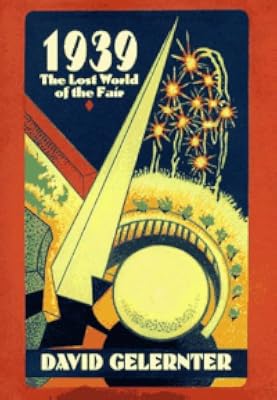
1939: The Lost World of the Fair
by David Gelernter
On This Page
Description
Recreates the sights, sounds, and atmosphere of the New York World's Fair in 1939, highlighting its importance to a country reviving from the Great Depression and preparing for World War II.Tags
Recommendations











Member Reviews
Mostly enjoyed this odd but also oddly rewarding tale of the 1939 World’s Fair in New York and the era of U.S. history it depicts.
Why odd? Because it occupies a weirdly uncomfortable space between fiction and non-fiction. What’s real (as far as I can tell) … all the wonderfully detailed information about the 1939 World’s Fair: the antecedents, the personalities, the infrastructure, the historical context, the period detail. The book has a bibliography, pictures, and a table of contents, for gosh sakes, What’s fictional (as far as I can tell) … the author’s conceit that he’s writing a non-fiction book based on interviews with an elderly woman who attended the World’s Fair and, conveniently, captured her memories in show more exhaustively detailed journal entries. The resulting novel ends up occupying an “uncanny valley” between the two extremes – a bit too real to be enjoyed as fiction, a bit too pompous to be enjoyed as non-fiction.
Don’t get me wrong: the stuff about the World’s Fair is wonderful! What a time machine back to where our country was in 1939: on the cusp of a war (WW2), on the cusp of a social revolution that was about to transform our civic religion (from a society focused on rule-following, family values and civility to a society based on self-absorption and competition), on the cusp of a revolution in the way we viewed technological innovation (moving from “tech as creative expression” to “tech as soulless commodity”). The fair represented a fascinating juxtaposition of art and tech, nostalgia and forward-thinking, idealism and consumerism, and I thoroughly enjoyed contemplating all the contradictions. Though Gelernter’s descriptions of the fair tend towards exhaustive rather than elegant, they convey the spectacle of the thing: the eclectic buildings, the whimsical exhibits, the resplendant displays of human ingenuity, the public art, the fountains, the elegant landcapes, the women in dresses, the men in suits and fedoras, the sense of wonder.
Gelernter’s fictional narrative – in which his MC, Hattie Levine, gradually reveals the story of her love affair with a talented, idealistic young architecture student named Mark – isn’t objectionable, but neither does it feel particularly authentic. Though he’s given them plausible backstories, there’s not a lot of emotional depth to their interactions, which undermines the dramatic climax of the novel in which we discover the fate of their romance. Hard to shake the feeling that Hattie & Mark are mostly mouthpieces engineered give voice to Gelernter’s sociological musings. Because this thing is chock-full of sociological musings, many of them genuinely thought-provoking but others hitting as a bit too opinionated and condescending.
My one recommendation for anyone attempting this: keep your phone at hand and take the time to look up all the things! Gelernter drops period-specific references – to NYC landmarks, political events, historical events, culture and merch – like apples in autumn. You can choose to read past them, but I gained so much extra enjoyment and enlightenment from taking the time to go down the rabbit holes.
You know that question that comes up at parties after everyone’s had a few too many to drink: “If you could go back in time, where would you go?” Based on this, I’m current leaning towards NYC in 1939. show less
Why odd? Because it occupies a weirdly uncomfortable space between fiction and non-fiction. What’s real (as far as I can tell) … all the wonderfully detailed information about the 1939 World’s Fair: the antecedents, the personalities, the infrastructure, the historical context, the period detail. The book has a bibliography, pictures, and a table of contents, for gosh sakes, What’s fictional (as far as I can tell) … the author’s conceit that he’s writing a non-fiction book based on interviews with an elderly woman who attended the World’s Fair and, conveniently, captured her memories in show more exhaustively detailed journal entries. The resulting novel ends up occupying an “uncanny valley” between the two extremes – a bit too real to be enjoyed as fiction, a bit too pompous to be enjoyed as non-fiction.
Don’t get me wrong: the stuff about the World’s Fair is wonderful! What a time machine back to where our country was in 1939: on the cusp of a war (WW2), on the cusp of a social revolution that was about to transform our civic religion (from a society focused on rule-following, family values and civility to a society based on self-absorption and competition), on the cusp of a revolution in the way we viewed technological innovation (moving from “tech as creative expression” to “tech as soulless commodity”). The fair represented a fascinating juxtaposition of art and tech, nostalgia and forward-thinking, idealism and consumerism, and I thoroughly enjoyed contemplating all the contradictions. Though Gelernter’s descriptions of the fair tend towards exhaustive rather than elegant, they convey the spectacle of the thing: the eclectic buildings, the whimsical exhibits, the resplendant displays of human ingenuity, the public art, the fountains, the elegant landcapes, the women in dresses, the men in suits and fedoras, the sense of wonder.
Gelernter’s fictional narrative – in which his MC, Hattie Levine, gradually reveals the story of her love affair with a talented, idealistic young architecture student named Mark – isn’t objectionable, but neither does it feel particularly authentic. Though he’s given them plausible backstories, there’s not a lot of emotional depth to their interactions, which undermines the dramatic climax of the novel in which we discover the fate of their romance. Hard to shake the feeling that Hattie & Mark are mostly mouthpieces engineered give voice to Gelernter’s sociological musings. Because this thing is chock-full of sociological musings, many of them genuinely thought-provoking but others hitting as a bit too opinionated and condescending.
My one recommendation for anyone attempting this: keep your phone at hand and take the time to look up all the things! Gelernter drops period-specific references – to NYC landmarks, political events, historical events, culture and merch – like apples in autumn. You can choose to read past them, but I gained so much extra enjoyment and enlightenment from taking the time to go down the rabbit holes.
You know that question that comes up at parties after everyone’s had a few too many to drink: “If you could go back in time, where would you go?” Based on this, I’m current leaning towards NYC in 1939. show less
I'm left with mixed feelings about this one, but I think I liked it more than not. I love reading books that make me stop and Google every few pages and this was definitely one of those. I also love reading about past World's Fairs---all the details, all the emotions, all the innovations---that's where I got a little annoyed with this one. The fictional love story did take a more prominent place than I would have liked it to, with even whole chapters being devoted to the story and not to the Fair.
One of my first "Google surprises" was that World's Fairs are still going on all over the world! (Don't laugh...I'm a hermit.) I had no idea but assumed that technology moved too fast for a Fair to be relevant. But I was wrong! I'd sure love to show more go to one. I think they're fascinating!
The author spent a lot of time trying to convince the reader that the 1930s were just as sophisticated as today. Is there any doubt? I'd say more so---and classier, too. Take his points about the code of dress and the "why bother" mentality. People who dress nicely do it to be respectful of others around them, just as much for themselves. This mentality has not left our society---it's just not promoted as important or moral anymore.
An interesting dichotomy was the things they were naive to compared to the things we assume they were naive to. For instance, these times weren't necessarily as innocent or "moral" as we might assume. There were lots of instances of nude art and even some soft porn featured at the fair. Yikes! On the other hand, the fair's SCIENCE DIRECTOR boasts, "the actual control of the weather for an entire town will by no means be impossible for air-conditioning engineers of the future." How someone not only believed that was possible or feasible but also didn't see the potential catastrophe that could create is shocking to me. However, these are also the parents of our current Baby Boomer "conspiracy theorists". Ha!
This was definitely a different time militarily. They had no such phrase to describe a nation as a, "super power", and if there would have been one, America wouldn't have been it. At that time, the French army was said to be the best in the world. Do we even hear about a French army now? Britain was possibly more powerful than us...but they sure seem awfully pacifist these days.
I really didn't too much enjoy the fictional love story and thought the story of the Fair could have been told just fine without it. I believe the author did it this way to help give a perspective of the feelings and reactions of the fairgoers, but at many points the dialogue became weirdly philosophical and didn't seem applicable.
Overall, it was a "fair"ly good read...but I think I'll be looking for something else on this particular Fair, as well. show less
One of my first "Google surprises" was that World's Fairs are still going on all over the world! (Don't laugh...I'm a hermit.) I had no idea but assumed that technology moved too fast for a Fair to be relevant. But I was wrong! I'd sure love to show more go to one. I think they're fascinating!
The author spent a lot of time trying to convince the reader that the 1930s were just as sophisticated as today. Is there any doubt? I'd say more so---and classier, too. Take his points about the code of dress and the "why bother" mentality. People who dress nicely do it to be respectful of others around them, just as much for themselves. This mentality has not left our society---it's just not promoted as important or moral anymore.
An interesting dichotomy was the things they were naive to compared to the things we assume they were naive to. For instance, these times weren't necessarily as innocent or "moral" as we might assume. There were lots of instances of nude art and even some soft porn featured at the fair. Yikes! On the other hand, the fair's SCIENCE DIRECTOR boasts, "the actual control of the weather for an entire town will by no means be impossible for air-conditioning engineers of the future." How someone not only believed that was possible or feasible but also didn't see the potential catastrophe that could create is shocking to me. However, these are also the parents of our current Baby Boomer "conspiracy theorists". Ha!
This was definitely a different time militarily. They had no such phrase to describe a nation as a, "super power", and if there would have been one, America wouldn't have been it. At that time, the French army was said to be the best in the world. Do we even hear about a French army now? Britain was possibly more powerful than us...but they sure seem awfully pacifist these days.
I really didn't too much enjoy the fictional love story and thought the story of the Fair could have been told just fine without it. I believe the author did it this way to help give a perspective of the feelings and reactions of the fairgoers, but at many points the dialogue became weirdly philosophical and didn't seem applicable.
Overall, it was a "fair"ly good read...but I think I'll be looking for something else on this particular Fair, as well. show less
A wonderful book, a masterpiece. It greatly recaptures the romance of the World's Fair, that bastion of optimism valiantly standing up against the depression and looming war. It's part history of the great figures and exhibits of the fair and part oral history telling the story of one frequent visitor. This is a beautifully written and informative book.
Half fiction, half nonfiction, 1939 is a masterpiece of living history. Readers see the 1939 World's Fair through the eyes of Laura Glassman, a young woman touring with her beau. The first person sections provide a nice counterpoint to the big issues that Gelernter returns to throughout the book. He sees the '30s as profoundly optimistic, and it is hard to read this book and not be affected by the intense hope for the future.
A snap shot of the NY worlds fair and U.S. history in 1939. Some times while reading it I kept thinking "It was the best of times it was the worst of times". The book is more sociology than history. It's a book I dicovered at a yard sail and was surprisingly pleased.
Half-read. So far, Gelernter is insufferable. It might improve in later chapters, and I'm interested enough in the subject matter to perservere. I think.
Ratings
Members
- Recently Added By
Lists

What A Year: Books titled with a particular year
147 works; 2 members
Author Information
19+ Works 1,216 Members
David Gelernter is the author of eight books and a professor of computer science at Yale University. His 1991 work, Mirror Worlds, not only "foresaw" (Reuters) the World Wide Web but is "one of the most influential books in computer science" (Technology Review). Gelernter's research has proved important to several leading Web-search efforts, and show more has been central in the development of the Java programming language as well as the first modern social network. He lives in Woodbridge, Connecticut. show less
Common Knowledge
- Original title
- 1939 The Lost World of the Fair
- Original publication date
- 1995
- Important places
- New York, New York, USA
- Important events
- New York World's Fair 1939
Classifications
Statistics
- Members
- 316
- Popularity
- 100,839
- Reviews
- 6
- Rating
- (3.71)
- Languages
- English
- Media
- Paper
- ISBNs
- 2