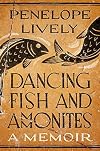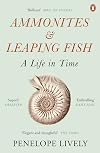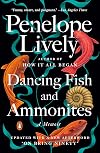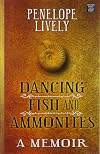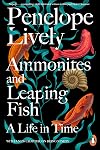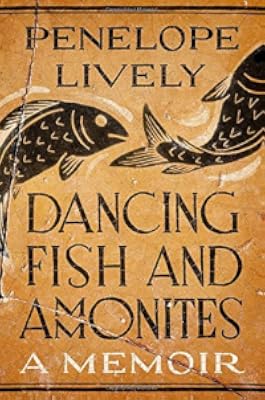
Dancing Fish and Ammonites: A Memoir
by Penelope Lively
On This Page
Description
"The beloved and bestselling author takes an intimate look back at a life of reading and writing. "The memory that we live with is the moth-eaten version of our own past that each of us carries around, depends on. It is our ID; this is how we know who we are and where we have been." Memory and history have been Penelope Lively's terrain in fiction over a career that has spanned five decades. But she has only rarely given readers a glimpse into her influences and formative years. Dancing Fish show more and Ammonites traces the arc of Lively's life, stretching from her early childhood in Cairo to boarding school in England to the sweeping social changes of Britain's twentieth century. She reflects on her early love of archeology, the fragments of the ancients that have accompanied her journey-including a sherd of Egyptian ceramic depicting dancing fish and ammonites found years ago on a Dorset beach. She also writes insightfully about aging and what life looks like from where she now stands"-- show lessTags
Recommendations








Member Recommendations
Member Reviews
12. Ammonites and Leaping Fish: A Life in Time by Penelope Lively
OPD: 2013
format: 234-page paperback
acquired: April 2023 read: Feb 23-29 time reading: 6:20, 1.6 mpp
rating: 3½
genre/style: Personal Essaystheme: TBR
locations: Mainly Egypt and England, but also New England, Wales and Jerusalem
about the author: English author born Cairo in 1933, who moved to England in 1945.
Very different from what I was expecting. I was hoping for a memoir, but really this is a collection of five personal essays on somewhat random topics - on being 80, on her life in light of the Suez crisis of 1956 (as she grew up in Egypt), on memory, on reading (and a little on writing), and on some personal objects and the thoughts they inspire (which is where the show more title comes from). It's all written with her sharp intelligent prose, that is it reads beautifully. And, reading her essay on being 80, you can't help but be struck by how mentally sharp she is as a writer.
I think if you are in the right state of mind, this is a wonderful book. I came at it wrong. And so, for me, it didn't amount to much more than some light distracting entertainment.
She does have some lovely quotes:
On writing versus life:
On memory:
On Reading:
On education in an Egyptian expat school:
2024
https://www.librarything.com/topic/358760#8449719 show less
OPD: 2013
format: 234-page paperback
acquired: April 2023 read: Feb 23-29 time reading: 6:20, 1.6 mpp
rating: 3½
genre/style: Personal Essaystheme: TBR
locations: Mainly Egypt and England, but also New England, Wales and Jerusalem
about the author: English author born Cairo in 1933, who moved to England in 1945.
Very different from what I was expecting. I was hoping for a memoir, but really this is a collection of five personal essays on somewhat random topics - on being 80, on her life in light of the Suez crisis of 1956 (as she grew up in Egypt), on memory, on reading (and a little on writing), and on some personal objects and the thoughts they inspire (which is where the show more title comes from). It's all written with her sharp intelligent prose, that is it reads beautifully. And, reading her essay on being 80, you can't help but be struck by how mentally sharp she is as a writer.
I think if you are in the right state of mind, this is a wonderful book. I came at it wrong. And so, for me, it didn't amount to much more than some light distracting entertainment.
She does have some lovely quotes:
On writing versus life:
You are looking to supply the deficiencies of reality, to provide order where life is a matter of contingent chaos, to suggest theme, and meaning, to make a story that is shapely where real life is linear.
On memory:
We can make a choice from accessible memories...but we can't choose what to remember. There is something disturbing about the thought that, if some other, hither to unavailable retrieval system were activated, I might find myself with a series of entirely unfamiliar memories - an alternate past that happened, but of which I had ceased to be aware.
On Reading:
What happens to all this information, this inferno of language? Where does it go? Much, apparently, becomes irretrievable sediment; a fair amount, the significant amount, becomes the essential part of us - what we know and understand and think about above and beyond our own immediate concerns. It becomes the life of the mind. What we have read makes us what we are - quite as much as what we have experienced, and where we have been and who we have known. To read is to experience.
On education in an Egyptian expat school:
The Iliad and Odyssey spilled out of the lesson time into the rest of the day; I enacted the siege, the wanderings, as I drifted around our garden, because of course I was there anyway - Penelope - so this must be something to do with me personally. The solipsism of the nine-year-old mind. Except that I was there in the wrong part; Penelope is not as beautiful as Helen, she is described as wise and good, qualities that did not appeal. And Ulysses - red-haired and crafty - is clearly not a patch on brave Hector or glamorous Achilles. So I juggled with the narrative - true to the tradition of reworking Homer, had I known it - airbrushed the tiresome Helen, and set myself up with Achilles. And, to bring things more up to date, equipped him with a Matilda tank and a Bren gun, instead of all that stuff with chariots and spears - the Libyan campaign was raging a hundred miles or so away, remember, in 1941.
2024
https://www.librarything.com/topic/358760#8449719 show less
There is memory here more than memoir as Penelope Lively looks back at her life and reconsiders it from the benefit of her advancing years.
It is an extremely fascinating read and all the more so having thoroughly enjoyed Being Mortal last month to which this is a most chewable, if unintended, companion piece. She has a lovely erudite but light touch with words and the pages slip by until an all too soon conclusion.
It is her memories of Egypt, her loving and often moving words about her departed husband (a tutor of mine at Warwick, Jack Lively) and especially on the subject of books that had me utterly rapt. Here she captured beautifully the real loss of her husband and coping with its grief and the readjustments of life:
"The world is show more full of widows - several among my closer friends. We have each know that grim rite of passage, have engaged with grief and loss, and have not exactly emerged but found a way of living after and beyond. It is an entirely changed life, for anyone who has been in a long marriage - forty-one years for me : alone in bed, alone most of the time, without that presence towards which you turned for advice, reassurance, with whom you shared the good news and the bad. Every decision now taken alone; no-one to defuse anxieties. And a thoroughly commonplace experience - everywhere, always - so get on with it and don't behave as if you're uniquely afflicted. I didn't tell myself that at the time, and I doubt if it would have helped if I had, but it is what I have come - not so much to feel as to understand pp 46
And she strikes a chord for me with this on books:
" No longer. I can admire but I no longer covet. Books of course are another matter; books are not acquisitions, they are necessities." pp 50
With such remarkable good sense, how could I fail to have been enthralled.
Penelope Lively is someone who would have been a perfect aunt. Understanding, wise and accessible. It shines from every sentence she writes. Lovely book. show less
It is an extremely fascinating read and all the more so having thoroughly enjoyed Being Mortal last month to which this is a most chewable, if unintended, companion piece. She has a lovely erudite but light touch with words and the pages slip by until an all too soon conclusion.
It is her memories of Egypt, her loving and often moving words about her departed husband (a tutor of mine at Warwick, Jack Lively) and especially on the subject of books that had me utterly rapt. Here she captured beautifully the real loss of her husband and coping with its grief and the readjustments of life:
"The world is show more full of widows - several among my closer friends. We have each know that grim rite of passage, have engaged with grief and loss, and have not exactly emerged but found a way of living after and beyond. It is an entirely changed life, for anyone who has been in a long marriage - forty-one years for me : alone in bed, alone most of the time, without that presence towards which you turned for advice, reassurance, with whom you shared the good news and the bad. Every decision now taken alone; no-one to defuse anxieties. And a thoroughly commonplace experience - everywhere, always - so get on with it and don't behave as if you're uniquely afflicted. I didn't tell myself that at the time, and I doubt if it would have helped if I had, but it is what I have come - not so much to feel as to understand pp 46
And she strikes a chord for me with this on books:
" No longer. I can admire but I no longer covet. Books of course are another matter; books are not acquisitions, they are necessities." pp 50
With such remarkable good sense, how could I fail to have been enthralled.
Penelope Lively is someone who would have been a perfect aunt. Understanding, wise and accessible. It shines from every sentence she writes. Lovely book. show less
This odd little book is both a memoir and a bit of an homage to books, reading, and writing. Penelope Lively looks back on her 80-plus years, exploring how memory has shaped her as a person and a writer. Lively was born in Egypt and lived there until she was about thirteen. Her early education was based on a curriculum provided to English children being raised abroad, and the methods were unusual by today’s standards. Once in England she followed the traditional path for her class: boarding school followed by a degree from Oxford, where she read history. Her career as a writer came much later.
Lively reveals her life story through a somewhat disjointed approach, touching on a variety of topics while simultaneously connecting them to show more points in her life. While some aspects were repetitive, reading her thoughts left me feeling like I was sitting in Lively’s kitchen having a nice long chat over cups of tea. Lively is one of my favorite authors, and this book is well-written, but the unusual structure will be most appreciated by her fans. show less
Lively reveals her life story through a somewhat disjointed approach, touching on a variety of topics while simultaneously connecting them to show more points in her life. While some aspects were repetitive, reading her thoughts left me feeling like I was sitting in Lively’s kitchen having a nice long chat over cups of tea. Lively is one of my favorite authors, and this book is well-written, but the unusual structure will be most appreciated by her fans. show less
'This is not quite a memoir' says Penelope Lively in the preface of [Ammonites and Leaping Fish]. 'Rather it is the view from old age'. And that is exactly what it is, a series of musings on the issues of ageing and memory, dealing with the more general issues of the old in today's society certainly, but above all a personal view from Penelope Lively's own perspective at the age of eighty. But this is not just a consideration of what it means to be old, a catalogue of the tribulations of old age - arthritis and failing eyesight and more and more hospital visits - it's much more interesting and wide-ranging than that.
One of the most fascinating elements of the book to me is Lively's consideration of the relationship between the older and show more the younger self. She argues that as who we are is so bound up with the times through which we are living, as well as with our own life experiences, our attitudes on looking back to our younger selves can almost seem 'kindly, indulgent, as though towards a younger relative'. We are clearly the same person, but also somehow ... not.
Does anyone identify with the age in which they were young? I don't. It seems to me more that we slide accommodatingly along with the decades, adjusting plumage as we go - dressing accordingly, thinking accordingly, or up to a point. I don't feel
out of sympathy with today, by no means, though it has aspects that I deplore; I can play the grumpy old woman at moments. But there is far more that is alien and unappealing about 1945.
I'm not sure I agree with her about the universality of this. I've certainly known people who would be much more comfortable living out their lives without the changes in attitudes, society, or technology that have happened in their later years, my mother being one of them. But equally I know people at eighty or more who embrace the current day for what it can offer. Perhaps it is all a matter of personality.
But one thing that has been ubiquitous in Lively's life, and remains so even as other pleasures have diminished or been abandoned, is the love of books. Here's something to look forward to when I reach eighty:
I've enjoyed all of [[Penelope Lively]]'s books that I've read and this one is no exception. My only caveat is that the discussion about certain objects (where we eventually get to meet the ammonites and leaping fish), a device that works well in her earlier book [A
House Unlocked], here feels rather tacked onto the end. But otherwise very enjoyable, and recommended. show less
One of the most fascinating elements of the book to me is Lively's consideration of the relationship between the older and show more the younger self. She argues that as who we are is so bound up with the times through which we are living, as well as with our own life experiences, our attitudes on looking back to our younger selves can almost seem 'kindly, indulgent, as though towards a younger relative'. We are clearly the same person, but also somehow ... not.
Does anyone identify with the age in which they were young? I don't. It seems to me more that we slide accommodatingly along with the decades, adjusting plumage as we go - dressing accordingly, thinking accordingly, or up to a point. I don't feel
out of sympathy with today, by no means, though it has aspects that I deplore; I can play the grumpy old woman at moments. But there is far more that is alien and unappealing about 1945.
I'm not sure I agree with her about the universality of this. I've certainly known people who would be much more comfortable living out their lives without the changes in attitudes, society, or technology that have happened in their later years, my mother being one of them. But equally I know people at eighty or more who embrace the current day for what it can offer. Perhaps it is all a matter of personality.
But one thing that has been ubiquitous in Lively's life, and remains so even as other pleasures have diminished or been abandoned, is the love of books. Here's something to look forward to when I reach eighty:
Can't garden. Don't want to travel. But can read, must read. For me, reading is the essential palliative, the daily fix. Old reading, revisiting, but new reading too, lots of it, reading in all directions, plenty of fiction, history and archaeology always, reading to satisfy perennial tastes, reading sideways too - try her, try him, try that ... So I have my drug, perfectly legal and I don't need a prescription.
I've enjoyed all of [[Penelope Lively]]'s books that I've read and this one is no exception. My only caveat is that the discussion about certain objects (where we eventually get to meet the ammonites and leaping fish), a device that works well in her earlier book [A
House Unlocked], here feels rather tacked onto the end. But otherwise very enjoyable, and recommended. show less
“Books are the mind's ballast, for so many of us--the cargo that makes us what we are, a freight that is ephemeral and indelible, half-forgotten but leaving an imprint. They are nutrition, too. My old age fear is not being able to read--the worst deprivation. “
“I can measure out my life in books. They stand along the way like signposts: the moments of absorption and empathy and direction and enlightenment and sheer pleasure.”
“Reading in old age is doing for me what it has always done- it frees me from the closet of my own mind...So I have my drug, perfectly legal and I don't need a prescription.”
This was a pleasant memoir, spanning five decades. It traces Lively's early childhood in Cairo, her boarding school years in show more London and her development as a writer. Of course, it also covers her love of books, which, of course, were my favorite parts. I will have to read more of her work. I have only read Moon Tiger, which I loved. show less
“I can measure out my life in books. They stand along the way like signposts: the moments of absorption and empathy and direction and enlightenment and sheer pleasure.”
“Reading in old age is doing for me what it has always done- it frees me from the closet of my own mind...So I have my drug, perfectly legal and I don't need a prescription.”
This was a pleasant memoir, spanning five decades. It traces Lively's early childhood in Cairo, her boarding school years in show more London and her development as a writer. Of course, it also covers her love of books, which, of course, were my favorite parts. I will have to read more of her work. I have only read Moon Tiger, which I loved. show less
It was a supreme delight to re-read such a thoughtful memoir. I especially appreciated her wry exploration of “the view from old age,” which is how she refers to Memory — the vapor trail without which we are undone. Lively has such skill at using the right turn of words. I might not have appreciated this book so much when I was younger, but it certainly resonates with me now.
An intriguing book by a writer looking at what old age implies. This is both physically (in terms of the body and possessions accumulated) and memory. Some interesting ideas, including how we want a story arc so much that real life can seem to be unreal because it doesn;t have that logical arc, things happen one after the other, they don;t have to make sense in the way one expects them to do so in a story. The passage on memory is excellent, the concept of different memory types, especially autobiographical memory, was very inventive. But why we can't remember names is still a mystery. And she has such amazing memories having lived such an interesting life.
Members
- Recently Added By
Lists

Forty Days of Non-Fiction
16 works; 1 member

Books Read in 2015
3,299 works; 126 members
Books Read in 2016
4,666 works; 199 members

Books Read in 2022
5,168 works; 114 members

Books Read in 2024
4,623 works; 126 members
Author Information

73+ Works 14,530 Members
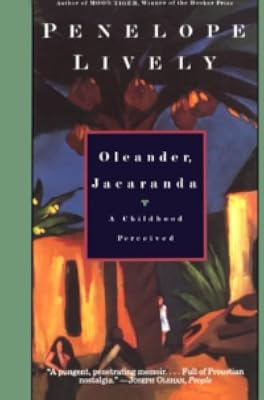
Penelope Lively has written over 18 books for children, and over 15 titles for adults, distinguishing herself on both levels. Among the awards she has received are the coveted Booker Prize for the adult novel "Moon Tiger" (1987) and the Carnegie Medal for the highly acclaimed juvenile work, "The Ghost of Thomas Kempe" (1973). In Lively's writing, show more for both adults and children, the recurrent theme is interpreting the past through exploring the function of memory. "My particular preoccupation as a writer is with memory. Both with memory in the historical sense and memory in the personal sense." Beginning her writing career in the early 1970's, Lively wrote exclusively for children for over a decade. Because children have limited memories, devices were used to explore their perceptions of the past, such as ghosts in "Uninvited Ghosts and Other Stories" (1985), and a sampler in "A Stitch in Time' (1976). Lively's first adult novel, "The Road to Lichfield" (1977) was the result of turning to an older audience when she felt inspiration running out. Her adult novels include "Passing On" (1995), the story of a mother's legacy to her children and 'Oleander, Jacarandi: A Childhood Perceived' (1994) which is a memoir of Lively's childhood. Penelope (Low) Lively, born March 17, 1933 in Cairo, Egypt, had a most unusual childhood. She grew up in Cairo with no formal education until age 12, when her family put her in boarding school in England. After earning a B.A. in history at Oxford in 1955, she married Jack Lively, a university professor, whom she calls her most useful critic. They have a son and a daughter, Adam and Josephine. (Bowker Author Biography) show less
Awards and Honors
Awards
Common Knowledge
- Canonical title
- Dancing Fish and Ammonites: A Memoir
- Alternate titles
- Ammonites and leaping fish: a life in time
- Original publication date
- 2013
- People/Characters
- Penelope Lively
- Dedication
- JACK - in memory
- First words
- This is not quite a memoir. Rather, it is the view from old age.
- Quotations
- The world is full of widows - several among my closer friends. We have each know that grim rite of passage, have engaged with grief and loss, and have not exactly emerged but found a way of living after and beyond. It is an e... (show all)ntirely changed life, for anyone who has been in a long marriage - forty-one years for me : alone in bed, alone most of the time, without that presence towards which you turned for advice, reassurance, with whom you shared the good news and the bad. Every decision now taken alone; no-one to defuse anxieties. And a thoroughly commonplace experience - everywhere, always - so get on with it and don't behave as if you're uniquely afflicted.
[Aged 16, at the London Library] "for some obscure reason I ordered Hakluyt's Voyages Round the World. It arrived on a trolley, in several volumes, and I sat stolidly reading for a week, unable to admit to a mistake."
Autobiographical memory is random, non-sequential, capricious, and without it we are undone.
Memory has acquired some merciful ability to close up, to diminish the worst passages of [more] recent life. For me, the awful summer and autumn of Jack's illness - the hospital months, the last weeks at home - are now not ti... (show all)me but a series of images I cannot lose.
If you have no sense of the past, no access to the historical narrative, you are afloat, untethered; you cannot see yourself as a part of the narrative, you cannot place yourself within a context. You will not have an underst... (show all)anding of time, and a respect for memory and its subtle victory over the remorselessness of time.
Sixty years or so of fiction reading now, for me. A torrent of story
poured in, much of it forgotten entirely, a good deal half remembered, some so significant that I go back again and again. I have had fitful relationship... (show all)s with some writers….I can’t abide Barbara Pym—enjoyed her once.
Classifications
Statistics
- Members
- 367
- Popularity
- 85,634
- Reviews
- 25
- Rating
- (4.07)
- Languages
- English
- Media
- Paper, Audiobook, Ebook
- ISBNs
- 17
- ASINs
- 7