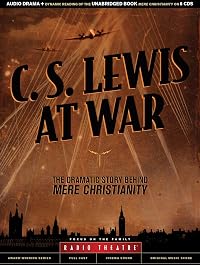
C. S. Lewis at War: The Dramatic Story Behind Mere Christianity (Radio Theatre)
by C. S. Lewis
On This Page
Description
Unabridged reading (6 audio discs) of C.S. Lewis's book, Mere Christianity, based on a series of 1942-1944 BBC radio talks while Lewis was at Oxford during World War II, and audio drama (2 audio discs) of C.S. Lewis's life and the events behind the creation of his classic work. Mere Christianity was originally written for a generation that had lost its faith, against a background of the hard realities of World War I and World War II and the personal difficulties of the author.Tags
Recommendations








Member Reviews
What is it about? It opens with a radio broadcast being interrupted to announce that war has been declared against Nazi Germany. A few minutes later, listeners hear C.S. Lewis' lecture--or guest lecture--being interrupted to deliver the same news to students. So, essentially it is focused on World War II, and, the effect of the war on the British home front. Particular attention is paid to the BBC and to C.S. Lewis. It is a behind-the-scenes glimpse of the creating of Mere Christianity and The Screwtape Letters.
Further thoughts: Though I am not typically a fan of audio books, I have a harder time listening than reading, I thought the format of this one worked well. Why? Because the heart of the story is about RADIO BROADCASTS, so it show more makes perfect sense to LISTEN to the story in such a dramatic, polished way.
Would I recommend listening to this? Yes! I really loved it. I found myself listening to this one several weekends in a row.
Who would I recommend it to? Anyone who has read C.S. Lewis. This includes anyone who has read The Lion, The Witch, and The Wardrobe, Screwtape Letters, or Mere Christianity. Anyone who is interested in history and world war II. Anyone who enjoys fiction or nonfiction set in the UK. Anyone who is interested in the history of radio. show less
Further thoughts: Though I am not typically a fan of audio books, I have a harder time listening than reading, I thought the format of this one worked well. Why? Because the heart of the story is about RADIO BROADCASTS, so it show more makes perfect sense to LISTEN to the story in such a dramatic, polished way.
Would I recommend listening to this? Yes! I really loved it. I found myself listening to this one several weekends in a row.
Who would I recommend it to? Anyone who has read C.S. Lewis. This includes anyone who has read The Lion, The Witch, and The Wardrobe, Screwtape Letters, or Mere Christianity. Anyone who is interested in history and world war II. Anyone who enjoys fiction or nonfiction set in the UK. Anyone who is interested in the history of radio. show less
World War II England, and in particular, WWII London, was an intimidating place to be; it seems that around 40,000 civilians in total were killed in England during the war. During this time, when many bombs were being dropped by Nazi Germany on the civilian population, the director and the assistant director of the BBC's Religious Broadcasting department, James Welch and Eric Fenn, were searching for someone to draw people to the religious programs they were broadcasting on the BBC's radio station which were apparently being passed by in deference to stations/programs that were entertaining. C. S. Lewis was the man they ended up recruiting.
C. S. Lewis and Mere Christianity by Paul McCusker is the story of how C. S. Lewis' book, Mere show more Christianity came to be. It took a little bit for me to get used to the way the book was put together. The story is told, not by mere sequence of events, but also by 'flashbacks' to C. S. Lewis' history, and constantly switches from section to section from what C. S. Lewis is doing, to what is going on at the BBC, and also explanations of what world events are happening in regards to Hitler, Churchill and the war in general. I got used to it quite quickly, and it does keep the interest pretty well, though sometimes you want the part you were just reading to continue going instead of switching to a different topic.
There are also what I'll call 'information boxes', some of them very large/long, that pop up in the middle of the part you were just reading, some give biographical summaries of people who were just mentioned in the narrative, others explain different aspects of the war, and there were still other topics as well. It was a bit odd and I couldn't quite figure out if it was annoying or not. At least I know I didn't absolutely dislike them, it was just unusual to me.
This account of the making of "Mere Christianity" (of which I have only read snippets) is quite interesting. I didn't fully realize that it originated from some of the radio broadcasts Lewis did during the war on various topics related to Christianity. The book gives quite a bit of information of what was going on in his life at the time. As he was working on the scripts for the radio broadcasts, he was taking care of, and dealing with, his 'adopted' mother(who apparently was quite bossy), helping and encouraging his brother who had problems with alcohol, teaching at Oxford, doing his duties as a home guard, writing books, as well as other tasks.
I'm always a bit wary of Lewis because of his rather ecumenical views, and my perspective is no different having read this book. As an example of where I am concerned about his views, it seems that during the war Lewis felt as though he should go to a 'confessor', and convinced himself of it by thinking of a quote, apparently speaking of Christian beliefs, "Let us hold on to that which has been believed everywhere, always, by everyone", and went to an Anglican confessor, apparently continuing the practice throughout his life. I find his reasoning very flawed and dangerous, especially considering Christ's command: "Enter ye in by the narrow gate: for wide is the gate, and broad is the way, that leadeth to destruction, and many are they that enter in thereby. For narrow is the gate, and straitened the way, that leadeth unto life, and few are they that find it. "(Mat 7:13-14 ASV)
But I did find the book a very interesting read, and a very intriguing look at WWII.
Thanks to Tyndale House Publishers for sending me a review copy of this book!(My review did not have to be favorable) show less
C. S. Lewis and Mere Christianity by Paul McCusker is the story of how C. S. Lewis' book, Mere show more Christianity came to be. It took a little bit for me to get used to the way the book was put together. The story is told, not by mere sequence of events, but also by 'flashbacks' to C. S. Lewis' history, and constantly switches from section to section from what C. S. Lewis is doing, to what is going on at the BBC, and also explanations of what world events are happening in regards to Hitler, Churchill and the war in general. I got used to it quite quickly, and it does keep the interest pretty well, though sometimes you want the part you were just reading to continue going instead of switching to a different topic.
There are also what I'll call 'information boxes', some of them very large/long, that pop up in the middle of the part you were just reading, some give biographical summaries of people who were just mentioned in the narrative, others explain different aspects of the war, and there were still other topics as well. It was a bit odd and I couldn't quite figure out if it was annoying or not. At least I know I didn't absolutely dislike them, it was just unusual to me.
This account of the making of "Mere Christianity" (of which I have only read snippets) is quite interesting. I didn't fully realize that it originated from some of the radio broadcasts Lewis did during the war on various topics related to Christianity. The book gives quite a bit of information of what was going on in his life at the time. As he was working on the scripts for the radio broadcasts, he was taking care of, and dealing with, his 'adopted' mother(who apparently was quite bossy), helping and encouraging his brother who had problems with alcohol, teaching at Oxford, doing his duties as a home guard, writing books, as well as other tasks.
I'm always a bit wary of Lewis because of his rather ecumenical views, and my perspective is no different having read this book. As an example of where I am concerned about his views, it seems that during the war Lewis felt as though he should go to a 'confessor', and convinced himself of it by thinking of a quote, apparently speaking of Christian beliefs, "Let us hold on to that which has been believed everywhere, always, by everyone", and went to an Anglican confessor, apparently continuing the practice throughout his life. I find his reasoning very flawed and dangerous, especially considering Christ's command: "Enter ye in by the narrow gate: for wide is the gate, and broad is the way, that leadeth to destruction, and many are they that enter in thereby. For narrow is the gate, and straitened the way, that leadeth unto life, and few are they that find it. "(Mat 7:13-14 ASV)
But I did find the book a very interesting read, and a very intriguing look at WWII.
Thanks to Tyndale House Publishers for sending me a review copy of this book!(My review did not have to be favorable) show less
Very insightful into all his works
Very insightful into all his works
Members
- Recently Added By
Author Information

528+ Works 522,965 Members
C. S. (Clive Staples) Lewis, "Jack" to his intimates, was born on November 29, 1898 in Belfast, Ireland. His mother died when he was 10 years old and his lawyer father allowed Lewis and his brother Warren extensive freedom. The pair were extremely close and they took full advantage of this freedom, learning on their own and frequently enjoying show more games of make-believe. These early activities led to Lewis's lifelong attraction to fantasy and mythology, often reflected in his writing. He enjoyed writing about, and reading, literature of the past, publishing such works as the award-winning The Allegory of Love (1936), about the period of history known as the Middle Ages. Although at one time Lewis considered himself an atheist, he soon became fascinated with religion. He is probably best known for his books for young adults, such as his Chronicles of Narnia series. This fantasy series, as well as such works as The Screwtape Letters (a collection of letters written by the devil), is typical of the author's interest in mixing religion and mythology, evident in both his fictional works and nonfiction articles. Lewis served with the Somerset Light Infantry in World War I; for nearly 30 years he served as Fellow and tutor of Magdalen College at Oxford University. Later, he became Professor of Medieval and Renaissance English at Cambridge University. C.S. Lewis married late in life, in 1957, and his wife, writer Joy Davidman, died of cancer in 1960. He remained at Cambridge until his death on November 22, 1963. (Bowker Author Biography) show less
Classifications
- Genres
- Nonfiction, Religion & Spirituality, General Nonfiction, Biography & Memoir, History
- DDC/MDS
- 230 — Religion Christianity Christianity
- BISAC
Statistics
- Members
- 46
- Popularity
- 647,313
- Reviews
- 4
- Rating
- (4.00)
- Languages
- English
- Media
- Audiobook
- ISBNs
- 1
- UPCs
- 1
- ASINs
- 1