
On This Page
Description
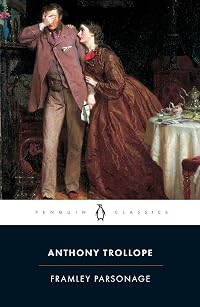
Nineteenth-century British writer Anthony Trollope created what has become one of the most beloved literary chronicles of English country life in the Chronicles of Barsetshire series. Framley Parsonage, the entertaining fourth novel in the series, follows the financial travails of a young vicar, the romantic entanglements of a pair of star-crossed lovers, and various other social skirmishes and conflicts in and around the seemingly sleepy village of Framley..
Tags
Recommendations
















Member Reviews
The fourth book in The Chronicles of Barsetshire is really quite wonderful. A young clergyman, Mark Robarts, gets himself into financial trouble when he co-signs loans for an aristocrat, Nathaniel Sowerby, with whom he has just become acquainted. Mark is tempted by the society which he is introduced to, but of which he has no understanding. He has a most forgiving wife named Fanny. His patron is Lady Lufton and her son Ludovic, Lord Lufton, who has, to his mother's dismay, fallen in love with Mark's sister, Lucy. There are at least four love stories here, some of which include characters that we have met in previous books in the series. Politics is at a minimum, and character descriptions are clever and witty. Miss Dunstable is back - show more she is a great character, along with Doctor Thorne, the Granthems, Grantleys, Arabins, and Proudies. Trollope's descriptions of the society of the time are clever. I love the way he handles his female characters. show less
It is no doubt very wrong to long after a naughty thing. But nevertheless How They Were All Married, Had Two Children, and Lived Happy Ever Afterwe all do so. One may say that hankering after naughty things is the very essence of the evil into which we have been precipitated by Adam's fall.
Mark Robarts is the recently appointed vicar of Framley, and happily married to Fanny. His future appears secure, but Mark longs after "naughty things" like fox hunting, horses, and parties. His troubles begin when he co-signs a loan for a so-called friend, Nathaniel Sowerby. Unbeknownst to Robarts, Sowerby is deeply in debt and on the run from creditors and bill collectors. Robarts naively believes everything will work out, and fails to tell his wife show more about the debt he's incurred.
In Framley Parsonage we are also reunited with several other notable characters from the three previous books: Archdeacon Grantly and his family, Dean Arabin and his wife Eleanor, Mrs Proudie the bishop's domineering wife, Doctor Thorne, Frank and Mary Gresham, and the outspoken and very funny heiress Miss Dunstable. I loved seeing these old friends in new settings. I also enjoyed Trollope's wit, as he poked fun at the clergy:
Let those who know clergymen, and like them, and have lived with them, only fancy it! Clergymen to be paid, not according to the temporalities of any living which they may have acquired, either by merit or favour, but in accordance with the work to be done! O Doddington! and O Stanhope, think of this, if an idea so sacrilegious can find entrance into your warm ecclesiastical bosoms! Ecclesiastical work to be bought and paid for according to its quantity and quality!
And at men in general:
"My dear!" said her husband, "it is typhus, and you must first think of the children. I will go." "What on earth could you do, Mark?" said his wife. "Men on such occasions are almost worse than useless; and then they are so much more liable to infection."
But back to Mark Robarts. It wasn't long before his future looked bleak, but this is Trollope's Chronicles of Barsetshire, where things invariably turn out well in the end. In fact, the last chapter of Framley Parsonage is entitled, "How They Were All Married, Had Two Children, and Lived Happy Ever After". The journey from near ruin to happily ever after is a long, meandering one with several related threads. As Mark is facing financial ruin, his sister Lucy comes to stay, and meets young, unmarried Lord Lufton. They are instantly attracted to one another, but Lady Lufton has strong feelings about her son marrying the vicar's sister. And so begins another long, meandering journey in which Lady Lufton discovers why Lucy is the ideal choice for her son, and learns a few things about herself in the process. Trust me -- that's not a spoiler! Trollope's outcomes are always predictable, but it doesn't matter because getting there is so much fun. show less
Mark Robarts is the recently appointed vicar of Framley, and happily married to Fanny. His future appears secure, but Mark longs after "naughty things" like fox hunting, horses, and parties. His troubles begin when he co-signs a loan for a so-called friend, Nathaniel Sowerby. Unbeknownst to Robarts, Sowerby is deeply in debt and on the run from creditors and bill collectors. Robarts naively believes everything will work out, and fails to tell his wife show more about the debt he's incurred.
In Framley Parsonage we are also reunited with several other notable characters from the three previous books: Archdeacon Grantly and his family, Dean Arabin and his wife Eleanor, Mrs Proudie the bishop's domineering wife, Doctor Thorne, Frank and Mary Gresham, and the outspoken and very funny heiress Miss Dunstable. I loved seeing these old friends in new settings. I also enjoyed Trollope's wit, as he poked fun at the clergy:
Let those who know clergymen, and like them, and have lived with them, only fancy it! Clergymen to be paid, not according to the temporalities of any living which they may have acquired, either by merit or favour, but in accordance with the work to be done! O Doddington! and O Stanhope, think of this, if an idea so sacrilegious can find entrance into your warm ecclesiastical bosoms! Ecclesiastical work to be bought and paid for according to its quantity and quality!
And at men in general:
"My dear!" said her husband, "it is typhus, and you must first think of the children. I will go." "What on earth could you do, Mark?" said his wife. "Men on such occasions are almost worse than useless; and then they are so much more liable to infection."
But back to Mark Robarts. It wasn't long before his future looked bleak, but this is Trollope's Chronicles of Barsetshire, where things invariably turn out well in the end. In fact, the last chapter of Framley Parsonage is entitled, "How They Were All Married, Had Two Children, and Lived Happy Ever After". The journey from near ruin to happily ever after is a long, meandering one with several related threads. As Mark is facing financial ruin, his sister Lucy comes to stay, and meets young, unmarried Lord Lufton. They are instantly attracted to one another, but Lady Lufton has strong feelings about her son marrying the vicar's sister. And so begins another long, meandering journey in which Lady Lufton discovers why Lucy is the ideal choice for her son, and learns a few things about herself in the process. Trust me -- that's not a spoiler! Trollope's outcomes are always predictable, but it doesn't matter because getting there is so much fun. show less
After having a little trouble getting into Doctor Thorne, I was sucked into Framley Parsonage almost immediately, and enjoyed every minute of this fourth journey into Barchester. Another bunch of fascinating characters dealing with the everyday machinations of English life, including the wonderful Lady Lufton, the indomitable Miss Dunstable back again, and some other good old friends from previous volumes. More than once I wanted to smack Mark Robarts upside the head for being a doofus, and he would have deserved it, too. But the story is a good one, and I think reading this in the three-chapter sections as which it was originally serialized lent a certain extra punch to the book.
This is the book that started the whole readalong. After reading and loving Jo Walton’s “Tooth and Claw” I found out that it’s a retelling of Framley Parsonage using dragons. The entire Chronicles of Barsetshire readalong was started because I was curious how the original novel compared to the dragon-filled version and I’m OCD, so obviously I had to read the first three books in the series before getting to this one.
There are two main plots in the book; the first revolves around the young impetuous clergyman, Mark Robarts and a shady financial decision. He guarantees a bill for an untrustworthy man, which puts his own future in jeopardy. The second plot regards his sister Lucy and the wealthy Lord Lufton who falls for her. show more Lufton’s mother is opposed to the marriage and Lucy feels that to accept the Lord without his mother’s approval would be wrong.
The strength of the novel lies in its characters’ sincere struggles. We feel for Lucy as she wrestles with her feelings. Our hearts break for Mark Robarts even though we know he made a stupid mistake. Trollope has built a fascinating world within the Barsetshire society and now four books into the series we recognize characters and remember their stories from previous books.
**A few of my favorite SPOILERY scenes:
When Fanny Robarts finds out about her husband’s financial ruin she is beyond kind and patient. She makes it clear to him that no matter what happens, she is on his side. He already feels ashamed and sick for what he’s done and nothing she could have said would have made him regret his actions more. Choosing to show him love and forgiveness in that situation was such a demonstration of strength and compassion.
I was absolutely giddy over Doctor Thorne’s sweet romance with Martha Dunstable. They were not young, but with the help of his niece they both realized how happy they would be together. His honest-to-a-fault love letter was too funny. It’s never too late to find love.
**SPOILERS OVER**
BOTTOM LINE: I so enjoyed this one, but I will say I couldn’t help comparing it to “Tooth and Claw” throughout the book. Both are great, but adding dragons to the mix adds a special layer of fun. I love that this novel has more depth and a few additional side plots that the retelling skipped. Mark Robarts character was particularly good, since in “Tooth and Claw” he becomes a straightforward villain. After Doctor Thorne I think this is my favorite of the series so far. show less
There are two main plots in the book; the first revolves around the young impetuous clergyman, Mark Robarts and a shady financial decision. He guarantees a bill for an untrustworthy man, which puts his own future in jeopardy. The second plot regards his sister Lucy and the wealthy Lord Lufton who falls for her. show more Lufton’s mother is opposed to the marriage and Lucy feels that to accept the Lord without his mother’s approval would be wrong.
The strength of the novel lies in its characters’ sincere struggles. We feel for Lucy as she wrestles with her feelings. Our hearts break for Mark Robarts even though we know he made a stupid mistake. Trollope has built a fascinating world within the Barsetshire society and now four books into the series we recognize characters and remember their stories from previous books.
**A few of my favorite SPOILERY scenes:
When Fanny Robarts finds out about her husband’s financial ruin she is beyond kind and patient. She makes it clear to him that no matter what happens, she is on his side. He already feels ashamed and sick for what he’s done and nothing she could have said would have made him regret his actions more. Choosing to show him love and forgiveness in that situation was such a demonstration of strength and compassion.
I was absolutely giddy over Doctor Thorne’s sweet romance with Martha Dunstable. They were not young, but with the help of his niece they both realized how happy they would be together. His honest-to-a-fault love letter was too funny. It’s never too late to find love.
**SPOILERS OVER**
BOTTOM LINE: I so enjoyed this one, but I will say I couldn’t help comparing it to “Tooth and Claw” throughout the book. Both are great, but adding dragons to the mix adds a special layer of fun. I love that this novel has more depth and a few additional side plots that the retelling skipped. Mark Robarts character was particularly good, since in “Tooth and Claw” he becomes a straightforward villain. After Doctor Thorne I think this is my favorite of the series so far. show less
There hardly seems a fitting way to begin a review of any of Trollope’s novels without saying that one can never go wrong with him. One gets lost in his worlds of ecclesiastical politics, county politics, sexual politics, and the very astute way he has with getting inside characters’ minds so that the scoundrel figure (here, Mr. Sowerby) still comes across as sympathetic, and the romance plot—a slight reworking of the one in the preceding Barchester book, Dr. Thorne, whose characters recur here, as do others in the preceding chronicles—is hardly sappy or melodramatic. There is high comedy here, as well as tragedy; but Trollope makes us see this as the extremes of life, with the middle ground being the aim—albeit never an easy show more aim or aspiration in modern life.
Dr. Thorne, for me, is truly where the Barchester Chronicles begin to realize their potential as a series of books with interwoven stories and characters. Indeed, it is only in this book, Framley Parsonage, that meta-references occur back to prior books and some knowledge of prior characters (e.g., the Grantlys, Mrs. Proudie, Miss Dunstable, et al.) would assist a reader unfamiliar with the previous books. Still, as Trollope insists in his meta-comments and in his afterward to the series, these are truly standalone books, despite likely making more sense as their plots build and as his prowess and skill as a novelist grows to read them in order.
Especially interesting here, as is usually the case in Trollope, are the interlocking threads of characters’ lives who are of very different social classes. There are Lady Lufton and her Lord son, of Framley Court; there are the Robartses, a vicor selected by Lady Lufton among her son's friends to lead “her” parish, his wife, and, to date, Trollope's most interesting young female character, Lucy Robarts, Mark's sister; and there is a Duke and a budding fop marquis and a nouveau-riche millionairesss and several shady MPs with whom Mark Roberts has dealings that taint his cloth and make him question his faith as well as his standing in his community.
To reduce any Trollope novel to one mere storyline or say that there is only one hero or one heroine would be to naively reduce the joy one finds immersed in the worlds he builds. I often wonder at times why reading Trollope’s novels takes me longer than reading denser, but equally long books, such as those by James. And I think it boils down to the fact that the worlds Trollope constructs for his readers are so rich and so real, it might take you 200 pages before you realize that you’re hooked; but, once you’re hooked, you’re stuck there until the end—and with his psychological acuity, the reader is right there along with the characters as they experience debt, heartbreak, conflict in their communities and families, and sometimes soul-wrenching crises of faith that, in Trollope’s prose, especially in the third and second Barchester books, is truly a forerunner to the intense psychological insights found in Eliot and in James a bit later on.
Onward… The wonderful thing about finishing a Trollope is knowing that there are so many more into which one can dive.
And, if you happen to be new to Trollope, I still stand by my recommendation that The Claverings is the best place to start. show less
Dr. Thorne, for me, is truly where the Barchester Chronicles begin to realize their potential as a series of books with interwoven stories and characters. Indeed, it is only in this book, Framley Parsonage, that meta-references occur back to prior books and some knowledge of prior characters (e.g., the Grantlys, Mrs. Proudie, Miss Dunstable, et al.) would assist a reader unfamiliar with the previous books. Still, as Trollope insists in his meta-comments and in his afterward to the series, these are truly standalone books, despite likely making more sense as their plots build and as his prowess and skill as a novelist grows to read them in order.
Especially interesting here, as is usually the case in Trollope, are the interlocking threads of characters’ lives who are of very different social classes. There are Lady Lufton and her Lord son, of Framley Court; there are the Robartses, a vicor selected by Lady Lufton among her son's friends to lead “her” parish, his wife, and, to date, Trollope's most interesting young female character, Lucy Robarts, Mark's sister; and there is a Duke and a budding fop marquis and a nouveau-riche millionairesss and several shady MPs with whom Mark Roberts has dealings that taint his cloth and make him question his faith as well as his standing in his community.
To reduce any Trollope novel to one mere storyline or say that there is only one hero or one heroine would be to naively reduce the joy one finds immersed in the worlds he builds. I often wonder at times why reading Trollope’s novels takes me longer than reading denser, but equally long books, such as those by James. And I think it boils down to the fact that the worlds Trollope constructs for his readers are so rich and so real, it might take you 200 pages before you realize that you’re hooked; but, once you’re hooked, you’re stuck there until the end—and with his psychological acuity, the reader is right there along with the characters as they experience debt, heartbreak, conflict in their communities and families, and sometimes soul-wrenching crises of faith that, in Trollope’s prose, especially in the third and second Barchester books, is truly a forerunner to the intense psychological insights found in Eliot and in James a bit later on.
Onward… The wonderful thing about finishing a Trollope is knowing that there are so many more into which one can dive.
And, if you happen to be new to Trollope, I still stand by my recommendation that The Claverings is the best place to start. show less
Ah, the joy of opening the first pages on a Trollope novel and meeting someone new who is dwelling right in Barsetshire along with all our old friends and acquaintances. Our new friend, this installment, is Mr. Mark Robarts, the clergyman at Framley Parsonage, the living attached to Framley Court, home of Lady Lufton and her son, Ludovic. It does not take a great deal of time to realize this novel is going to be a lesson in social climbing, and the perils thereof.
I am sometimes amazed at the desire people have to rub shoulders with celebrities, even minor ones, and the length they will go to have it believed that they are of importance to such people. They will do very foolish things, fooling no one but themselves ofttimes.
And there is show more nothing viler than the desire to know great people--people of great rank, I should say; nothing worse than the hunting of titles and worshipping of wealth. We all know this, and say it every day of our lives. But presuming that a way into the society of Park Lane was open to us, and a way also into that of Bedford Row, how many of us are there who would prefer Bedford Row because it is so vile to worship wealth and title?
And there's the rub for our Mark Robarts. He knows he is better not to try to run the race with an inferior horse, but he cannot resist, and having the invitation extended to him, he cannot help feeling that these people desire his company and think of him as an equal.
We have a bit of a villain in another character we meet early on, Mr. Sowerby, but one of the things I admire about Trollope is that he never creates any character who is less than human, and so his heroes have clay feet and his villains are complex and three-dimensional.
We see and hear of such men as Mr. Sowerby, and are apt to think that they enjoy all that the world can give, and that they enjoy that all without payment either in care or labour; but I doubt that, with even the most callous of them, their periods of wretchedness must be frequent, and that wretchedness very intense.
We have, within these pages, examples of what is good and evil in people, the destructive nature of pride, the beauty of sacrificial love, the struggle for true morality in the face of temptations, and the right of individual choice. I love the fire and determination of Mark’s sister, Lucy; the devotion of his wife, Fanny (which I must note was a very popular name in this era and one you never encounter today); and the true friendship of Mr. Arabin for his friend Crawley.
I was also delighted to find Dr. Thorne, Miss Dunstable, the obnoxious Mrs. Proudie, and The Grantleys popping back into view. It makes you feel so at home when you encounter people you already know and either love or despise--it is if you take the story up again where you have left it.
I have two novels left in the series, and I hope to get to them both before the end of the year. show less
I am sometimes amazed at the desire people have to rub shoulders with celebrities, even minor ones, and the length they will go to have it believed that they are of importance to such people. They will do very foolish things, fooling no one but themselves ofttimes.
And there is show more nothing viler than the desire to know great people--people of great rank, I should say; nothing worse than the hunting of titles and worshipping of wealth. We all know this, and say it every day of our lives. But presuming that a way into the society of Park Lane was open to us, and a way also into that of Bedford Row, how many of us are there who would prefer Bedford Row because it is so vile to worship wealth and title?
And there's the rub for our Mark Robarts. He knows he is better not to try to run the race with an inferior horse, but he cannot resist, and having the invitation extended to him, he cannot help feeling that these people desire his company and think of him as an equal.
We have a bit of a villain in another character we meet early on, Mr. Sowerby, but one of the things I admire about Trollope is that he never creates any character who is less than human, and so his heroes have clay feet and his villains are complex and three-dimensional.
We see and hear of such men as Mr. Sowerby, and are apt to think that they enjoy all that the world can give, and that they enjoy that all without payment either in care or labour; but I doubt that, with even the most callous of them, their periods of wretchedness must be frequent, and that wretchedness very intense.
We have, within these pages, examples of what is good and evil in people, the destructive nature of pride, the beauty of sacrificial love, the struggle for true morality in the face of temptations, and the right of individual choice. I love the fire and determination of Mark’s sister, Lucy; the devotion of his wife, Fanny (which I must note was a very popular name in this era and one you never encounter today); and the true friendship of Mr. Arabin for his friend Crawley.
I was also delighted to find Dr. Thorne, Miss Dunstable, the obnoxious Mrs. Proudie, and The Grantleys popping back into view. It makes you feel so at home when you encounter people you already know and either love or despise--it is if you take the story up again where you have left it.
I have two novels left in the series, and I hope to get to them both before the end of the year. show less
Elizabeth Gaskell once declared: “I wish Trollope would go on writing Framley Parsonage for ever. I don’t see any reason why it should come to an end.” But end it did, for me anyway, during the wee hours of the morning but I know exactly what she means. Framley is the fourth volume in the six book Barsetshire Chronicles.
Mark Robarts, a young man whose “good fortune followed him throughout his life”, benefitted from his friendship with Lord Lufton whose mother was responsible for the selection of the parish vicar at Framley, since her family provided the yearly living. Although intelligent, Mark really was not suited for the religious life. He longed to continue the sporting life that he loved and while in pursuit of this, he show more naively signs a promissory note for a local MP, Mr. Sowerby, who has a gambling problem and thumbs his nose at personal responsibility. Soon Mark is in deep trouble as the debt soars and the money lenders are at the door and his reputation is in shreds.
I think it’s safe to say that this volume depended less on plotting mechanisms and more on a gently surging and exhaustive narrative. Some might find this feature tedious and mind-numbing but I fall firmly in Mrs. Gaskell’s camp. As usual, Trollope brings up the differences of class and once again turns it on it’s head.
Trollope brought back many characters from previous volumes including Bishop and Mrs. Proudie, the Grantlys, Doctor Thorne, and Frank and Mary (Thorne) Gresham. But the real star of the entire volume is the fan favorite, Miss Dunstable. The middle aged (40+) and decidedly plain spinster is still fighting off suitors who are maniacally advancing their intentions to marry her for her fortune. She has turned down scads of hopeless gold diggers and although she’s happy enough with her single life, she would marry if the right man came along who had no interest in her wealth. Her droll sense of humor is on full display when her friend, Mrs. Harold Smith, tries to promote her politician brother as a marriage partner without even bothering to conceal the fact that he needs boatloads of money to save himself:
It is Trollope’s characterization of everyday life, his witty dialogue, the ordinary characters who create a sense of well-being and knowing that all this will continue in another volume, possibly with a return of favorite characters that make me such a fan of the author. show less
Mark Robarts, a young man whose “good fortune followed him throughout his life”, benefitted from his friendship with Lord Lufton whose mother was responsible for the selection of the parish vicar at Framley, since her family provided the yearly living. Although intelligent, Mark really was not suited for the religious life. He longed to continue the sporting life that he loved and while in pursuit of this, he show more naively signs a promissory note for a local MP, Mr. Sowerby, who has a gambling problem and thumbs his nose at personal responsibility. Soon Mark is in deep trouble as the debt soars and the money lenders are at the door and his reputation is in shreds.
I think it’s safe to say that this volume depended less on plotting mechanisms and more on a gently surging and exhaustive narrative. Some might find this feature tedious and mind-numbing but I fall firmly in Mrs. Gaskell’s camp. As usual, Trollope brings up the differences of class and once again turns it on it’s head.
Trollope brought back many characters from previous volumes including Bishop and Mrs. Proudie, the Grantlys, Doctor Thorne, and Frank and Mary (Thorne) Gresham. But the real star of the entire volume is the fan favorite, Miss Dunstable. The middle aged (40+) and decidedly plain spinster is still fighting off suitors who are maniacally advancing their intentions to marry her for her fortune. She has turned down scads of hopeless gold diggers and although she’s happy enough with her single life, she would marry if the right man came along who had no interest in her wealth. Her droll sense of humor is on full display when her friend, Mrs. Harold Smith, tries to promote her politician brother as a marriage partner without even bothering to conceal the fact that he needs boatloads of money to save himself:
”I ought to ask no questions of the kind when your brother proposes to do me so much honour. As for my expecting the love of a man who condescends to wish to be my husband, that, of course, would be monstrous. What right can I have to think that any man should love me? It ought to be enough for me to know that as I am rich, I can get a husband. What business can such as I have to inquire whether the gentleman who would so honour me really would like my company, or would only deign to put up with my presence in his household?”
It is Trollope’s characterization of everyday life, his witty dialogue, the ordinary characters who create a sense of well-being and knowing that all this will continue in another volume, possibly with a return of favorite characters that make me such a fan of the author. show less
Members
- Recently Added By
Lists

Favourite 19th century fiction
257 works; 62 members

Books Set in Great Britain
191 works; 13 members

Folio Society
831 works; 49 members

19th Century
190 works; 16 members

Newark Public Library's 1904 List of a Thousand of the Best Novels
95 works; 5 members

Global Reads: Books Set in the United Kingdom and Ireland
109 works; 5 members
Out of Copyright
244 works; 14 members

Victorian Period
113 works; 10 members

1860s
25 works; 4 members
Books Read in 2015
3,299 works; 129 members

Books mentioned in Julian Symons’ Bloody Murder
438 works; 6 members

Books Read in 2021
5,361 works; 113 members

Tagged 19th Century
104 works; 7 members

I Could Live There
185 works; 12 members

2024-25 reading
36 works; 1 member
Talk Discussions
Past Discussions
Group read: Framley Parsonage by Anthony Trollope - Thread 2 (Chapters 17 - 32) in 75 Books Challenge for 2013 (September 2019)
Group read: Framley Parsonage by Anthony Trollope in 75 Books Challenge for 2013 (September 2019)
1815: Anthony Trollope - Chronicles of Barsetshire IV: Framley Parsonage in Literary Centennials (May 2016)
Framley Parsonage in Trollope lovers unite or fight (May 2013)
Chronicles of Barsetshire in Trollope lovers unite or fight (July 2009)
Author Information

344+ Works 50,502 Members
Anthony Trollope was born in London, England on April 24, 1815. In 1834, he became a junior clerk in the General Post Office, London. In 1841, he became a deputy postal surveyor in Banagher, Ireland. He was sent on many postal missions ending up as a surveyor general in the post office outside of London. His first novel, The Macdermots of show more Ballycloran, was published in 1847. His other works included Castle Richmond, The Last Chronicle of Barset, Lady Anna, The Two Heroines of Plumplington, and The Noble Jilt. He died after suffering from a paralytic stroke on December 6, 1882. (Bowker Author Biography) show less
Some Editions
Awards and Honors
Series

Belongs to Publisher Series
Work Relationships
Is contained in
Contains
Has the adaptation
Is abridged in
Inspired
Common Knowledge
- Canonical title
- Framley Parsonage
- Original publication date
- 1861
- People/Characters
- Mark Robarts; Fanny Robarts; Lucy Robarts; Ludovic, Lord Lufton; Lady Lufton; Nathaniel Sowerby (show all 16); Griselda Grantly; Rev Josiah Crawley; Mr Fothergill; Mary Crawley; Francis Newbold Gresham (Frank); Mary Gresham; Eleanor Arabin; Marchioness of Hartletop; Martha Thorne; Dr Thomas Thorne
- First words
- When young Mark Robarts was leaving college, his father might well declare that all men began to say all good things to him, and to extol his fortune in that he had a son blessed with so excellent a disposition.
- Last words
- (Click to show. Warning: May contain spoilers.)And the big room looking into the little garden to the south is still the nursery at Framley Court.
Classifications
Statistics
- Members
- 2,059
- Popularity
- 10,051
- Reviews
- 47
- Rating
- (4.03)
- Languages
- English, French, Italian
- Media
- Paper, Audiobook, Ebook
- ISBNs
- 125
- ASINs
- 83