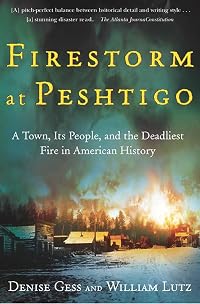
Firestorm at Peshtigo: A Town, Its People, and the Deadliest Fire in American History
by Denise Gess, William Lutz
On This Page
Description
Documents the conflagration that swept through Peshtigo, Wisconsin, on October 8, 1871--the same night as the Great Chicago Fire--incinerating more than 2,400 square miles of land and killing more than two thousand people.Tags
Recommendations








Member Recommendations

Member Reviews
I had never heard of Peshtigo, Wisconsin before reading this book, and now I will never forget it or its people. A friend lent me this book as we struggled to come to grips with the 3rd huge fire in less than 2 years to ravage California; and two of those fires had burned homes of my extended family.
In 1871 the Peshtigo fire destroyed the town, farms, forests, and parts of Chicago, even burning towns into Canada. But what most people remember is only the Chicago Fire. The loss of life was immeasurable; some accounts were over 2500 men, women and children perished. The survivors not only dealt with recovering from horrific burns, they also had nothing to come back to having lost members of their families and their homes. The town of show more Peshtigo was built around a farming community whose main industry was lumber, and the forests were plentiful—huge trees, by lakes, rivers to move the logs. Railroads being built, telegraph lines, new roads being cleared; but the push for rapid expansion left waste like sawdust, and timber piles in a town where everything was made out of wood, even the sidewalks. This created hazards, which were helped by a long drought and extreme weather conditions that ignited a devastating firestorm. So many things contributed to the fire, but only a few saw the danger, and those few had only small pieces of the bigger picture. It is good that we have their accounts, because a lot of what we know now about fires, weather, and fire science came from those few people. Unfortunately we are still making mistakes when it comes to helping people recover after these types of disasters. The authors did a magnificent job telling this part of America’s history, it is well researched and the writing isn’t boring or cumbersome: I was pulled in and touched emotionally, so I’m strongly recommending it with a little caution because there are some graphic accounts about the people and animals in the fire. 4 stars show less
In 1871 the Peshtigo fire destroyed the town, farms, forests, and parts of Chicago, even burning towns into Canada. But what most people remember is only the Chicago Fire. The loss of life was immeasurable; some accounts were over 2500 men, women and children perished. The survivors not only dealt with recovering from horrific burns, they also had nothing to come back to having lost members of their families and their homes. The town of show more Peshtigo was built around a farming community whose main industry was lumber, and the forests were plentiful—huge trees, by lakes, rivers to move the logs. Railroads being built, telegraph lines, new roads being cleared; but the push for rapid expansion left waste like sawdust, and timber piles in a town where everything was made out of wood, even the sidewalks. This created hazards, which were helped by a long drought and extreme weather conditions that ignited a devastating firestorm. So many things contributed to the fire, but only a few saw the danger, and those few had only small pieces of the bigger picture. It is good that we have their accounts, because a lot of what we know now about fires, weather, and fire science came from those few people. Unfortunately we are still making mistakes when it comes to helping people recover after these types of disasters. The authors did a magnificent job telling this part of America’s history, it is well researched and the writing isn’t boring or cumbersome: I was pulled in and touched emotionally, so I’m strongly recommending it with a little caution because there are some graphic accounts about the people and animals in the fire. 4 stars show less
You probably know The Great Chicago Fire. Only, did you know that "The Fire" was really the 31st and 32nd fires of that month? Did you know that 250 people died in that fire? The firestorm that swept the Peshtigo area killed between 1,000 and 2,500 people. Entire families died by burns, suffocation, or starvation because of the firestorm. While both are tragedies, I can't help but wonder why the Chicago Fire is one that everyone remembers.
Well written. Entertaining as well as horrifying.
Well written. Entertaining as well as horrifying.
I started reading this over Labor Day weekend of 2017. That seemed appropriate, because some idiot 15 year old with firecrackers had just started a fire on the beloved Eagle Creek trail in the Columbia River Gorge. Similar conditions prevailed - a long hot summer, near record drought, and the air choked with smoke all summer from fires all around the area. Reading this book with smoke in the air, and with daily updates on the Eagle Creek fire and other fires on inciweb, made the Peshtigo story even more vivid.
Having obliterated the forests of the northeastern US, after the civil war the logging industry moved into the upper Midwest in pursuit of Pinus strobus, eastern white pine. Business interests promoted the development of railroads show more through the region. After cutting their way through the dense forest, the railroad crews would pile the logs and slash alongside the rail line, and burn them. The summer of 1871 was exceptionally hot and dry, and people who worked in the woods had been reporting fires burning on the ground in the peat.
Many of the settlers in the area were recent immigrants, living in homesteads scattered across the area. Lacking the communication technologies and the weather forecasts we take for granted today, they had no warning of the approaching disaster. Something ignited a larger fire, and tornado strength winds devastated a wide area, killing approximately 250 people in Chicago and an estimated 2500 in the area around Peshtigo. The authors combine news stories from the time, family histories, and interesting tangents into early weather forecasting and other topics, to make this a compelling story. show less
Having obliterated the forests of the northeastern US, after the civil war the logging industry moved into the upper Midwest in pursuit of Pinus strobus, eastern white pine. Business interests promoted the development of railroads show more through the region. After cutting their way through the dense forest, the railroad crews would pile the logs and slash alongside the rail line, and burn them. The summer of 1871 was exceptionally hot and dry, and people who worked in the woods had been reporting fires burning on the ground in the peat.
Many of the settlers in the area were recent immigrants, living in homesteads scattered across the area. Lacking the communication technologies and the weather forecasts we take for granted today, they had no warning of the approaching disaster. Something ignited a larger fire, and tornado strength winds devastated a wide area, killing approximately 250 people in Chicago and an estimated 2500 in the area around Peshtigo. The authors combine news stories from the time, family histories, and interesting tangents into early weather forecasting and other topics, to make this a compelling story. show less
A little slow taking off, but gets better after Chapter 8 when the fire begins. The author does a pretty good job describing a play by play of what people were doing the minute up to the fire when they realized they had to run. The stories were collected from a variety of sources, which are all listed in the “Notes” section at the back of the book for further reading if interested. There are photos of a few of the survivors and town officials who played a huge part in the recovery efforts.
This fire was part of the Great Chicago Fire of 1871, which was the main headlines in all the newspapers. It destroyed “America’s” town and killed around 300 people. Chicago boasted that this was the greatest fire in history; therefore, they show more received the majority of the news coverage.
But, the greater hell was in Peshtigo and the surrounding towns in Wisconsin where thousands of people lost their lives, survivors witnessed their loved ones, friends and neighbors burned alive in an instant. And those who made it to the river, burned and drowned in the river. Those who walked out of the river were badly burned. Of Peshtigo's 2000 residents, approximately 1,800 of them died on that day. All their stories are collected in these pages. Plus, more people died in the surrounding towns. The exact number of people who died will never be known. Charred remains were found even a few years after the fire. There was no official count ever taken.
It was always snowing ashes from the fires all around. The people were somewhat accustomed to this kind of atmosphere. In 1871, new arrivals were constantly clearing their land and burning the timber. This created a constant haze of smoke polluted air. Citizens walked around with hankies over their noses and mouths. They were constantly fighting off small fires that ignited here and there and were only a little more concerned when the snow of ash became so heavy, one couldn’t see their neighbors face. This was the norm for the lumber mill town of Peshtigo.
What they couldn’t see was the sleeping giant burning between Chicago and Michigan. When the low pressure from Galveston and the cold front from Canada merged over Lake Michigan area, it turned all the clearing fires and other surrounding raging fires into one great firestorm, much like an atomic bomb, with temperatures reaching up to at least 1800 degrees and fire tornadoes with speeds up to 100 mph. show less
This fire was part of the Great Chicago Fire of 1871, which was the main headlines in all the newspapers. It destroyed “America’s” town and killed around 300 people. Chicago boasted that this was the greatest fire in history; therefore, they show more received the majority of the news coverage.
But, the greater hell was in Peshtigo and the surrounding towns in Wisconsin where thousands of people lost their lives, survivors witnessed their loved ones, friends and neighbors burned alive in an instant. And those who made it to the river, burned and drowned in the river. Those who walked out of the river were badly burned. Of Peshtigo's 2000 residents, approximately 1,800 of them died on that day. All their stories are collected in these pages. Plus, more people died in the surrounding towns. The exact number of people who died will never be known. Charred remains were found even a few years after the fire. There was no official count ever taken.
It was always snowing ashes from the fires all around. The people were somewhat accustomed to this kind of atmosphere. In 1871, new arrivals were constantly clearing their land and burning the timber. This created a constant haze of smoke polluted air. Citizens walked around with hankies over their noses and mouths. They were constantly fighting off small fires that ignited here and there and were only a little more concerned when the snow of ash became so heavy, one couldn’t see their neighbors face. This was the norm for the lumber mill town of Peshtigo.
What they couldn’t see was the sleeping giant burning between Chicago and Michigan. When the low pressure from Galveston and the cold front from Canada merged over Lake Michigan area, it turned all the clearing fires and other surrounding raging fires into one great firestorm, much like an atomic bomb, with temperatures reaching up to at least 1800 degrees and fire tornadoes with speeds up to 100 mph. show less
Four generations on its hard to reconstruct what happened that fall in eastern Wisconsin just north of Green Bay; this is a pretty good effort. Its the personal accounts and remarks that make it a gripping horror story. Though it has three maps, and a list of principal players, there are many others mentioned and not all of them are identified by the places they lived or worked, so it was still confusing. Ms. Gess organized the narrative in chronological order. She started with August, and I think the tension would have built better in late September, if the fire date of October 8, 1871, had been shared with the readers earlier. I got tired of reading quotes of silly newspaper boosterisms, and advertisments. The photos of the woodworks, show more if placed earlier in the book, would have helped erase the image of Peshtigo being a woodsy parallel of a one-horse town.
I did however totally relate to the mentality of the pioneers -- lumbermen, immigrants, and farmers like my uncle. How did anyone manage to avoid the flames during that terrible hot, dry, smoky summer and fall? Scary how close my ancestors were to the firestorm. Fifty years on, the mere whiff of smoke from a wildfire anywhere in northern Wisconsin, and a town would be deputized and mobilized to put out the flames-- shirking the call would be cause for immediate arrest. The State's fire fighting command center was in my hometown and we knew many employed there full time. Like Peshtigo, my hometown is surrounded by bogs and peat marshes, with a river running through it. Clearly the State's attitudes and measures were a response to the disaster -- how long did it take to get organized? If the humus was burnt out over two feet below the surface, what has happened since? How long before it was viable? What's there today?
The conclusion: the weather, drought, topography, and the continued presence of unchecked fires that fall, all combined to generate the firestorm. I would have liked more details on topography, and a better description of just what "Sugar Bush" is like, what the Peshtigo River was like .. how big, how wide,.. and most of all, where were the peat bogs that caught fire earlier and never went out? Nothing illustrated what was going on better than the descriptions by survivors of lines of wooden fenceposts spontaneously bursting into flames like giant matchsticks. It is still common for farmers to build a "root cellar" near the house to store potatoes, carrots, cabbage, in the winter.. a cool place, normally. But with the sod and peat underneath them on fire, they could literally turn into oxygen-less ovens.
Even being from Wisconsin, with immigrant grandparents who were loggers and farmers whose children grew up just to the west of Peshtigo, I didn't know the story. The biggest surprises: the connection between Chicago, and Peshtigo -- the first mayor of Chicago was the principal investor in the sawmill, logging and woodworking businesses in Peshtigo. There is scarcely a mention of the Menominee peoples who lived there before the white settlers moved in. Surely there would be stories from that community that would have been passed on even if they didn't have a newspaper, and finally, I found it creepy that during WWII that the military studied firestorms so they could create them in Germany and Japan. show less
I did however totally relate to the mentality of the pioneers -- lumbermen, immigrants, and farmers like my uncle. How did anyone manage to avoid the flames during that terrible hot, dry, smoky summer and fall? Scary how close my ancestors were to the firestorm. Fifty years on, the mere whiff of smoke from a wildfire anywhere in northern Wisconsin, and a town would be deputized and mobilized to put out the flames-- shirking the call would be cause for immediate arrest. The State's fire fighting command center was in my hometown and we knew many employed there full time. Like Peshtigo, my hometown is surrounded by bogs and peat marshes, with a river running through it. Clearly the State's attitudes and measures were a response to the disaster -- how long did it take to get organized? If the humus was burnt out over two feet below the surface, what has happened since? How long before it was viable? What's there today?
The conclusion: the weather, drought, topography, and the continued presence of unchecked fires that fall, all combined to generate the firestorm. I would have liked more details on topography, and a better description of just what "Sugar Bush" is like, what the Peshtigo River was like .. how big, how wide,.. and most of all, where were the peat bogs that caught fire earlier and never went out? Nothing illustrated what was going on better than the descriptions by survivors of lines of wooden fenceposts spontaneously bursting into flames like giant matchsticks. It is still common for farmers to build a "root cellar" near the house to store potatoes, carrots, cabbage, in the winter.. a cool place, normally. But with the sod and peat underneath them on fire, they could literally turn into oxygen-less ovens.
Even being from Wisconsin, with immigrant grandparents who were loggers and farmers whose children grew up just to the west of Peshtigo, I didn't know the story. The biggest surprises: the connection between Chicago, and Peshtigo -- the first mayor of Chicago was the principal investor in the sawmill, logging and woodworking businesses in Peshtigo. There is scarcely a mention of the Menominee peoples who lived there before the white settlers moved in. Surely there would be stories from that community that would have been passed on even if they didn't have a newspaper, and finally, I found it creepy that during WWII that the military studied firestorms so they could create them in Germany and Japan. show less
This was a sad and gripping story. Sometimes the writing was confusing so I don't think it was the best written book. But the story kept me rivetted. I even read parts of it to Stan and it kept his interest. I learned a lot and applaud the authors for doing the research and presenting it in an interesting book.
This is about a little known fire, the "deadliest fire in American history", that occurred in Wisconsin and Illinois on 10/8/1871. It was eclipsed by the Chicago fire. It was an unusual fire and tornado combination that began in Chicago and swept south nearly all the way to Green Bay. There had been a terrible drought that year and fires had started in the Sugar Bush logging area and in Chicago. A storm barrelled down and a show more tornado started. The fire fed the wind and vice versa. It was so fast and so horrible. It made a moonscape of Peshtigo and surounding towns. So many people died there was no way to count them. Many were reduced to nothing but ashes, others burned beyond recognition, many just missing and never found. They estimate 2500 died but it could be more or less as there was no way to do an accurate count. The authors told a lot of personal stories which really makes the book and they did a good job of tying the personal stories to the survivor stories at the end. Even the survivors suffered horribly having lost everything, lost their families, many terribly burned themselves and there was no medical help for the burn survivors back then. Those who survived the fire died later of complications and it was a slow, painful death. Others suffered mental problems for the rest of their lives because of what they had seen. After the fire, the next spring, Army worms came out of the ground and ate every green thing that struggled to come alive. The fire had driven the birds and other natural controllers from the area so the worms became an unbelievable problem. They clogged wells and creeks making the water undrinkable. They had to use shovels and buckets to clear a path through the millions of worms. Then, it was flies. A plague of flies that made life miserable. And the ground was so arid, after the fire, that crops were unable to survive even after the worms were gone. They didn't know about fertilizer back then and had to let the ground remain fallow for a time before anything would grow. show less
This is about a little known fire, the "deadliest fire in American history", that occurred in Wisconsin and Illinois on 10/8/1871. It was eclipsed by the Chicago fire. It was an unusual fire and tornado combination that began in Chicago and swept south nearly all the way to Green Bay. There had been a terrible drought that year and fires had started in the Sugar Bush logging area and in Chicago. A storm barrelled down and a show more tornado started. The fire fed the wind and vice versa. It was so fast and so horrible. It made a moonscape of Peshtigo and surounding towns. So many people died there was no way to count them. Many were reduced to nothing but ashes, others burned beyond recognition, many just missing and never found. They estimate 2500 died but it could be more or less as there was no way to do an accurate count. The authors told a lot of personal stories which really makes the book and they did a good job of tying the personal stories to the survivor stories at the end. Even the survivors suffered horribly having lost everything, lost their families, many terribly burned themselves and there was no medical help for the burn survivors back then. Those who survived the fire died later of complications and it was a slow, painful death. Others suffered mental problems for the rest of their lives because of what they had seen. After the fire, the next spring, Army worms came out of the ground and ate every green thing that struggled to come alive. The fire had driven the birds and other natural controllers from the area so the worms became an unbelievable problem. They clogged wells and creeks making the water undrinkable. They had to use shovels and buckets to clear a path through the millions of worms. Then, it was flies. A plague of flies that made life miserable. And the ground was so arid, after the fire, that crops were unable to survive even after the worms were gone. They didn't know about fertilizer back then and had to let the ground remain fallow for a time before anything would grow. show less
Not many people know about the fire in Peshtigo, although most know about the Great Chicago Fire, which happened at the same time. Really a fascinating read, especially if you're into Chicago history.
Members
- Recently Added By
Lists

Disaster Books
74 works; 19 members

Best History Books about Disasters
33 works; 19 members

Accidents, Disasters, and Tragedies
175 works; 7 members
Author Information

3+ Works 274 Members
Denise Gess is the visiting assistant professor of fiction writing at the University of North Carolina, Wilmington.
17+ Works 678 Members
William Lutz is a professor of English at Rutgers University, Camden. They live in Philadelphia.
Common Knowledge
- Original publication date
- 2002
- People/Characters
- William Butler Ogden; Isaac Stephenson; Luther B. Noyes; Benjamin Franklin Tilton; William A. Ellis; Father Peter Pernin (show all 17); Cleveland Abbe; General Albert J. Myer; Increase Lapham; General Henry Howgate; Governor Lucius Fairchild; Frances Fairchild; Elbridge West Merrill; Charles "Karl" Lamp; Captain A. J. Langworthy; Maggie Williamson; Phineas Eames
- Important places
- Peshtigo, Wisconsin, USA; Wisconsin, USA
- Important events
- Fire at Peshtigo (1871); Great Chicago Fire (1871)
- Epigraph
- "From water to earth, from earth to air,
from air to fire and round again."
Heraclitus - Dedication
- For United States forest-fire fighters
and fire meteorologists,
and in memory of all the victims
of Peshtigo, known and unknown - First words
- (Prologue) September 13, 1871
Luther Noyes could feel the fires smoldering in the woods even when he couldn't see them, and at first light he could taste them: grit and burnt sap.
The working day began before dawn in the gloom in the forest surrounding Peshtigo. - Quotations
- The women and young girls were particularly vulnerable to the fire. When their clothes caught, the clothing acted as a covering wrapped around a lighted candle would, securing the wax drippings inside the candle, thereby inte... (show all)nsifying the heat. Because females have higher fat contents in their bodies and wore so many layers of clothing, once they were set to flame, the fat naturally acted as extra fuel. Like the superheated resin inside the trees that made the trunks explode, the intensely hot human "fat drippings" caused Mrs. Towsley's body to combust. Hopeless to rescue his other children as the flames advanced, Towsley took the knife and slit their throats, then killed himself.
- Last words
- (Click to show. Warning: May contain spoilers.)Their descendants still farm the same land, but they go by the name of Lemke.
- Original language
- English US
- Canonical DDC/MDS
- 977.533
- Canonical LCC
- F589.P48
Classifications
- Genres
- Nonfiction, History, General Nonfiction, Science & Nature
- DDC/MDS
- 977.533 — History & geography History of North America North central United States Wisconsin Northeast counties Marinette
- LCC
- F589 .P48 — Local History of the United States, Canada and Latin America United States local history Wisconsin
- BISAC
Statistics
- Members
- 261
- Popularity
- 124,003
- Reviews
- 10
- Rating
- (3.77)
- Languages
- English
- Media
- Paper
- ISBNs
- 2
- ASINs
- 2